
My Husband Had Just Died—Then My Brother Tried to Take His Mercedes, My Father Turned on Me, and They Walked Straight Into the Safeguard Henry Had Left Behind
Part One: The Empty Chapel
My name is Grace Miller, and at thirty years old, I learned that the people who share your blood can sometimes be more dangerous than any stranger you might meet on the street.
Three days after my husband died, I sat alone in a cold chapel on the outskirts of Columbus, Ohio.
The room smelled faintly of rain, polished wood, and lilies that had already begun to wilt. Outside, a gray November sky pressed down over the cemetery, and water traced slow, crooked paths along the stained-glass windows.
I sat in the front pew, staring at the polished mahogany casket that held Henry—my husband, my closest friend, and the only person who had ever loved me without demanding something in return.
Henry was thirty-two.
He had started his career driving forklifts in unheated warehouses during Ohio winters. Over the years, through long shifts and relentless discipline, he worked his way up to become a logistics manager overseeing regional supply chains across the Midwest.
He was kind without being weak, patient without being passive, and protective without ever trying to control me.
Then a tractor-trailer lost traction on black ice along Interstate 70.
In one terrible moment, the future we had carefully built disappeared.
The silence inside the chapel felt almost physical. It pressed against my ears and settled heavily across my shoulders.
Every pew behind me was empty.
My father, Thomas, was not there to place a comforting hand on my shoulder.
My mother, Sandra, was not there to hold my hand while I struggled to breathe.
My younger brother, Logan, and his wife, Megan, had not even bothered to sign the guest book.
My younger sister, Lauren—the sister whose college expenses I had helped pay—sent a brief text claiming she had a prior commitment she could not change.
None of them came to mourn Henry.
They had never forgiven him.
The reason was painfully simple: Henry refused to let them treat me like a personal bank account.
To understand why my family stayed away from the funeral, only to appear later when they believed there was something to claim, you have to understand how I grew up.
In the eyes of Thomas and Sandra Miller, I was never simply their daughter.
I was an asset.
I was the oldest child, the dependable one, the person expected to absorb every financial crisis and emotional burden so everyone else could move through life without consequences.
When I was twenty-two, I worked nearly fifty hours a week as an administrative coordinator. I lived in a small apartment, drove a ten-year-old compact car, and counted every dollar before buying groceries.
That was when my father demanded that I take out a twenty-thousand-dollar personal loan.
Logan had launched a jet-ski rental business despite having no experience, no business plan, and no understanding of seasonal demand in Ohio. By the end of his first summer, the company was collapsing.
Thomas did not ask me to help.
He told me I would.
“You have good credit,” he said. “Logan needs one chance to get back on his feet.”
I hesitated.
My father leaned across the kitchen table and stared at me.
“Family doesn’t abandon family.”
So I signed.
Logan stopped making payments within months. The collection calls did not go to him. They came to me.
For four years, I ate cheap noodles, avoided medical appointments I could not afford, and worked weekend shifts at a diner near downtown Columbus to repair the damage he had caused.
Logan never apologized.
He acted as though the loan had been my responsibility from the beginning.
When Lauren was accepted at Ohio State University, my parents turned to me again. They had promised to help with tuition but had saved almost nothing.
My mother called me late one evening, crying into the phone.
“Grace, we’re family. Family makes sacrifices for one another. You don’t want your little sister to lose her future, do you?”
That was how they always did it.
They transformed every boundary into cruelty and every refusal into betrayal.
I transferred the money.
I gave up much of my twenties, my financial security, and my peace of mind because some part of me still believed that if I proved my loyalty often enough, my parents might finally value me the way they valued Logan.
Then I met Henry.
He understood the family dynamic almost immediately.
He did not see an ungrateful daughter, as my parents described me. He saw an exhausted woman who had been trained to confuse exploitation with love.
The defining moment came during a family dinner.
Thomas had demanded another ten thousand dollars so Logan could replace his truck with a newer model. Logan claimed he needed an impressive vehicle to attract business contacts.
I sat at the table, staring at my plate, already calculating how long it would take to rebuild my savings.
Henry placed his fork down.
“No,” he said.
The entire table fell silent.
Thomas looked at him sharply.
“What did you say?”
Henry met my father’s stare.
“I said no. Grace is not paying for Logan’s lifestyle anymore.”
Thomas pushed back his chair.
“This is a family discussion.”
“Grace is my family,” Henry replied. “And she has already done more than enough.”
From that moment forward, war was declared.
My parents accused Henry of controlling me. They told relatives he had isolated me and turned me against my own blood.
In reality, Henry had done the opposite.
He taught me that I was allowed to say no.
He taught me that guilt was not the same as responsibility and that love without respect was not love at all.
When Henry and I married four years later in a small courtroom ceremony in downtown Columbus, none of my relatives attended.
We exchanged vows beneath fluorescent lights while a clerk and two of Henry’s coworkers served as witnesses.
It was not glamorous, but it was peaceful.
For the next four years, Henry and I built a quiet life in a tree-lined Columbus suburb.
We bought a modest three-bedroom house with pale brick, dark shutters, and a small American flag mounted beside the front porch. We saved consistently, paid our bills on time, and stayed well within our means.
The only true luxury Henry ever bought was a midnight-blue Mercedes-Benz E-Class.
He had saved for six years to purchase it. He bought it outright, without a loan or lease.
The Mercedes sat inside our garage, always spotless. Henry polished the paint himself and kept the black leather interior immaculate.
To him, the car was not merely a status symbol.
It represented the distance he had traveled from warehouse loading docks to regional management offices. It was proof that patience, discipline, and honest work could eventually build something beautiful.
My family knew about the Mercedes.
Logan resented it more than anything else Henry owned.
He had spent years launching one questionable business after another, including an online store that sold imitation luxury accessories. He lived in a rented townhouse with Megan and drove an aging silver sedan whose transmission had begun to fail.
Whenever Logan saw Henry’s car, he complained that life was unfair.
He insisted that someone like Henry did not deserve to drive a Mercedes while he struggled.
As I sat in the chapel looking at Henry’s casket, I naïvely believed my family’s resentment had limits.
I thought that even they would show restraint in the face of death.
I believed they had stayed away from the funeral because they were ashamed.
I was wrong.
They stayed away because they were waiting for the moment when I would be most vulnerable.
Part Two: The Driveway
The drive home from the cemetery was a blur of rain, brake lights, and an emptiness so deep that I could barely feel my hands on the steering wheel.
I drove Henry’s midnight-blue Mercedes.
The faint trace of his cologne remained in the upholstery. His sunglasses were still tucked inside the center console, and the seat was adjusted exactly as he had left it.
Sitting there, surrounded by those small reminders, was the only thing keeping me together.
When I turned onto our street, a heavy gray drizzle hung over the neighborhood. Wet leaves clung to the sidewalks, and porch lights glowed behind curtains as families settled into their ordinary evenings.
Our house looked unbearably still.
All I wanted was to step inside, remove my soaked wool coat, lock the front door, and finally allow myself to collapse without anyone watching.
Then I reached the driveway.
Two vehicles were parked sideways across the concrete, blocking the entrance to the garage.
One was my father’s faded red Ford pickup.
The other was Logan’s silver sedan.
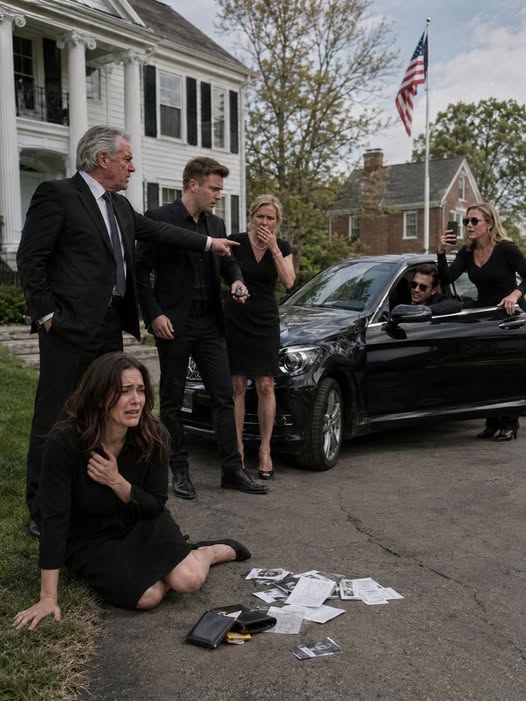
Before I could place the Mercedes in park, their doors opened.
Thomas stepped out first, wearing a heavy hunting jacket. His expression was hard and impatient.
Logan emerged from the sedan in a cheap tracksuit, studying the house and garage as though he were evaluating property that already belonged to him.
My mother climbed down from the passenger side of the truck, clutching her purse against her chest.
Megan followed with her phone already raised.
Even Lauren was there. She stood near the rear bumper with her arms folded, staring at the wet pavement.
My hands tightened around the steering wheel.
They had not come to the chapel.
They had not stood beside Henry’s grave.
They had driven directly to my house.
I turned off the engine and stepped into the rain.
“What are you doing here?” I asked.
My voice trembled despite my effort to steady it.
“I just buried my husband.”
Thomas walked toward me and stopped less than two feet away.
He did not look at my swollen eyes. He did not offer a condolence.
His gaze went past me to the Mercedes.
“We know what happened,” he said. “We’re here to make sure everything gets handled properly before you make an emotional decision.”
“Handled properly?”
I stared at him.
“What are you talking about? Please leave. I need to be alone.”
“You don’t get to order us off,” Logan said.
He stepped around our father and approached the Mercedes with an arrogant smile. Then he dragged his fingertips across the wet hood, leaving streaks on the carefully maintained paint.
“Nice car,” he said. “Henry always enjoyed looking important.”
“Step away from my husband’s car.”
Logan glanced at me.
“It isn’t really his anymore, is it?”
“Henry is gone,” Sandra added from the edge of the driveway. Her voice carried the false softness she used whenever she wanted something. “You’re alone now, Grace. This is when family needs to come together.”
I looked from one face to another.
“What do you want?”
Sandra sighed as though I were being deliberately difficult.
“Logan’s transmission is failing. He needs a dependable vehicle for his sales work. You cannot maintain a car like this on your salary, and it makes no sense for it to sit here.”
Logan held out his hand.
“We’re taking the keys.”
For several seconds, I could not speak.
Henry had been buried less than an hour earlier, and my family was standing in our driveway dividing his belongings.
“Have you lost your minds?” I asked.
My voice rose as disbelief gave way to anger.
“Henry bought this car with money he earned. It is legally part of our estate plan. You did not even attend his funeral, and now you are here trying to take it.”
Megan laughed and raised her phone higher.
“There’s the dramatic widow performance,” she said. “You spent years keeping everything to yourself while your brother struggled.”
“Put that phone away.”
“You owe this family,” Megan continued. “Hand over the key.”
“Get off my property.”
My words echoed through the rain.
“All of you. Leave now, or I’m calling the police.”
Thomas’s face hardened.
The same authority he had used to intimidate me throughout childhood returned to his posture. He stepped forward and pointed at me.
“Do not threaten your father.”
“I am not threatening you. I am telling you to leave my home.”
“You are going to give Logan the keys,” Thomas said. “Then you are going to show us Henry’s bank statements and the paperwork for this house.”
My breath caught.
“The house?”
“You don’t need a three-bedroom home by yourself,” Sandra said. “Logan and Megan need more space. You can find an apartment.”
For the first time, Lauren looked up.
She said nothing.
Thomas continued.
“You are not going to hoard Henry’s estate while your real family receives nothing.”
I stepped backward, clutching my purse against my coat.
“You are not receiving anything. Not the car, not the house, and not a single financial document.”
“Grace,” Sandra warned.
“No.”
The word felt strange in my mouth.
Then it felt powerful.
“I said no. Leave.”
Something in my father’s expression changed.
For years, he had relied on my fear. He had always believed that one raised voice or disapproving look would make me surrender.
When I did not, his restraint disappeared.
He closed the distance between us and struck me across the cheek.
The sound cut through the damp air.
My head turned sharply, and I lost my footing on the rain-slick concrete. I stumbled against the brick wall beside the garage, stunned by the sudden pain and the realization of what he had done.
“Do not speak to me like that,” Thomas shouted.
I pressed one hand against my cheek.
He stood over me, breathing heavily.
“I raised you. You owe your brother. You owe this family.”
My lip was injured, and the side of my face throbbed. Yet what hurt more was the sight of my mother standing only a few yards away, watching without concern.
She folded her arms.
“You caused this,” Sandra said. “You have always been too proud. Give him the keys so everyone can go home.”
I looked toward Lauren.
“Please,” I whispered. “Help me.”
She took half a step backward.
Her eyes showed discomfort, but not courage.
She looked toward the street and remained silent.
While I struggled to regain my balance, Logan moved toward me. He seized my purse, opened it, and emptied the contents onto the wet driveway.
My wallet, lipstick, tissues, and Henry’s memorial cards scattered across the concrete.
Then the Mercedes key fob fell beside his shoe.
“Found it,” Logan announced.
He picked it up.
“No, Logan. Put it down.”
He ignored me.
When I tried to move toward him, Thomas seized the collar of my wool coat and pulled me away. My knees struck the rough driveway, tearing my stockings. He dragged me several feet and forced me onto the wet lawn beside the porch.
“Stay there,” he ordered.
Logan pressed the unlock button.
The Mercedes answered with two familiar beeps.
He opened the driver’s door and lowered himself onto the black leather seat where Henry had sat only days before.
The sight broke something inside me.
Megan smiled into her phone, recording herself with the car behind her.
Logan started the engine.
The deep sound rolled through the quiet suburban street.
“This is what success looks like,” he called through the open window. “Consider it payment for all the years you acted better than us.”
My father walked toward his pickup.
Before climbing inside, he looked back at me lying in the wet grass.
“We will return Friday for the deed,” he said. “Have the paperwork ready to transfer the house to Logan.”
I stared at him.
“You have no right to my home.”
Thomas’s voice dropped.
“You are alone now. No one is coming to protect you.”
Logan accelerated out of the driveway, carrying away the last thing Henry had driven.
My father followed in his truck with Sandra and Megan. Lauren left with them without looking back.
Their vehicles disappeared into the rain.
I remained on the lawn for several minutes, unable to understand how the day had become even worse than the funeral.
My cheek burned. My knees were scraped, and cold water soaked through my coat.
But beneath the pain, another feeling began to emerge.
Stillness.
The woman who had spent ten years begging for her parents’ approval ended on that driveway.
The woman who had signed loans for Logan, emptied her savings for Lauren, and apologized whenever other people mistreated her was gone.
Slowly, I pushed myself upright.
I gathered Henry’s memorial cards from the pavement and carried them inside.
Then I locked the door.
I was no longer crying.
My family believed Henry’s death had made me defenseless. They thought that without him beside me, I would return to the frightened young woman they could manipulate.
They had forgotten one critical fact.
Henry had not merely protected me.
He had taught me how to protect myself.
Part Three: What the Cameras Saw
I walked past the living room and entered our home office.
Henry’s mahogany desk stood beneath the window. His coffee mug was still beside the keyboard, exactly where he had left it on his final morning at home.
I sat in his chair, opened the top drawer, and removed a small black backup drive.
Six months earlier, after a series of garage break-ins in nearby neighborhoods, Henry had installed a commercial-grade security system around the property.
Four high-definition cameras covered the front porch, garage entrance, side walkway, and entire driveway. Each camera recorded audio and stored encrypted copies on a secure cloud account as well as the local drive.
At the time, I teased him for being overly cautious.
Henry had smiled.
“Evidence is more useful than arguments,” he said. “People can deny words. They have a harder time denying a recording.”
I opened the security software.
The footage loaded.
There they were.
Every second had been captured from multiple angles.
The camera above the garage showed Thomas approaching me. It recorded the confrontation, the moment he struck me, and the way he pulled me across the driveway when I tried to stop Logan.
Another camera showed Logan taking my purse, emptying it onto the pavement, and removing the Mercedes key.
The audio captured every demand.
It recorded Sandra insisting that Logan deserved the car.
It recorded Thomas ordering me to transfer the house.
It recorded his promise to return Friday.
It also captured Megan laughing while filming and Lauren watching without intervening.
The evidence was painful to view, but it was clear.
My family had left no room to reinterpret what happened as a misunderstanding.
I did not call my mother.
I did not plead with Lauren.
I did not send an angry message to Logan.
Instead, I opened the emergency contacts folder Henry had created and called Marcus Vance, a criminal and probate attorney whose office was in downtown Columbus.
Marcus answered on the fourth ring.
“This is Marcus.”
“My name is Grace Miller. You represented my husband, Henry.”
His voice softened immediately.
“Grace, I heard about the accident. I am deeply sorry.”
“His funeral ended two hours ago,” I said. “My family came to my house afterward. My father struck me, my brother took Henry’s Mercedes, and they demanded that I sign over my home.”
There was a short silence.
“Are you safe right now?”
“I am inside. The doors are locked.”
“Are they still on the property?”
“No.”
“Do you require medical assistance?”
“I need to be examined, but I can stand.”
“Call emergency services and report the incident immediately,” Marcus said. “Do not wait until tomorrow. Preserve your clothing, photograph every injury, and do not clean or rearrange anything outside until officers have documented it.”
“I have something else.”
“What?”
“The entire incident was recorded by our security system. Multiple camera angles with audio.”
Marcus’s tone sharpened.
“Make two copies. Do not edit the original files. Upload one copy to the secure link I am sending you now.”
He paused.
“And Grace—do not contact your relatives. Do not warn them. Do not respond to calls or messages. Let the evidence speak for you.”
Within minutes, Columbus police officers arrived.
They photographed the driveway, the scattered items, and the marks on my coat. An ambulance crew examined me and transported me to a nearby hospital, where a physician documented my swollen cheek, injured lip, bruising, and scraped knees.
I gave a complete statement.
By midnight, Marcus had reviewed the recordings.
The next morning, he met with me at his office.
Rain had given way to a hard, pale sky over downtown Columbus. From the conference-room window, I could see traffic moving along Broad Street and people hurrying between government buildings with coffee cups tucked beneath their coats.
Marcus placed a folder in front of me.
“Your family made several serious miscalculations,” he said.
He explained that the Mercedes was not an informal part of Henry’s possessions that relatives could simply claim.
Two years earlier, Henry and I had created a revocable family trust. Our house, investment accounts, and several major assets were held or governed through that estate plan. I was the surviving trustee and sole beneficiary.
The Mercedes was specifically listed in the trust documents and registered under an ownership arrangement that transferred full control to me after Henry’s death.
“My brother said the car belonged to the family.”
“It does not,” Marcus replied. “It belongs to you under the trust and title documents. Logan had no permission to take it.”
He opened another file.
“The recording also shows that the vehicle was taken through force and intimidation. That makes this far more serious than an argument over property.”
I thought about my father’s threat.
“They said they would come back Friday for the deed.”
“That statement is recorded clearly. We will seek a protective order and make sure they cannot legally approach you or the house.”
Marcus leaned back.
“There is something else Henry asked me to retain.”
He handed me a sealed envelope.
Inside were copies of financial records, loan agreements, and correspondence involving my parents.
Five years earlier, Thomas and Sandra had nearly lost their four-bedroom home after falling behind on their mortgage. Henry had paid sixty-two thousand dollars to prevent foreclosure.
My parents had always described the money as a gift.
It had not been a gift.
Henry required them to sign a formal promissory note secured by a recorded lien against their property. The agreement established a repayment schedule and clearly stated that failure to pay could lead to legal collection proceedings.
They had not made a payment in three years.
With interest and contractual fees, the balance had reached approximately seventy-eight thousand five hundred dollars.
“Henry never mentioned enforcing this,” I said.
“He hoped he would never need to,” Marcus replied. “But he insisted that the agreement remain valid. He told me it was protection for you in case your family ever tried to pressure you after his death.”
I looked down at Henry’s signature.
Even before the accident, he had understood what they might do.
Another document concerned a forty-five-thousand-dollar equipment loan Thomas had taken out for his failing contracting business.
My name appeared as a guarantor.
The signature looked similar to mine, but I had never signed it.
Three years earlier, I discovered the loan while checking my credit report. When I confronted Thomas, he admitted that he had used my information.
“You were never going to say yes,” he told me. “I did what I had to do.”
I had been too afraid to report him.
Marcus studied the document.
“Are you prepared to address this now?”
I thought about the empty funeral chapel.
I thought about my father standing over me in the rain.
“Yes,” I said. “I am.”
That afternoon, I filed an identity-theft report and submitted a sworn affidavit to the lender’s fraud department. The bank froze collection activity against me and opened an investigation into the signature and loan application.
The investigation would take time. It was not an instant judgment, and Marcus made that clear.
But for the first time, my father would be required to answer questions instead of silencing me.
Marcus also sent my parents a formal notice of default regarding the mortgage agreement.
They were given an opportunity to respond and negotiate repayment. If they ignored the notice, the trust could begin lawful foreclosure proceedings through the Franklin County court system.
We did not need to exaggerate or threaten them.
The contracts were enough.
Meanwhile, Logan and Megan appeared unaware of what was developing.
That afternoon, Megan posted a public video showing Logan behind the wheel of the Mercedes.
Her caption read:
“Upgraded our ride today. Hard work pays off. Stop letting toxic family hold you back.”
She added photographs from several angles, including one that clearly displayed the Ohio license plate.
Marcus preserved every post, comment, and timestamp.
The video established that Logan knowingly possessed the car after taking it from my driveway. His own wife had created a public record of it.
They believed I was sitting alone in the dark, too frightened to respond.
They did not understand that the moment Logan pressed the unlock button, the consequences had already begun.
Part Four: Accountability
On Wednesday morning, three Columbus police cruisers entered the quiet townhouse development where Logan and Megan lived.
Logan had just stepped onto the porch wearing sunglasses and holding the Mercedes key fob. According to the police report, he was preparing to drive to a local car gathering where he intended to show the vehicle to several friends.
Megan followed him outside with a travel mug and her phone.
Officers approached before Logan reached the driver’s door.
They ordered him to place the keys on the ground and step away from the vehicle.
Megan began recording and demanded to know why they were interfering with a private family matter.
One officer warned her to remain back.
Logan initially claimed I had given him the Mercedes.
Then the detective told him they had video of the entire incident.
His expression changed.
He was arrested on charges related to motor-vehicle theft, robbery, and receiving stolen property. The final charges would later be determined by the prosecutor, but the evidence was already substantial.
Less than half an hour later, deputies arrived at my parents’ house.
Thomas was working in the front yard.
He raised his voice and insisted that he had only been disciplining an ungrateful daughter during a family dispute.
The deputies had already viewed the footage.
They arrested him in connection with the assault, coercive threats, and his role in the taking of the vehicle.
Sandra ran outside demanding that the officers release him.
For years, my parents had controlled the story because they controlled who was allowed to speak.
This time, they were facing evidence they could not interrupt.
A police-authorized towing company loaded Henry’s Mercedes onto a flatbed and returned it to my house after investigators finished processing it.
The car had not been seriously damaged.
When the truck arrived, I stood in the doorway and watched the midnight-blue body descend slowly toward the driveway.
I did not feel victorious.
I felt tired.
The Mercedes was home, but Henry was not.
That evening, my phone filled with calls and messages.
Sandra left the first voicemail.
“Grace, what have you done? Your father and brother are in custody. They are discussing bail. You need to tell the police this was a misunderstanding.”
I saved the recording.
Her second message was angrier.
“We are your family. How can you do this to us after everything we have done for you?”
Megan sent a series of messages accusing me of ruining Logan’s future.
She claimed that he had only borrowed the Mercedes and that I was using Henry’s death as an excuse to punish everyone.
Lauren sent one sentence.
Please fix this before it goes too far.
I did not respond.
Marcus added the messages to the harassment file, and the court granted a temporary protection order preventing Thomas and Logan from contacting me or approaching my property.
The legal cases did not end overnight.
Real accountability rarely arrives as quickly as people imagine.
There were hearings, continuances, attorney conferences, financial reviews, and months of document requests.
The bank hired a handwriting examiner and reviewed the original equipment-loan application. Investigators found that Thomas had submitted my personal information without authorization and had signed my name as guarantor.
Faced with the evidence, he eventually entered a plea involving identity fraud, forgery, and the offenses connected to the driveway confrontation.
The mortgage dispute also moved forward.
Marcus gave Sandra several opportunities to establish a reasonable repayment plan. She refused each one, insisting Henry’s money had been a gift and claiming the signed agreement should not count because they were family.
The county recorder’s documents told a different story.
After repeated defaults and unsuccessful settlement discussions, the trust initiated foreclosure proceedings.
The process took months, but the outcome was unavoidable. My parents had signed the note, accepted Henry’s money, and ignored their obligations for years.
Six months after the funeral, I stood inside the Franklin County Courthouse wearing a tailored black suit.
The building smelled of old paper and floor polish. Shoes echoed along the marble hallway as attorneys moved between courtrooms carrying files and leather briefcases.
Thomas and Logan sat on the opposite side of the courtroom.
My father looked smaller than he had in my driveway.
Without his booming voice and family authority, he was simply a man answering for documented choices.
The prosecutor presented portions of the security recording, the medical report, the threatening statements, and the financial evidence.
Thomas received a custodial sentence of three years under the plea agreement, followed by supervision and financial restitution requirements.
Sandra stared straight ahead when the judge announced the sentence.
She never looked at me.
Logan’s attorney negotiated a different outcome because Logan had no comparable record and had not been accused of striking me. He received a felony conviction, five years of strict probation, mandatory counseling, community service, and an order to reimburse the trust for towing, investigative expenses, and legal costs associated with recovering the Mercedes.
The conviction destroyed the image he had worked so hard to manufacture.
His prospective sales position disappeared when the employer conducted a background check.
The online business collapsed after Megan’s celebratory Mercedes video was circulated alongside public court records. People who had praised their “new car” realized they had been celebrating property taken from a grieving widow.
Megan removed the posts, but copies remained.
Several months later, she filed for divorce.
I did not celebrate their separation. Their marriage was their responsibility, just as their choices were.
Logan eventually moved into Sandra’s small apartment on the far side of Columbus after the foreclosure on my parents’ house was completed.
The four-bedroom home they had once treated as proof of their superiority was sold under court supervision. The trust recovered the unpaid balance, interest, and authorized expenses. Any remaining equity went to my mother according to the law.
I did not take more than the agreement permitted.
I did not want revenge.
I wanted the obligations they had ignored to be acknowledged.
Lauren came to my house one evening in early spring.
The trees along the street had begun to bloom, and children rode bicycles beneath the soft yellow glow of the streetlights.
She stood on my porch holding a small overnight bag.
Her eyes filled with tears when I opened the door.
“I’m sorry,” she said.
I waited.
She looked toward the driveway, where Henry’s Mercedes sat inside the open garage.
“I should have stopped Dad.”
“Yes,” I said.
“I was afraid.”
“So was I.”
She lowered her head.
“Mom says the family will never recover unless you forgive everyone.”
There it was.
Even her apology carried another request.
“What does forgiveness mean to you, Lauren?”
She looked confused.
“It means dropping the anger. Helping Mom. Giving Logan another opportunity.”
“That is not forgiveness,” I said. “That is returning to the same arrangement.”
She began to cry.
“I don’t want to lose my sister.”
“You watched Dad hurt me. You watched Logan take my purse and Henry’s car. Then you left me lying in the rain.”
“I didn’t know what to do.”
“You could have called the police.”
She wiped her face.
“I froze.”
“I understand that fear can make people freeze,” I told her. “But afterward, you still did nothing. You did not call that night. You did not ask whether I was safe. Your first message asked me to protect Dad and Logan from the consequences.”
Lauren had no answer.
I stepped inside and returned with a suitcase containing the remaining childhood belongings she had stored in our basement—school photographs, old yearbooks, winter clothes, and several boxes of letters.
I placed it beside her.
“I hope you build a better life than the one our parents taught us to accept,” I said. “But I cannot rebuild a relationship while you still believe peace requires me to surrender.”
“Does this mean you never want to see me again?”
“It means I will not support you financially, rescue you from difficult choices, or pretend the driveway did not happen. What comes after that depends on what you do, not what you promise tonight.”
She picked up the suitcase.
For once, I did not comfort her for the pain caused by her own decisions.
I quietly closed the door.
That evening, I stepped into the driveway.
The air was crisp and clear. Somewhere nearby, a lawn sprinkler clicked rhythmically, and the distant sound of traffic drifted from the highway.
I ran my hand across the immaculate hood of Henry’s Mercedes.
For a moment, I could almost see him standing beside me with a microfiber cloth over one shoulder, pretending to be offended because I had touched the paint without checking whether my hands were clean.
I smiled through my tears.
The car was never the most important thing.
It mattered because Henry had loved it, because he had earned it, and because my family believed his death gave them permission to erase his wishes.
They had mistaken grief for weakness.
They had mistaken silence for surrender.
Most of all, they had mistaken my kindness for an unlimited resource they could take without consequence.
Henry had left me more than a house, a trust, and a carefully maintained Mercedes.
He left me the understanding that love should never require a person to disappear.
For years, I thought being a good daughter meant enduring every demand, paying every debt, and accepting every insult without resistance.
I was wrong.
Family is not defined only by blood, shared photographs, or the name printed on a birth certificate.
Family is revealed in the moments when someone has nothing to gain from showing up.
Henry had shown up for me again and again.
My relatives could not even enter a chapel to honor him, yet they arrived at my driveway before the rain had dried on his grave because they believed there was property to claim.
That truth hurt, but it also freed me.
I did not become cruel.
I did not spend the rest of my life plotting ways to make them suffer.
I simply stopped protecting them from the consequences of their own behavior.
There is a difference between revenge and accountability.
Revenge tries to create pain.
Accountability refuses to keep absorbing it.
Over the following year, I began rebuilding my life.
I returned to work gradually and joined a grief-support group at a community center near Worthington. I met widows and widowers who understood how ordinary moments—a grocery-store aisle, an empty passenger seat, a familiar song on the radio—could suddenly make breathing difficult.
I also began volunteering with a local nonprofit that helped people recognize financial exploitation within families.
The first time I spoke to the group, my hands trembled.
I told them about the loan I had signed for Logan, the tuition money, the forged guarantor documents, and the years I spent believing that saying no made me selfish.
After the meeting, a woman in her sixties approached me.
“My daughter keeps using my credit cards,” she whispered. “I thought I had to allow it because she’s my child.”
I looked into her frightened eyes and recognized the woman I used to be.
“You are allowed to protect yourself,” I said.
The words sounded like Henry.
That was when I understood how his legacy would continue.
Not through the Mercedes.
Not through court orders or financial documents.
It would continue each time I chose dignity over fear and helped someone else do the same.
On the first anniversary of Henry’s death, I drove the Mercedes west along Interstate 70.
The sky was bright, and the fields beyond Columbus stretched beneath the pale autumn sun. I kept both hands on the steering wheel while Henry’s favorite playlist filled the car.
I stopped at a quiet overlook and sat there until sunset.
“I miss you,” I said aloud.
There was no answer except the soft ticking of the cooling engine.
But for the first time since the funeral, the silence did not feel empty.
It felt peaceful.
My family had believed I was alone.
They had been right in one sense: no one arrived in the driveway to rescue me.
But they were wrong about what that meant.
Being alone did not make me powerless.
It forced me to discover the strength Henry had spent years helping me build.
I could not change the family I had been born into.
I could not recover the years I spent buying affection from people who viewed generosity as weakness.
I could not bring Henry home.
What I could do was decide that the cycle ended with me.
No more loans signed under pressure.
No more apologies for reasonable boundaries.
No more confusing fear with respect or obligation with love.
As the last sunlight reflected across the midnight-blue hood, I finally understood the lesson Henry had tried to teach me from the day he stood up at my parents’ dinner table.
The people who truly love you will never demand that you sacrifice your safety, your dignity, or your entire future to prove that you belong.
And sometimes the bravest way to honor the person who protected you is to learn, at last, how to stand on your own.