
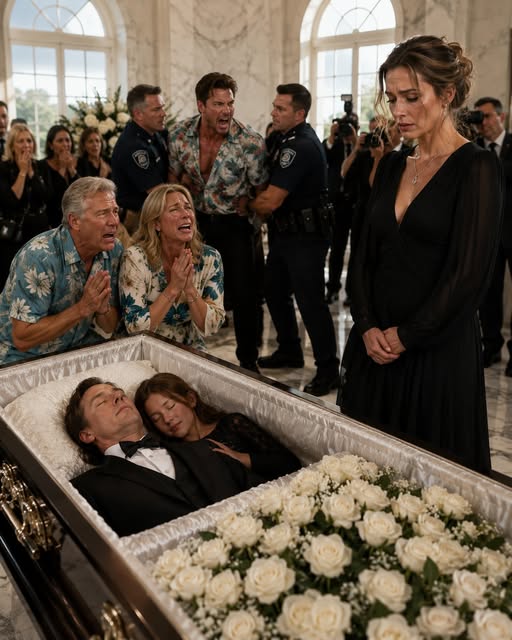
I buried Samuel and our daughter, Penelope, beneath a sky so dark it felt like the world itself was grieving.
While I stood beside two coffins, my phone buzzed.
It was a picture from my mother.
She, my father, and my younger brother Marcus were smiling on a white beach with tropical drinks in their hands like they were starring in a vacation ad.
Her caption made my stomach turn.
“We’re sorry, sweetheart, but flights are expensive, and funerals are emotionally exhausting. This is too trivial to ruin the trip over.”
Too trivial.
Those words echoed through every silent hour after I came home.
Penelope’s tiny yellow rain boots were still by the front door, dried mud clinging to them from the last afternoon we spent together. Samuel’s favorite coffee mug still rested beside the sink, waiting for someone who would never pick it up again.
The house had become painfully still.
Then, three evenings later, someone started pounding on my front door.
I opened it and found my parents standing there with fresh sunburns and expensive vacation clothes. Marcus leaned against a rental SUV as if he had all the time in the world.
My mother brushed past me without asking.
“Finally,” she said, looking me over. “You look awful.”
My father scanned the room instead of my face.
“Where’s the insurance paperwork?” he asked.
I stared at him.
“That’s your first question?”
Mom dropped her purse onto the table.
“Don’t start acting fragile, Jane,” she snapped. “Samuel had life insurance. There has to be an accident settlement too.”
Marcus finally stepped inside.
“We only need forty thousand dollars,” he said with a shrug. “It’s not that much.”
“All you need?” I asked quietly.
Mom folded her arms.
“After everything we’ve done for you, you owe us.”
Not one of them asked how I was surviving.
Not one of them mentioned Samuel.
Not one of them even spoke Penelope’s name.
They stood there expecting a paycheck while my family’s ashes were barely cold.
I looked from one face to another—their smug expressions, their absolute certainty that I would give them whatever they wanted.
Then I lowered my eyes to the black folder I had been holding since I opened the door.
For the first time since the funeral, I smiled.
Slowly, I opened it.
Inside the folder was a copy of Samuel’s life insurance policy.
My mother’s eyes immediately brightened.
“I knew it,” she whispered.
I turned the first page toward them.
“Samuel changed the beneficiary six months ago,” I said.
Dad frowned. “Changed it to whom?”
“To Penelope.”
For one brief second, silence filled the room.
Then Marcus laughed. “She’s dead too, Jane. That means the money goes to you.”
“It would have,” I replied, “except Samuel added a secondary beneficiary.”
My mother snatched the papers from my hand. Her eyes raced across the page, then stopped.
Her face drained of color.
The secondary beneficiary was the Bright Horizons Children’s Foundation—the charity that had helped pay for Penelope’s heart surgery when she was a baby.
Every cent of Samuel’s two-million-dollar policy would go to them.
“You let strangers take your money?” Mom shrieked.
“It was Samuel’s decision.”
Dad stepped closer, his jaw tight. “What about the accident settlement?”
I pulled another document from the folder.
“There won’t be one.”
Marcus stopped smiling.
I placed three printed photographs on the table. They showed the intersection where Samuel’s car had been struck, the shattered guardrail, and a black SUV disappearing through a red light.
Marcus’s rental SUV outside was black.
The room seemed to shrink.
Mom looked at him sharply. “What is this?”
I met my brother’s eyes.
“The police found traffic-camera footage this morning.”
Marcus went pale.
Dad grabbed the photograph. “That could be anyone.”
“Maybe,” I said. “But the license plate belongs to Marcus.”
My mother’s mouth opened, but no sound came out.
Marcus backed toward the door.
“It was an accident,” he stammered. “Samuel shouldn’t have followed me.”
My heartbeat stopped.
“Followed you?”
Marcus realized his mistake too late.
The detective had only said the SUV ran the light. No one had mentioned Samuel following anyone.
A knock sounded behind us.
Two uniformed officers stood on the porch.
Marcus spun toward the kitchen, but Dad suddenly caught his arm.
“Don’t run,” he hissed. “You’ll make all of us look guilty.”
All of us.
The officers heard it.
So did I.
Then my mother reached for her purse—and a second black folder slipped out, stamped with Samuel’s company logo.