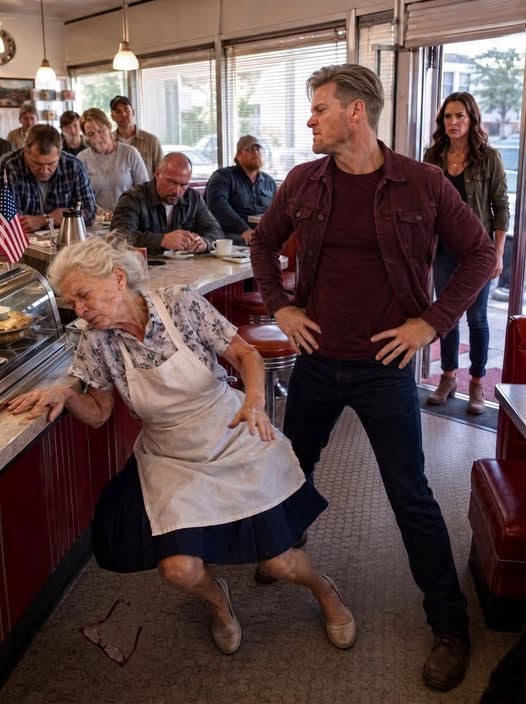
When a bu:lly sh0ved my 75-year-old mother during a confrontation in her North Carolina diner and warned he could do whatever he wanted, the regulars lowered their eyes and the sheriff called it a fall. I came home quietly, preserved the video he thought was incomplete, and waited beside the counter—until two black SUVs stopped outside and an officer entered using a rank no one knew I held.
The video lasted twelve seconds.
I was standing inside a briefing room at Fort Bragg, North Carolina, when my phone vibrated against the conference table. Twelve officers were reviewing logistics around me, and I still had a laser pointer in my hand when I saw my neighbor Carol’s name on the screen.
“Nicole,” she said, her voice shaking. “You need to see what happened to your mother.”
The video arrived before she finished.
I stepped into the hallway and pressed play.
Turner’s Family Diner appeared on my screen—the same red vinyl booths, chrome-edged tables, and brass bell over the door that had been there since childhood.
My mother, Evelyn Turner, stood behind the counter in her faded apron. At seventy-five, she still opened before sunrise, knew every regular’s coffee order, and refused to replace an apron stained in the shape of Ohio because she claimed it had “another ten good years left.”
A man leaned across the counter with one finger near her face.
I recognized him from photographs almost immediately.
Travis Cain.
His father, Wade Cain, owned half the commercial property in the county and had spent months pressuring my mother to sell the diner’s lease and the narrow parcel behind it.
My mother shook her head.
Then she made the gesture I had known all my life—both hands raised slightly, palms outward.
No.
She would not sign.
She would not sell.
Travis raised his hand.
My mother lost her balance and fell beside the counter. Her glasses slid beneath a booth while the customers stared into their plates.
Nobody moved.
These were people she had fed on credit. People whose children she had watched grow up. Men who had spent twenty years discussing football, crops, and local politics over her coffee.
Not one of them stood.
Travis adjusted his jacket and looked around the diner as if he wanted everyone to remember who controlled the room.
“Around here,” he said, “I do whatever I want.”
The video ended.
I requested emergency leave before returning to the briefing room.
I had served in the U.S. Army for more than twenty years. I commanded a Ranger battalion and had spent most of my adult life learning to make decisions under pressure.
But on the flight home, rank meant nothing.
I was simply a daughter replaying twelve seconds she could not change.
My mother was in a hospital outside town with a injuries to her shoulder and a bru:ising on her face.
When I entered her room, she did not look relieved.
She looked frightened.
“You should not have come,” she said.
“Someone put you on the floor of your own restaurant.”
“I’m fine.”
Her good hand closed around mine. The grip was still strong, but her eyes moved toward the door before she continued.
“Please don’t make this bigger.”
“What does Wade Cain want?”
She pulled the blanket higher over her waist.
“The diner. The land behind it. Your father refused him years ago, and now I have refused him too.”
My father had died six years earlier in a single-vehicle accident on Route 9.
The road had been dry. He had driven it thousands of times.
Until that moment, I had never connected his death to the Cain family.
“Don’t gather a storm,” my mother whispered.
It was an old expression she used whenever she wanted me to leave trouble alone.
But the trouble had already entered her diner.
The following morning, I spoke to the waitress, the cook, and two regulars who had been present.
Each gave me a version of the same answer.
“I didn’t see anything.”
Their hands told a different story.
The waitress, Kayla, wiped the same clean section of counter until her knuckles turned pale. One of the regulars held his coffee cup with both hands to stop it from trembling.
The building owner claimed the security system had malfunctioned.
Sheriff Don Harper called my mother’s injuries the result of “an unfortunate fall.”
He never asked to see my phone.
He never asked why Travis Cain appeared in the video.
He folded his hands on his desk and said, “Without a cooperating witness, there is nothing meaningful to investigate.”
That evening, someone knocked softly on my mother’s front door.
Kayla stood on the porch wearing a gray hoodie.
She kept looking toward the road.
“I recorded more,” she said.
Her phone contained forty-seven seconds, not twelve.
The longer video showed Travis demanding my mother’s signature. It also showed a second man standing near the pie display in an expensive gray suit.
Wade Cain watched everything.
He never tried to stop his son.
He did not even look surprised.
I saved three copies of the video and sent one to a secure account before Kayla left.
Then I began checking county property records.
Thirty families had sold land to Cain Realty Group during the previous six years. Most had refused the first offer. Soon afterward, each experienced a sudden problem—a disputed lien, a failed inspection, missing permits, or unexplained damage.
Every complaint had passed through Sheriff Harper’s office.
Every zoning request connected to Cain Realty had been approved by Mayor Linda Brooks.
Then I found my father’s name.
An assessor’s file described him as “uncooperative” after he rejected Wade Cain’s third offer.
The note recommending “e$c@lation” had been dated three weeks before my father’s acc:ident.
I did not accuse anyone.
I copied the page, photographed the original, and placed everything in a folder.
The next morning, I returned to the diner in jeans and an old university sweatshirt. My hair was tied back, and nothing about me revealed my command or rank.
My mother was already behind the counter with her arm in a sling.
The bell rang.
Travis Cain walked in smiling.
“I hear your daughter has been digging through records,” he told my mother.
“She is worried about me.”
“She should worry about herself.”
I rose from the corner booth.
“You must be Travis.”
He turned.
“I’m Nicole. Evelyn’s daughter.”
His smile widened.
“So you’re the soldier girl.”
He leaned against the counter and lowered his voice.
“Let me explain something. Around here, my family decides what becomes a problem and what disappears.”
“My father’s accident disappeared quickly.”
For half a second, his expression changed.
Then he smiled again.
“Accidents happen to people who don’t know when to leave things alone.”
My mother’s coffee pot stopped inches above a cup.
I kept my voice level.
“The law is coming, Travis. It is simply late.”
He stood and pressed his shoulder into mine, testing whether I would react.
I did not move.
Sheriff Harper entered almost immediately.
He looked at me instead of Travis.
“Ms. Turner, you need to leave. We will not tolerate disturbances here.”
Then two black SUVs stopped outside the diner.
The engines remained running.
A man in a U.S. Army service uniform stepped from the first vehicle, removed his cap, and walked through the door.
He looked past the sheriff, past Travis Cain, and directly at me.
“Good afternoon, Colonel Turner.”
A coffee cup slipped from someone’s hand and struck the counter.
PART 2: The name that changed the diner
Colonel James Whitfield crossed the diner and stopped beside me.
He was my commanding officer.
“I heard a member of one of my officers’ families was being intimidated,” he said. “I was already nearby and decided to confirm her safety personally.”
Sheriff Harper’s shoulders tightened.
Travis took one step backward, then recovered.
“Her military rank has nothing to do with a private property dispute.”
“You’re right,” I said. “It doesn’t.”
I removed my phone from my pocket.
“That is why I preserved the evidence instead of bringing soldiers.”
Kayla stepped away from the register.
Her hand trembled, but her voice did not.
“I saw what happened.”
Travis turned toward her.
“You were in the kitchen.”
“No. I recorded it.”
She pressed play.
The complete video showed Travis demanding my mother’s signature. Then the frame shifted, revealing Wade Cain beside the pie display, watching his son threaten her without intervening.
Sheriff Harper reached toward the phone.
“That recording may have been obtained improperly.”
Kayla pulled it against her chest.
“It was recorded in the dining room where I work.”
My mother finally raised her voice.
“And I never agreed to sell.”
Travis looked from her to the phone.
“This can still be handled privately.”
Before I could answer, the bell above the diner door rang again.
An elderly man entered carrying a worn leather satchel.
“My name is Harold Weiss,” he said. “I was your father’s attorney.”
He placed the satchel on the counter and opened its brass clasp.
“Your father left evidence with me six weeks before he died.”
What had Nicole’s father hidden inside that satchel—and why did Sheriff Harper immediately reach for his phone?
The next part and the full ending of the story. Type “Next” and press “Like” so Facebook can boost the post’s engagement, allowing us to share the entire story right under the
Chapter 1 — Twelve Seconds
The call came at 5:42 on a Tuesday afternoon. I was in a briefing room at Fort Bragg, holding a laser pointer, when everything I thought was ordinary shifted in an instant.
Twelve seconds. That was the entire recording. Twelve seconds of my seventy-five-year-old mother collapsing onto the diner’s linoleum floor after a confrontation, her glasses sliding beneath a red vinyl booth while a man stood over her with a smug smile, as though what had just happened entertained him.
Before the clip even finished, I knew my life had changed.
People talk about silence. Real silence carries weight; it settles on your chest until even breathing feels deliberate. I had known that kind of silence overseas — the pause after danger announced itself but before anyone knew where it would strike.
I had heard it in military hospitals in the middle of the night, when doctors walked through swinging doors and families searched their faces for hope.
But I had never known silence the way I did that afternoon.
Twelve officers surrounded the conference table as my phone vibrated against the polished surface. My neighbor Carol’s name. I almost ignored it. We were reviewing logistics — Colonel Renick was outlining supply-chain contingencies while I prepared to present readiness numbers for the Ranger battalion under my command.
Then something tightened in my chest. Call it instinct. Call it experience. After more than two decades in the Army, I had learned not to dismiss the quiet warnings that came before my mind understood the reason.
I answered.
“Nicole.” Carol’s voice shook so badly I barely recognized it. “Nicole, you need to see this right now. It’s your mom.”
She never finished. The video arrived while she was still speaking.