
The first lie broke before dawn.
It broke in the eyes of a six-month-old baby.
By the time the mountains disappeared behind a white wall of snow, Nora Gallagher had traveled too far to turn back. The stagecoach wheels groaned over the frozen Montana road, sliding dangerously close to ravines that vanished beneath the storm. Every gust struck the carriage like a giant fist.
No sensible traveler would have crossed those mountains after sunset.
But Nora was not traveling because it was sensible.
She was traveling because her husband was dead, her money was nearly gone, and the infant sleeping against her heart had survived too much for Nora to surrender now.
Wrapped in a cream-colored blanket, little Lily breathed softly beneath Nora’s faded brown shawl. She did not know that her mother had carried her more than fifteen hundred miles. She did not know they were heading toward a ranch owned by a man Nora had never met.
She did not know that somewhere beneath the blanket covering her tiny body, a secret had been sewn into the lining.
Nora did not know it either.
The stagecoach stopped outside the gates of the Ayers Ranch shortly after dusk. The driver refused to go farther.
“Storm will bury the pass within the hour,” he warned.
Nora climbed down with Lily in one arm and a battered carpetbag in the other. Before she could ask whether he might wait until she was admitted, the driver cracked his whip.
The coach vanished into the snow.
Nora stood alone.
Beyond the gate stretched a wide ranch yard surrounded by barns, bunkhouses, corrals, and a sprawling timber house. Lanterns glowed dimly through the blizzard. Horses stamped nervously behind closed doors.
A tall man approached from the house.
The first thing Tom Ayers noticed was not Nora’s exhausted face.
It was not the snow frozen in her chestnut hair or the worn hem of her dress.
It was the baby.
Tom stopped inside the gate. Broad-shouldered and rigid beneath a heavy black ranch coat, he looked like a man the winter itself had carved from stone. His gray-blue eyes traveled over Nora before settling on Lily.
His expression hardened.
“I hired a cook,” he said. “Not a widow with a child.”
The words cut more deeply than the wind.
Nora tightened her arms around Lily. “I can cook.”
“That isn’t the problem.”
“Then what is?”
Tom glanced toward the barn. Several ranch hands had become suspiciously interested in polishing saddles while listening to every word.
“A cattle ranch is no place for an infant,” he said. “There are horses, tools, blizzards, and men working at all hours.”
“My daughter won’t interfere.”
“You should have told me about her.”
“I did.”
His eyes narrowed.
“No.”
“I wrote that I was widowed and bringing my baby.”
“I never received that letter.”
The storm roared between them.
Nora looked back toward the road. It was already gone beneath the snow.
Tom followed her gaze.
“You can sleep in the storeroom tonight,” he said at last. “But you leave at first light.”
Nora nearly begged.
Nearly.
She had begged landlords for one more week. She had begged doctors to save Lily during a fever that turned the child’s lips blue. She had begged relatives not to sell the last pieces of furniture her husband had built.
Every act of mercy had demanded a piece of her dignity.
She had almost none left to surrender.
“Thank you for the night,” she whispered.
As she stepped through the gate, Lily released a sleepy sigh.
Tom flinched.
The reaction was so slight that Nora might have imagined it. Yet for one instant, something crossed his face—not anger, but pain.
It looked like recognition.
A cheerful red-haired cowboy hurried across the yard.
“Let me carry that bag, ma’am.”
“I have it.”
“I can see that. Doesn’t mean you should have to.” He took the carpetbag before she could protest. “Name’s Eli.”
“Nora Gallagher.”
He smiled at the infant. “And who’s this little angel?”
“Lily.”
The other ranch hands drifted closer.
Tom’s voice cracked across the yard.
“Back to work.”
They scattered immediately, though Eli gave Nora an apologetic smile before leading her toward the house.
Inside, the ranch home was enormous and strangely lifeless. Dust covered the mantel. A fire burned in the stone hearth, but no chair faced it. There were no portraits, fresh flowers, embroidered cushions, or books left open beside a lamp.
It felt less like a home than a place waiting for someone who had never returned.
Tom opened a narrow storeroom near the kitchen.
“Blankets are in the chest.”
“Where is the kitchen?” Nora asked.
“You aren’t here to work.”
“I only asked.”
“Down the hall.”
“Who cooks now?”
“We take turns.”
“That badly?”
“Worse.”
For the briefest instant, the corner of Tom’s mouth moved.
Then the almost-smile vanished.
The blizzard did not loosen its grip during the night.
It strengthened.
Snow buried the fences, sealed the barn doors, and piled against the ranch house windows until the world outside disappeared. The temperature fell so sharply that nails cracked inside the walls.
Before sunrise, Nora woke to Lily’s hungry cry.
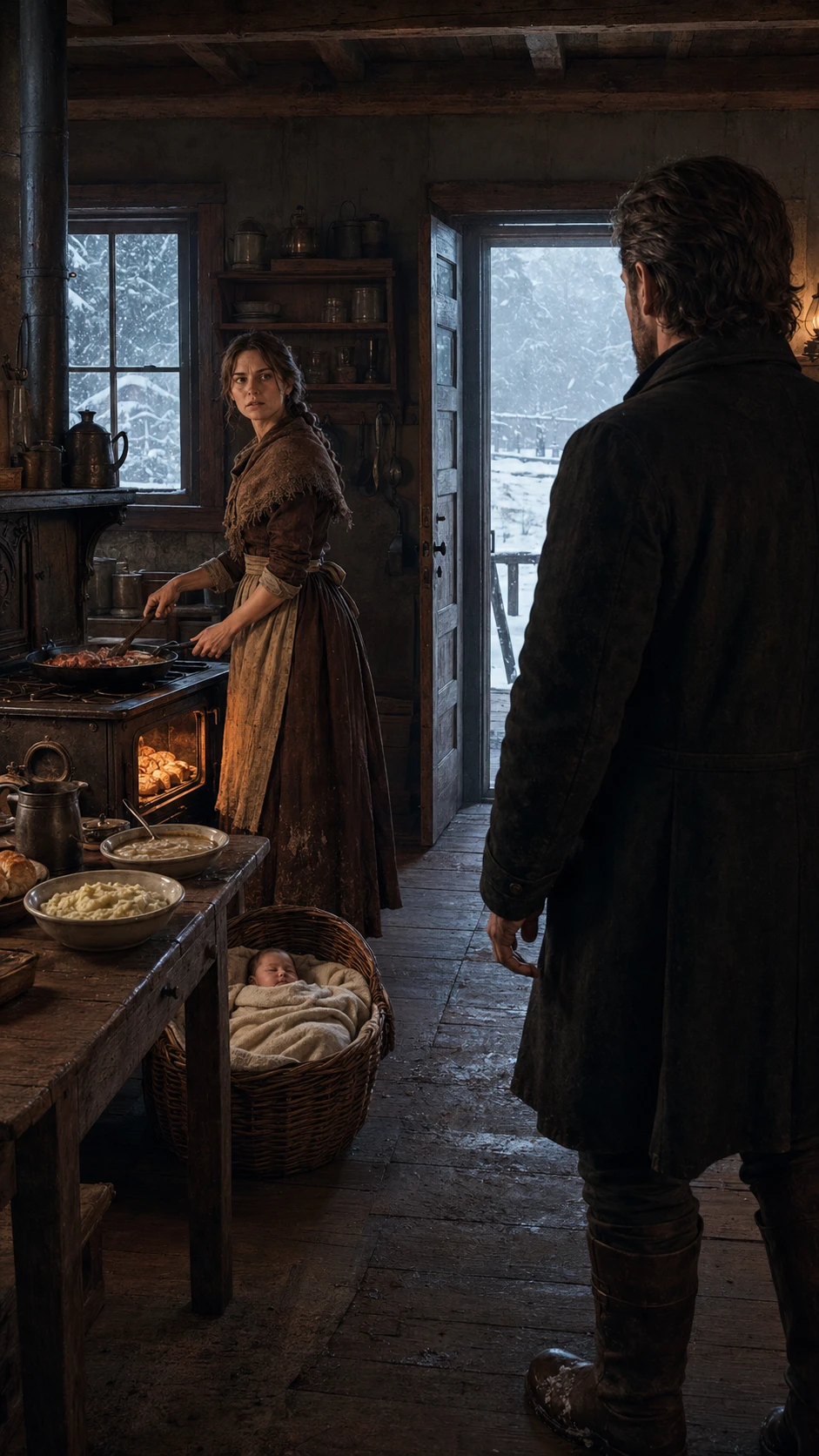
She fed the baby, tucked her into a blanket-lined basket, and followed the scent of stale coffee into the kitchen.
What she found there offended her on a personal level.
A half-burned pot of oats sat on the stove. Hardened grease coated the pans. The bread box contained two biscuits dense enough to stop a bullet.
Nora stared at them.
Then she rolled up her sleeves.
When Tom entered an hour later, he stopped in the doorway.
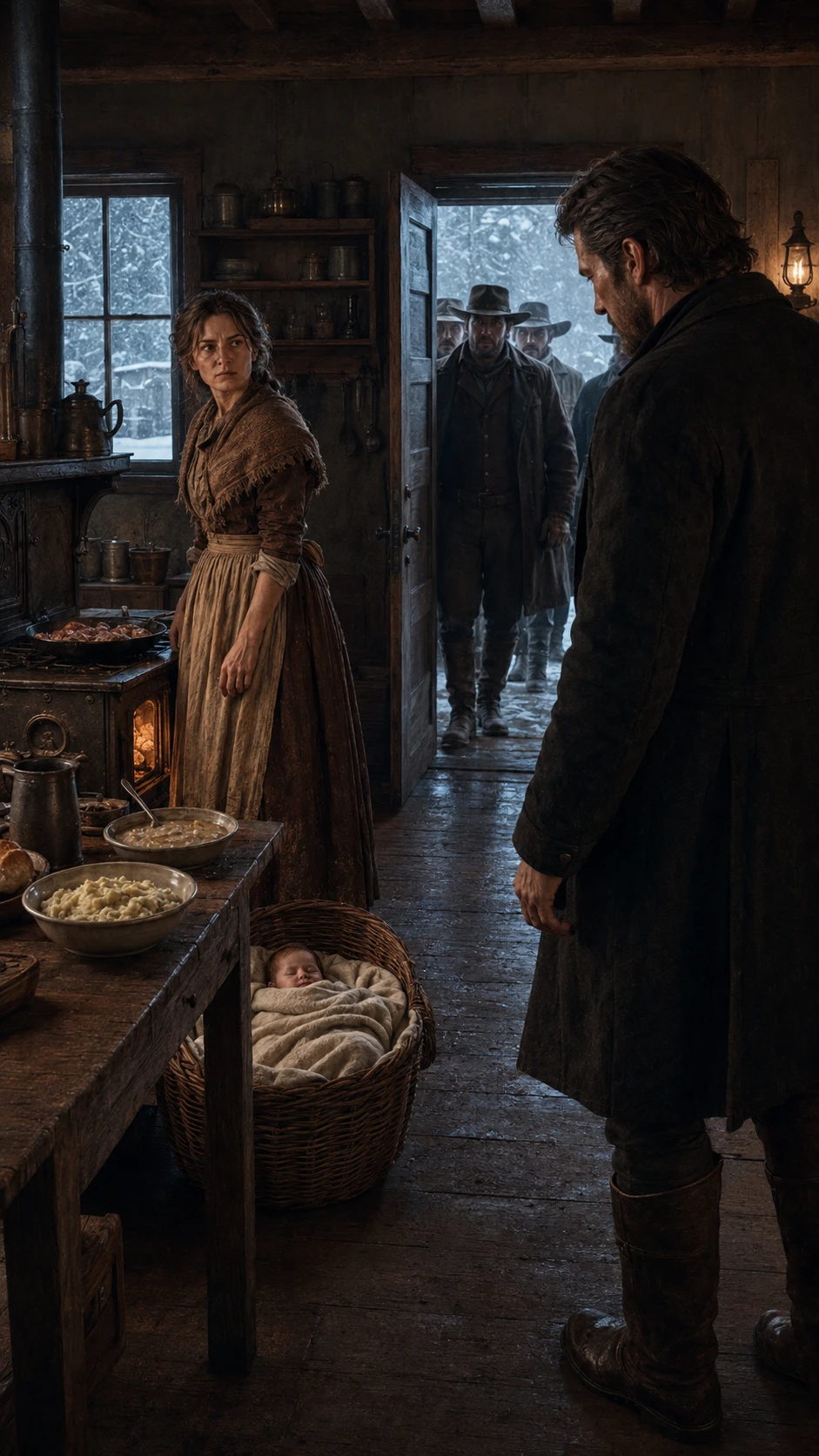
Ham sizzled in a cast-iron pan. Fresh biscuits browned in the oven. Thick gravy bubbled beside creamy mashed potatoes, and strong coffee steamed from a polished pot.
Lily slept safely in her basket beside the stove.
“What are you doing?” Tom demanded.
“Making breakfast.”
“I told you—”
“The road is buried,” Nora interrupted. “Unless thirteen hungry ranch hands plan on eating frozen oats, let me finish.”
Tom’s eyes shifted toward Lily.
“Move her back to the storeroom.”
Nora did not move.
“No.”
His face darkened. “No?”
“I won’t leave my daughter alone behind a closed door in a house she has never seen.”
“This is my house.”
“And she is my daughter.”
The room fell completely silent.
At that exact moment, the ranch hands crowded into the doorway, drawn by the smell. Eli stopped so abruptly that the men behind him collided with his back.
His eyes widened at the table.
“Is that… ham?”
A few men laughed nervously.
Then Lily stirred.
Her eyelids opened.
She looked directly at Tom.
Every trace of color vanished from his face.
Nora followed his stare. Lily’s eyes were an unusual shade—pale gray-blue near the center, darkening toward the edges. They sometimes appeared silver in bright light.
Tom took one step backward.
“What?” Nora asked.
He did not answer.
Lily yawned, freeing one tiny hand from her blanket. A pale crescent-shaped mark showed on the inside of her wrist.
Tom gripped the doorframe.
“Where did she get that?”
Nora looked down. “The birthmark?”
“Where?”
“She was born with it.”
“Did her father have one?”
Nora’s breath caught.
“Yes.”
Tom stared at her.
“Where?”
“On his left shoulder.”
A metal cup struck the floor behind them.
The oldest ranch hand, Silas Creed, stood at the rear of the group.
Silas was the ranch foreman, a lean man in his late fifties with iron-gray hair and deep-set eyes. He had entered so quietly that no one had noticed him. Now he stared at Lily as if the baby had aimed a pistol at his heart.
He recovered quickly.
“Cup slipped,” he said.
But Nora saw the fear before it disappeared.
Tom did too.
“Everybody sit,” Tom ordered.
The men required no further encouragement. They filled the table, passing biscuits and ham with reverence. Within minutes, the kitchen rang with forks, praise, and the astonished noises of men who had forgotten food could taste like anything other than smoke.
Tom did not eat.
He stood near the window, watching Nora.
Silas did not eat either.
He watched the baby.
After breakfast, Tom found Nora washing dishes.
“You said your husband had the same mark.”
Nora kept her hands in the water. “His was larger.”
“What was his name?”
“Daniel Gallagher.”
Tom’s expression did not change, but his fingers tightened around the back of a chair.
“Where was he born?”
“He didn’t know.”
“Everyone knows where they were born.”
“Not orphans.”
Tom looked away.
Nora dried her hands.
“Daniel was left outside a church in Pennsylvania when he was a few days old. A family named Gallagher adopted him. They were good people, but they died before we married.”
“What did he look like?”
“Why?”
“Answer me.”
Nora’s exhaustion sharpened into anger.
“You have made it clear that my daughter and I are unwelcome here. You do not get to interrogate me as though I have committed some crime.”
Tom’s jaw worked.
Then his voice lowered.
“My wife disappeared twenty-seven years ago.”
Nora froze.
“She was carrying my child.”
The kitchen seemed to grow colder.
Tom stared at Lily’s basket.
“Her family had that same mark.”
Before Nora could answer, Silas entered.
“The west barn roof is bowing,” the foreman announced. “Need every available man.”
His gaze moved from Tom to Nora.
“The widow ought to remain out of ranch business.”
Tom looked at him for a long moment.
“Mrs. Gallagher is cooking until the road clears.”
Silas’s face tightened.
“You told her to leave.”
“The road is buried.”
“Then send her when we dig it out.”
Tom’s eyes turned cold. “Did I ask your opinion?”
Silas removed his hat.
“No.”
“Then get the men.”
When Silas left, Nora noticed that Tom was still watching the doorway.
“You don’t trust him,” she said.
“Silas has worked here thirty years.”
“That was not my question.”
Tom did not reply.
Instead, he pointed toward Lily.
“Your husband. Did he ever mention Montana?”
“Only once.”
Tom turned.
Nora walked to her carpetbag and removed a small brass music box, its surface scratched and blackened by age.
“Daniel carried this for as long as I knew him. He said it was found in the blanket wrapped around him when he was abandoned.”
Tom took the box with trembling hands.
On its lid was the outline of a wild rose.
He opened it.
A thin, imperfect melody floated into the room.
Tom closed his eyes.
Nora had heard Daniel hum the tune to Lily many times. She had assumed it was a lullaby learned from his adoptive mother.
Tom whispered a name.
“Clara.”
“Who was Clara?”
“My wife.”
The music stopped.
Tom opened a small compartment beneath the mechanism and removed a faded strip of paper.
Nora had never known the compartment existed.
Written across it in fragile ink were six words:
For our child, until we come home.
Tom lowered himself into a chair.
For the first time since Nora had met him, he looked old.
“My wife owned this box.”
Clara Ayers had disappeared during another winter storm.
Tom told Nora the story that afternoon while the ranch hands fought to save the west barn.
He had been twenty-eight, proud, ambitious, and too easily controlled by his father, Amos Ayers. Clara had been the daughter of a schoolteacher—a woman who read newspapers, questioned powerful men, and refused to lower her eyes when someone insulted her.
Amos hated her.
“He said she weakened me,” Tom explained. “Said a ranch could not be built by a man who listened to a wife.”
“Did you believe him?”
Tom stared into the fire.
“For too long.”
The night Clara vanished, she and Tom had argued. She accused Amos of falsifying deeds and stealing land from struggling homesteaders. Tom, furious and unwilling to believe his father capable of such things, told Clara that if she despised the Ayers name, she could leave it.
By morning, her wagon was gone.
Tracks led toward the northern pass.
A broken wheel was found near the ravine. Pieces of the wagon lay below, but no bodies were ever recovered.
“My father said the river carried them away,” Tom said.
“Them?”
“Clara and the child.”
Nora looked toward Lily.
“You never searched beyond the ravine?”
“For months. Then years.” Tom’s voice roughened. “I searched every town between here and the Canadian border. I hired men. I offered rewards. Nothing.”
“What about the music box?”
“It was in her wagon.”
“Then how did Daniel have it?”
Tom had no answer.
The front door opened, and Eli entered with snow on his shoulders.
“Roof’s holding,” he reported. “Silas wants more rope.”
He noticed the music box in Tom’s hands.
The color left his freckled face.
“I’ve seen that rose before.”
Tom stood.
“Where?”
Eli reached beneath his shirt and drew out a small brass pendant on a leather cord. It was no larger than a coin and had been cut unevenly down one side.
Engraved on its surface was half of a wild rose.
“I had it when the sisters found me,” Eli said.
Nora stared at him.
“You were an orphan too?”
“Left at Saint Agnes Mission during a blizzard. No note. No name.” His smile was strained. “Sister Catherine called me Elias because it was the saint’s day.”
Tom took the pendant.
Its broken edge fit precisely into a narrow groove inside the music box.
The room became so quiet that they heard the wind scraping snow against the roof.
Daniel’s music box and Eli’s pendant belonged together.
Tom looked from Nora to Eli, then toward the infant in the basket.
Silas appeared in the doorway.
This time, he could not hide his fear.
That evening, Lily developed a fever.
It began with restlessness and a flushed cheek. Within an hour, her breathing grew rapid.
Nora’s terror returned with brutal force.
“No,” she whispered, pressing her lips to Lily’s forehead. “Not again.”
The baby had nearly died from fever once before. Nora remembered sitting beside a rented-room window, listening to a doctor say there was nothing more he could do.
Daniel had held Lily through the entire night, singing Clara’s lullaby until the fever broke.
Now Daniel was gone.
Nora carried Lily into the kitchen and prepared cool cloths. Her hands shook so badly that she dropped the basin.
Tom caught it before it struck the floor.
“Tell me what you need.”
“I can manage.”
“That wasn’t what I asked.”
Their eyes met.
Nora swallowed. “Willow bark from my bag. Fresh water. More wood.”
Tom moved instantly.
Eli fed the stove. Two ranch hands boiled water. Another fetched snow to cool the room. The men who had gathered around breakfast now obeyed Nora without hesitation.
Silas remained absent.
Near midnight, Lily began to cry.
Tom stood at the doorway, helpless.
“Hold her,” Nora said.
He recoiled. “No.”
“I need both hands.”
“I can bring someone else.”
“You are here.”
Tom looked at the baby as though she were a flame.
Then he slowly extended his arms.
Nora placed Lily against his chest.
The baby cried harder for three breaths.
Then Tom began humming.
The melody emerged unconsciously—the same melody from Clara’s music box, the same lullaby Daniel had sung.
Lily quieted.
Tom’s face crumpled.
He pressed his cheek against the baby’s hair.
For twenty-seven years, Tom Ayers had believed his child was dead. Now his lost wife’s lullaby was calming a baby who carried her birthmark.
By dawn, Lily’s fever had eased.
Nora woke in a chair and found Tom still holding her.
He had not slept.
“She looks like Clara,” he whispered.
Nora’s grief rose unexpectedly.
“She looks like Daniel.”
Tom glanced at her.
“How did he die?”
“A warehouse accident in Chicago. A support beam fell during a fire.”
“Did you see him afterward?”
Nora’s throat closed.
“No. The building burned. They found his watch and wedding ring.”
“Who identified them?”
“The supervisor.”
“What was his name?”
Nora tried to remember.
“Samuel Creed.”
Tom went completely still.
“Creed?”
“Yes.”
Tom placed Lily carefully in her basket.
“Silas has a brother named Samuel.”
They searched Silas’s room while he was supposedly checking the cattle.
Inside a locked chest, Tom found Nora’s missing letter.
The seal had been broken.
Beneath it lay three envelopes addressed in Daniel’s handwriting to Thomas Ayers, Ayers Ranch, Montana Territory.
None had ever reached Tom.
Nora’s knees weakened.
“He wrote to you.”
Tom opened the oldest letter.
Mr. Ayers,
I believe my birth may be connected to your ranch and to a woman named Clara. I possess a music box bearing the Ayers wild rose. I seek no money. I only want the truth.
The second letter was more urgent.
A man has followed me twice. If you know the name Silas Creed, do not trust him.
The final letter had been written one week before the warehouse fire.
I have discovered that Clara survived the ravine. She gave birth in a line cabin north of your ranch. I believe there were two children.
Tom looked toward Eli.
Eli had stopped breathing.
Nora took the letter from Tom.
At the bottom, Daniel had drawn a symbol—a circle divided by a jagged line. One half resembled the pendant Eli wore.
The other resembled a metal disk Nora had found among Daniel’s belongings after his death.
She ran to the storeroom, tore open her carpetbag, and emptied it onto the floor.
Clothes, diapers, a comb, two coins, Daniel’s watch.
Then a small half-circle of brass rolled beneath the table.
Eli knelt.
With shaking fingers, he joined it to his pendant.
The pieces formed a complete medallion engraved with two initials:
D.T. and E.J.
On the reverse were three words:
Born together. Home together.
Eli sat down heavily.
“Daniel was my brother.”
“Not merely your brother,” Tom said.
His voice broke.
“My sons.”
A floorboard creaked in the hallway.
Tom spun toward the door.
No one was there.
Then a horse screamed outside.
The ranch bell began ringing.
“Fire!” someone shouted.
Smoke rolled past the windows.
The north barn was burning.
Chaos swallowed the ranch yard.
Men formed a line between the well and the barn. Wind drove flames across the roof, sending sparks toward the hayloft. Horses kicked against their stalls.
Tom and Eli ran outside.
Nora remained in the kitchen with Lily, helping fill buckets.
Then she smelled something unfamiliar.
Not smoke.
Cold air.
The back door stood open.
Lily’s basket was empty.
For one terrible second, Nora could not understand what she was seeing.
Then she saw the cream-colored corner of Lily’s blanket disappearing beyond the rear porch.
“Lily!”
She ran into the storm without her shawl.
A rider crossed the far paddock, hunched against the wind. Silas held Lily beneath his coat.
Nora screamed his name.
He did not turn.
Tom reached her moments later.
“He took her.”
Tom looked toward the northern ridge.
“The old line cabin.”
“How do you know?”
“Because that is where Clara survived.”
Eli brought three horses.
The wind had already begun erasing Silas’s tracks.
“You stay here,” Tom told Nora.
She seized the reins.
“He has my daughter.”
“The ridge will kill you.”
“Then ride fast enough that it doesn’t.”
Tom saw something in her face and stopped arguing.
They followed Silas into the white darkness.
Snow blinded the horses. Ice coated their manes. Twice, Nora nearly fell, but each time she heard Lily’s imagined cry and forced herself upright.
The line cabin appeared through the storm like a black wound in the snow.
Silas’s horse stood outside.
Tom dismounted and drew his revolver.
Eli circled toward the rear.
Nora approached the door.
Inside, Lily was crying.
Silas’s voice followed.
“You should have stayed east, Mrs. Gallagher.”
Nora pushed the door open.
The cabin consisted of one room. A lantern burned on a table. Silas stood near the fireplace, holding Lily in one arm and a pistol in the other.
“Give her to me.”
“I cannot.”
“She is a baby.”
“She is evidence.”
Tom entered behind Nora, gun raised.
“Put her down, Silas.”
The foreman laughed without humor.
“You always were slow to see what stood in front of you.”
“Where is Daniel?”
Silas’s eyes flickered.
Nora saw it.
Daniel was not dead.
The realization struck so violently that she stopped feeling the cold.
“Where is my husband?”
Silas tightened his grip on Lily.
“Dead men do not answer questions.”
A faint sound came from beneath the floor.
Three knocks.
Nora’s heart stopped.
Then came three more.
“Daniel?”
Silas fired.
Tom shoved Nora aside. The bullet struck the wall. Eli crashed through the rear window, showering the room with glass.
Silas turned his weapon toward him.
Nora seized a burning log from the fireplace and swung it against Silas’s wrist.
The gun discharged into the ceiling.
Lily slipped.
Tom dropped his revolver and caught her before she struck the floor.
Eli tackled Silas into the table. The lantern fell, spilling fire across the boards.
Smoke erupted.
Silas struck Eli with the pistol and crawled toward the door. Nora kicked the weapon away.
Tom wrapped Lily in his coat.
“Get outside!”
“No!” Nora fell to her knees where she had heard the knocking. “Daniel is under us.”
Flames raced toward the wall.
Eli found an iron ring hidden beneath a rug. Together, he and Nora pulled open a trapdoor.
A wave of foul air rose from the darkness.
A man lay chained in the shallow cellar.
He was thin, bearded, and barely conscious.
But Nora knew him before his eyes opened.
She knew the shape of his hands.
She knew the scar above his eyebrow.
She knew the wedding band still circling his finger.
“Daniel.”
His eyes opened.
“Nora?”
The world seemed to split apart.
She dropped into the cellar and pressed her hands to his face.
“You died.”
“I tried,” he whispered.
She laughed and sobbed at once.
Above them, Silas staggered to his feet.
Tom pointed the recovered pistol at him.
“Tell me everything.”
Fire climbed the curtains.
Silas looked around the burning cabin and finally understood there would be no more years in which to hide.
“It was Amos,” he said.
Tom’s face hardened.
“My father?”
“He knew Clara had found the ledgers. Every deed he forged. Every family he drove from this valley. She intended to take them to the territorial judge.”
“You sabotaged her wagon.”
Silas’s silence answered.
Nora and Eli lifted Daniel from the cellar.
Silas continued, his voice breaking beneath the roar of flames.
“Amos ordered me to frighten her. Cut one harness strap. I told myself the wagon would stop.”
“But it went into the ravine,” Tom said.
“She survived. Crawled two miles through the snow to this cabin. She gave birth that night.”
Tom looked at Eli and Daniel.
“Twins.”
Silas nodded.
“She named them Daniel Thomas and Elias James. She made me promise to take them to you.”
“Why didn’t you?”
“Amos arrived before dawn.”
The roof groaned.
“He said if the children returned, Clara would expose everything. He ordered me to kill them.”
Tom raised the pistol.
Silas closed his eyes.
“I could not. I gave one child to a family traveling east. The Gallaghers. I left the other at Saint Agnes. Then I told Amos both infants had died.”
“And Clara?” Tom demanded.
“She hid the ledgers before Amos found her. He wanted to know where. She refused.”
Tom’s voice became almost inaudible.
“What did he do?”
Silas looked at the floor.
“He left her outside in the storm.”
Tom struck him.
Silas crashed against the wall.
“You murdered her.”
“Your father murdered her!”
“And you watched.”
“Yes!”
The confession seemed to empty him.
“For twenty-seven years, I watched you search for a grave I had helped create.”
Daniel coughed.
“I found Samuel Creed in Chicago,” he said weakly. “He admitted Silas had paid him to watch me. Before I could come here, they staged the fire.”
Nora held him tighter.
“Why keep you alive?”
“The ledgers,” Daniel said. “Silas believed I knew where Clara hid them.”
Silas looked toward Lily.
“He said the answer was with his daughter.”
Nora stared at him.
“What does that mean?”
Daniel’s gaze found the cream blanket wrapped around Lily.
“My adoptive mother said it was part of the blanket I arrived in. Before I left Chicago, I stitched my papers into Lily’s lining because I knew they were following me.”
“But this blanket is new,” Nora said.
“No. You repaired the outside. The inner cloth was mine.”
Flames reached the ceiling beam.
Tom shouted, “We have to go.”
They carried Daniel outside as the roof collapsed.
Silas tried to run.
He made it three steps before Eli caught him.
The two men fell into the snow.
Silas reached for a knife.
A burning section of roof crashed through the doorway, sending sparks into the storm. Silas recoiled, lost his footing, and slid down the steep bank behind the cabin.
He seized a tree root with one hand.
Eli lay flat and reached for him.
“Take my arm!”
Silas stared up at the son he had abandoned.
For a moment, shame transformed his face.
Then the root tore free.
Silas disappeared into the ravine.
His scream was swallowed by the wind.
They returned to the ranch shortly before dawn.
The north barn had been saved. The fire had been a diversion, started with lamp oil and a slow-burning rag.
Daniel was carried into the house and placed in Tom’s bed. His wrists were infected, two ribs had healed badly, and hunger had reduced him to skin and bone.
But he was alive.
Nora sat beside him, afraid to blink.
Each time Daniel drifted into sleep, she touched his hand to make certain he remained real.
Lily rested between them.
When Daniel woke, Nora kissed him, then struck his shoulder.
He winced.
“That was for dying.”
“I didn’t intend to.”
She kissed him again.
“That was for coming back.”
Outside the room, Tom stood beside Eli.
Neither man knew what to say.
Eli finally looked at him.
“I have spent half my life wondering who left me at that mission.”
Tom’s voice trembled.
“I spent yours believing you had never drawn breath.”
Eli swallowed.
“You cannot make twenty-seven years disappear.”
“No.”
“You cannot become my father because a piece of brass says you are.”
“No.”
Eli studied him.
Tom removed his hat.
“But if you permit it, I would like to spend whatever years remain learning how.”
The younger man’s eyes filled.
After a long silence, Eli stepped forward.
Tom embraced him.
The ranch hands turned away, pretending not to witness their employer weeping into the shoulder of the son who had worked beside him for nine years without either man knowing the truth.
Three days later, the blizzard ended.
Sunlight struck the snow so brightly that the entire valley appeared newly created.
Daniel was strong enough to sit near the fire. Lily’s fever had disappeared. Nora cooked soup while Tom and Eli carefully opened the lining of the cream-colored blanket.
Between the layers, they found Daniel’s letters, a hand-drawn map, and several pages copied from a ledger.
But there was something else.
A narrow pocket had been sewn into the oldest section of cloth decades earlier.
Inside it lay a folded document written in Clara’s hand.
Tom could barely unfold it.
My dearest Tom,
If this reaches you, then someone kinder than your father has survived him.
I found Amos’s records. The Ayers Ranch was not built only by work. Much of its land was taken through forged debts, false surveys, and threats. Your father believed the name mattered more than the truth.
I know you are not him.
I know the cruel words you spoke came from pride, not hatred. I left because I feared Amos, not because I ceased loving you.
Our children are two boys.
Daniel Thomas has your eyes.
Elias James has your stubborn mouth.
If I cannot bring them home, remember this: a home is not the land beneath a house. It is the truth the people inside it are brave enough to keep.
Tom stopped reading.
His tears fell onto the page.
Nora placed a hand over his.
“There is more,” Daniel said.
At the bottom of the letter, Clara had written directions to the original ledgers.
They were hidden beneath the nursery floor.
Tom had kept the nursery locked for twenty-seven years.
He had believed opening the door would mean admitting Clara was never coming back.
Now he climbed the stairs with both sons beside him.
The key turned reluctantly.
Dust covered the room. A small cradle stood near the window. Faded paper roses climbed the walls. On a table rested two unfinished wooden horses.
Tom crossed the room as if entering a church.
Beneath the cradle, they pried up three boards.
A metal box lay between the beams.
Inside were Amos Ayers’s original ledgers, forged deeds, stolen property records, and signed confessions from men he had bribed.
There was also a legal document transferring Clara’s share of the ranch to her children.
Tom read it twice.
Then he handed it to Daniel and Eli.
“The ranch belongs to you.”
Eli stared at him. “You built this place.”
“On land my father stole.”
“You did not know.”
“I know now.”
Daniel leaned back against the wall.
“What will you do?”
Tom looked around the nursery—the room he had preserved as a tomb.
“We return every acre that can be returned. We compensate every family we can find. What remains will be held equally in your names.”
Eli shook his head in disbelief.
“And you?”
Tom looked through the window toward the valley.
“I hope my sons will hire an old rancher who cooks badly.”
Eli laughed.
It was a wet, broken sound.
Then Daniel began laughing too.
For the first time in decades, laughter lived inside the Ayers house.
Spring arrived late that year.
The snow retreated from the valley, revealing fences, grass, and the first purple mountain flowers. Investigators came from Helena to examine Amos’s ledgers. Samuel Creed was arrested in Chicago. Families who had lost land received letters inviting them home or offering repayment.
Some accepted.
Some refused.
Some came only to stand before Tom and tell him what the Ayers name had cost them.
Tom listened to every word.
He did not defend himself.
Nora remained at the ranch, though she was no longer merely the cook. She reorganized the household, planted herbs beside the kitchen, and moved chairs toward the fireplace.
She placed Clara’s portrait above the mantel.
Daniel healed slowly. At first, he could walk only from the bed to the window. By May, he reached the porch. By June, he crossed the yard with a cane.
Eli walked beside him.
The brothers were not identical. Daniel had dark hair and Tom’s gray-blue eyes. Eli had Clara’s red hair and quick smile.
Yet when they stood together, no one could doubt they were twins.
They tilted their heads the same way when listening.
They both hated turnips.
They both hummed Clara’s lullaby without realizing it.
Lily adored them both.
Tom adored Lily with the solemn devotion of a man who believed every smile was something sacred.
One evening, Nora found him sitting on the porch with the baby sleeping against his chest.
“You once said a cattle ranch was no place for an infant,” she reminded him.
Tom looked offended.
“I was clearly misinformed.”
“By whom?”
“An extremely foolish man.”
Nora sat beside him.
Across the yard, Daniel and Eli argued over the proper way to repair a gate. The ranch hands had begun placing bets on which brother would win each disagreement.
Nora watched her husband in the golden light.
For months, she had mourned him.
Now he was here.
Sometimes happiness frightened her more than grief. Grief asked only that she endure. Happiness demanded that she trust life not to steal everything again.
Daniel looked toward the porch and smiled at her.
Nora smiled back.
Tom glanced down at Lily.
“She brought us here.”
“Nobody asked her permission.”
“She did it anyway.”
The baby opened her strange silver-blue eyes.
Around her wrist, the crescent-shaped mark caught the evening sun.
In August, a final letter arrived from Saint Agnes Mission.
The sisters had searched their oldest records after learning about Eli. Most pages from the year of his arrival had been destroyed by water.
One entry remained.
Tom opened it at the kitchen table while Nora, Daniel, and Eli gathered around.
Infant male received during winter storm. Approximate age: two days. Delivered by unidentified man. Child wrapped in brown wool. Brass token attached.
Below the entry, another sentence had been added in different handwriting.
A second infant was heard crying inside the man’s wagon.
No one spoke.
Daniel looked at Eli.
“Second infant?”
“We were the twins,” Eli said.
Tom reread Clara’s letter.
Our children are two boys.
The kitchen suddenly seemed too small.
Nora remembered Silas’s confession.
Clara gave birth that night. She named them Daniel Thomas and Elias James.
Two boys.
Two tokens.
Yet the mission record said another infant had been crying after Eli was surrendered.
Daniel’s face changed.
“The Gallaghers told me I was brought to them by a woman.”
“Silas said he delivered you,” Tom replied.
“He lied about that too.”
Nora felt cold despite the summer heat.
They returned to Clara’s hidden box and searched every page. Beneath the ledgers, Daniel found a false bottom.
Inside lay a final sheet of paper.
It was not written by Clara.
It was written by Silas.
Tom read aloud.
Amos does not know about the third child.
Clara was too weak to understand what happened. The midwife swore the infant girl was stillborn, but I heard her cry. I took her before Amos arrived and gave her to the schoolteacher traveling east.
I told myself one child beyond the Ayers name might remain safe.
Tom’s hands began to shake.
“A third child,” Eli whispered.
“Your sister,” Nora said.
Daniel looked at the date.
Then he looked at Nora.
“What was your mother’s birthday?”
Nora frowned.
“The tenth of January.”
The same date Clara’s twins had been born.
No one moved.
Nora’s mother, Eleanor, had been raised by a widowed schoolteacher. She had never known her biological parents. She had possessed the same gray-blue eyes as Lily.
And on the inside of her wrist, she had carried a pale crescent-shaped birthmark.
Nora stood so quickly that her chair fell backward.
“No.”
Daniel stared at her in astonishment.
Tom’s face had become white.
Eli whispered, “Nora’s mother was our sister.”
The truth rearranged every relationship in the room.
Daniel and Nora were not strangers who had married by chance.
They were the children of siblings.
Cousins.
Nora pressed both hands against the table.
A wave of horror crossed Daniel’s face.
Then Tom continued reading.
There is one truth even Clara did not know.
The girl was not hers.
The midwife brought another woman to the cabin that night—a traveler whose husband had died on the pass. The woman gave birth and did not survive. Her daughter was placed beside Clara’s children for warmth.
When Amos approached, the midwife feared he would kill every infant he found. She asked me to take the orphan girl east.
Clara’s third child never breathed.
The girl called Eleanor carried no Ayers blood.
Silence crashed through the room.
Nora sank slowly into her chair.
Daniel exhaled.
Eli covered his face and began laughing from sheer relief.
Tom read the last lines.
But Eleanor carried Clara’s blanket, Clara’s blessing, and Clara’s name for the daughter she had lost.
Blood did not make her part of the story.
Love did.
Nora looked toward Lily.
The child sat in her high chair, striking a wooden spoon against the tray, entirely unconcerned with the secrets of the dead.
Tom folded the confession.
“So Nora is not my granddaughter by blood.”
Nora’s eyes filled despite herself.
Tom walked around the table.
He placed one hand on her shoulder.
“But Clara chose your mother’s name. Daniel chose you. Lily brought all of you home.”
His voice thickened.
“That is enough blood for me.”
Nora covered his hand with hers.
The final secret had not divided the family. It revealed why they had survived. None of them had reached the ranch through blood alone. They had reached it through promises made by frightened people in the middle of storms.
A year after Nora arrived, another blizzard crossed the Montana mountains.
Snow buried the roads. Wind shook the windows. The ranch hands gathered around the kitchen table while Nora served ham, biscuits, gravy, and mashed potatoes.
Thirteen men ate until they could barely move.
Daniel sat beside Eli, their chairs angled toward the fire. Tom held Lily on his knee while she attempted to steal food from his plate.
The old storeroom had become a pantry.
The locked nursery had become Lily’s bedroom.
The mantel was no longer empty. It held portraits of Clara, Daniel, Eli, Nora, and a baby wrapped in a cream-colored blanket.
Outside, the storm tried to erase the world.
Inside, the house refused to be silent.
Eli raised his coffee cup.
“To the woman Tom tried to throw out.”
Tom frowned. “I allowed her to stay.”
“You offered her a storeroom and an eviction at sunrise.”
“The road was dangerous.”
“You were afraid of a baby.”
“I was not afraid.”
Lily slapped both hands against the table.
Everyone laughed.
Nora stood in the kitchen doorway, looking at the family the blizzard had uncovered.
She thought of the journey west, the vanished road, the cold gate, and the man who had looked at her child as if he had seen a ghost.
Perhaps he had.
The dead had followed Lily into that house—not to haunt it, but to return everything that lies had stolen.
A wife’s truth.
A father’s sons.
A brother thought lost.
A husband thought dead.
A family built from blood, choice, forgiveness, and courage.
Tom caught Nora watching them.
“You all right?”
She nodded.
“Just thinking about the morning you told me to leave.”
Tom looked at Lily.
The baby—now a bright-eyed toddler—reached across the table and curled her fingers around his thumb.
His stern face softened instantly.
“I was wrong,” he said.
Nora lifted an eyebrow. “Could you repeat that?”
“No.”
The men laughed again.
The storm raged throughout the night, but no one inside feared it.
Because the ranch was no longer a monument to what Tom Ayers had lost.
It was a home built around what a baby had returned.
And beneath the roar of the blizzard, Clara’s music box played beside the fire—its wild rose complete, its hidden compartment empty, and its promise finally fulfilled.
Born together. Home together.