
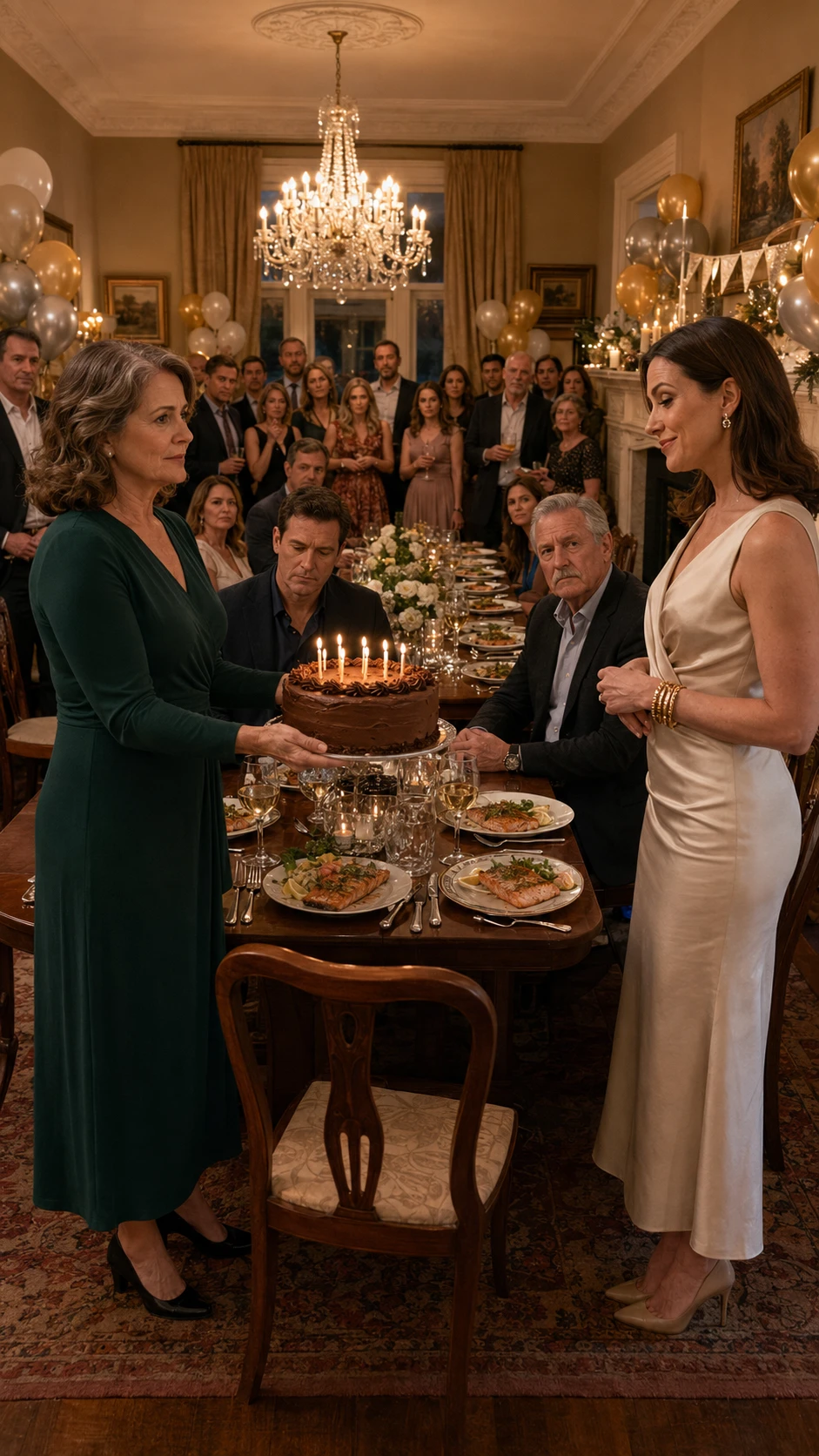
The moment Vanessa ordered my wife out of the house, Elaine was still holding the birthday cake she had baked with her own tired hands.
Thirty candles trembled above the mocha frosting. Their flames leaned toward her wrists as though even they were trying to escape the cold that had entered the dining room.
“Happy Birthday, Danny” was written across the top in blue sugar.
My son was forty-two years old, but Elaine had called him Danny since the morning she first held him against her chest and whispered that name into his hair.
Vanessa laughed when she saw it.
Not a surprised laugh.
Not an affectionate one.
It was the bright, cutting laugh of a woman who had waited all evening for the room to become quiet enough to hear her cruelty.
“Danny?” she repeated. “He is a grown man, Elaine.”
My wife’s fingers tightened around the glass cake plate.
“I know. It’s just what I’ve always—”
“And that,” Vanessa interrupted, “is exactly the problem.”
The thirty guests seated around the long dining table stopped moving.
Silverware hovered above plates. White wine sweated inside crystal glasses. Grilled salmon cooled beneath serving tongs while everyone pretended not to understand what was happening.
My son Daniel stared at the tablecloth.
Vanessa stood beneath the chandelier in cream silk, her bracelets chiming delicately as she folded her arms.
“You walk into my kitchen and rearrange things,” she continued. “You bring old-fashioned decorations. You call my husband by a childish name in front of our friends. You behave as though you still run this family.”
Elaine’s face went pale.
“I was only trying to help.”
“No, you were trying to make yourself important.”
A fork slipped from someone’s hand and struck a plate.
The little sound seemed enormous.
Vanessa smiled at the guests as though she were handling an unpleasant but necessary household matter.
“Since everyone is here, perhaps this is the best time to establish a boundary. This is my house, my kitchen, and my family.”
Then she pointed toward the front hallway.
“I think you should leave.”
Elaine looked at Daniel.
Our son did not defend her.
He did not lift his head.
The boy we had raised, educated, rescued, financed, and loved sat twelve feet from his mother while his wife expelled her from a house that would not have survived a single year without us.
I had spent thirty-four years with the Columbus Fire Department.
I had walked into burning apartments while ceilings collapsed. I had carried strangers through black smoke and listened for cries beneath falling timber.
Fire taught me something most people never learn:
The visible flame is rarely where the destruction begins.
It begins behind walls.
Inside wiring.
Under floorboards.
In small heat ignored for too long.
Vanessa’s smile was only smoke.
The fire had started years earlier.
I rose from my chair.
I did not shout.
I did not overturn the table or answer humiliation with humiliation.
I pushed my chair neatly into place and took Elaine’s cold hand.
“Of course we’ll leave,” I said.
Vanessa’s shoulders relaxed.
Then I looked at my son.
“Right after Daniel tells everyone the truth he has been avoiding.”
His head snapped up.
The look on his face made Vanessa’s smile falter.
“Robert,” she said sharply, “this is not the time for one of your speeches.”
“I agree.”
I reached inside my jacket and removed a thick brown envelope.
“This is the time for documents.”
Daniel closed his eyes.
Vanessa looked at him.
“What documents?”
No one answered.
She laughed again, but the sound was thinner now.
“This is ridiculous. Daniel, tell your father to stop.”
Daniel finally raised his eyes.
They were red.
“Vanessa,” he said, “the house isn’t ours.”
Silence dropped over the room.
Vanessa stared at him.
“What?”
“The house does not belong to us.”
Her expression barely changed at first, as though the sentence were too absurd to enter her mind.
Then she looked at me.
“This is our home.”
“It has been your residence,” I said. “That is not the same thing.”
I removed the deed from the envelope and laid it beside Daniel’s untouched dinner plate.
The property was owned by the Miller Family Preservation Trust.
Elaine and I were its controlling trustees.
Twelve years earlier, Daniel’s construction consulting business had failed after his partner disappeared with client deposits. Daniel owed nearly four hundred thousand dollars. His credit was ruined, and the bank prepared to foreclose on the smaller house he and Vanessa occupied at the time.
Elaine and I used most of my retirement savings to settle the claims.
Then we purchased this house so Daniel, Vanessa, and their two young children would have stability.
Daniel paid a modest monthly amount toward expenses.
We paid the property taxes, major repairs, insurance, and the remaining mortgage.
When the roof failed, I replaced it.
When a pipe burst behind the upstairs bathroom, Elaine and I covered the restoration.
When Vanessa demanded a new kitchen because the oak cabinets looked “provincial,” we paid half after Daniel promised it would be the final request.
Vanessa had spent years introducing the property as the house she and Daniel had built through hard work.
In reality, she had selected the marble while we paid for the foundation beneath it.
“This is some technical arrangement,” she said. “Daniel told me the trust would transfer the property to us.”
Daniel swallowed.
“I said it might happen one day.”
“You said this house was ours.”
“I said Mom and Dad allowed us to live here.”
Her face sharpened.
“You lied to me.”
“No,” I said. “You heard what benefited you and ignored everything else.”
Vanessa turned toward the guests.
“This is a private legal misunderstanding.”
“It stopped being private when you ordered my wife out in front of thirty people.”
She looked at the deed again.
“Fine. Then transfer it now.”
Elaine’s hand trembled inside mine.
Vanessa saw it and mistook pain for weakness.
“You’ve always claimed everything you did was for Daniel,” she continued. “If that is true, sign the house over and stop holding it above our heads.”
“I have never held it above anyone’s head,” Elaine said softly.
“You appear whenever you want. You criticize my choices. You make Daniel feel indebted.”
“I brought him a birthday cake.”
“You brought him guilt covered in frosting.”
Elaine flinched.
That was when something inside me hardened completely.
I removed a second document.
“We cannot transfer the house,” I said, “because you attempted to do it yourself six weeks ago.”
Vanessa stopped breathing.
Daniel looked toward the hallway.
Several guests exchanged frightened glances.
I placed a copy of a home-equity application beside the deed.
The application requested $620,000 against the property.
It bore my signature.
It bore Elaine’s.
Both were forged.
The requested funds were to be deposited into a company called Vane House Concepts.
Vanessa’s interior-design consultancy.
“That application was never completed,” she said.
“The bank’s fraud department disagrees.”
“I was preparing options.”
“You submitted notarized documents.”
“I had authorization.”
“No, you had copies of our identification.”
Her eyes moved toward Daniel.
“You gave them to me.”
Daniel shook his head.
“I gave you a folder containing the insurance policy when the kitchen flooded. I did not authorize a loan.”
“You knew I needed capital.”
“I knew you wanted investors.”
“I was trying to build something for our family.”
The guests seated nearest her began looking away.
Vanessa’s business had appeared successful from the outside. Her social media showed luxury renovations, champagne consultations, and photographs beside clients’ swimming pools.
The financial records told a different story.
Her company had lost money for three consecutive years.
She had paid personal shopping bills through corporate accounts, overstated client contracts, and borrowed from friends by claiming she was moments away from securing the Miller house as collateral.
Two guests at the table had invested in her company.
One of them, a dentist named Marcus Hale, pushed back his chair.
“You told me Daniel owned this property outright.”
Vanessa ignored him.
I removed a third document.
“Two months ago, you also prepared a petition claiming Elaine was suffering from cognitive decline.”
My wife’s breath caught.
Vanessa’s eyes flicked toward her.
The petition described Elaine as confused, forgetful, and unable to understand complex financial matters.
It requested temporary authority for Daniel and Vanessa to act on her behalf.
Elaine was sixty-five.
She volunteered three mornings a week at the public library, managed our household accounts, and had never missed a birthday, appointment, or bill in her life.
But Vanessa had begun collecting moments.
A misplaced set of keys.
A forgotten grocery item.
A question Elaine repeated during a crowded conversation.
Ordinary human mistakes had been recorded and rewritten as evidence of incapacity.
“You were building a case against her,” I said.
Vanessa’s expression changed from outrage to calculation.
“This sounds much worse than it was.”
Elaine stared at her.
“You told me I should see a neurologist.”
“I was concerned.”
“You asked me to sign forms after my dental procedure.”
“I was helping you.”
“You were trying to take my name off the trust.”
Vanessa said nothing.
The cake remained between them, its candles burning lower.
Blue wax had begun dripping into the word Danny.
I looked at my son.
“Now tell them the rest.”
Daniel’s face crumpled.
Vanessa turned on him.
“What else have you said?”
He reached beneath the table and removed his phone.
“For the last seven weeks, I have been recording our conversations.”
Vanessa stepped backward.
“No.”
“I found the loan application in your office.”
“You searched my things?”
“I found a copy of Mom’s driver’s license, Dad’s Social Security number, and a draft petition declaring them both incompetent.”
The room erupted in whispers.
“You misunderstood,” she said.
“I asked you about it.”
“And I explained.”
“You told me we deserved the house because my parents were old and would not need it much longer.”
Elaine covered her mouth.
I had heard the recording.
The words still cut.
Daniel’s voice shook as he continued.
“You said once the loan closed, you would move the funds into Vane House Concepts. Then you planned to refinance again after the trust transferred ownership.”
“I was protecting our future.”
“You were planning to leave me.”
Vanessa froze.
That was the truth she had not expected him to reveal.
Daniel played an audio file.
Her voice filled the dining room.
“Once the title clears, I can’t remain trapped in this family. Robert watches every dollar, Elaine treats you like a child, and you have no ambition unless someone pushes you. I’ll take my share and start again somewhere people understand me.”
A man’s voice answered.
“You promised we would move to Scottsdale.”
Several guests turned toward the far end of the table.
Vanessa’s business partner, Graham Pike, sat completely still.
His wife was beside him.
The blood drained from her face.
Vanessa lunged toward Daniel’s phone.
I stepped between them.
Graham stood.
“This is not what it sounds like.”
His wife slapped him before anyone could respond.
The room broke into chaos.
Chairs scraped. Guests whispered. Someone began crying.
Vanessa stared at Graham with pure hatred.
“You recorded us?”
Daniel’s voice was quiet.
“No. You used our home-security system.”
Vanessa had installed microphones throughout the remodeled kitchen so she could control lights and music through voice commands.
She apparently forgot that the central system stored temporary audio logs.
Daniel discovered the conversations while searching for evidence connected to the loan.
For six weeks, he had worked with a forensic accountant and my attorney.
He had also been speaking to detectives from the county’s financial-crimes unit.
Vanessa looked toward the windows.
Blue-and-red light flashed faintly against the curtains.
Her confidence finally shattered.
“You invited the police to my house?”
“Our house?” Daniel asked.
The words struck her harder than any shout could have.
Two detectives waited outside because we had agreed Daniel would give Vanessa one final opportunity to explain the forged documents voluntarily.
No one expected her to order Elaine out.
No one expected the confrontation to happen in front of thirty witnesses.
But cruelty often speeds toward its own exposure.
Vanessa turned toward me.
“You planned this dinner as a trap.”
“No. Elaine planned a birthday dinner for her son.”
My wife looked at the cake.
Tears had slipped down her cheeks.
“She spent two days making that,” I continued. “She chose the mocha frosting because Daniel loved it when he was eight. She did not know detectives would be here. She did not know you would humiliate her.”
I looked at my son.
“And she did not know Daniel would remain silent while you did it.”
He lowered his head.
That truth belonged in the room too.
Daniel had helped investigators.
He had gathered evidence.
But when Vanessa attacked his mother, he froze.
Perhaps fear explained his silence.
It did not excuse it.
“Dad,” he whispered, “I needed her to keep talking.”
“You could have defended your mother without revealing the investigation.”
“I was afraid Vanessa would destroy the files.”
“So you allowed her to destroy Elaine instead.”
Daniel closed his eyes.
“I’m sorry, Mom.”
Elaine looked at him for a long time.
“I believe you are sorry.”
Hope appeared in his face.
“But I needed you to be brave before it became safe.”
His shoulders folded.
Vanessa moved toward the hallway.
A detective entered through the front door.
“Mrs. Miller, please remain inside.”
“I have done nothing criminal.”
The detective glanced at the documents.
“That will be determined through the investigation.”
“These people are conspiring against me.”
“You may explain that with counsel present.”
Graham attempted to leave through the kitchen.
A second detective stopped him.
Vanessa looked toward the guests, searching for someone willing to support her.
The people who had laughed at Elaine’s old-fashioned candles now stared at the table.
Her investors looked furious.
Graham’s wife had removed her wedding ring.
Daniel stood beside the cake, appearing older than he had one hour earlier.
Vanessa pointed at me.
“You have always hated me.”
“No,” I said. “I distrusted the way you treated people you believed could not benefit you.”
“You never accepted me.”
“We paid your debts.”
“That was control.”
“We cared for your children.”
“That was interference.”
“We kept a roof above you.”
“And reminded us every day that it belonged to you.”
Elaine stepped forward.
Her voice was barely above a whisper.
“I never reminded you.”
Vanessa looked at her.
“I brought groceries when Daniel lost work,” Elaine continued. “I stayed with the children when you traveled. I hemmed your daughter’s recital dress. I sat beside you in the hospital after your miscarriage because your own mother would not come.”
Vanessa’s face shifted.
For one second, shame appeared.
Then pride buried it.
“I didn’t ask you to do those things.”
“No,” Elaine said. “You only accepted them.”
The detectives escorted Vanessa and Graham from the house for questioning.
The guests left quietly.
No one ate the cake.

The investigation lasted nine months.
The bank confirmed that Vanessa had forged signatures on the loan application.
She had also falsified business statements and misled four private investors.
Graham had helped create fake renovation contracts to inflate her company’s value.
Both accepted plea agreements after the financial evidence became impossible to deny.
Vanessa avoided prison but received probation, restitution orders, and a prohibition against managing investment funds.
Graham’s marriage ended.
So did Daniel’s.
Vanessa demanded half the value of the house during the divorce.
Her attorney withdrew the claim after reviewing the trust deed.
She left with her personal property, a damaged business, and the consequences of believing generosity eventually became ownership.
Daniel moved into a small apartment.
He did not ask to remain in the house.
For the first time since he was twenty-seven, he paid market rent, managed his expenses, and lived without his parents rescuing him from every difficulty.
Elaine spoke with him every Sunday.
I spoke with him less often.
My anger lasted longer than hers.
One evening, he came to our home carrying the blue cake plate.
It had remained in the refrigerator after the birthday dinner until Elaine finally threw the ruined cake away.
“I’m sorry I didn’t return this sooner,” he said.
I let him inside.
He placed the plate on the table.
“Dad, I keep replaying that moment.”
“Which one?”
“When Vanessa told Mom to leave.”
I waited.
“I told myself I was protecting the investigation,” he said. “But that wasn’t the whole truth.”
“What was?”
“I was afraid of her.”
“Vanessa?”
“Of losing the marriage. Of admitting that everyone who warned me had been right. Of starting over at forty-two.”
He looked down at his hands.
“So I let Mom absorb the humiliation because she had always forgiven me.”
That was the first honest thing he had said about the dinner.
“You believed her love made her the safest person to hurt.”
“Yes.”
The admission filled the kitchen.
I thought of the burning buildings I had entered.
People assumed firefighters feared flames.
Most of us feared arriving too late.
“You cannot return to that room and stand up sooner,” I said.
“I know.”
“But you can decide what kind of man enters the next one.”
He nodded.
“Will Mom forgive me?”
“She already loves you.”
“That isn’t what I asked.”
“No.”
He accepted the answer.
Forgiveness did not arrive because Daniel wanted relief.
It would arrive, if it came at all, because he became trustworthy again.
One year after the dinner, the house was sold.
Daniel was stunned when we told him.
He assumed Elaine and I would leave it to him eventually.
That assumption was the final ember of the old fire.
“We helped you live there for twelve years,” I said. “We are not required to turn that help into an inheritance.”
“What will happen to the money?”
Elaine smiled.
“We have plans.”
Years earlier, while I was still with the fire department, Elaine and I met families who lost everything in house fires.
Insurance payments took months. Temporary housing was scarce. Parents slept in cars while children attended school wearing donated clothes.
We used the sale proceeds to purchase and renovate a small apartment building near downtown Columbus.
It became Miller House, a temporary residence for families displaced by fires and other emergencies.
Each apartment included furniture, clothing vouchers, legal assistance, and access to counseling.
The dining room from Daniel’s house was recreated in the community space—not with Italian chairs or polished silver, but with long wooden tables where families could eat together.
Elaine hung one photograph near the entrance.
It showed me at thirty-six, covered in soot after carrying a child from a burning duplex.
Beneath it was a plaque:
A HOME IS NOT PROVEN BY WHO ORDERS OTHERS OUT.
A HOME IS PROVEN BY WHO IS WELCOMED IN.
Daniel volunteered during renovations.
He painted walls, assembled beds, and installed kitchen shelves.
No cameras recorded him.
No one praised him publicly.
He came anyway.
On his forty-third birthday, Elaine invited him to Miller House.
Only six people attended.
No champagne.
No silk tablecloth.
No performance.
Elaine carried out a small mocha cake.
Across the top, in blue sugar, she had written:
Happy Birthday, Danny.
Daniel stared at it.
His face crumpled.
“Mom.”
She placed the cake before him.
“I thought you said boundaries were important,” I teased gently.
Elaine looked at our son.
“They are.”
Daniel wiped his eyes.
“Then why did you write Danny?”
“Because forgiveness does not require me to forget who you were before you became lost.”
He embraced her carefully.
Then he turned toward me.
I did not hug him immediately.
Some wounds need truth before tenderness.
“You understand that Miller House will not belong to you?” I asked.
He gave a small, broken laugh.
“Yes, Dad.”
“You understand you are not being restored to an inheritance?”
“Yes.”
“You understand your mother is not forgiving you because you earned the house back?”
He looked at Elaine.
“Yes.”
“Then happy birthday, Danny.”
I put my hand on the back of his neck and pulled him toward me.
Across the room, a little girl whose family had lost their apartment in a fire began singing before the candles were lit.
Others joined her.
The song was uneven, loud, and beautiful.
Daniel closed his eyes.
For the first time in years, he did not look like a man worried about how the room perceived him.
He looked like our son.
Later that evening, after the families had gone upstairs, Daniel asked me one final question.
“What would have happened if Vanessa hadn’t ordered Mom out that night?”
I looked around Miller House.
At the donated books.
At the children’s drawings.
At the keys waiting for families who did not yet know they would need them.
“The investigation would still have exposed the fraud,” I said.
“But would you have sold the house?”
“Probably not.”
He nodded slowly.
“So Vanessa caused all this.”
“No.”
I looked toward Elaine, who was washing blue frosting from the cake plate.
“Vanessa revealed what the house had become.”
A stage for status.
A weapon in a marriage.
A reward everyone expected without gratitude.
It had stopped being a home long before she ordered Elaine out.
The final twist was not that Vanessa never owned the property.
It was not that her signatures were forged, her affair exposed, or her business destroyed.
The final twist was that none of us would own it in the end.
The house she fought to control became apartments for strangers.
The money she tried to steal became safety for families with nowhere to sleep.
And the birthday cake she mocked became the beginning of the year Daniel finally learned that love is not proved by what parents leave behind.
It is proved by what children become after everything unearned has been taken away.
Vanessa once stood beneath a chandelier and declared, “My house. My kitchen. My family.”
She lost all three before the candles cooled.
Elaine, the woman she expelled, walked into Miller House one year later and opened the door to a frightened mother carrying two children and a plastic bag of smoke-damaged clothes.
“Come inside,” Elaine told her. “You’re safe here.”
That was the moment I understood we had not lost a house at all.
We had finally turned it into a home.