
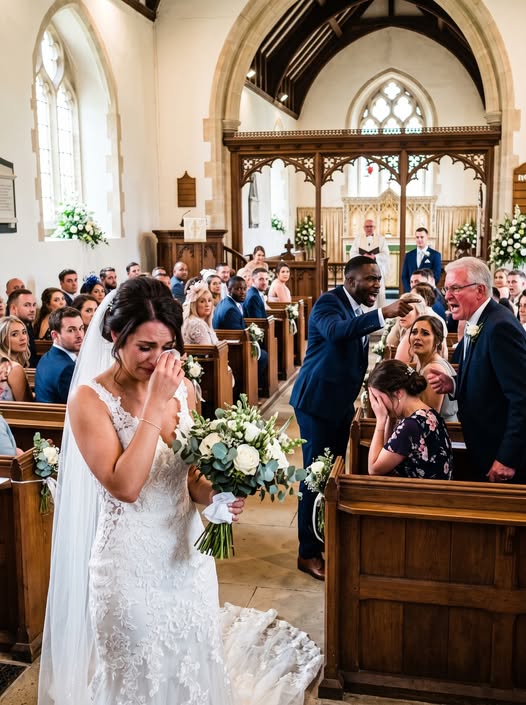
He Coldly Told Me to Walk Down the Aisle by Myself Because My Father “Didn’t Belong” at the Wedding—But Halfway Through the Ceremony, Everyone Turned in Shock as They Came for My Father Instead, and the Celebration Unraveled Before Our Eyes.
Part 1 — The Double Doors
My father sat in the back row.
Not because he had arrived late.
Because he had chosen it.
He wanted the vantage point of someone delivering a sentence, not the position of a parent witnessing a beginning.
He had said: walk yourself. That’s what happens when you marry a nobody.
Then he sat down beside my mother, who looked at her purse, and my brother Caleb, who stared at the floor, and the chapel went quiet in the way chapels go quiet when something has happened that everyone witnessed and no one is addressing.
My fiancé Ethan stood at the altar with his hands folded and his pale face and his eyes steady on mine.
I gripped the bouquet until the stems bent.
I walked.
Each step felt louder than the piano.
Ethan stepped forward, ready to meet me halfway.
I shook my head slightly.
I wanted to make it to him on my own.
Halfway down the aisle the chapel doors behind me opened.
Thirty people in matching gray suits walked in with the quiet precision of people who have been together in difficult rooms and know how to move without disruption.
Men and women. Young and old. Several wore small pins shaped like silver shields.
They lined both sides of the aisle, leaving a path between them.
The music stopped.
A tall man in his fifties with a trimmed beard stopped near my father’s row.
He looked directly at my father.
He said: sir —
My father stood, red-faced.
He said: who the hell are you people?
The man removed his glasses.
He said: my name is Marcus Bell. I’m an investigator with the South Carolina Bar’s Innocence Review Network.
Part 2 — What Marcus Said
He turned toward me.
He said: Maya, we apologize for arriving this way. We tried to reach you privately this morning but your phone was off.
I said: what is this?
He looked at Ethan. Then back at me.
He said: your fiancé saved my son from serving twenty-five years for a crime he did not commit. Every person standing here is connected to someone Ethan Cole defended when no one else would listen.
A woman beside me began to cry.
Marcus turned to face my father.
He said: you called him a nobody. Sir, half this room is here because that nobody gave our families our names back.
My father’s mouth opened.
Nothing came out.
Then Marcus reached into his jacket and held up an envelope.
He said: Mr. Whitmore, before this ceremony continues, you should know that your daughter’s fiancé also uncovered evidence tied to your company’s charity fund. The state attorney general’s office is outside.
The bouquet slipped lower in my hands.
Ethan whispered: Maya. I was going to tell you tonight.
The chapel doors opened again.
Two officers stepped inside.

Part 3 — What Ethan Told Me
I need to be honest about the forty-eight hours that followed because the story deserves honesty more than it deserves drama.
My father was escorted out.
Not arrested on the spot. Escorted outside for an interview with the attorney general’s investigators. There is a difference and the difference matters.
The charity fund associated with my father’s car dealership group had been the subject of a quiet audit for several months. Ethan had encountered evidence of the discrepancy not because he had been looking for it but because the evidence had appeared in a case he was working — a client whose circumstances intersected with charitable funding that had been misrepresented.
Ethan had reported what he found through proper channels.
He had intended to tell me that evening.
He had not told me before because he did not yet know the full picture and because he understood, correctly, that telling me partial information about my father’s possible legal exposure while I was preparing for our wedding would not have served any useful purpose.
I processed this on the steps of the chapel while thirty people in gray suits stood at a respectful distance.
Marcus Bell sat beside me.
He said: I want to tell you about my son.
I said: please.
He told me.
His son Darius had been charged with a robbery that had occurred twenty miles from where Darius could be placed at the time. The witnesses had been uncertain. The public defender on the case before Ethan had filed basic motions and moved on.
Ethan had taken the case in a review.
He had spent four months working it on his own time.
He had found the surveillance footage that placed Darius at his cousin’s house. He had located the cousin. He had rebuilt the alibi that the first attorney had never assembled.
Darius had been released eight months ago.
He was standing at the end of the aisle in a gray suit.
He was twenty-two years old.
Marcus said: my son would have been inside for twenty-four more years. For something he did not do. Because no one was paying attention.
He said: Ethan was paying attention.
He said: that’s what your fiancé is.
Part 4 — The Ceremony
We waited two hours.
The guests waited with us.
They sat in the chapel pews and talked quietly and the women in gray suits moved through the rows introducing themselves.
Each of them had a story.
An exoneration. A sentence reduced. A case reopened. A person given back to their family.
Ethan sat with me on the steps.
He said: I know I should have told you sooner.
I said: you found it in your work.
He said: yes. I didn’t go looking for anything about your father.
I said: I know.
He said: Maya. If you want to—
I said: Ethan.
He said: yes.
I said: my father has been telling everyone you were beneath us for six months.
He said: yes.
I said: thirty people came to my wedding in gray suits because you gave their families their names back.
He said: I was doing my job.
I said: I know.
I said: that’s why I’m marrying you.
He looked at me.
I said: not because you uncovered something about my father. That happened because you were paying attention in a case that had nothing to do with us. You were doing your job.
I said: I’m marrying you because you do your job when no one is watching and no one is paying attention and the only person who needs you is a twenty-two-year-old kid who was about to lose twenty-four more years.
He said: I love you.
I said: I know. Let’s get married.
We went back inside.
My mother was still in her seat.
She had not left.
Caleb was beside her.
He had been talking to Marcus Bell for the past forty minutes.
I did not know at the time what they were talking about.
I found out later that Caleb had asked Marcus to explain what Ethan’s work actually meant.
Marcus had explained it.
Caleb had listened.
The ceremony began the second time without piano.
We had moved past the moment for piano.
The officiant asked who stood to witness this marriage.
Thirty people in gray suits stood.
My mother stood.
Caleb stood.
Part 5 — After
My father’s situation moved through its legal process.
The charity fund discrepancy was real and the investigation was real and the outcome is part of a legal record I will not describe in detail because it belongs to the record.
What I will tell you is that my father was not immediately arrested on my wedding day.
What I will tell you is that the process took eleven months and produced consequences that reflected what the investigation found.
What I will tell you is that during those eleven months my mother called me every Sunday.
Not to discuss my father’s situation.
To talk about ordinary things.
The garden. Caleb’s job. The grandchild she was hoping for.
She said on one of those calls: I should have stood up sooner.
I said: yes.
She said: not on your wedding day. Before that. For years before that.
I said: I know.
She said: I was afraid of him.
I said: I know that too.
She said: Maya.
I said: yes.
She said: Ethan is not a nobody.
I said: no. He is not.
She said: I knew it before the wedding. I should have said it.
I said: you stood when the officiant asked.
She said: that was the least I could do.
I said: it wasn’t nothing.
She said: no. But it wasn’t enough.
We keep talking on Sundays.
That is something.
Ethan and I live in Charleston.
He is still a public defender.
He will always be a public defender.
He told me once that the work was not about winning.
He said: it’s about paying attention when no one else is.
Thirty people in gray suits came to our wedding because he paid attention.
They came in quietly.
They lined the aisle.
They gave my father back something he had not earned — the information that the man he called a nobody had been doing important work in rooms my father had never bothered to enter.
I walked myself halfway down the aisle.
Then thirty people lined the path.
Then I walked the rest of the way to Ethan.
That is the whole of it.
Some nobodies give families their names back.
Some fathers sit in the back row and deliver sentences.
Some bouquets are gripped until the stems bend.
And some officiant’s questions — who stands to witness this? — are answered by thirty people in gray suits who drove from across the state because a public defender paid attention when he didn’t have to.
They stood.
We were witnessed.
That was everything.