
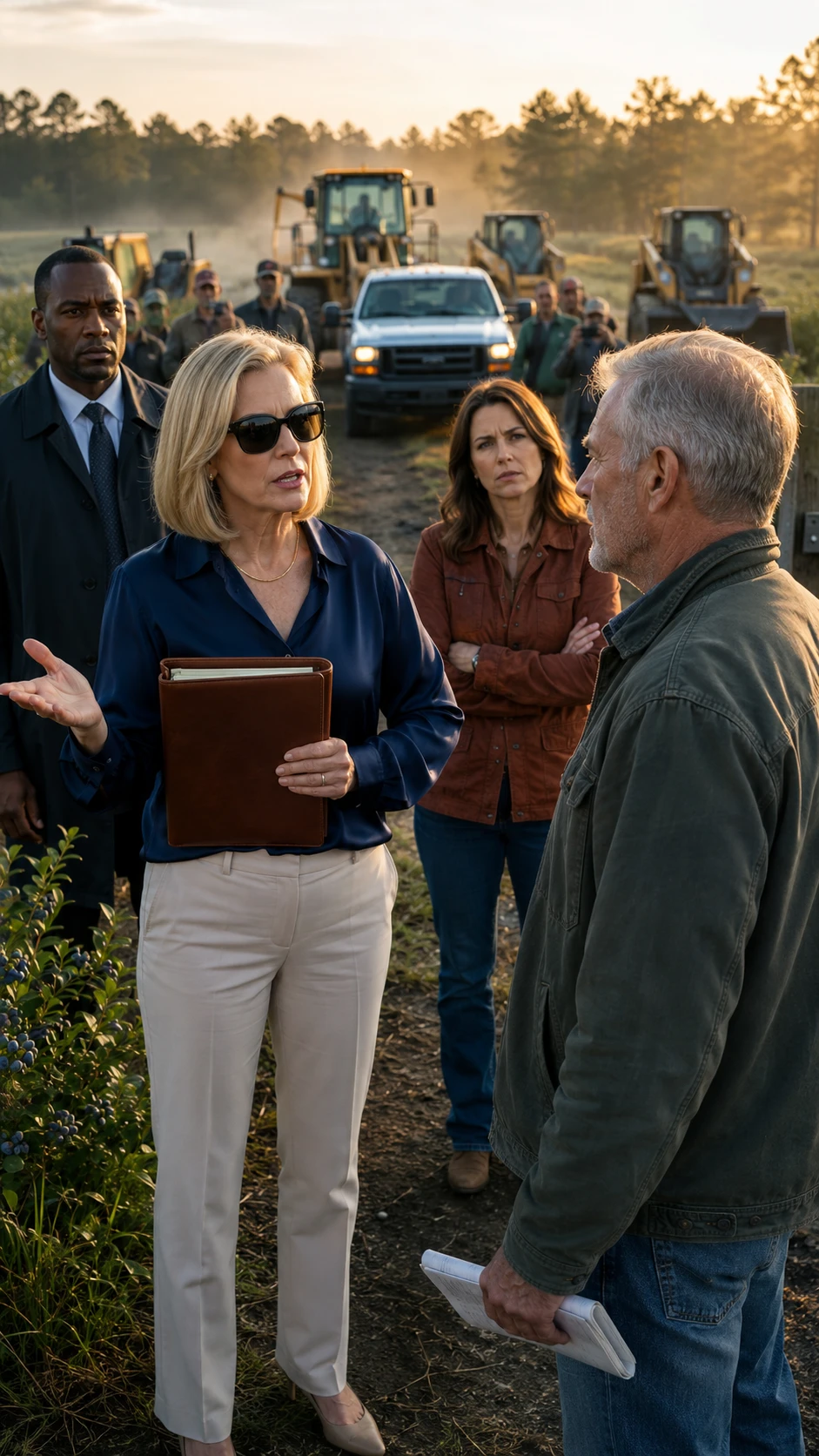
The woman from the homeowners association smiled when she told me the bulldozers were coming Monday.
I remember that smile better than I remember most threats.
It was small and polished, the kind people practice in bathroom mirrors before committee meetings. It never reached her eyes. Her eyes were already looking past me, through my fence, across the eastern corner of my blueberry field as though the land had agreed to become something else simply because she had imagined it.
“Residents shouldn’t have to park along the road,” she said.
She stood outside my fence in a floral dress and white shoes that had never touched honest mud. A leather binder was pressed against her chest. Behind her, two men in bright orange vests were planting pink survey flags between my bushes.
I set my coffee mug on top of the fence post.
“You’re on my property,” I said.
The taller surveyor looked up.
The woman did not.
Her name was Karen Bell. She had introduced herself three weeks earlier as president of the Cedar Grove Estates Homeowners Association, the new development that had gone up beyond my northern tree line.
Before Cedar Grove, there had been thirty-seven acres of pasture owned by the Wilson family. Then old Frank Wilson died, his children sold, and the land became roads, mailboxes, decorative lamps, and houses painted in five approved shades of beige.
My field had been there long before any of it.
My father planted the first bushes in 1954. I had been six years old. I remembered him kneeling in the dirt with his sleeves rolled up, pressing soil around the roots with hands that could fix an engine, mend a fence, or carry a feverish child without waking him.
By the time Karen arrived at my property line, some of those original bushes were still producing.
She called them underutilized.
“We’re conducting preliminary measurements,” she said.
“You’re trespassing.”
She opened the binder as if my answer had been anticipated and filed under Difficult Old Man.
“Mr. Miller, the county’s development language allows for temporary community-use accommodations when they serve a public safety need.”
“This is not community property.”
“It would only involve a small portion.”
“It would involve my portion.”
Her smile tightened.
Karen was in her mid-fifties, maybe younger. It was hard to tell with people who wore their expressions like armor. Her blond hair was cut perfectly at the jaw. A gold chain rested against her throat. She smelled like perfume and air-conditioning.
I smelled like coffee, damp soil, and the sulfur spray I had used on the southern rows the evening before.
She pointed toward the flags.
“We’re proposing to grade this corner and lay temporary gravel. After Founders Day, the area can remain as emergency overflow parking.”
“Emergency for what?”
“Community events.”
“That’s not an emergency.”
“Parking along the county road creates a hazard.”
“Then hold your gala somewhere with a parking lot.”
One of the surveyors coughed to hide a laugh.
Karen turned her head toward him.
He immediately found something fascinating about his measuring wheel.
Cedar Grove’s Founders Day gala was scheduled for the following Saturday. The development was less than two years old, but they already had founders, traditions, committees, engraved plaques, and a newsletter that referred to the residents as a legacy community.
The gala would have food trucks, rented tents, a string quartet, children’s games, and a speech by Karen about neighborhood unity.
According to the flyer that had appeared in my mailbox, attendance was expected to exceed three hundred people.
I had not been invited.
Not that I cared.
What I cared about were the flags running through my Duke and Bluecrop rows.
“Pull those out,” I said.
Karen’s fingers tightened around her binder.
“We’re prepared to discuss compensation.”
“Pull them out.”
“The board has already allocated funds.”
“I didn’t ask how much.”
“You haven’t even heard the offer.”
“I don’t need to hear an offer for something that isn’t for sale.”
Her face changed then.
Not much.
Just enough.
People like Karen rarely shout at first. They lower their voice because they believe calmness belongs to whoever has the most power.
“We’ve tried to be neighborly, Mr. Miller.”
“No. You’ve tried to be obeyed.”
The shorter surveyor stopped walking.
Somewhere behind me, a mockingbird called from the power line.
Karen stared at me for a long moment.
Then she looked across the field again.
My land stretched south and east from the farmhouse, forty-two acres in total, though only eighteen were planted in berries. The rest was pine, drainage ground, equipment sheds, and an old pond where my wife, Ellen, used to sit in the evenings with a book balanced on her knees.
Ellen had been gone five years.
Cancer took her slowly enough for us to say everything and too quickly for any of it to feel finished.
After she died, people asked why I stayed.
They saw an old house, an aging farmer, and rows that required more work every season.
I saw my father’s hands.
I saw Ellen’s straw hat hanging on the hook by the back door.
I saw my daughter learning to drive the tractor, my grandson falling asleep in a berry crate, summer workers laughing beneath the packing shed roof while rain hammered the tin.
Land is never just land.
It is memory, labor, taxes, weather, blood, argument, birth, death, and all the quiet days between.
Karen saw parking.
“We’ve reviewed the county map,” she said. “This strip appears to fall within a shared access consideration associated with the development corridor.”
“Appears?”
“The HOA’s counsel believes—”
“I don’t care what your counsel believes.”
“You should.”
I stepped closer to the fence.
I did not raise my voice.
I had learned a long time ago that people hear you better when they have to stop talking.
“Ma’am, I know where my property begins. I know where it ends. I know every recorded easement, every drainage restriction, every agricultural designation, and every survey marker on those forty-two acres. You and your men are standing twelve feet inside my eastern boundary.”
The surveyors looked at each other.
Karen barely blinked.
“I’m sure there’s room for interpretation.”
“There isn’t.”
“We can settle this without hostility.”
“You came onto my farm without permission and started measuring what you planned to take.”
“Use,” she corrected.
“Take.”
“Temporarily.”
“Take.”
The smile disappeared completely.
She closed the binder.
“Monday,” she said. “The grading crew will arrive at seven.”
“Tell them to bring good coffee.”
For the first time, she looked uncertain.
Only for a second.
Then the smile returned.
“I hope you’ll reconsider before this becomes expensive.”
“So do I.”
She turned toward the road.
The surveyors followed, leaving the pink flags behind.
“Gentlemen,” I called.
They stopped.
“Take your flags.”
The shorter man started back toward them.
Karen snapped, “Leave them.”
He hesitated.
I reached over the fence, pulled the nearest flag from the ground, and held it up.
“You can take them now,” I said, “or collect them from the county office after I file the trespass complaint.”
The men gathered every flag.
Karen waited beside her silver SUV with her arms crossed. When they finished, she drove away fast enough to throw dust over the roadside grass.
I watched until the vehicle disappeared beyond the bend.
Then I picked up my coffee.
It had gone cold.
That bothered me more than it should have.
Maybe because it was such an ordinary thing.
A cold cup. A quiet field. A threat delivered before breakfast.
I walked the boundary line twice.
Near the southeast corner, I found one flag the surveyors had missed. It stood beside an old concrete marker sunk low in the earth, the numbers worn but visible.
I pulled the flag.
Then I crouched and brushed the moss from the marker.
My father had taught me to check boundary stones after every hard winter.
“Fences rot,” he used to say. “Memory bends. Stone is patient.”
By ten that morning, I was in the wood-paneled office at the back of my farmhouse.
Ellen used to call it the bunker because I kept everything.
Tax records.
Deeds.
Water tests.
Crop certifications.
Old aerial photographs.
Insurance papers.
Survey plats.
Agricultural assessment forms.
County inspection notices.
There were documents in that office older than Karen Bell.
I opened the gray metal cabinet beside my desk and pulled out the property file.
The first deed was dated 1952.
The most recent survey had been completed three years earlier when Cedar Grove’s developer petitioned the county to relocate a drainage culvert near my northern line.
I laid the map flat beneath the green desk lamp.
The eastern boundary was clear.
No shared-access corridor.
No temporary-use provision.
No ambiguity.
What did exist was an agricultural preservation designation recorded against the land when my father enrolled the farm in the county program in 1987. I had renewed it after he died. The designation restricted nonagricultural surface conversion and required written county approval before grading, filling, or paving.
It protected the soil.
It also reduced my property taxes.
The agreement was not secret.
It was attached to the deed.
Any competent lawyer could have found it in fifteen minutes.
I read the section twice anyway.
Then I checked the zoning map.
Then the stormwater plan.
Then the right-to-farm notice Cedar Grove’s developer had been required to provide every buyer in the subdivision.
That document interested me.
Every Cedar Grove homeowner had signed an acknowledgment that they were purchasing property adjacent to an active agricultural operation. It warned them about machinery noise, dust, fertilizer odor, early-morning activity, seasonal workers, and the farmer’s protected right to continue normal operations.
Their own closing papers said my land was a farm.
Karen’s binder called it wasted.
I made copies.
By evening, I had six neat piles on my desk.
By morning, I had made four calls.
One to my attorney.
One to county zoning.
One to the agricultural preservation office.
And one to the sheriff’s non-emergency line.
The more questions I asked, the uglier the situation became.
Karen had not applied for a grading permit.
She had not requested temporary-use approval.
She had not contacted the agricultural office.
She had not commissioned a legal boundary survey.
The bright-vested men at my fence had been employees of the excavation company, not licensed surveyors.
Most interesting of all, the HOA had submitted a public-event plan to the county listing three hundred attendees and seventy-six parking spaces.
On the application, someone had drawn a rectangle over the corner of my field and labeled it:
AUTHORIZED OVERFLOW PARKING.
I stared at that word for a long time.
Authorized.
Not proposed.
Not pending.
Authorized.
The signature below the site plan belonged to Karen Bell.
I leaned back in my chair and listened to the old clock above the bookshelf strike eleven.
Confident people often think confidence and correctness are the same thing.
They are not.
And some people only sound powerful because nobody has ever made them finish a sentence under pressure.
I called my attorney again.
“What do you want to do?” he asked.
I looked out the office window toward the eastern rows.
“Let her come Monday.”
There was a pause.
“John.”
“She said she’s bringing machines.”
“And you want to let them cross?”
“I want witnesses.”
“You understand there’s risk.”
“I do.”
“She may damage the crop.”
“She’ll pay for it.”
“You sound certain.”
“I’m not certain,” I said. “I’m prepared.”
That was different.
It had always been different.
By noon, I had a certified letter ready for Karen, the HOA board, and the excavation contractor.
It stated that no one had permission to enter, alter, grade, park on, or otherwise use my land.
It included the parcel number, boundary survey, preservation designation, and photographs of the posted signs along the fence.
It warned that unauthorized entry would constitute trespass and that any damage to protected agricultural land would be documented and reported.
I mailed the letters.
Then I drove three steel posts beside the eastern gate and attached new signs.
PRIVATE PROPERTY.
ACTIVE FARM.
NO TRESPASSING.
The last sign said:
ENTRY BY HEAVY EQUIPMENT PROHIBITED.
When I finished, I stood in the field with the post driver resting against my shoulder.
A breeze moved through the blueberry leaves.
From beyond the trees came the faint sound of construction in Cedar Grove. Hammers. A backup alarm. Someone’s radio playing country music.
Monday was four days away.
Karen had given me a deadline.
What she did not understand was that deadlines work both ways.

PART 2: THE STORY SHE TOLD ABOUT ME
Karen did not slow down after receiving my letter.
She sped up.
By Thursday afternoon, Cedar Grove residents had a new flyer tucked beneath their front doors.
A copy reached me through my neighbor, Sam Ortega, whose back fence bordered both the subdivision and my pine lot.
Sam was sixty-three, a retired electrician with a bad left knee and the permanent expression of a man who expected nonsense and was rarely disappointed.
He handed me the flyer over my gate.
“This woman really doesn’t know when to stop,” he said.
The headline read:
FOUNDERS DAY PARKING IMPROVEMENT MOVES FORWARD.
Below it was a paragraph about the HOA’s commitment to safety, accessibility, and responsible land use.
The final sentence said:
Despite resistance from an adjacent property owner, the board remains confident that the approved temporary parking project will proceed on schedule.
“Approved by whom?” Sam asked.
“Herself, apparently.”
He scratched his jaw.
“My wife says half the neighborhood thinks you agreed and then changed your mind.”
“I never agreed.”
“I know that.”
“The other half?”
“Think the HOA can use it because the developer promised an access strip.”
“There is no access strip.”
“I know that too.”
I folded the flyer and put it in my shirt pocket.
Sam leaned against the gate.
“You planning to stop them?”
“Yes.”
“How?”
“Legally.”
“That sounds less entertaining than what I had in mind.”
“I’m seventy-one, Sam.”
“You’re a retired Marine.”
“Retired means I’m supposed to know better.”
He looked toward the blueberry rows.
“They really coming with bulldozers?”
“A grader and two skid steers, according to the contractor.”
Sam let out a low whistle.
“I’d pay admission to see Monday morning.”
“You may get your chance.”
His eyebrows lifted.
I told him what I needed.
Not backup.
Not confrontation.
Just a witness.
Someone willing to stand on the public side of the fence, keep his phone recording, and say what he saw.
Sam nodded before I finished.
“I’ll bring coffee.”
“Bring your wife too.”
“Maria wouldn’t miss it.”
That evening, Karen held an emergency HOA meeting at the Cedar Grove clubhouse.
I knew because the meeting announcement appeared on the subdivision’s public social media page, along with a photograph of Karen standing beside the gala banner.
The caption called the dispute an unfortunate misunderstanding with a neighboring landholder.
Landholder.
Not farmer.
Not owner.
Landholder sounded temporary.
Remote.
Like I had wandered into possession of the place and might be persuaded to wander out.
At seven thirty, three Cedar Grove residents arrived at my farmhouse.
A young couple named Daniel and Alicia Cho came first. They lived in a house near the northern boundary. With them was an older woman named Ruth Talbot, who had purchased one of the development’s smaller cottages after her husband died.
They stood on my porch with the uncertain posture of people afraid they might be intruding.
I invited them in.
Alicia held the HOA flyer in both hands.
“We’re sorry to bother you, Mr. Miller,” she said.
“John is fine.”
Daniel glanced around the kitchen. His eyes stopped on the framed photograph of Ellen and me at our fortieth anniversary.
“We just came from the meeting,” he said.
“What did Karen tell you?”
“That the HOA has a legal right to use the field because of an old county access designation.”
“It doesn’t.”
“She said you were demanding an unreasonable amount of money.”
“I haven’t demanded any money.”
Ruth’s mouth tightened.
“I asked to see the documents,” she said. “She said the board’s attorney had them.”
“Did the attorney attend?”
“No.”
“Did she name the attorney?”
“No.”
I poured coffee.
They sat at the kitchen table while I brought in the copies from my office.
I showed them the deed.
The survey.
The agricultural designation.
The subdivision acknowledgment form.
Daniel recognized the last document immediately.
“We signed this at closing,” he said.
“So did we,” Alicia said.
Ruth adjusted her glasses and read the paragraph twice.
“Then she knows this is protected farm property.”
“She should.”
Daniel looked embarrassed.
“We didn’t move here to push anyone off their land.”
“I know.”
“We moved here because it was quiet.”
I almost smiled.
“Farms aren’t always quiet.”
“No,” Alicia said. “But they’re real.”
That sentence stayed with me.
Real.
Cedar Grove was not fake. The families inside it had mortgages, children, illnesses, grief, and ordinary fears like anybody else.
The problem was not the people.
The problem was the story Karen had told them.
She said she was protecting them from a stubborn outsider.
She never told them she had drawn parking spaces across a man’s farm without asking.
“Can we make copies?” Ruth asked.
“You can take these.”
She gathered the papers carefully.
“Karen won’t like this.”
“I expect she won’t.”
Daniel looked toward the dark window.
“What happens Monday?”
“That depends on whether the contractor reads his mail.”
The contractor did read it.
Friday morning, a man named Travis Boone called me from Boone Earthworks.
He had a rough voice and sounded tired before I said a word.
“Mr. Miller, I received your certified notice.”
“Good.”
“I was told the HOA had authorization.”
“They don’t.”
“I’ve got a signed work order.”
“Signed by the landowner?”
“Signed by the HOA president.”
“Then you have a signed work order from somebody who doesn’t own the work site.”
He was quiet.
I heard papers moving.
“Our map shows access from Hawthorne Lane.”
“Your map was drawn by the HOA.”
“That’s what I’m looking at.”
“Did you verify the parcel?”
Another pause.
“No.”
“Did you request a permit number?”
“They said temporary grading didn’t require—”
“It does on preserved agricultural land.”
His voice changed slightly.
Not defensive.
Concerned.
“Are you saying the whole lot is preserved?”
“The whole parcel.”
“All right,” he said. “I’ll call them.”
“Do that.”
“I’m not putting my guys in the middle of a property dispute.”
“This isn’t a dispute. The property is mine.”
“I understand.”
“I hope you do.”
We ended the call.
For almost an hour, I thought the machines might not come.
Then Karen called.
She did not say hello.
“You contacted our contractor.”
“He contacted me.”
“You’re interfering with an authorized HOA project.”
“I informed a contractor that you hired him to trespass.”
“You are deliberately creating conflict.”
“You created conflict when you drew parking spaces on my field.”
Her breath sharpened through the receiver.
“Mr. Miller, the board is prepared to seek an emergency injunction.”
“On what grounds?”
“Public safety.”
“Your gala is optional.”
“The event has been planned for months.”
“My field has been here for seventy-two years.”
“Your field is barely productive.”
That line landed harder than the others.
Not because it was true.
Because she wanted it to be.
The previous season had been rough. Late frost damaged the early blossoms. Summer rain brought fungus. Production had fallen almost thirty percent.
Karen had probably noticed fewer harvest trucks and decided decline meant surrender.
“My crop yield is none of your concern,” I said.
“It becomes our concern when neglected land affects the community.”
Neglected.
I looked through the kitchen window.
Every row had been pruned.
The irrigation lines had been repaired.
The grass between the bushes was cut.
The packing shed roof had been replaced two years earlier.
She did not see neglect.
She saw an old man doing work she did not understand.
“Do not enter my property Monday,” I said.
“You can’t stop progress forever.”
“I’m not trying to stop progress.”
“That’s exactly what you’re doing.”
“No. I’m stopping you.”
Silence.
Then she said, “We’ll see.”
The line went dead.
That afternoon, Boone Earthworks sent me an email confirming that the company would not proceed without proof of landowner authorization or a court order.
I printed the email and put it in the file.
At five twenty, I received another call.
This one came from a different excavation company.
A young dispatcher asked where the staging area should be located for Monday’s grading operation.
I asked who hired them.
“Cedar Grove HOA.”
I looked at Boone’s email on my desk.
Karen had replaced the contractor within hours.
“Did they give you the parcel number?” I asked.
“No, sir. Just the access point.”
“Write this down.”
I gave her the parcel number.
I gave her the agricultural designation.
I gave her the number for county zoning.
Then I told her a certified trespass notice had already been delivered to the HOA.
Her tone became cautious.
“I’ll have our project manager review it.”
“Please do.”
At six ten, the project manager called.
He said they would require Karen to sign an indemnity statement confirming she had legal authority to order the work.
I almost laughed.
“Is that enough for you?” I asked.
“It protects our company.”
“No,” I said. “It gives you someone to sue after you damage my land.”
He did not appreciate that.
“We’ll verify.”
“Verify before Monday.”
“We will.”
They did not cancel.
Instead, on Saturday morning, workers placed orange traffic cones along Hawthorne Lane.
A portable sign appeared near the Cedar Grove entrance:
EVENT PARKING PREPARATION – MONDAY.
Karen had found someone willing to trust her signature.
That was her strength.
It was also the mistake I had been waiting for.
Saturday afternoon, my daughter Claire drove down from Richmond.
She was forty-four, a high school principal, and had inherited her mother’s ability to identify trouble from the way someone closed a door.
She entered my kitchen, saw the legal files spread across the table, and said, “What did you do?”
“I own land.”
“That’s not an answer.”
“It’s the cause.”
I explained.
She listened without interrupting, which was how I knew she was angry.
When I finished, she stood at the sink with both hands braced on the counter.
“You’re letting them bring equipment onto the farm?”
“I’m not giving permission.”
“You know what I mean.”
“I’ve notified everyone.”
“What if they damage the bushes before the county gets there?”
“Then the damage is documented.”
“What if somebody gets hurt?”
“The sheriff knows.”
“You called the sheriff?”
“Yes.”
“And they’re just going to wait?”
“They can’t arrest someone for trespass before they trespass.”
Claire turned around.
“This is not one of your training exercises.”
“No.”
“You don’t need to prove anything.”
“I’m not proving anything.”
“That woman insulted you, and now you’re setting a trap.”
“She made a plan to take part of this farm. I’m giving her every opportunity to stop.”
“And if she doesn’t?”
“Then she’ll explain herself to people whose authority is real.”
Claire looked toward the photograph of her mother.
“You know what Mom would say.”
“Yes.”
“She’d say you were enjoying this too much.”
“No. She’d say I should eat something before Monday.”
That broke the tension.
Claire laughed once despite herself.
Then her eyes filled.
She crossed the kitchen and hugged me.
She had not hugged me like that in years—not since the funeral, maybe.
“Dad,” she said against my shoulder, “I know what this place means to you.”
I looked past her toward the field.
“No,” I said quietly. “You know what it means to us.”
That evening, Claire walked the rows with me.
I showed her the corner Karen intended to grade.
Thirty-eight bushes stood inside the proposed parking area. Most were mature Bluecrop plants, ten to twelve years old. A few were older.
At current yield and replacement cost, the loss would not ruin me.
But that was never the point.
We stopped beside the concrete boundary marker.
Claire crouched and traced the weathered number with her thumb.
“Grandpa showed me this when I was little.”
“He showed everybody.”
“He said land disappears one careless promise at a time.”
“That sounds like him.”
“He also said you were too stubborn to own anything with roots.”
“That also sounds like him.”
At dusk, we returned to the farmhouse.
Three cars were parked outside.
Sam and Maria Ortega stood on the porch with Ruth, Daniel, and Alicia.
Ruth carried a folder.
“We had another meeting,” she said.
Karen had accused unnamed residents of spreading misinformation.
She claimed the land-preservation documents did not apply to temporary public-use projects.
She said the county had been notified.
She said opposition to the gala was being driven by one hostile landowner and a small group of disruptive residents.
Then she had called for a board vote authorizing immediate preparation of the parking area.
Three board members voted yes.
Two voted no.
One abstained.
Ruth handed me the folder.
Inside was a copy of the meeting minutes and the approved resolution.
At the bottom, in bold letters, were the words:
WORK TO COMMENCE MONDAY AT 7:00 A.M. REGARDLESS OF EXTERNAL DELAY TACTICS.
Claire read the sentence over my shoulder.
“She put that in writing?”
“She insisted,” Ruth said.
I closed the folder.
Some people spend years building a wall around themselves.
Then, in one moment of arrogance, they hand you the key.
PART 3: THE LONGEST WEEKEND
Sunday was quiet.
That was the strangest part.
The sky was clear. The temperature reached eighty-four. Bees moved lazily among the late blossoms. A red-tailed hawk circled over the pines.
From Cedar Grove came the sound of lawn mowers and children riding bicycles.
Nobody looking at the field would have guessed that by the next morning, someone intended to carve a parking lot into it.
I spent Sunday doing normal work.
I checked the irrigation pump.
Repaired a loose board on the packing shed.
Sharpened the mower blades.
Filled the tractor.
Calm is not the absence of anger.
Calm is what anger becomes when you give it a job.
At noon, I received confirmation from the county agricultural preservation officer, Lisa Monroe. She had reviewed my documentation and the HOA’s event plan.
Her email was careful.
The proposed grading, she wrote, appeared inconsistent with the parcel’s preservation agreement and could not proceed without review.
Appeared.
Could not.
Government language always walked before it ran.
But she had agreed to come Monday morning.
County zoning inspector Paul Dorsey would come too.
The sheriff’s department had advised that a deputy would respond if unauthorized equipment entered after the posted notice and certified warning.
My attorney, Marcus Reed, planned to be present as a private observer.
Nothing had been guaranteed.
No one promised a dramatic rescue.
They promised to witness.
Sometimes that is enough.
At three, a black pickup stopped on the road.
A broad man with a gray beard stepped out and approached the gate. His name was Hank Willis, owner of Willis Grading and Hauling—the replacement contractor.
He studied the no-trespassing signs.
“You John Miller?”
“I am.”
“I’ve been hired to clear and grade this corner.”
“I know.”
He looked across the field.
“You got a problem with that?”
“Yes.”
“The HOA says they have use rights.”
“They don’t.”
“They showed me a site plan.”
“Drawn by them.”
“They showed me a board resolution.”
“A board cannot vote itself ownership of my farm.”
He rubbed the back of his neck.
“Ms. Bell says this is a boundary misunderstanding.”
“It isn’t.”
“She says county officials support the project.”
“They don’t.”
“You got that in writing?”
I handed him copies through the gate.
He read the first page.
Then the second.
His jaw shifted.
“She told me you refused to provide documentation.”
“I mailed it to the HOA Wednesday.”
“She said you were threatening contractors.”
“I told them entering would be trespass.”
“That could be considered a threat.”
“It could also be considered a definition.”
He almost smiled.
Almost.
Then he folded the papers.
“I’ve got twelve men scheduled.”
“Cancel them.”
“I’ve got equipment rented.”
“Return it.”
“I’ve already been paid a deposit.”
“Keep it.”
His eyes narrowed.
“You’re pretty comfortable telling other men how to run their businesses.”
“I’m telling you how not to run a grader across mine.”
He looked again at the signs.
“Ms. Bell signed an authorization.”
“She does not own this property.”
“She signed indemnification.”
“That protects you after the lawsuit?”
His mouth tightened.
I had used the same line on the project manager.
It worked better in person.
Hank removed his cap and wiped his forehead.
“I’m not trying to steal your land.”
“I believe you.”
“I’m a contractor.”
“I know.”
“I show up where the client tells me.”
“Then choose clients who know what they own.”
He stood there for another minute.
I thought he might cancel.
Instead, he put his cap back on.
“We’ll be here at seven. If there’s a legal issue, show me a court order.”
“This is private property. I don’t need a court order to tell you no.”
“That’s between you and the HOA.”
“No,” I said. “The moment your tracks cross that gate, it’s between you and me.”
He walked back to his truck.
Before climbing in, he looked over his shoulder.
“Maybe you should block the entrance.”
“I could.”
“But you won’t?”
“No.”
“Why not?”
“Because nobody will be able to claim they entered by accident.”
Hank stared at me.
Then he drove away.
Claire had watched from the porch.
When I turned, she was shaking her head.
“You scared him,” she said.
“He should be scared.”
“You’re scaring me too.”
I climbed the porch steps.
“Everything is documented.”
“You keep saying that like paper can stop steel.”
“It can.”
“Not immediately.”
“No.”
That was the truth.
Paper only has power when people honor it.
Karen did not.
Hank might not.
For a few minutes Monday morning, the field would be protected only by a fence, signs, and the willingness of grown adults to recognize another person’s rights.
That should have been enough.
The fact that it was not was why witnesses mattered.
Sunday night, I barely slept.
At two fourteen, I walked to the kitchen and found Claire sitting at the table.
She had made tea.
“You too?” I asked.
“You snore when you’re worried.”
“I snore when I’m asleep.”
“Exactly.”
I sat across from her.
Moonlight lay across the floorboards.
For a while, neither of us spoke.
Then she said, “Are you keeping the farm because you love it, or because letting go would feel like losing Mom again?”
The question came softly.
That made it harder.
I looked down at my hands.
My knuckles had grown thick with age. There was a pale scar across my right thumb from a pruning knife. Another on my wrist from Vietnam. More from engines, wire, and ordinary carelessness.
“I don’t know,” I said.
It was the most honest answer I had.
Claire wrapped both hands around her cup.
“I don’t want you to sell.”
“I didn’t say I would.”
“I know. I’m saying this isn’t about me pushing you.”
“All right.”
“I just don’t want the farm to become a battlefield because you think protecting it is the only way to prove your life mattered.”
I looked toward the dark hallway.
Ellen’s straw hat still hung by the back door.
“Your mother wanted the land protected,” I said.
“She wanted you protected too.”
“I’m not in danger.”
“You know that isn’t what I mean.”
I did.
I had spent thirty years after the Marines trying to become a quieter man.
Ellen had helped.
She never asked me to forget what I had seen or done. She simply taught me that not every problem needed to be defeated.
Some needed to be endured.
Some forgiven.
Some left alone.
But there was another lesson she believed just as strongly.
Kindness offered to a bully becomes permission when it has no boundary.
“You think I should stop them before they arrive?” I asked.
Claire considered it.
“No.”
The answer surprised me.
“I think you should do exactly what you planned.”
“Then why are we arguing?”
“Because I need to know you’re doing it for the right reason.”
“And what is the right reason?”
She looked toward the window.
“Not because Karen called you old. Not because she embarrassed you. Not because you want everyone to watch her fail.”
I waited.
“Do it because the next person she tries this on might not have your records, your attorney, or your stubbornness.”
That settled something in me.
Not the anger.
The direction.
At six Monday morning, the sky was pale behind the pines.
I drank black coffee from the heavy brown mug Ellen had bought me at a roadside pottery shop twenty-six years earlier.
Then I put on clean jeans, work boots, and a dark green field jacket.
In the left pocket were copies of the deed and survey.
In the right was my phone.
Marcus arrived at six fifteen.
Sam and Maria came ten minutes later with folding chairs and a thermos.
By six forty, twelve Cedar Grove residents had gathered along the public side of Hawthorne Lane.
Some carried phones.
Some carried coffee.
Most looked uncomfortable.
Ruth stood nearest the fence.
Daniel and Alicia were with her.
Claire remained beside me inside the gate.
At six fifty-two, Karen arrived.
She wore cream-colored slacks, a navy blouse, and sunglasses despite the weak morning sun.
Two HOA board members followed in separate cars.
Karen parked near the cones and stepped out carrying the same leather binder.
When she saw the residents, she smiled.
When she saw Marcus, the smile faltered.
“Who are you?” she asked.
“Marcus Reed. Counsel for Mr. Miller.”
“This is a neighborhood matter.”
“No,” Marcus said. “It is a private-property matter.”
Karen looked at me.
“You brought a lawyer to intimidate volunteers?”
“I brought a lawyer because you brought bulldozers.”
Her gaze shifted to the posted signs.
“You’ve made your position clear.”
“So have you.”
She turned to the crowd.
“For everyone’s information, the board is proceeding under its lawful authority. We will not allow one individual to derail an event serving hundreds of families.”
Ruth stepped forward.
“Show us the authority, Karen.”
“The documents are confidential.”
“The deed is public.”
“This isn’t the time.”
“You’ve had all week.”
One of the board members, a thin man named Greg Palmer, touched Karen’s arm.
“Maybe we should hold until counsel—”
“We voted,” Karen said.
“He voted no,” Ruth told me.
Karen removed her sunglasses.
“Mr. Miller, this is your final opportunity to cooperate.”
I glanced at my watch.
Six fifty-seven.
“Nothing has changed.”
Her chin lifted.
“You will be responsible for the cost of this delay.”
“Nothing is delayed.”
That confused her.
Before she could answer, the low rumble of diesel engines rolled up Hawthorne Lane.
People turned.
First came a white pickup marked WILLIS GRADING AND HAULING.
Behind it were two flatbed trucks carrying skid steers.
The last vehicle hauled a yellow tracked loader with a wide grading blade.
They looked enormous on the narrow road.
Engines growled.
Air brakes hissed.
The smell of diesel settled over the dew.
Hank Willis climbed from the lead truck.
He saw the crowd, the attorney, and the cameras.
Then he looked at Karen.
“You said this had been resolved.”
“It has.”
Hank pointed at me.
“He says it hasn’t.”
“He has no legal basis to prevent temporary access.”
“I have the deed,” I said.
Karen opened her binder.
“I have the board’s authorization.”
Hank’s face told me he understood how weak that sounded.
But he had brought men.
He had brought equipment.
He had accepted money.
Pride can become a debt people pay with someone else’s property.
“Where’s the county permit?” he asked.
Karen pulled out a document.
“This is the approved event plan.”
“That isn’t a grading permit,” Marcus said.
“It includes the parking area.”
“Because you drew it there.”
Karen ignored him.
She pointed toward the eastern gate.
“Mr. Willis, you have a contract. Please begin.”
Hank looked at the gate.
The chain had been removed.
The gate stood open.
Not an invitation.
Evidence.
The signs were fixed to posts on both sides.
PRIVATE PROPERTY.
NO TRESPASSING.
ENTRY BY HEAVY EQUIPMENT PROHIBITED.
No one could miss them.
Hank walked toward me.
“You going to physically block us?”
“No.”
“You going to touch my machines?”
“No.”
“You calling the police?”
“The sheriff already knows.”
That made him stop.
Behind him, one of his workers shifted uneasily.
Karen stepped between us.
“This performance has gone far enough.”
I looked at her.
“It hasn’t started.”
For the first time that morning, her confidence cracked.
Then a man in the crowd raised his phone higher, and she saw the audience again.
That restored her.
She turned toward Hank.
“Proceed.”
At seven oh-three, the first skid steer rolled down the ramp.
Its engine whined.
The operator paused at the roadside.
Hank gave a signal.
The machine moved toward the gate.
Claire caught my arm.
I covered her hand with mine.
“Let go,” I said gently.
“Dad—”
“Let it cross.”
The skid steer passed the first warning sign.
Then the second.
Its front wheels entered my field.
The rear wheels followed.
The machine crushed a narrow strip of grass and stopped ten feet inside the boundary.
Nobody spoke.
I took out my phone.
Karen smiled.
Triumphant.
As though the crossing itself had made her right.
I placed one call.
“My name is John Miller,” I said. “The equipment has entered.”
Then I ended the call and started walking toward the gate.
Behind Karen, someone noticed the dark county sedan turning onto Hawthorne Lane.
PART 4: THE PEOPLE WHOSE AUTHORITY WAS REAL
The county sedan stopped behind the grading trucks.
A white SUV pulled in after it.
Then came a sheriff’s cruiser.
Karen’s smile vanished in stages.
First from her mouth.
Then from her eyes.
Lisa Monroe stepped from the county sedan carrying a folder. She wore khaki pants, boots, and a green jacket with the county seal.
Paul Dorsey, the zoning inspector, emerged from the SUV.
Deputy Aaron Cole parked his cruiser at an angle that partially blocked the road.
The skid-steer operator shut off his engine.
The sudden quiet felt heavier than the noise.
Karen recovered quickly.
People like her often do.
She marched toward Lisa with the binder open.
“I’m glad you’re here,” she said. “This property owner is obstructing an approved community-safety project.”
Lisa looked past her at the skid steer inside my fence.
“Who authorized that machine to enter the parcel?”
“The HOA board.”
“That wasn’t my question.”
Karen stopped.
Lisa turned to me.
“Mr. Miller, did you give permission?”
“No.”
“Did you give permission to grade, clear, fill, park on, or otherwise alter this land?”
“No.”
“Did you revoke or waive the notice delivered to the HOA?”
“No.”
Lisa looked at Hank.
“Who is the site supervisor?”
“I am.”
“Shut down all equipment.”
“It’s shut down.”
“Unload nothing else.”
Hank nodded.
Karen’s voice sharpened.
“There is a valid use provision connected to the development corridor.”
Paul Dorsey opened a rolled map on the hood of his SUV.
“No,” he said. “There isn’t.”
She walked over.
“That’s not the map provided by our planning committee.”
“This is the recorded parcel map.”
“Our counsel interpreted—”
“Who is your counsel?” Marcus asked.
Karen ignored him.
Paul placed a finger on the eastern boundary.
“This line separates Cedar Grove common property from parcel 18-447B, owned by John Miller. There is a utility easement north of the drainage ditch and a county maintenance easement along the road shoulder. Neither grants HOA access to the field.”
“The event plan was approved.”
“The event plan was conditionally accepted based on the representations in your application.”
Karen’s face reddened.
“We submitted an accurate plan.”
Paul looked at her over the top of his glasses.
“You labeled this area authorized parking.”
“It was approved by the board.”
“The board does not own it.”
“It serves a public-safety function.”
“A private gala is not a public infrastructure project.”
“Three hundred residents—”
“Do not change the subject.”
The tone stopped her.
Paul picked up another paper.
“The county asked for proof of site control. Your application indicated that documentation was on file with the HOA.”
“It is.”
“Show it.”
Karen turned pages in the binder.
Slowly at first.
Then faster.
Minutes earlier, the binder had been a weapon.
Now it was only paper.
She pulled out the board resolution.
Paul read the first paragraph.
“This authorizes the HOA to proceed.”
“Yes.”
“It does not show the HOA has any legal right to the parcel.”
“It reflects the board’s determination.”
“The board cannot determine ownership.”
She pulled another document.
“The developer’s original concept plan includes a secondary access lane.”
Paul examined it.
“This is a preliminary planning sketch from before final plat approval.”
“It establishes intent.”
“It has a stamp across the bottom that says NOT FOR CONSTRUCTION.”
Karen looked at the page.
She had either never noticed the stamp or believed nobody else would.
Ruth whispered something behind me.
I did not turn.
Lisa approached the gate.
“Mr. Miller, may I enter?”
“Yes.”
That question mattered.
She asked.
Lisa walked to the skid steer and photographed its position. She documented the tire marks, the signs, and the property marker.
Deputy Cole spoke with the operator, then with Hank.
Marcus remained beside me, silent.
He had told me before the machines arrived that silence was useful when the facts were loud.
Karen came toward me.
“You orchestrated this.”
“I notified the county.”
“You arranged an ambush.”
“You announced the date and time.”
“You left the gate open.”
“I posted signs.”
“You wanted the machine to cross.”
“I wanted you to stop it.”
“You could have chained the entrance.”
“You could have respected the deed.”
Her voice dropped.
“You’re enjoying humiliating me.”
“No.”
That was almost true.
I had imagined this moment more than once during the week.
In those imaginings, Karen lost her voice. The crowd turned against her. Justice arrived clean and immediate.
Reality was different.
Her face was pale beneath the makeup. Her hands trembled slightly around the binder.
I did not feel triumphant.
I felt tired.
“You had six days to stop,” I said. “I sent the deed. I sent the survey. I sent the preservation papers. Two contractors warned you. Your own residents asked questions. Your board members asked questions. You kept going.”
“You made me look like a liar.”
“You signed the application.”
“I relied on information provided to me.”
“By whom?”
“The planning committee.”
“Who on the committee?”
She looked toward Greg Palmer.
He immediately shook his head.
“Don’t put this on us,” he said. “I told you Friday that we needed legal review.”
Another board member, Linda Shaw, stepped closer.
“We never saw the certified letter before the vote.”
Karen turned on her.
“It was discussed.”
“You summarized it,” Linda said. “You said his claims had no legal basis.”
“They don’t.”
Lisa returned from the field.
“They do,” she said.
Karen looked at her.
Lisa held up the agricultural preservation agreement.
“This parcel cannot be graded or converted to parking without formal review and written authorization. No application was submitted.”
“It’s temporary gravel.”
“Temporary surface conversion is still surface conversion.”
“We planned to restore it.”
“There is no restoration plan.”
“It was a preliminary phase.”
“You hired heavy equipment.”
Karen’s lips parted.
No answer came.
Lisa continued.
“The county is issuing an immediate stop-work order. The unauthorized entry and attempted land alteration will be referred for enforcement review.”
Hank swore under his breath.
Karen turned toward him.
“You said you had the necessary permits.”
“No,” Hank said. “You said permits weren’t required.”
“I gave you the event plan.”
“You gave me an indemnity form.”
“You accepted it.”
“Because you told me the landowner issue was resolved.”
“He was being obstructive.”
“He sent you a trespass notice.”
Hank’s anger had replaced his hesitation.
“You told me the first contractor quit because he was overbooked.”
Every face turned toward Karen.
That was one detail I had not known.
Boone Earthworks had not merely withdrawn.
Karen had lied about why.
Hank took the folded papers I had given him Sunday from his truck dashboard and held them up.
“I asked you about this. You said the county preservation record was outdated.”
Karen’s voice became thin.
“That was my understanding.”
“From who?”
“Our planning consultant.”
“Name him.”
She said nothing.
The whole week had been built on that silence.
A lawyer who never appeared.
A consultant without a name.
A corridor that existed only on a preliminary sketch.
Authority that always came from someone just beyond reach.
Until someone asked her to produce it.
Deputy Cole stepped forward.
“Ms. Bell, were you personally served with written notice that the owner denied permission to enter?”
Karen straightened.
“I received correspondence.”
“Did the correspondence state that heavy equipment was prohibited?”
“It was an aggressive and legally questionable letter.”
“That isn’t my question.”
She looked at me.
I said nothing.
“Yes,” she answered.
“Did you instruct the contractor to enter after receiving that notice?”
“I instructed the contractor to perform an authorized project.”
“Authorized by the property owner?”
“Authorized by the board.”
The deputy glanced toward the skid steer.
“Mr. Willis, remove the machine from the property.”
Hank signaled to the operator.
The engine started.
The skid steer reversed slowly through the gate.
Its tires left two dark tracks in the damp grass.
A young blueberry branch near the entrance had been bent beneath the wheel. It did not spring back.
I noticed that more than anything else.
One branch.
Crushed leaves.
Green fruit scattered in the dirt.
Claire noticed too.
She crouched beside it after the machine cleared the boundary.
Her fingers touched the broken stem.
Karen was still arguing.
“This is absurd. No permanent damage occurred.”
Claire stood.
She held one green berry between her fingers.
“You don’t get to decide what counts as damage,” she said.
Karen looked at her.
“And you are?”
“His daughter.”
“This matter is between the HOA and Mr. Miller.”
“No,” Claire said. “That’s what you never understood. The field is part of a family. The neighborhood is full of families. You turned them against each other because you wanted a parking lot for a party.”
“I was protecting residents.”
“You were protecting your gala.”
Karen flinched.
That was the first accusation that reached her.
Not trespass.
Not permits.
Vanity.
From the crowd, Daniel spoke.
“You told us John demanded forty thousand dollars.”
My head turned.
Karen’s face froze.
Alicia stepped beside him.
“You said he agreed to lease the corner and then increased the price.”
“I never discussed a price,” I said.
Murmurs moved through the residents.
Ruth opened her folder.
“At Thursday’s meeting, you said there had been a verbal agreement.”
“No,” I said.
Karen raised one hand.
“The board was informed that initial discussions had occurred.”
“With who?” Linda asked.
“Mr. Miller.”
“I met her once before this week,” I said. “She asked whether I would consider selling the eastern acre. I said no.”
Karen pointed at me.
“That was a negotiation.”
“No,” I said. “That was an answer.”
Sam laughed.
He tried to hide it in his coffee cup.
It did not work.
The crowd’s mood shifted.
Until that moment, Karen had been losing an argument about land use.
Now they understood she had been lying to them.
She felt it too.
Her shoulders tightened.
Her voice rose.
“Founders Day is in five days. We have contracts, vendors, insurance obligations, and guests. I was trying to solve a logistical problem that none of you were willing to address.”
Greg Palmer stepped forward.
“We suggested shuttle parking at the church.”
“It was undignified.”
The word hung there.
Undignified.
That was the truth beneath everything.
Not unsafe.
Not impossible.
Undignified.
The residents of Cedar Grove might have to park half a mile away and ride a shuttle.
Karen believed paving part of my family farm was less embarrassing than asking gala guests to sit on a bus.
Maria Ortega shook her head.
“This was about appearances.”
Karen closed the binder.
“I will not be attacked in public for doing my job.”
Ruth looked at her steadily.
“You made it public.”
Karen walked toward her SUV.
Deputy Cole called after her.
“Ms. Bell, I still need your statement.”
“You have my attorney’s information.”
“No,” Marcus said. “We don’t.”
She stopped but did not turn around.
“I’ll provide it.”
“When?” Greg asked.
Her shoulders lifted with a breath.
Then she climbed into her SUV and slammed the door.
The vehicle reversed too quickly, struck an orange cone, and dragged it several feet before the cone rolled free.
Nobody laughed.
That made it worse.
After Karen left, the county officials completed their reports.
Hank loaded his equipment.
Before driving away, he approached me.
“I should’ve walked yesterday.”
“Yes.”
“I’m sorry about the bush.”
I looked toward the damaged plant.
“It may survive.”
“I’ll pay for it.”
“Your company will hear from my attorney.”
He nodded.
“That’s fair.”
He held out his hand.
I considered it, then shook.
He had made a bad choice.
But when the truth stood in front of him, he stopped digging.
Not everybody did.
By nine thirty, the road was empty except for residents, officials, and a few abandoned traffic cones.
The parking lot had lasted less than thirty seconds.
The damage was small.
The consequences were not.
PART 5: WHAT THE LAND WAS WORTH
Founders Day did not take place in my field.
It did not take place in Cedar Grove either.
Three days after the attempted grading, the county suspended the event permit because the submitted parking plan contained a false representation of site control.
The HOA could have filed a corrected plan.
They could have used shuttle parking.
They could have reduced attendance.
Instead, the board canceled the gala.
Karen called it an act of government overreach.
Most residents called it the result of her decisions.
On Thursday evening, the Cedar Grove board held another emergency meeting.
This time, more than a hundred residents attended.
The clubhouse could not hold them all, so people stood in the hallway and gathered outside the windows.
I did not go.
The matter no longer needed me in the room.
Ruth called afterward.
The board voted four to one to remove Karen as president pending an audit of HOA records and legal expenditures.
Karen cast the only vote against.
The audit found that she had paid the grading deposit from the association’s event account without final board approval. She had also used HOA funds for a legal consultation that, according to the lawyer involved, had never addressed my property.
The lawyer had reviewed the gala’s vendor contracts.
Nothing more.
Karen had taken a vague conversation about event liability and turned it into legal support for using my land.
The planning consultant did exist.
He was a volunteer homeowner who had once worked as a drafting technician.
He had told Karen that the old concept sketch showed a possible access lane.
He had also told her the lane did not appear on the recorded plat.
She repeated the first part.
She buried the second.
None of it was criminal genius.
That would have made the story easier for her.
It was ordinary arrogance.
A lie told because the truth was inconvenient.
A signature placed where permission should have been.
A belief that pressure could become authority if applied long enough.
The county fined the HOA for submitting inaccurate site information and initiating unpermitted work on preserved agricultural land.
The fine was not enormous.
The legal bills were worse.
Marcus sent claims to the HOA’s insurer and to Willis Grading.
Within two months, they agreed to cover the survey verification, attorney’s fees, soil inspection, damaged crop, and restoration of the gate area.
The final amount was less than Karen had implied I demanded and far more than shuttle buses would have cost.
Money has a way of making simple lessons visible.
I did not celebrate.
I replanted the damaged bush.
The old one survived, but barely. Its main stem had cracked near the crown. I cut it back, reinforced it, and gave it a season to recover.
Claire helped.
As we worked, she told me Cedar Grove residents had started a petition requesting that the HOA establish a permanent agricultural-neighbor policy.
“What does that mean?” I asked.
“They have to acknowledge the farm in future event planning. No complaints about normal farm operations unless there’s an actual code violation. No entering your property. No using photographs of the field in HOA materials without permission.”
“People need a policy for that?”
“Apparently.”
I pressed soil around the replacement plant.
“What happened to common sense?”
“It joined a committee.”
I laughed.
That felt good.
The following Saturday, the day the gala had been scheduled, I woke before sunrise.
Old habits do not care about community drama.
I made coffee.
Pulled on my boots.
Walked the eastern rows while the first light caught on the dew.
Near seven, I heard vehicles on Hawthorne Lane.
For one sharp second, my body tensed.
Then I saw folding tables in the beds of pickup trucks.
No machinery.
No graders.
No orange vests.
Daniel and Alicia arrived first.
Then Ruth.
Then Greg Palmer and Linda Shaw.
Sam and Maria came through my south gate carrying coolers.
Behind them were families from Cedar Grove.
Thirty people.
Then fifty.
Then more.
Claire stepped out of one of the cars with my grandson, Noah, who was twelve and already tall enough to reach the higher branches.
“What is this?” I asked.
Claire smiled.
“A workday.”
“I didn’t ask for help.”
“I know.”
Daniel approached carefully.
“We thought we owed you something.”
“You don’t owe me labor.”
“Maybe not,” he said. “But we’d like to know our neighbor.”
For a moment, I could not answer.
I looked at the people gathering beside the field.
Some wore gardening gloves.
Some had brought water.
Children carried empty buckets.
Ruth held a handwritten sign that said:
CEDAR GROVE NEIGHBOR DAY — WITH PERMISSION.
That last part was underlined.
I shook my head.
“Who organized this?”
“Everybody,” she said.
“Meaning you.”
“Mostly.”
They spent the morning helping me clear weeds between rows, repair irrigation clips, and spread mulch around the younger bushes.
I did not let anyone prune.
Goodwill is not the same as competence.
At noon, Maria served sandwiches beneath the packing shed.
Children chased each other between berry crates.
Sam told the story of the skid steer crossing the gate at least six times, improving his own role with every version.
By the fourth telling, he had personally faced down the entire excavation crew.
“I remember you sitting in a folding chair,” I said.
“Strategic command position.”
“You spilled coffee on your shirt.”
“Combat conditions.”
Laughter rolled through the shed.
For the first time since Cedar Grove had been built, the people on the other side of the trees did not feel like a development.
They felt like neighbors.
Not all of them came.
Some still believed I had overreacted.
Some thought the county should have allowed temporary parking.
Some simply wanted the whole matter forgotten.
That was fine.
Justice does not require unanimous applause.
It only requires the line to hold.
Karen’s house went on the market in September.
I saw the listing sign from the road.
She remained in Cedar Grove long enough to attend one final board meeting, where she read a statement blaming misinformation, personal hostility, and a lack of support from people who had once encouraged her leadership.
She never apologized to me.
She never paid me a visit.
She never admitted she had been wrong.
For a while, I thought that mattered.
Then one October morning, I found an envelope in my mailbox.
There was no return address.
Inside was a copy of the original HOA flyer calling my field underutilized land.
Across the bottom, someone had written:
We believed her because her story was easier than asking you.
I kept the note.
Not because it made me feel vindicated.
Because it was true.
Most injustice does not begin when a cruel person acts.
It begins when everyone else accepts the first convenient version of the story.
Old man.
Small farm.
Unused corner.
Harmless project.
Progress.
Each word made the next choice easier.
Until a machine crossed a fence.
The blueberry harvest the following year was one of the best I had seen in a decade.
The winter was cold enough.
Spring came without a late frost.
Rain fell when it was needed and stopped before the fungus set in.
The repaired bush produced only a handful of berries, but the replacement beside it grew strong.
Noah worked the packing shed during summer break.
He complained about the heat, ate too much fruit, and learned to drive the small tractor in a straight line.
One evening, after the last workers had gone, he and I sat near the pond.
The sky was orange behind the pines.
He tossed a pebble into the water.
“Mom says you might put the farm in a trust.”
“I might.”
“Does that mean you’re giving it away?”
“No.”
“What does it mean?”
“It means I’m deciding what happens after I’m gone.”
He thought about that.
“Can the HOA ever take it?”
“No.”
“You sure?”
“I’m sure.”
He looked toward the rows.
“Why did that lady think she could?”
There are complicated answers adults give children because we are embarrassed by the simple ones.
I could have talked about property law.
Board authority.
Zoning.
False representations.
Preservation agreements.
Instead, I told him the truth.
“She thought wanting something badly enough gave her a right to it.”
Noah frowned.
“That’s stupid.”
“Yes.”
“Did you know the county people would stop her?”
“I believed they would.”
“But what if they didn’t come?”
I looked across the pond.
That question had stayed with me too.
“What would you have done?” he asked.
“I would have kept fighting.”
“How?”
“However the law allowed.”
He picked up another pebble.
“You weren’t scared?”
“Yes.”
That surprised him.
“You didn’t look scared.”
“Looking calm and feeling calm are different things.”
He nodded as though storing that away.
The evening light touched the tops of the bushes.
My father had planted the first rows before I knew what land meant.
For years, I believed protecting the farm meant keeping it exactly as he left it.
Then Ellen died, Claire built her own life, and my body began reminding me that no man holds anything forever.
I started to understand.
Protection is not the same as refusing change.
It is choosing which changes honor what came before.
Cedar Grove was change.
New families.
New roads.
New expectations.
The farm did not need to defeat them.
It needed them to understand the boundary.
A few weeks later, the Cedar Grove board sent me a formal letter.
The first paragraph apologized for the attempted unauthorized use of my property.
The second acknowledged the farm’s protected status and the HOA’s duty to respect its boundaries.
The third requested permission for the neighborhood children to tour the blueberry operation the following spring.
I read the letter twice.
Then I signed the permission form.
With conditions.
Children needed closed-toe shoes.
Adults had to remain with the group.
No one entered equipment sheds.
And every visitor would be told the history of the field before they picked a single berry.
In May, forty-two children arrived.
Ruth came with them.
So did Daniel, Alicia, Greg, and Linda.
I stood beside the old concrete marker while the children gathered around.
“This stone marks the property line,” I said.
A little girl raised her hand.
“Is that where the bad lady tried to build the parking lot?”
Several adults looked uncomfortable.
I considered the question.
“She made a bad decision,” I said.
“Did she go to jail?”
“No.”
“Why not?”
“Because not every wrong choice is a crime.”
The girl seemed disappointed.
“Did she get punished?”
“She lost people’s trust.”
The girl thought about that.
“That’s worse.”
Sometimes children understand consequences faster than adults.
I showed them how to identify ripe berries.
Blue all the way around.
No red near the stem.
A gentle twist instead of a pull.
By noon, their buckets were full.
Their hands were stained purple.
Their laughter carried across the rows.
I stood near the gate and watched parents take photographs.
The corner Karen had called wasted land was alive with children.
Not because she had improved it.
Because she had failed to erase what was already there.
Before the group left, the little girl who had asked about jail walked over and handed me three blueberries.
“The biggest ones,” she said.
I accepted them.
“Thank you.”
She pointed at the concrete marker.
“Are you going to keep that rock forever?”
“As long as I can.”
“Why?”
I looked down at the worn numbers.
“Because fences rot,” I said. “Memory bends. Stone is patient.”
She had no idea what that meant.
Not yet.
She ran back to her mother.
That evening, I carried my chair to the edge of the field.
The sun dropped behind Cedar Grove’s rooftops. Porch lights came on one by one beyond the trees.
I could hear a lawn mower.
A dog barking.
Someone calling a child home for dinner.
Closer to me, the blueberry leaves moved in the wind.
I thought about Karen standing at my fence in her floral dress, smiling as she promised the machines would come.
She had looked across my land and seen an empty space waiting for her authority.
She had mistaken age for weakness.
Patience for fear.
Quiet for surrender.
People had made that mistake about me before.
They had made it about my father.
They would probably make it about someone else.
That was why the papers mattered.
The calls mattered.
The witnesses mattered.
But more than any of those, the refusal mattered.
A boundary does not exist because it is written on a map.
It exists because someone is willing to stand beside it and say:
This is where your convenience ends.
I finished my coffee and walked the eastern line one last time before dark.
The gate was closed.
The signs were still posted, though the letters had faded in the sun.
Near the corner, the damaged bush had put out new growth.
Small leaves.
Thin branches.
Nothing impressive.
But alive.
I touched one of the stems gently.
Then I looked toward the road where the bulldozers had appeared.
Karen had told me they were coming Monday.
I had told her to go ahead.
Not because I was giving her permission.
Because I knew something she did not.
Land remembers who cares for it.
Records remember who owns it.
And when arrogant people mistake a smile, a title, and a binder for authority, sometimes the best thing you can do is step aside, let them cross the line, and make sure the right people are watching.