
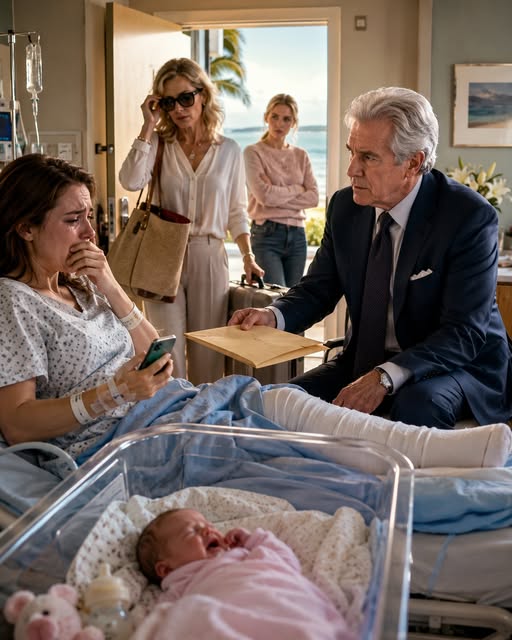
After my car accident, Mom refused to take care of my six-week-old baby, saying, “Your sister never has emergencies like this.” Then she left for a Caribbean cruise. From my hospital bed, I arranged professional care and stopped the $4,500 monthly support I had been paying her for nine years—$486,000 in total. A few hours later, Grandpa stepped into my room and said…
The first sound I heard after the crash was my baby crying through the speaker of my phone.
The second was my mother saying, “Your sister never has emergencies like this.”
I was stretched out in a hospital bed with my phone against my ear, listening to Lily scream while the emergency babysitter struggled to soothe her. My leg was heavily wrapped, my ribs screamed every time I took a breath, and the only person I believed would come help me was the exact person who refused.
“Mom,” I whispered. “Please. Just keep Lily for two days. I’ll cover everything.”
She appeared on the video screen in oversized sunglasses, standing beside a packed suitcase.
“I already told you, Meredith. I’m leaving for my cruise.”
“The Caribbean will still be there. Your granddaughter needs you now.”
She let out an irritated sigh.
“Your sister organized her life better. Claire never causes emergencies like this.”
Claire.
The daughter who constantly needed rescuing.
The daughter whose problems somehow always became everybody else’s responsibility.
I stared at my mother and suddenly understood that she wasn’t seeing her injured daughter lying in a hospital bed.
She was seeing an inconvenience.
“Mom, I’ve been paying your rent for nine years.”
Her face changed immediately.
“Don’t use your generosity as a weapon.”
“Four thousand five hundred dollars. Every single month.”
“And you’ve never missed a payment,” she replied. “So don’t pretend you have nothing.”
Then, somewhere behind her, I heard Claire speaking.
“Mom, just tell her no. She always turns everything into being about her.”
That sentence hurt worse than the accident itself.
Because in that moment, I finally understood something I had spent years refusing to see.
I wasn’t considered family when I was the one who needed help.
I was only family when I was paying to solve everyone else’s problems.
My mother told me to hire somebody.
So that was exactly what I did.
I called a licensed overnight nurse. I arranged postpartum assistance.
Then I called my attorney.
My voice sounded weak, but there was nothing weak about the decision I had made.
“Stop the monthly transfer to my mother. Effective immediately.”
My attorney went silent for a moment.
“All financial support?”
“Every dollar.”
For nine years, I had transferred $4,500 every month because I truly believed that protecting family meant carrying the burden whenever no one else could.
But lying in that hospital room, listening to my newborn daughter cry while my own mother prepared to board a cruise ship, I finally realized I had spent years protecting people who had never once protected me.
A few hours later, Grandpa walked into my hospital room.
His eyes moved from the IV attached to my arm, to the documents sitting beside my bed, and then to my phone, where Lily’s sitter was still trying to call me.
Without saying anything at first, he stepped inside and quietly shut the door behind him.
“I’ve been waiting to see how long it would take you to remember whose blood runs through your veins.”
Then he placed something on the table beside my hospital bed.
And the moment I saw it, I realized there was a truth missing from my family’s story—one that had been hidden for years…

Grandpa laid the worn manila envelope on the rolling hospital table as carefully as if it contained glass.
“I’ve kept this for fifteen years,” he said quietly.“I promised your father I would only give it to you when you finally stopped believing love had to be earned.”
My hands trembled as I opened it.
Inside was a handwritten letter.
My father’s handwriting.
He had passed away when I was twenty-three, only a year before Lily was born.Cancer had taken him far too early, and for years I had believed his greatest wish had been for me to keep our family together.
Instead, the first line shattered everything I thought I knew.
Meredith, if you’re reading this, it means you’ve finally seen the truth your mother never wanted you to see.
Tears blurred the page.
You were never responsible for carrying this family.
I was.
When I knew I was dying, I asked your grandfather to watch over you because I feared your kindness would become the easiest thing for others to spend.
I swallowed hard.
Every word felt as though my father were standing beside my bed.
You will always confuse loyalty with sacrifice if you aren’t careful.
Real family walks toward you when you’re hurting, not away from you.
I couldn’t stop crying.
Grandpa gently squeezed my shoulder.
“He loved you more than anything,” he whispered.
“But why didn’t he tell me?”
“He tried,” Grandpa answered.“You were grieving.
And after he passed, your mother convinced everyone that she needed help more than anyone else.”
For years, I believed her.
After Dad’s funeral, Mom had cried about losing the house.
Then about medical bills.
Then about retirement.
Then Claire lost another job.
Then Claire divorced.
Then Claire needed a new car.
Every crisis somehow became mine.
Every month, $4,500 left my account without question.
When friends asked why I worked weekends despite owning a successful consulting business, I always laughed.
“Family comes first.”
Looking back, I realized something heartbreaking.
Family had always come first.
I simply wasn’t included in that definition.
Grandpa opened another folder.
Inside were copies of bank statemenTS.
ReceipTS.
Checks.
Every payment I had ever made.
“I kept records,” he said.“I knew one day you’d need to remember how much you’ve given.”
Nine years.
One hundred and eight paymenTS.
Four hundred eighty-six thousand dollars.
Nearly half a million.
Not once had I asked for anything in return.
Not once.
Yet when I needed forty-eight hours of help after nearly losing my life, my mother chose a cruise.
The silence in the hospital room was interrupted by my phone vibrating.
Mom.
I answered.
“What have you done?” she demanded before I could speak.
“What do you mean?”
“My bank says the transfer didn’t arrive!”
“It won’t.”
There was silence.
Then laughter.
“Oh, stop being dramatic.”
“I’m not.”
“You’ll restart it next month.”
“No.”
Her tone hardened.
“You owe me.”
I almost smiled.
“For what?”
“For raising you.”
I looked toward Grandpa.
He slowly shook his head.
I finally answered the way I should have years earlier.
“Parents don’t send invoices for raising their children.”
She inhaled sharply.
“I sacrificed everything.”
“And I appreciated that.”
“So you’re abandoning your own mother?”
“No.”
“I’m simply no longer financing someone who abandoned me.”
She began crying immediately.
Not because I had been injured.
Not because Lily needed care.
Because the money had stopped.
Claire grabbed the phone.
“You’re unbelievable.”
“I learned from experTS.”
“What does that mean?”
“I watched both of you put yourselves first for years.”
She hung up.
Three days later social media exploded with pictures of Mom smiling on a luxury cruise ship.
Cocktails.
Beach sunseTS.
Designer dresses.
One caption read:
‘Much-needed vacation after years of sacrifice.’
I stared at the screen in disbelief.
Grandpa simply muttered, “People who rewrite history eventually run into the truth.”
The truth arrived faster than anyone expected.
One of Mom’s closest friends commented publicly beneath the photos.
‘Wait… weren’t you supposed to stay home because Meredith was hospitalized after a car accident?’
Another friend replied.
‘Hospitalized? She left anyway?’
Then someone else wrote:
‘I thought Meredith has been supporting you financially for years.’
Within hours, the comments multiplied.
Mom deleted the pictures.
But screenshots spread.
For the first time, people started asking questions.
Neighbors.
Church friends.
Extended relatives.
People who had always believed Mom’s version.
She began calling me repeatedly.
I didn’t answer.
Instead, I focused on healing.
The overnight nurse was incredible.
Lily smiled for the first time while I watched from my hospital bed.
It reminded me that love isn’t measured by DNA.
It’s measured by who shows up.
A week later, I was discharged.
Because my injuries required months of rehabilitation, Grandpa insisted we move into his home temporarily.
“I’ve got three empty bedrooms,” he smiled.
“And I make better pancakes than anyone in this family.”
He wasn’t exaggerating.
Every morning he carried Lily through the kitchen while singing old songs my father used to sing.
Every afternoon he helped me practice walking again.
Every evening he reminded me that accepting help isn’t weakness.
It’s what healthy families do.
Six weeks later, my attorney called.
“Your mother is contesting your father’s estate records.”
I frowned.
“What records?”
“The letter wasn’t the only thing your grandfather kept.”
Grandpa quietly placed another folder on the dining table.
Inside was Dad’s final estate plan.
One paragraph caught my attention.
Any future financial assistance provided to my wife shall remain voluntary and shall never become an obligation of my daughter.
Dad had anticipated everything.
Even this.
Mom’s attorney withdrew the complaint within days.
She no longer had any legal argument.
Months passed.
I regained my strength.
Business returned.
Lily grew from a fragile newborn into a laughing little girl who loved chasing Grandpa around the backyard.
One Saturday morning, while planting flowers together, Grandpa suddenly asked,
“Do you know why your father admired you most?”
“I thought because I worked hard.”
He smiled.
“No.”
“Because no matter how much life hurt you, you never stopped choosing kindness.”
I looked toward Lily, who was trying to hand a daisy to our old golden retriever.
“But kindness,” Grandpa continued, “must include yourself.”
Those words stayed with me.
A year later, I established the Daniel Harper Family Recovery Fund, named after my father.
Instead of sending $4,500 each month to someone who only valued me for what I provided, I used that money to help single parents facing medical emergencies.
The fund paid for emergency childcare.
Temporary home nurses.
Transportation.
Groceries.
Things that kept families together during impossible momenTS.
Every month, another parent received the help I had begged for but never received.
One afternoon, a young mother hugged me with tears in her eyes.
“I don’t know how to repay you.”
I smiled through my own tears.
“You don’t.”
“When you’re able, help someone else.”
Years later, Lily asked me why we visited Grandpa every Sunday.
I looked at the old man laughing in his rocking chair.
“Because he reminded me what family really means.”
“And what’s that?”
I wrapped my arm around her tiny shoulders.
“Family isn’t the people who expect you to carry them forever.”
“It’s the people who help carry you when you can’t stand.”
Grandpa looked over, smiled, and lifted his coffee mug toward us.
In that quiet moment, I realized something extraordinary.
Ending those monthly payments had never made me poorer.
It had finally made room for the richest life I had ever known.
The accident broke bones that eventually healed.
But it also broke generations of unhealthy expectations.
And sometimes, the most loving thing you can do…
…is stop rescuing the people who would never stop watching you drown.
Because love given freely is beautiful.
Love demanded as payment is not love at all.
And the greatest inheritance my father ever left me wasn’t the letter, the legal documents, or even the truth.
It was the courage to believe that I deserved a family that would reach for my hand—not just my wallet.
From that day forward, Lily never grew up wondering whether love had to be earned.
She grew up knowing exactly what my father had hoped I would one day learn:
The strongest families aren’t built by the person who sacrifices everything.
They’re built by the people who never let one person carry everything alone.
The crash happened before Meredith understood the real damage it would leave behind.
The twisted metal, the hospital lights, and the pain were terrifying.
But the moment that stayed with her was not the accident.
It was hearing her newborn daughter cry through the phone while her own mother explained why she would not come.
Meredith had always believed family meant showing up.
She had built her life around that belief.
For nine years, she had sent her mother $4,500 every month.
Rent.
Bills.
Repairs.
The expenses that started as temporary help and slowly became something everyone expected.
Nobody asked how much it cost her.
Nobody asked what happened when she was the one who needed support.
That answer came from a hospital bed.
After the accident, Meredith was unable to care for six-week-old Lily by herself.
She did the only thing she could think of.
She called her mother.
She expected hesitation, maybe inconvenience, maybe a complaint.
She never expected a suitcase in the background.
Her mother was preparing for a Caribbean cruise.
When Meredith begged her to take Lily for only two days, the response was simple.
Her sister Claire never had emergencies like this.
That sentence changed something inside Meredith.
She had spent years believing she was the dependable one.
The person who could handle everything.
The person who did not need anyone.