
The moment I stepped through my front door, I knew someone had tried to erase me.
It was not one dramatic thing that told me. It was a dozen small violations, each one whispering that the house no longer belonged to the woman who had locked it two weeks earlier.
A pair of black high heels stood beside the umbrella rack.
A bright pink coat hung from the brass hook where George’s brown jacket had remained for almost three years.
The lace curtain above the kitchen sink had been tied back with a silk ribbon I had never seen before.
And the air—my air, the familiar mixture of lavender polish, old wood, and morning coffee—had been swallowed by the sharp sweetness of Jessica’s perfume.
I remained in the doorway with my travel bag in one hand and the key still pressed between the fingers of the other.
I had been gone for fourteen days.
Fourteen days caring for my seriously ill sister, Helen, after pneumonia put her in the hospital and left her too weak to walk safely through her own apartment. Before leaving, I had scrubbed the kitchen, changed the bedsheets, watered the roses George and I had planted, and asked my son to check the pipes if the temperature dropped.
Matthew had kissed my cheek and said, “Don’t worry about anything, Mom. I’ll take care of the house.”
He had taken care of it, all right.
He had handed it to his wife.
Jessica appeared at the end of the hallway wearing my slippers.
Not slippers like mine.
My actual blue slippers, the soft pair George had bought during our last Christmas together.
She stopped when she saw me.
There was surprise in her face, but no guilt. The surprise vanished quickly, replaced by irritation.
“You’re back early.”
“I live here,” I said.
She walked toward me slowly, as though I were an intruder she did not want to frighten into doing something unpredictable.
“You were supposed to stay with Helen until Friday.”
It was Wednesday.
My grip tightened on the travel bag.
“How did you know when I was supposed to return?”
Jessica’s eyes flickered toward the living room.
That was when I saw Matthew.
My only son was sitting in his dead father’s chair.
George’s chair was a heavy oak recliner he had built with his own hands during the first winter we lived in the house. He had shaped every armrest, sanded every edge, and covered the cushions in deep green leather. After he died, I could not bring myself to sit in it.
Sometimes, on quiet evenings, I would place my hand on the back and remember the warmth of his shoulder beneath my palm.
Matthew sat there now with one ankle resting over his knee.
For one terrible second, he looked so much like George that my heart lifted.
Then he lowered his eyes.
That single movement broke the illusion.
Cardboard boxes were stacked behind him. A television twice the size of mine had been mounted on the wall. George’s books had disappeared from the shelves, replaced by framed photographs of Matthew and Jessica smiling on beaches, at restaurants, in front of expensive hotels.
I looked back at Jessica.
“What is happening?”
She folded her arms.
“You shouldn’t have let yourself in.”
I stared at her.
Then she pointed toward the open door behind me.
“Get out of my house.”
The words seemed to strike the walls and return from every room.
Her house.
I had scrubbed other people’s floors until my knees swelled to save the down payment for that house. I had sewn hems after midnight, skipped holidays, stretched every dollar, and worn the same winter coat until the lining came apart.
When George and I finally received the keys twenty years earlier, I had cried on the front steps.
It was not a mansion. It had two bedrooms, a narrow staircase, and a roof that leaked during the first spring.
But it was ours.
After George died, it became the one place where I could still feel him near me.
I set my travel bag on the floor.
“This is my home, Jessica.”
Her smile weakened for half a second.
Then it returned.
“Matthew said we’re living here now.”
I turned to my son.
“Matthew?”
He stared at the carpet.
“Say something.”
His throat moved.
“We needed more space.”
“You have an apartment.”
“The rent went up.”
“So you moved into my home without asking?”
“We’re family, Mom.”
Family.
The word made something cold settle inside me.
Family did not erase your memories while you were away caring for someone who was sick.
Family did not remove your husband’s books, fill your rooms with boxes, and put your slippers on another woman’s feet.
Family did not sit in silence while someone ordered you out of the home you had paid for with the best years of your life.
I walked past them.
Jessica moved to block the stairs, but I looked at her until she stepped aside.
The kitchen had been rearranged. My blue plates were packed in a box marked DONATION. My favorite coffee mug—the white one that said GEORGE’S BETTER HALF—was nowhere in sight.
The guest room was filled from floor to ceiling with suitcases and storage bins.
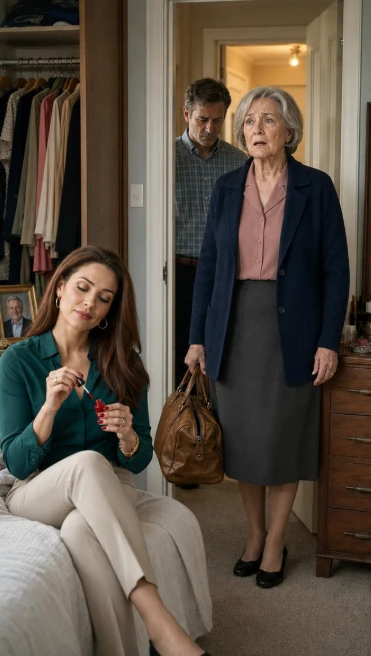
Upstairs, the bathroom cabinet contained Jessica’s creams, sprays, and bottles. My medicine had been stuffed into a plastic grocery bag beneath the sink.
Then I opened my bedroom door.
My breath left me.
Jessica’s dresses filled my closet. Her shoes lined the floor. Her jewelry had been arranged across my dresser beside George’s framed photograph.
She had placed her diamond earrings across the bottom of his picture as though decorating a grave.
The sheets I had changed before leaving were rumpled. A bottle of red nail polish stood open on the bedside table.
Jessica came up behind me.
“Why are your things in my room?” I asked.
She laughed softly.
“Because it’s our room now.”
Our room.
The room where George had held my hand during sleepless nights.
The room where he had told me he was frightened before his heart surgery.
The room where I had sat alone after his funeral, clutching his pillow and wondering how the world could keep moving when mine had stopped.
Jessica walked past me and sat on the bed.
“You can use the spare room,” she said. “Once we clear some boxes.”
I looked at Matthew.
“Explain this to me.”
His answer was barely louder than a whisper.
“We thought it made sense.”
“You thought taking my bedroom made sense?”
“Mom, please.”
Jessica picked up the nail-polish brush.
“We’re keeping this room. There’s no reason to make everything dramatic.”
That was when I understood what they were waiting for.
They were watching to see whether I would cry.
Whether I would plead.
Whether I would become confused and frightened and grateful for whatever corner they offered me.
They had mistaken age for surrender.
I had survived poverty, widowhood, childbirth, surgery, grief, and the slow disappearance of almost everyone who had once known me as a girl.
I had not survived seventy-two years to be evicted by a woman painting her nails on my bed.
I straightened my shoulders.
“You have forty-eight hours.”
Jessica paused.
“Forty-eight hours for what?”
“To pack everything you brought into this house and leave my property.”
She laughed.
Matthew did not.
He finally looked at me, and the expression in his eyes was not quite fear.
It was a warning.
They had assumed possession could become ownership if they acted confidently enough.
They had assumed Matthew could promise Jessica a house that had never belonged to him.
What neither of them knew was that I had visited someone before coming home.
And inside my travel bag was an envelope containing documents that could destroy their entire plan.
I returned downstairs, unzipped the bag, and pulled it out.
The laughter died in Jessica’s throat when she saw the name printed across the front.
MIRIAM COLE
ESTATE LITIGATION AND FORENSIC INHERITANCE
Matthew’s face went pale.
I held the envelope between them.
“Before I left Helen’s apartment this morning,” I said, “I spent two hours with George’s attorney.”
Jessica stood very still.
Then her gaze shifted from the envelope to my face.
“What did she tell you?”
The question came too quickly.
That was the moment I realized something even worse than the theft of my home.
Jessica had heard Miriam Cole’s name before.
Miriam had called me the previous afternoon while I was helping Helen back into bed.
At first, I nearly ignored the phone. Helen was shivering despite three blankets, and I was trying to balance a bowl of soup on one hand while pulling the curtains with the other.
Then I saw Miriam’s name.
I had not spoken to her since George’s estate was settled.
“Eleanor,” she said when I answered, “are you currently attempting to transfer your home?”
“No.”
“Have you signed any documents in the last ten days?”
“No.”
There was a silence.
“Are you alone?”
I looked at Helen, who had closed her eyes.
“My sister is here.”
“Is anyone else able to hear?”
“No.”
Miriam’s voice changed.
“Someone filed a deed with the county six days ago. It appears to transfer your house to Matthew and Jessica Hart.”
For several seconds, I heard only Helen’s clock ticking.
“That isn’t possible.”
“The document carries your signature.”
“I did not sign it.”
“It was notarized by a Denise Vale.”
I knew the name.
Denise was Jessica’s cousin.
My knees weakened, and I sat on the edge of Helen’s bed.
Miriam continued carefully.
“The signature is good, Eleanor. Very good. Whoever produced it had access to multiple examples.”
Birthday cards.
Checks.
Tax papers.
The drawer in my desk contained years of my handwriting.
“What should I do?”
“Do not confront anyone until you speak to me.”
I almost laughed when she said that.
Miriam had known me for thirty years. She knew I had confronted a hospital administrator over George’s missing medication, a contractor who tried to overcharge us, and a school principal who called Matthew lazy when he was twelve.
“I’m going home tomorrow.”
“I suspected you might say that.”
On my way back, I stopped at Miriam’s office.
She had changed since I last saw her. Her black hair was streaked with silver, and the skin around her eyes had tightened. But she still wore crimson lipstick and spoke with the calm precision of someone who had spent her life watching liars underestimate paper.
She spread the copied deed across her desk.
My name appeared at the bottom.
The signature looked like mine.
Almost.
The final curve of the E was wrong.
George had once told me that no machine could reproduce the hesitation in a person’s hand. At the time, I thought he was being sentimental.
Now that tiny hesitation might save my home.
“The filing has not completed the transfer,” Miriam explained. “The house is held by the George and Eleanor Hart Protective Trust. A simple deed cannot override the trust.”
“Do they know that?”
“They may believe the trust dissolved when George died.”
“Didn’t it?”
“No.”
She opened a thick folder.
“George amended it eight months before his death.”
I stared at her.
“What amendment?”
Miriam hesitated.
“He instructed me not to discuss it unless one of three things occurred.”
“What things?”
“Someone challenged your capacity. Someone attempted to force you from the property. Or someone tried to transfer the title without your knowledge.”
A chill moved across my arms.
“He expected this?”
“He feared the possibility.”
“From Matthew?”
Miriam did not answer directly.
“George loved your son.”
“He was George’s son too.”
Miriam looked down.
That was the first sign that the truth beneath my house was deeper than a forged signature.
She placed several documents into a heavy cream envelope.
“The first is a certified copy of the amended trust. The second is the forensic report on the deed. The third is a petition we can file immediately if they refuse to leave.”
“And the rest?”
“There is a sealed letter from George.”
My fingers froze against the desk.
“A letter?”
“He left instructions that you should read it only inside the house.”
“Why?”
“I don’t know.”
I searched her face.
Miriam Cole was an excellent liar when a courtroom required strategy.
But she was not lying then.
She was frightened.
Before I left her office, she caught my wrist.
“Eleanor, listen to me. If you see anything unusual involving George’s chair, call me immediately.”
I stared at her.
“What does the chair have to do with this?”
“I wish I knew.”
Now, standing in my invaded living room, I watched Jessica’s eyes settle on the envelope.
Her confidence had not vanished.
But it had cracked.
Matthew rose from George’s chair.
“Mom,” he said, “maybe we should talk privately.”
Jessica snapped her head toward him.
“There’s nothing to discuss privately.”
He looked at her, and for one brief second I saw something pass between them.
Fear.
Not the fear of losing a house.
The fear of being discovered.
I removed the first document from the envelope.
“This property remains in the George and Eleanor Hart Protective Trust,” I said. “I am the sole living trustee and beneficiary. Neither of you owns a brick, a nail, or a blade of grass.”
Jessica’s face hardened.
“We have a deed.”
“You have a forged piece of paper.”
“You can’t prove that.”
“Miriam already has.”
I showed them the forensic report.
Matthew did not look at it.
Jessica snatched it from my hand.
Her eyes raced across the page.
Then she smiled.
It was a smaller smile now, but more dangerous.
“You’re confused,” she said.
“I am not.”
“You’ve been under stress. Helen is sick. You’re grieving.”
“My husband died three years ago.”
“Exactly. You still talk about him as though he’s in the room.”
I felt the accusation beneath her words.
Not grief.
Incompetence.
She was not simply trying to steal my house.
She was preparing to argue that I was too confused to own it.
Matthew rubbed a hand over his face.
“Jessica.”
“What?” she said. “We all know she’s been struggling.”
I looked at my son.
“Is that what you told her?”
He opened his mouth.
Nothing came out.
Jessica crossed the room and picked up a folder from the coffee table.
She held it against her chest.
“We have a letter from a physician expressing concern about your memory.”
I almost smiled.
“My physician?”
“A physician.”
“Who has never examined me?”
“That can be arranged.”
The room seemed to become perfectly still.
I understood then that the boxes, the bedroom, and the order to leave were not impulsive acts.
This had been planned.
They wanted me frightened enough to go quietly.
If I resisted, they would call me unstable.
If I became angry, they would call me aggressive.
If I cried, they would call me confused.
Every human reaction had been turned into evidence against me.
I placed the documents back in the envelope.
“My offer remains the same. Forty-eight hours.”
“And if we refuse?” Jessica asked.
“Then I file the petition. I report the forged deed. And I ask the police to investigate every document you have touched.”
She stepped closer.
“You wouldn’t do that to your own son.”
I looked at Matthew.
“No,” I said. “A mother should never have to.”
Then I looked back at her.
“But you are not my son.”
They did not leave.
Jessica spent the next hour moving loudly through the house, slamming drawers and making telephone calls behind closed doors.
Matthew carried one box from the guest room to the hallway, then stood over it as though he had forgotten what boxes were for.
I took my bedroom back.
Jessica protested, but I removed her clothes from my closet one armful at a time and placed them in the corridor.
When she threatened to call the police, I handed her the telephone.
She did not call.
At six o’clock, my neighbor Ruth knocked at the door.
Ruth was seventy-five, five feet tall, and capable of making a grown man apologize with one raised eyebrow. She had lived next door since before George and I bought the house.
She entered carrying a casserole and stopped when she saw the boxes.
“I wondered why a moving truck was here last week.”
Jessica appeared behind Matthew.
“This is a private family matter.”
Ruth looked at her.
“I have known this family since before your eyebrows were fashionable.”
Jessica touched one eyebrow instinctively.
Ruth turned to me.
“Are you all right?”
“I’m staying.”
“Good.”
She set the casserole on the kitchen counter and lowered her voice.
“I saw Jessica’s cousin come by three nights ago. The one with the white car.”
“Denise?”
“Yes. She brought a black document case.”
Jessica was listening from the hallway.
Ruth raised her voice.
“And she parked across my driveway, which tells me everything I need to know about her character.”
Despite everything, I nearly laughed.
Ruth left only after making me promise to call if I needed help.
That night, I locked my bedroom door.
For the first time in twenty years, I felt unsafe in my own home.
I lay on my side, staring at George’s photograph.
“What did you know?” I whispered.
The photograph offered his familiar half-smile.
George had never liked having his picture taken. In almost every photograph, he looked as though he had been interrupted while repairing something.
I remembered the last months before his death.
He had become watchful.
He checked the locks twice.
He asked unusual questions about the deed and whether I kept copies of my signature in the desk.
Once, when Jessica visited, I found him standing alone in the living room with both hands gripping the back of his chair.
“She wants something,” he had said.
“Everyone wants something.”
“Not like this.”
I thought he was being overprotective.
George had never fully trusted Jessica. I assumed it was because she was confident, expensive, and impatient with old people’s stories.
When he died six weeks later, the doctor called it a heart attack.
He had been found in his chair.
Jessica claimed she had stopped by to bring him groceries and discovered him unresponsive.
Matthew had arrived ten minutes later.
I had been volunteering at the church pantry.
For years, I tortured myself over that hour.
If I had come home earlier, could I have saved him?
Near midnight, I heard footsteps.
Not upstairs.
Downstairs.
A floorboard creaked in the living room.
I sat up.
Another creak followed.
Then a soft scraping sound.
I slipped out of bed, opened the door, and moved silently along the hallway.
The living room was dark except for the yellow glow of a lamp.
Jessica was kneeling beside George’s chair.
She held a small flashlight between her teeth and was running her fingers beneath the wooden frame.
“What are you doing?”
She jerked so violently that the flashlight fell.
It struck the floor and rolled beneath the coffee table.
Jessica stood.
“I dropped an earring.”
“Under George’s chair?”
“Yes.”
“You were wearing both earrings at dinner.”
Her hand flew to her ear.
Both gold hoops were there.
For a moment, neither of us spoke.
Then she smiled.
“You really do watch people closely.”
“I learned to.”
She stepped around the chair.
Her face was half-shadowed.
“You should be careful wandering around at night, Eleanor. People your age fall.”
“People your age go to prison.”
The smile vanished.
She walked past me without another word.
I waited until her footsteps reached the guest room.
Then I turned to the chair.
The leather was cold beneath my fingers.
At first, I saw nothing unusual.
Then I noticed pale scratches along the underside of the right armrest.
New scratches.
Someone had tried to pry the wood apart.
Miriam’s warning returned to me.
If you see anything unusual involving George’s chair, call me immediately.
I reached for my phone.
Before I could dial, Matthew spoke from the doorway.
“Don’t.”
I turned.
He stood in the darkness wearing the same shirt he had worn all day. His face looked gray.
“Why not?”
“Because she’ll hear you.”
“Who?”
He glanced toward the stairs.
“My wife.”
“You say that as though I have forgotten.”
He came closer.
“Mom, listen to me. You need to act as if you haven’t noticed anything.”
“Anything about the chair?”
His jaw tightened.
“What did your father hide in it?”
“I don’t know.”
“Jessica thinks you do.”
“I know.”
His answer stopped me.
“You know?”
Matthew looked toward the hallway again.
Then he whispered, “I can’t explain everything yet.”
“You had two weeks to explain why you were moving into my house.”
“I didn’t move in because I wanted the house.”
“Then why are you here?”
His eyes filled with something that looked almost like shame.
“To keep her from finding what Dad left behind.”
I stared at him.
“You expect me to believe that?”
“No.”
“Did you sign the deed?”
He closed his eyes.
“Yes.”
Pain moved through me so sharply that I gripped the chair.
“You signed it.”
“She said it was only to prove I had an interest in the property.”
“You knew you had no interest while I was alive.”
“I know.”
“Did you know she forged my name?”
He did not answer.
That was answer enough.
I stepped away from him.
“Get out of my sight.”
“Mom—”
“Not my house. My sight.”
His face folded.
For a second, he was six years old again, standing in the kitchen after breaking George’s favorite watch.
Then the expression disappeared.
“I’m sorry,” he said.
“That word has become very cheap in this house.”
I picked up the flashlight and turned it toward the chair.
Matthew watched me examine the scratches.
“Dad once told me there was a compartment,” he said.
“When?”
“The week before he died.”
My hand stopped.
“What exactly did he say?”
“He said, ‘A good chair supports a man. A great chair keeps his secrets.’ I thought he was joking.”
George had used the same phrase with me years earlier.
A great chair keeps his secrets.
I crouched.
The right armrest had a carved rose near the front, one of the small details George had added for me.
I pressed it.
Nothing happened.
I twisted it.
There was a faint click.
A narrow panel released beneath the arm.
Matthew inhaled.
Inside was a brass key, a small digital recorder, and a sealed envelope yellowed slightly at the edges.
My name was written across it in George’s handwriting.
Eleanor. Only when the house is threatened.
My knees weakened.
Matthew reached toward me.
I pulled away.
“Do not touch it.”
Upstairs, a door opened.
Jessica called, “Matthew?”
His face changed immediately.
“Hide them.”
I placed the recorder and letter inside my robe.
Matthew pushed the panel closed just as Jessica entered the room.
She looked from him to me.
“What are you doing?”
“I couldn’t sleep,” I said.
Her eyes went to the chair.
“Neither could we,” Matthew added.
Jessica studied his face.
Then she looked at mine.
For a second, I was certain she knew.
But she only said, “Come back to bed.”
Matthew followed her.
At the bottom of the stairs, he glanced over his shoulder.
His expression carried a message I could not yet understand.
Do not trust me.
Or perhaps:
Trust me once more.
I waited until the house fell silent.
Then I locked myself in the bathroom and opened George’s letter.
My hands trembled so badly that the paper rustled.
Eleanor,
If you are reading this, then I failed to protect you while I was alive.
I stopped breathing.
George’s handwriting leaned slightly to the right, strong and deliberate.
There are things I should have told you. I kept silent because I wanted certainty before I brought danger into our home. That was pride, not protection. Forgive me.
Jessica did not meet Matthew by accident.
The room seemed to tilt.
I sat on the closed toilet lid.
Years before she met him, Jessica contacted me privately. She claimed to be the daughter of Lydia Vale, a woman I knew before I met you. Lydia and I had a brief relationship. Jessica presented a DNA report stating that I was her biological father.
I read the paragraph twice.
George had a daughter.
Jessica was George’s daughter.
My daughter-in-law had married his adopted son.
Matthew had not been born to George. I had been pregnant when I met him, abandoned by a fiancé who disappeared before my son’s birth. George married me when Matthew was two and adopted him at four.
We had never hidden it from Matthew, but we rarely spoke of it. George was his father in every way that mattered.
Jessica and Matthew were not related by blood.
Still, the thought of George meeting Jessica secretly made my stomach twist.
The letter continued.
I wanted to believe her. I felt guilt for what Lydia might have endured. I offered Jessica support and asked for an independent test.
She refused.
Instead, she began dating Matthew.
When I confronted her, she admitted she knew he was my legal son. She believed he would inherit the house and everything else. She told me blood was entitled to blood.
I changed the trust immediately.
I also hired an investigator.
The first DNA report was fraudulent.
Jessica is not my daughter.
A sound escaped my mouth.
Not relief.
Something closer to horror.
George had known she was lying.
She targeted Matthew because she believed he would inherit.
He wrote:
The independent laboratory found no biological relationship between us. Lydia later admitted in writing that Jessica pressured her to support the claim. Jessica threatened to expose Lydia’s debts and take away her housing.
I intended to tell Matthew everything. Before I could, Jessica learned about the second test.
If anything happens to me, listen to Track Seven.
I looked at the recorder.
My thumb hovered over the power button.
The bathroom suddenly felt too small.
I connected the earbuds stored with the device and switched it on.
The first tracks contained George’s voice describing repairs.
“Kitchen window sticks in wet weather.”
“Replace the hinge on Eleanor’s sewing cabinet.”
On Track Four, he laughed because he had forgotten what he wanted to say.
My eyes filled with tears.
Then I selected Track Seven.
At first, there was silence.
A door closed.
Jessica’s voice entered, clear and angry.
“You had no right to contact another laboratory.”
George answered, “I had every right.”
“You promised my mother.”
“I promised to help if the claim was true.”
“You think a piece of paper changes what you owe me?”
“It proves you lied.”
A pause.
Then Jessica said, “Matthew believes the house will be his.”
“It won’t.”
The words were so calm that I could picture George sitting in his chair.
“He is my son, but the house belongs to Eleanor. I amended the trust.”
“You can change it back.”
“No.”
“You will.”
“No.”
There was a rustling sound.
A bottle rattled.
George said, “What are you doing?”
Jessica’s voice lowered.
“You should have accepted me.”
“I offered you kindness.”
“You offered me charity.”
“I offered you the truth.”
The recording filled with movement.
Then George gasped.
A chair leg scraped.
His voice became strained.
“My tablets.”
Jessica said nothing.
“My heart tablets. Where are they?”
A long silence followed.
Then she spoke softly.
“You always said this chair would outlive you.”
I pressed a hand over my mouth.
George struggled to breathe.
There was a dull sound, as if something had fallen to the floor.
Then Jessica’s final words:
“Matthew will inherit. And when he does, I’ll finally have what you denied me.”
The recording continued for another forty-three seconds.
Forty-three seconds of my husband gasping for help.
Forty-three seconds of Jessica standing near him.
Forty-three seconds in which she did not call an ambulance.
The final sound was the front door closing.
I removed the earbuds.
My entire body shook.
George had not died alone.
He had died with the woman who later stood at his funeral holding my son’s hand.
She had watched him reach for medicine she had taken.
And then she had left him in the chair.
I wanted to scream.
Instead, I became very calm.
Grief can be loud when it first enters you.
But when grief discovers it has been deceived, it becomes something colder.
I called Miriam.
She answered on the second ring.
“I found the compartment.”
“Are you safe?”
“For the moment.”
“What was inside?”
“A letter and a recorder.”
“Do not play anything for Jessica.”
“I already listened.”
Miriam was silent.
I told her what I had heard.
When I finished, she said, “Eleanor, lock your door. I’m calling Detective Alvarez.”
“The police believed it was a heart attack.”
“They did not have this recording.”
“Will it be enough?”
“Not by itself. The defense will challenge the device, the date, the context, everything.”
“She let him die.”
“I believe you.”
“I heard him breathing.”
My voice broke for the first time.
Miriam’s tone softened.
“We will prove what we can. But you must not confront her.”
I looked at my reflection in the mirror.
My face appeared older than it had that morning.
“She is sleeping in my house.”
“Not for much longer.”
A knock sounded at the bathroom door.
I nearly dropped the phone.
“Eleanor?” Jessica called. “Are you all right?”
I covered the receiver.
“Yes.”
“You’ve been in there a long time.”
“I’m seventy-two. Everything takes longer.”
She did not laugh.
I heard her hand touch the doorknob.
It was locked.
“Are you talking to someone?”
“No.”
Silence.
Then her footsteps retreated.
Miriam whispered, “She suspects something.”
“Yes.”
“Can you leave?”
I looked toward the door.
“No.”
“Eleanor—”
“If I leave, she will tear this house apart.”
“The evidence matters more than the house.”
“To you, perhaps.”
I thought of George shaping the chair with his hands.
“To me, they are the same thing.”
By morning, Jessica had changed tactics.
She made coffee.
She placed a cup in front of me and sat across the kitchen table with a concerned expression.
“Last night got emotional,” she said.
I did not touch the cup.
“Did it?”
“We all said things.”
“I remember what I said.”
“Matthew and I aren’t trying to hurt you.”
“You forged my signature.”
“We were trying to create stability.”
“For whom?”
“For everyone.”
I looked at the coffee.
The surface was perfectly still.
Jessica followed my gaze and smiled faintly.
“It isn’t poisoned.”
The casual way she said it made my skin tighten.
“Why would you say that?”
“Because you’re looking at it as though it might be.”
She drank from her own cup.
I pushed mine away.
Matthew entered the kitchen.
He looked as though he had not slept.
Jessica turned to him.
“Tell your mother what we discussed.”
His eyes moved to me.
“We can work this out.”
“No,” I said.
“We could sell the house and divide the money.”
Jessica smiled encouragingly.
“See? That is reasonable.”
“The house is not for sale.”
“It’s too much for you,” Matthew said.
The words sounded rehearsed.
“Is that your opinion?”
He looked toward Jessica.
“Yes.”
I studied him.
There was a small dark mark below the collar of his shirt.
A wire?
Or a bruise?
When he shifted, his hand brushed his chest.
Then he looked directly at me and said, “You have to think about what Dad would want.”
The sentence struck me as cruel.
But his eyes held mine a fraction too long.
George’s letter had contained one more line beneath his signature.
Matthew may appear to choose her. Give him one chance to choose the truth.
I did not understand how George could have predicted that.
Unless Matthew knew more than he had admitted.
I stood.
“You have thirty-one hours remaining.”
Jessica’s cup struck the saucer.
“You cannot keep threatening us.”
“It is not a threat. It is a deadline.”
“Perhaps we should call someone about your behavior.”
“Call anyone you like.”
She leaned closer.
“What if I call Adult Protective Services?”
“To protect me from you?”
“To evaluate whether you can live independently.”
Matthew flinched.
Jessica continued.
“You left the stove on last month.”
“No, I did not.”
“You forgot Helen’s birthday.”
“I was at her birthday.”
“You speak to George.”
“I speak about George.”
“I heard you talking to his photograph.”
“Then you were listening outside my bedroom.”
Her expression changed.
Only slightly.
But I had found the edge.
“You have no idea how vulnerable you look,” she said.
“And you have no idea how guilty you sound.”
Matthew stepped between us.
“That’s enough.”
Jessica stared at him.
“Whose side are you on?”
He hesitated.
That hesitation seemed to satisfy her.
He turned to me.
“You should rest.”
I walked upstairs without answering.
Inside my room, my phone showed a message from Miriam.
DETECTIVE ALVAREZ NEEDS TIME. KEEP HER TALKING. DO NOT REVEAL THE RECORDING.
A second message appeared.
MATTHEW CONTACTED US THREE WEEKS AGO.
I stared at the screen.
Three weeks ago.
Before I left for Helen’s.
Before the forged deed.
Before they moved into my home.
My son had contacted George’s attorney.
Another message arrived.
HE BELIEVES JESSICA WAS INVOLVED IN GEORGE’S DEATH. HE AGREED TO COOPERATE.
I sat on the bed.
The silence downstairs had changed meaning.
Matthew’s lowered eyes.
His stiff movements.
The way he had warned me not to call Miriam where Jessica could hear.
His admission that he signed the deed.
Had it all been part of an investigation?
Or was he trying to save himself after joining the plan?
I typed:
DID HE FORGE MY SIGNATURE?
Miriam replied:
NO. JESSICA AND DENISE DID. MATTHEW SIGNED HIS OWN NAME UNDER POLICE INSTRUCTION AFTER HE REPORTED THE PLAN.
My anger did not disappear.
He had still allowed me to walk into my own home and believe he had betrayed me.
He had watched Jessica wear my slippers and take my bedroom.
He had not warned me.
But beneath the anger, something fragile moved.
Hope.
I wrote:
WHY DIDN’T HE TELL ME?
The answer came quickly.
JESSICA CHECKS HIS PHONE. DETECTIVE BELIEVES SHE WOULD RUN IF SHE SUSPECTED HIM. YOUR EARLY RETURN WAS NOT PART OF THE PLAN.
I had returned two days earlier than expected because Helen’s neighbor had agreed to stay with her.
Jessica had planned around Friday.
I had stepped into the trap before the police were ready.
A crash sounded downstairs.
I hid the phone and opened the bedroom door.
Jessica stood in the living room with the drawers of George’s chair pulled apart.
She had overturned the cushions.
Matthew grabbed her wrist.
“What are you doing?”
She tore free.
“Looking for the original trust.”
“It isn’t there.”
“How do you know?”
He did not answer quickly enough.
Her eyes narrowed.
Then she saw me on the stairs.
“Where is it?”
“The trust?”
“What did George leave in that chair?”
I descended slowly.
“A place to sit.”
“Don’t play games.”
“Why are you frightened of a chair?”
Jessica looked at Matthew.
“Search her room.”
He did not move.
“Matthew.”
“No.”
The single word carried more strength than anything he had said since I arrived.
Jessica stared at him.
“You said you wanted this house.”
“I said I wanted us to stop drowning in debt.”
“You said you would do whatever was necessary.”
“I was wrong.”
Her face became empty.
It was more frightening than anger.
“You pathetic little man.”
Matthew’s hands curled at his sides.
Jessica turned to me.
“He has been stealing from you for years.”
“Jessica,” he warned.
“He took money from the account you opened for him. He borrowed against his retirement fund. He lied about his job.”
Each sentence landed because each contained truth.
Matthew looked at the floor.
Jessica smiled.
“He is not protecting you, Eleanor. He is protecting himself.”
I believed that partly.
Perhaps that was what made the trap convincing.
Good lies do not replace truth.
They wrap themselves around it.
Jessica stepped closer.
“He agreed to sell the house. He agreed you were too old to manage it. He agreed you would be happier in assisted living.”
Matthew’s face tightened.
“Stop.”
“Tell her.”
“I said what you wanted me to say.”
“You signed the papers.”
“Because I needed proof.”
Jessica froze.
The room seemed to contract around those four words.
Matthew realized his mistake.
So did she.
“Proof of what?” she asked.
He said nothing.
Her gaze dropped to his shirt.
To the small dark mark beneath his collar.
She reached for him.
Matthew stepped back.
Jessica lunged.
Her hand tore open the top buttons of his shirt.
A thin black wire crossed his chest.
For one second, no one moved.
Then Jessica ran.
Not toward the door.
Toward the kitchen.
Matthew followed.
I heard a drawer open, metal scrape, Ruth shout from somewhere outside, and Matthew yell, “Put it down!”
When I reached the kitchen, Jessica stood beside the counter holding one of my carving knives.
Matthew faced her from six feet away.
Her eyes were wild.
“You recorded me?”
He raised both hands.
“Jessica, put the knife down.”
“You brought police into our home?”
“It is not our home,” I said.
She turned the knife toward me.
The blade caught the morning light.
“This is your fault.”
“My fault?”
“If you had simply left, none of this would have happened.”
“You forged my name.”
“You had more than you needed.”
“You watched George die.”
The words left me before I could stop them.
Matthew’s face drained of color.
Jessica became perfectly still.
I had revealed the recording.
Miriam had told me not to.
Detective Alvarez had needed time.
But there was no taking the words back.
Jessica stared at me.
Then she smiled.
“You found it.”
Matthew whispered, “Found what?”
Her gaze moved toward the living room.
“The recorder.”
Outside, a car door slammed.
Jessica heard it.
She grabbed my arm and pulled me against her.
The knife pressed beneath my ribs.
Matthew took one step forward.
“Don’t.”
“Tell them to leave,” she said.
The front door opened.
“Police!” a voice called. “Put down the weapon!”
Jessica dragged me backward.
Detective Alvarez appeared in the hallway with two officers behind him.
He was broad-shouldered, gray-haired, and frighteningly calm.
“Jessica,” he said, “set the knife on the floor.”
“You don’t understand.”
“I understand you are holding a knife against a seventy-two-year-old woman.”
“She stole my life.”
I could feel her breath near my ear.
Detective Alvarez kept his eyes on hers.
“No one has stolen anything from you.”
“George did.”
There it was.
The name she could not stop circling.
“He lied to my mother,” Jessica said. “He abandoned us. Then he built this perfect little house and gave everything to them.”
“He was not your father,” I said.
The knife pressed harder.
“You don’t know anything.”
“I read the second DNA report.”
Her breathing changed.
Matthew whispered, “What second report?”
Jessica’s grip tightened.
“There was no second report.”
“George had an independent test.”
“He forged it.”
“The first report was the forgery.”
“Shut up.”
“Lydia admitted it.”
“Shut up!”
The knife moved.
Matthew lunged.
Everything happened at once.
He struck Jessica’s wrist.
The knife fell.
I stumbled against the table.
Two officers crossed the room and forced Jessica to the floor.
She screamed, kicked, and twisted with such violence that one of the kitchen chairs broke beneath them.
Matthew caught me before I fell.
For the first time since I had returned, my son held me.
“Mom.”
His voice cracked.
“I’m sorry.”
I wanted to push him away.
I wanted to pull him closer.
Instead, I stood in his arms and watched officers handcuff his wife on the same floor where George and I had once danced while waiting for bread to rise.
Jessica stopped struggling when Detective Alvarez picked up the knife.
Her hair covered half her face.
She looked at me through the strands.
“You think that recording proves anything?”
Alvarez glanced at her.
“What recording?”
Her expression changed.
The detective had known about it.
But he wanted her to speak.
Jessica realized too late.
Matthew’s wire had captured everything.
She laughed once, breathlessly.
“You people are so stupid.”
No one answered.
“You think George was innocent?” she continued. “He used Lydia. He made promises.”
“He dated her for three months forty-five years ago,” I said.
“He owed me.”
“He offered to help you.”
“He offered me scraps.”
“You were not his daughter.”
“I could have been.”
The sentence was so strange that even the officers paused.
Jessica pushed herself upright against the cabinet.
“I should have been. I was smarter than Matthew. Stronger. I understood what that house was worth.”
Matthew stared at her.
“You married me for the house.”
“At first.”
The words seemed to hollow him out.
“At first?” he repeated.
She smiled at him.
“Don’t look so wounded. You needed someone to tell you who to be.”
He stepped back.
Detective Alvarez said, “Tell me about the day George died.”
Jessica’s eyes moved to him.
“I found him.”
“The recording suggests you were there before he collapsed.”
“He was already dying.”
“You removed his medication.”
“I moved a bottle.”
“Why?”
“He was agitated.”
“You asked him to change the trust.”
“He refused to correct an injustice.”
“He asked for his heart tablets.”
Jessica looked at me.
Something cold and proud entered her expression.
“He always kept them in the left pocket of his cardigan.”
I felt the room turn silent.
That detail had never appeared in the police report.
It had never been mentioned at the funeral.
Only George and I knew where he carried those tablets.
Detective Alvarez asked, “How did you know that?”
Jessica’s smile vanished.
Matthew closed his eyes.
Alvarez continued.
“The original investigators did not know where George kept his medication. The bottle was never recovered.”
Jessica said nothing.
“Where did you put it?”
Still nothing.
Then Ruth appeared in the kitchen doorway behind the police.
She held something wrapped in a dish towel.
“I believe,” she said, “this was thrown into my rose bushes three years ago.”
Everyone turned.
Ruth unwrapped the towel.
Inside was a small brown medicine bottle.
George’s name was printed across the faded label.
My knees nearly gave way.
Ruth looked at me, tears in her eyes.
“I found it the week after he died. I thought it had fallen from the rubbish. I put it in my garage cabinet and forgot.”
Detective Alvarez took the bottle carefully.
“Did you touch the tablets?”
“No.”
“There aren’t any tablets,” Ruth said. “It was empty when I found it.”
Jessica stared at the bottle.
Her face betrayed her before her mouth could.
Recognition.
Fear.
Alvarez saw it.
So did Matthew.
The detective crouched in front of her.
“You threw this over the fence after leaving the house.”
“No.”
“Your fingerprints may still be under the label.”
“No.”
“You removed George’s medication and watched him die.”
“He was going to ruin everything!”
The confession exploded from her.
No one moved.
Jessica breathed hard.
Then she seemed to hear her own words.
Alvarez remained quiet.
She began shaking her head.
“No. That isn’t what I meant.”
“What did you mean?”
“He was going to tell Matthew.”
“Tell him what?”
“That I had lied.”
“About being his daughter?”
“About everything.”
Her eyes filled with tears, but I saw no grief in them.
Only rage that the world had refused to become the world she believed she deserved.
“I didn’t plan for him to die,” she said. “I only took the pills so he would listen. I was going to give them back.”
“He asked for them.”
“He insulted me.”
“He was having a heart attack.”
“He said I was nothing.”
I remembered George’s voice on the recording.
I offered you kindness.
I offered you the truth.
He had not called her nothing.
She had heard the word anyway.
Detective Alvarez stood.
“Jessica Hart, you are under arrest for the suspected murder of George Hart, forgery, attempted fraud, and assault.”
As they led her away, she looked over her shoulder at Matthew.
“You’ll come for me.”
He did not answer.
“You always come back.”
He looked at her for a long moment.
Then he said, “I came back for my mother.”
The front door closed behind her.
The house became silent.
For several minutes, none of us knew what to do.
Police officers moved through the rooms, photographing the chair, collecting the recorder, and placing documents into evidence bags.
Ruth made tea no one drank.
Matthew sat at the kitchen table with his head in his hands.
I stood at the sink and looked out at the roses.
George had planted the yellow bush during our second summer in the house. He used to complain that roses were arrogant flowers because they demanded blood before offering beauty.
I had teased him for being dramatic.
Now I watched one yellow bloom move in the wind and wondered how many truths had been growing beside me while I remained unaware.
Miriam arrived shortly after noon.
She embraced me with unusual force.
Then she turned to Matthew.
“You nearly destroyed the operation.”
He looked up.
“I know.”
“You exposed the wire.”
“She had a knife.”
“I’m aware.”
He rubbed his face.
“I couldn’t let her hurt Mom.”
Miriam’s expression softened slightly.
“You did the right thing at the end.”
“At the end,” I repeated.
Matthew looked at me.
I sat across from him.
“Start at the beginning.”
He nodded slowly.
Three weeks earlier, he had discovered an old email account Jessica kept hidden.
He had been searching for a receipt because they were behind on rent. Instead, he found messages between Jessica and Denise discussing my house, sample signatures, notary stamps, and the value of the property.
There were also messages about George.
One line read:
THE OLD MAN SHOULD HAVE SIGNED WHEN HE HAD THE CHANCE.
Another said:
THE CHAIR MAY STILL HAVE THE DEVICE.
Matthew had remembered George’s remark about the hidden compartment.
He contacted Miriam.
Miriam contacted Detective Alvarez, who had reviewed George’s death after Lydia Vale came forward with a statement about the false paternity claim.
“Lydia contacted you?” I asked.
Miriam nodded.
“Six months ago. She was dying.”
“Is she dead?”
“Last November.”
Helen had never mentioned it.
Of course she had not known.
Miriam continued.
“Lydia confessed that Jessica pressured her into supporting the paternity story. Lydia believed George would offer money. She did not know Jessica intended to target Matthew.”
Matthew stared at his hands.
“Jessica told me George had rejected her,” he said. “She made him sound cruel. I thought Dad had abandoned a child.”
“You knew he wasn’t your biological father,” I said.
“Yes.”
“Did you never question why she chose you?”
“I did. Just not soon enough.”
His voice broke.
“She knew every insecurity I had. She knew I always felt like Dad had chosen me rather than truly belonged to me. She said she understood what it felt like to stand outside a family.”
I remembered Jessica’s early kindness toward him.
The way she praised his work.
The way she laughed at stories others ignored.
Manipulation often resembles love most convincingly to the person who needs it.
Matthew continued.
“When I found the emails, I confronted her. She cried. She said Denise had pressured her. Then she told me she was pregnant.”
I looked at him.
“Was she?”
“No.”
He swallowed.
“The test was fake.”
Jessica had forged a pregnancy, a deed, a doctor’s concern, and a family connection.
She had built her life from documents that said whatever she needed them to say.
“Detective Alvarez asked me to cooperate,” Matthew said. “Jessica already planned to move in while you were with Aunt Helen. She wanted to establish that we lived here before challenging your competency.”
“And you let her.”
“I thought the police would stop it before you came home.”
“But I returned early.”
“Yes.”
“You could have whispered the truth.”
“She checked my phone. She followed me from room to room. The house had cameras she installed while you were gone.”
I turned to Miriam.
“Cameras?”
“Two were found this morning. One in the hallway and one facing the desk where you kept your signature samples.”
A violation deeper than the moved clothes passed through me.
Matthew reached across the table.
I withdrew my hand.
He stopped.
“I know I hurt you,” he said.
“You sat in George’s chair.”
“Jessica told me to search it. I was trying to keep her from cutting it apart.”
“You let me believe you had chosen her.”
“I needed her to believe it too.”
“You called me confused.”
His face crumpled.
“I hated myself for every word.”
“But you said them.”
“Yes.”
The simple admission mattered more than excuses would have.
He did not ask me to pretend the pain had been necessary.
He did not ask for instant forgiveness.
He only sat there and accepted that protecting me badly had still wounded me.
Miriam placed the cream envelope on the table.
“There is one document you have not seen.”
I looked at her.
“The amended trust?”
“The final page.”
She opened the papers.
George’s amendment removed Matthew as the automatic beneficiary after my death.
Instead, the house would pass to the Hart Haven Foundation, an organization George had quietly created to provide temporary housing for elderly widows displaced or exploited by relatives.
I stared at the name.
“Hart Haven?”
Miriam smiled sadly.
“He funded it with a life-insurance policy you never knew existed.”
Matthew looked stunned.
“Dad thought I would steal the house?”
“No,” Miriam said. “He feared Jessica might use you to reach it.”
She turned the page.
“There is a conditional provision.”
I read the paragraph.
If Matthew knowingly participated in an attempt to dispossess me, he would receive nothing.
If he discovered such an attempt and acted to protect me, the trust granted me the authority to restore him as a beneficiary.
The choice belonged entirely to me.
George had not predicted every event.
He had done something wiser.
He had created a test of character and left room for mercy.
Matthew stared at the page.
“Did Dad think I would fail?”
I answered before Miriam could.
“He thought you would have to choose.”
My son began to cry.
Not loudly.
He covered his face with both hands, and his shoulders shook.
I had seen Matthew cry only four times in his adult life: when George died, when his first child was lost before birth, when he was laid off after eighteen years at the same company, and now.
“I’m sorry,” he said again.
This time, the word did not sound cheap.
I moved around the table.
He stood, uncertain.
Then I placed my arms around him.
Forgiveness did not arrive all at once.
It was not a door that swung open.
It was a road.
But I took the first step.
Jessica’s trial began eleven months later.
The medicine bottle provided traces of her fingerprints beneath the label. The recorder’s timestamp matched data from George’s home computer. Lydia’s statement proved the paternity claim had been fabricated.
Most damaging of all was Jessica’s own voice.
The wire had captured her knowledge of George’s medication, her rage over the second DNA test, and her words:
He was going to ruin everything.
Denise accepted a plea agreement and admitted notarizing the forged deed.
The physician’s letter questioning my memory had been created from a stolen template.
Jessica had planned to petition for guardianship after moving into my house. If successful, she intended to sell the property through a development company connected to Denise’s husband.
The house was worth more than I knew.
A commercial developer had quietly purchased several nearby lots. Jessica expected my property to become the final piece of a project worth millions.
That was why two bedrooms and a leaking roof had become an obsession.
Not sentiment.
Not blood.
Not justice.
Money.
Jessica was convicted of second-degree murder, attempted fraud, forgery, and aggravated assault.
At sentencing, she asked to speak.
She stood before the judge in a dark suit, her auburn hair cut neatly at her shoulders. Without the jewelry and polished confidence, she looked younger.
Almost ordinary.
She turned toward me.
“I did love Matthew,” she said.
Matthew sat beside me but did not react.
Jessica continued.
“I know no one believes that. Maybe I did not love him in the right way. But I loved the life we could have had.”
I surprised myself by answering.
“You loved the life you imagined stealing.”
The judge told me not to interrupt.
Jessica looked at me.
For the first time, I saw something in her face other than calculation.
Emptiness.
She had spent her life inventing documents to prove she belonged somewhere.
A DNA test.
A deed.
A medical letter.
A pregnancy result.
But paper could not create a family.
It could only reveal the distance between what she claimed and what she was willing to do.
The judge sentenced her to thirty-two years.
As officers led her away, she did not look at Matthew.
She looked at me.
Perhaps she still believed I had taken something from her.
Perhaps people like Jessica could not survive the truth that nothing had ever been theirs.
The following spring, Matthew helped me restore the house.
We put George’s books back on the shelves.
We removed the enormous television and repaired the holes in the wall.
He carried Jessica’s boxes to a storage facility and paid for three months. After that, they became the responsibility of her family.
The blue slippers went into the rubbish.
Some things cannot be reclaimed simply because they are returned.
George’s chair required more work.
Jessica had damaged the underside while searching for the compartment. Matthew sanded the scratches and matched the stain as carefully as he could.
One afternoon, I found him kneeling beside it with a small brush.
“You missed a spot,” I said.
He smiled faintly.
“Dad would have pointed that out sooner.”
“He would have pretended not to notice, then fixed it after you left.”
Matthew sat back on his heels.
“Do you think he forgave me?”
“For what?”
“For not seeing Jessica sooner.”
I considered the question.
“George loved you from the day he first held you.”
“That isn’t an answer.”
“Yes, it is.”
His eyes lowered.
I touched his shoulder.
“Your father did not leave that clause because he believed you were bad. He left it because he knew love could make good people foolish.”
“Did he think I would choose you?”
“He hoped.”
“And if I hadn’t?”
“Then he was prepared to protect me from you.”
Matthew nodded slowly.
“That sounds like him.”
It did.
George had been gentle, but gentleness was not weakness.
That was perhaps the final thing he had tried to teach both of us.
In June, Helen recovered enough to visit.
She walked through the front door using a silver cane and immediately complained that the hallway color made the house look smaller.
“You nearly died,” I told her.
“That does not make the paint less ugly.”
We sat beneath the roses with lemonade.
Matthew joined us, carrying a tray of sandwiches.
Helen watched him move through the kitchen.
“He looks like George from behind.”
“He always has.”
She glanced at me.
“Have you decided about the trust?”
I had not told her about the conditional provision.
Miriam must have.
“I have,” I said.
Later that week, I met Miriam at her office.
I restored Matthew as a beneficiary—but not in the way anyone expected.
When I died, he would not inherit the house to sell or occupy.
Instead, he would become a trustee of Hart Haven.
The property would serve as the foundation’s first permanent residence, offering temporary rooms to older women forced from their homes by children, caregivers, landlords, or fraud.
Matthew would receive a salary for managing the program only if the other trustees judged his work satisfactory.
When I explained the decision, he smiled.
“Dad would approve.”
“I hope so.”
“Do I?”
The question was honest.
“Yes,” I said. “Because inheritance should not be a reward for sharing someone’s blood. It should be responsibility passed from one pair of hands to another.”
He looked toward George’s chair.
“I think I’m ready for that.”
Two years after the day I came home, Hart Haven opened.
The guest room became an office.
The upstairs bedroom remained mine.
The small room beside the kitchen was converted into a private suite for women needing emergency shelter.
Our first resident was a sixty-nine-year-old widow named Bernice whose grandson had convinced her to sign papers she could not read. Our second was a retired teacher whose daughter had emptied her bank account.
Each arrived carrying a bag and the same expression I must have worn in my doorway.
Shock.
Shame.
Disbelief that someone they loved had looked at their trust and seen an opportunity.
I told each woman the same thing.
“What happened to you is not proof that you were foolish. It is proof that someone else was willing to be cruel.”
George’s chair remained in the living room.
At first, no one sat in it.
Then one rainy afternoon, Bernice lowered herself carefully onto the green leather.
“Is this allowed?” she asked.
I looked at the chair.
For years, I had treated it as a monument to death.
But George had built it to hold living people.
“Yes,” I said. “It is.”
She leaned back and closed her eyes.
The chair creaked gently.
A month later, while Matthew was repairing a loose board beneath the seat, he found something we had missed.
A second compartment.
It was smaller than the first and hidden beneath a layer of felt.
Inside was a final envelope.
My name was written on it.
Beneath my name, George had added:
For when you believe the story is over.
Matthew handed it to me without opening it.
My fingers shook as I unfolded the paper.
Eleanor,
If you found this, then you found the recorder. If you found the recorder, then the truth has probably hurt you.
I am sorry.
But there is one truth I wanted to save for last.
I sat slowly.
Matthew stood beside me.
The letter continued.
You once asked why I chose the rose carving for the chair.
I told you it was because you loved roses.
That was only half the answer.
The other half is that a rose survives by protecting what is soft with what is sharp.
You have always believed I saved you when we met.
You were alone, pregnant, frightened, and abandoned. I offered marriage, a name for Matthew, and a home.
But the truth is that you saved me.
Before you, I had spent my life believing love was something people earned by being useful. You taught me that love could be given freely and still remain strong.
If Matthew chose greed, protect yourself.
If he chose truth, do not let my fear become his prison.
And if the house survives us all, fill it with people who need a door no one can close against them.
I stopped reading.
Matthew was crying again.
At the bottom of the letter was one final paragraph.
I have asked Miriam to keep one fact from you until the house becomes part of Hart Haven.
The land beneath our home was purchased with money from your sewing account, not mine. The first payment, the deposit, and every early mortgage installment came from wages you earned.
Legally, the trust bears both our names.
But morally, Eleanor, this house was always yours.
I looked around the living room.
At the shelves.
At the roses beyond the window.
At Bernice asleep in George’s chair.
At my son standing beside me, no longer hiding his eyes.
For years, I had believed the house mattered because George and I had built a life there.
Then Jessica tried to take it, and I believed it mattered because it contained my memories.
But George had understood something I had not.
A home is not sacred because no one else enters it.
A home becomes sacred because, after someone tries to turn it into a weapon, you choose to turn it into shelter.
Jessica had entered my house believing age made me weak.
She had believed silence meant surrender.
She had believed signatures could replace truth and possession could become ownership.
She had nearly taken my home.
Instead, she revealed what it had always been built to become.
I folded George’s letter and placed it against my heart.
Outside, the roses moved beneath the afternoon sun.
Matthew opened the front door for another woman carrying a small suitcase.
She stood on the step, frightened and uncertain.
“Is this Hart Haven?” she asked.
I walked toward her.
“Yes.”
“Do you have room?”
I looked back at George’s chair, at my son, and at the house that had survived betrayal, grief, and greed.
Then I smiled.
“There is always room for someone who has been told she no longer belongs.”