
She Smiled Through Her Fiancé’s Toast—Then Turned His Wedding Screens Into Evidence That Destroyed Everyone Who Tried to Steal Her Life
PART ONE — THE MESSAGE ON HIS WATCH
My fiancé asked me to wire $240,000 into our new joint account less than six hours after I saw a message from my best friend telling him she had booked their usual hotel room.
My mother called the transfer “proof that I deserved a man like Grant.”
My father told me not to embarrass the family by asking unnecessary questions.
I did not confront him.
I did not slap her.
I did not cancel the wedding.
I did not warn my parents.
I did not give any of them the satisfaction of seeing me break.
Instead, I smiled.
My name is Avery Bennett. I was thirty-four years old, living in Boston, and engaged to Grant Mercer, a polished vice president at a private investment firm.
At least, that was the version of Grant everyone knew.
My version was different.
My version kissed my forehead before early meetings. He brought me coffee exactly the way I liked it. He remembered the anniversary of our first date and sent flowers to my office for no reason.
He also had a habit of turning his phone facedown whenever my best friend walked into the room.
I had noticed.
I just had not understood.
The truth arrived during my final bridal fitting at a boutique on Newbury Street.
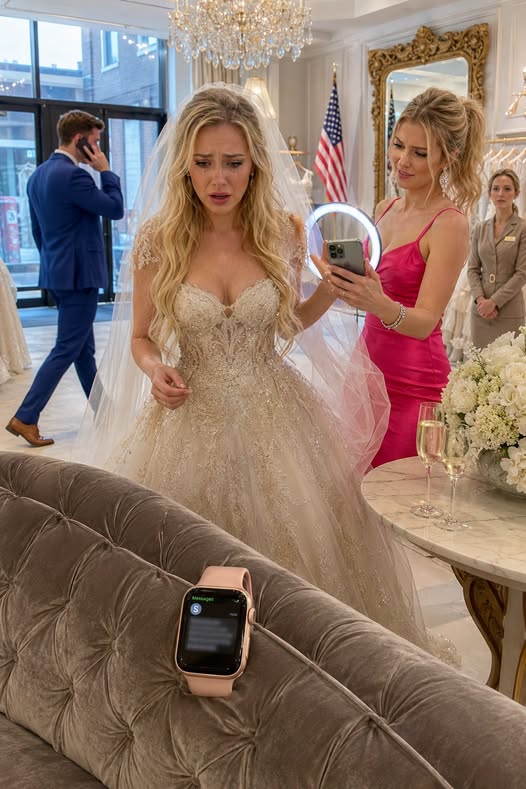
I was standing on a velvet platform while a seamstress pinned the hem of a silk wedding gown that cost more than my first car. Around me, mirrored walls reflected crystal lights, ivory fabric, and the carefully manufactured fantasy of a perfect marriage.
My best friend, Celeste Rowan, was filming everything.
Celeste had been beside me since graduate school. She knew every bad relationship, every private fear, every dream I had never admitted out loud.
She was also the founder of a struggling luxury event brand disguised as a successful lifestyle empire.
Online, Celeste appeared to live inside a champagne commercial.
In reality, almost everything she owned was rented, borrowed, sponsored, or overdue.
That afternoon, she wore a cream designer suit and carried a handbag she had once claimed was a gift from a European fashion house.
I knew the bag had come from a rental service.
I had helped suppress the story when a blogger nearly exposed her.
That was what I did for a living.
I owned Bennett Crisis Group, a discreet communications firm that protected executives, athletes, politicians, and public figures when their private disasters threatened to become public entertainment.
My clients called me before they called their lawyers.
I controlled narratives.
I located leaks.
I found weaknesses.
I knew how one photograph, one sentence, or one badly timed lie could destroy an empire.
Somehow, I had never applied those skills to my own life.
Grant had joined us at the boutique, charming the staff and praising the dress before I had even put it on.
Twenty minutes later, his phone rang.
He glanced at the screen and sighed.
“Singapore,” he said. “I have to take this.”
He kissed my cheek, left his suit jacket on a chair, and walked toward the lobby.
His smartwatch remained on the table beside his coffee.
Celeste was adjusting my veil when the watch lit up.
I did not move at first.
I only looked.
The sender was listed as “C.”
The profile image showed Celeste’s white Pomeranian wearing a pink ribbon.
The message read:
Suite 814. Four o’clock. I’m tired of pretending your bride is my best friend. Don’t be late again.
The boutique music continued playing.
A seamstress asked me to turn slightly.
Celeste complained that the lighting was flattening her cheekbones.
Something inside me became perfectly still.
I stepped down from the platform and reached for my water.
With my other hand, I opened the camera on my phone.
One photograph.
Then another.
Then a close-up showing the time, sender, and full message.
Nine seconds.
That was all I needed.
“Avery?” Celeste asked. “Are you okay?”
I looked at her reflection.
She had helped Grant choose my engagement ring.
She had cried when I asked her to be my maid of honor.
She had spent the past six months pushing me toward more expensive venues, larger deposits, and nonrefundable vendors.
Now I understood why.
“I’m wonderful,” I said.
My smile was so convincing that she smiled back.
Grant returned three minutes later.
He wrapped an arm around my waist and asked if he had missed anything.
“Nothing important,” I told him.
That evening, we had dinner at my parents’ townhouse in Beacon Hill.
My mother, Elaine, had decorated the dining room as though a lifestyle magazine might arrive without warning. Silver candlesticks stood between crystal glasses. Fresh orchids leaned over a bowl of imported pears no one was allowed to eat.
My father, Thomas, wore a dinner jacket in his own home.
Appearances had always been oxygen to my parents.
They were not truly wealthy.
They were wealthy from a distance.
The townhouse carried two mortgages. Their cars were leased. Their club memberships were paid with credit. Every beautiful object in the room existed to convince strangers that Elaine and Thomas Bennett belonged among people who never worried about bills.
They treated Grant like their entrance ticket.
He spoke the language of money.
He wore custom suits.
His business card had three impressive words beneath his name.
My parents had never cared that my company employed eighteen people or that our clients paid six-figure retainers.
To them, public relations was a feminine little occupation involving cocktail parties and press releases.
Grant managed investments.
Therefore, Grant mattered.
After dessert, he placed a leather folder beside my plate.
“I have something romantic to propose,” he said.
My mother clasped her hands.
Grant opened the folder and revealed forms for a joint investment account.
“I want us to begin our marriage without separate financial lives,” he said. “Everything together. No walls.”
He touched my hand.
“I’ve identified an opportunity that closes Friday. If we combine our liquid savings, we can secure a position before the next funding round.”
“How much?” I asked.
“Two hundred and forty thousand from you. I’ll contribute my portfolio.”
My father nodded immediately.
“That is how serious marriages work.”
My mother leaned closer.
“You cannot expect Grant to build a future while you hide money in little business accounts.”
I studied the forms.
The account had been opened through a boutique financial platform I did not recognize.
The beneficiary structure was vague.
Grant’s name appeared as managing authority.
Mine appeared as contributing partner.
“Friday?” I asked.
“The opportunity won’t wait.”
Neither would his creditors, apparently.
I picked up the pen.
Grant’s shoulders relaxed.
My mother smiled.
My father lifted his wineglass.
Then I placed the pen beside the folder.
“I’ll review the routing details tomorrow,” I said. “A transfer that large will require approval from my business manager.”
Grant’s smile tightened for less than a second.
Only someone trained to study faces would have noticed.
“I thought you handled your own accounts.”
“I do. This is merely procedure.”
I kissed his cheek.
“Don’t worry. I trust you.”
That night, Grant slept beside me while I stared into the darkness.
At 6:10 the next morning, I left our apartment carrying the folder.
I drove to Cambridge, where my younger sister, Paige, lived with her husband, Lucas Hale.
Paige opened the door wearing sweatpants and holding a mug of coffee.
One look at my face erased her smile.
“What happened?”
“I need Lucas.”
Her husband was already inside his office.
Lucas was a forensic auditor who specialized in tracing corporate fraud through shell companies, false valuations, and manipulated financial statements.
He had the patience of a surgeon and the instincts of a bloodhound.
I placed Grant’s forms on his desk.
Then I showed them both the photograph from the watch.
Paige covered her mouth.
Lucas studied the image without speaking.
“I need everything,” I said. “His debts. His investments. His business relationships. Celeste’s company too.”
Paige’s eyes filled with anger.
“I’ll go to her apartment right now.”
“No.”
“She is sleeping with your fiancé.”
“And if you confront her, she deletes evidence.”
Paige stared at me.
I kept my voice calm.
“They believe I am emotional, desperate, and easy to control. That belief is our greatest advantage.”
Lucas picked up the account forms.
“This platform is registered through a holding company,” he said. “Give me forty-eight hours.”
He called me thirty-one hours later.
When I returned, a stack of documents covered his desk.
Grant was not wealthy.
He was insolvent.
He had lost $418,000 through leveraged technology investments and private cryptocurrency loans. He had borrowed against his retirement account, maxed out four cards, and used client-adjacent funds to hide two margin calls from his employer.
Celeste was in nearly as much trouble.
Her event company owed vendors more than $170,000. Three former clients were preparing a joint fraud claim. A hotel group was threatening to expose the fact that she had fabricated sponsorships and charged clients for luxury services she never purchased.
“They are both running out of time,” Lucas said.
He turned one page toward me.
“This joint account is not an investment vehicle. Once your money enters, Grant can move it without your approval.”
Paige stood behind him, pale with fury.
“He was going to steal everything.”
“Not everything,” Lucas said.
He placed another document on top of the pile.
“There’s more.”
It was a wire transfer.
Fifty-eight thousand dollars.
Sent to Grant eleven days earlier.
The account belonged to Elaine and Thomas Bennett.
My parents.
Before I could speak, Lucas pointed to the memo line.
It contained only four words.
Avery acquisition — first installment.
PART TWO — THE PRICE OF BEING CHOSEN
I read the memo line until the words stopped looking real.
Avery acquisition.
Not investment.
Not family opportunity.
Acquisition.
Someone had reduced my future to a transaction and my parents had funded the opening payment.
“Could Grant have written the memo himself?” Paige asked.
Lucas nodded.
“But your parents still authorized the transfer.”
I drove to Beacon Hill alone.
My mother was arranging flowers when I entered the townhouse.
She did not ask why I had arrived without calling.
Instead, she began complaining about the wedding invitations.
“The paper looks inexpensive,” she said. “Celeste agrees.”
“Did you give Grant fifty-eight thousand dollars?”
The flower stem snapped in her hand.
It was small.
Almost nothing.
But I saw it.
My mother recovered quickly.
“You have been looking through Grant’s private accounts?”
“I asked you a question.”
My father entered from the adjoining room.
His expression told me he already knew.
“It was a temporary placement,” he said. “Grant gave us access to a private investment opportunity.”
“Where did the money come from?”
Neither answered.
I looked around the townhouse.
The new artwork.
The polished piano no one played.
The marble floors my mother had financed three years earlier.
“You borrowed against the house.”
My mother’s mouth hardened.
“It is called using equity intelligently.”
“You gave Grant borrowed money?”
“He guaranteed a forty-percent return,” my father said.
“No legitimate investment professional guarantees that.”
My mother laughed without humor.
“Here we go.”
“What does that mean?”
“It means you are threatened by him.”
I stared at her.
She stepped closer.
“You have always needed to be the most competent person in the room. Now you are marrying someone whose financial knowledge exceeds yours, and instead of being grateful, you are searching for reasons to undermine him.”
“I am trying to keep you from losing your home.”
“Our home is not your concern.”
My father pointed toward the door.
“What should concern you is securing this marriage before Grant reconsiders.”
My mother’s voice became softer and crueler.
“Men like Grant have options, Avery. Women in their mid-thirties do not.”
There it was.
The weapon she had sharpened my entire life.
My age.
My independence.
My refusal to perform gratitude whenever a man found me attractive.
For years, my parents had treated marriage as proof that someone had finally agreed to tolerate me.
They thought Grant had chosen me.
They never considered that I had chosen him.
Or that I could unchoose him.
“I came here to warn you,” I said.
“We do not need your warning,” my father replied.
My mother picked up another flower.
“What we need is for you to stop creating drama and transfer the money Grant requested.”
I nodded once.
“I understand.”
Relief passed between them.
They thought I had surrendered.
What I understood was that they had made a decision with full knowledge of the risk.
I would not save people who insulted me for trying to protect them.
That afternoon, I met with Evelyn Shaw, an attorney who had spent twenty-five years building legal fortresses around private wealth.
Evelyn had represented several of my clients during hostile divorces and corporate collapses.
She did not react when I showed her Grant’s account forms.
She did not react when I described the affair.
She reacted when I told her my parents’ transfer memo.
“Someone believes your business can be acquired through marriage,” she said.
“My business is not for sale.”
“Does Grant know its value?”
“He thinks I earn well. He does not know the full number.”
Bennett Crisis Group had produced more than fourteen million dollars in profit over the previous seven years.
I had reinvested most of it.
The company owned intellectual property, confidential client contracts, and several highly valuable crisis-response technologies.
Grant had never asked detailed questions.
I had mistaken his lack of curiosity for respect.
Now it appeared he had been curious in private.
Evelyn began moving my ownership interests into a protected pre-marital structure. Nothing disappeared illegally. Nothing was hidden from tax authorities.
It was simply placed beyond the reach of any future spouse.
By sunset, Grant could marry me, divorce me, sue me, or invent another hundred schemes.
He would never touch the company.
When I returned to our apartment, Grant was showering.
His briefcase sat open in the home office.
I did not search it randomly.
I photographed the visible documents and recorded their arrangement before touching anything.
Inside a side compartment, I found a draft prenuptial agreement.
The first pages looked standard.
The later sections did not.
One clause stated that any debt refinanced during the marriage would become a shared marital obligation.
Another gave Grant temporary voting authority over my privately held business interests if I became “emotionally incapacitated.”
The definition of emotional incapacity included hospitalization, treatment for anxiety, or a diagnosis of acute stress.
I read it twice.
He intended to steal my money.
If that failed, he planned to use my reaction to the betrayal as proof that I was unstable enough to take control of my company.
A crisis manager declared emotionally unfit would lose more than wealth.
I would lose the trust of every client who depended on my judgment.
The shower stopped.
I replaced the papers exactly as I had found them and returned to the kitchen.
Grant appeared in a robe, smiling.
“How was your day?”
“Productive.”
He poured himself a drink.
“Did the transfer clear?”
“The bank requested more documentation.”
His jaw tightened.
“I told you Friday was the deadline.”
I crossed the room and adjusted the collar of his robe.
“And I told you not to worry.”
My touch calmed him.
That disgusted me more than the affair.
“You know,” I said, “Celeste showed me the final estimate for the wedding.”
Grant’s eyes brightened.
“She has remarkable taste.”
“The Harbor Conservatory. Imported gardenias. The orchestra. The chef from Napa.”
“It will make an impression.”
“It will cost nearly two hundred thousand dollars.”
He hesitated.
I lowered my eyes.
“The vendors treat me like a little event planner when I ask questions. Maybe they would respect the contracts more if you signed as financial sponsor.”
Grant stood straighter.
“You want me to handle it?”
“You are the finance expert.”
He smiled.
The trap did not close that evening.
First, I made sure every contract was legitimate.
Every fee was clear.
Every cancellation penalty appeared in bold print.
Every page identified Grant as the sole guarantor.
Nothing was hidden.
Nothing was forged.
He simply did not read.
He signed the venue agreement.
He signed the catering contract.
He signed for a fifteen-piece orchestra, imported flowers, vintage wine, custom lighting, and a waterfront fireworks permit.
One hundred ninety-three thousand dollars.
He flipped past highlighted liabilities with the impatience of a man who believed consequences were designed for other people.
“All handled,” he said.
I kissed him.
“My hero.”
Two days later, he presented the prenuptial agreement.
He gave me the same speech I had heard from dishonest executives before every hostile negotiation.
This protects both of us.
This is standard.
This proves trust.
I asked to have Evelyn review it.
Grant agreed because refusing would have looked suspicious.
Evelyn returned a revised version containing a complete disclosure warranty.
Both parties affirmed under signature that they had revealed all debts, pending claims, extramarital relationships, and attempts to gain control of the other party’s business.
Any deliberate omission would void the offender’s protections and make that person solely responsible for undisclosed liabilities.
The new language appeared in a separate schedule.
It was titled clearly.
Grant received the document electronically three days before signing.
He opened the file for forty-three seconds.
Then he signed it before a notary.
His arrogance did what deception never could.
It made the agreement enforceable against him.
That night, Lucas called.
“I found the connection between Grant and Celeste,” he said.
“The affair?”
“No. The financial connection.”
He sent me a company registration.
Grant and Celeste had formed a Delaware entity eight months earlier.
Its name was North Row Holdings.
The company’s stated purpose was acquiring distressed communications firms.
My company was listed in an internal valuation document.
Beside it was a proposed purchase price.
Zero dollars.
Under acquisition method, they had written:
Transfer through marital control after founder incapacity.
Then Lucas sent the final page.
North Row Holdings had a third investor.
The name was hidden behind another corporation.
But the signature authorizing the first payment was perfectly clear.
It belonged to someone inside Bennett Crisis Group.
PART THREE — BUILDING THE ROOM WHERE THEY WOULD FALL
The traitor inside my company could wait.
Grant and Celeste could not.
The wedding was nine days away.
If I changed my behavior, they would know I had discovered the larger plan.
So I continued smiling.
I approved menus.
I attended floral meetings.
I let Celeste post photographs of us with captions about loyalty, sisterhood, and the joy of watching your best friend marry her soulmate.
Behind the scenes, Lucas examined North Row Holdings.
Evelyn preserved every document.
My internal security director quietly restricted access to sensitive company files without announcing why.
I also arranged a meeting between Celeste and Meridian House, a respected luxury-brand agency run by my former colleague, Dana Price.
Celeste had begged for an introduction to Dana for years.
I finally gave her one.
The meeting took place in a glass conference room overlooking Boston Harbor.
Dana praised Celeste’s audience reach and proposed an advance large enough to rescue her collapsing company.
Celeste almost cried.
Then Dana placed a due-diligence form in front of her.
It asked about unpaid vendors.
Pending lawsuits.
Undisclosed partners.
Conflicts of interest.
Fraud allegations.
Celeste checked no beside every question.
She signed beneath a statement confirming that false answers would trigger immediate termination, repayment of all funds, and transfer of pledged brand assets.
Dana did not trick her.
Dana asked direct questions.
Celeste lied because she believed honesty was for people without charm.
Three days later, the advance entered her business account.
Within hours, she used most of it to pay the hotel supplier threatening to expose her.
She had locked herself into the truth she denied.
Grant grew more affectionate as the wedding approached.
He brought home champagne.
He whispered about our future.
He asked whether my transfer would clear before the ceremony.
I told him the funds were moving through compliance.
He accepted the delay because he believed marriage itself would give him access.
The night before the rehearsal dinner, I told Grant I would stay with Paige.
He kissed me at the apartment door.
“Tomorrow changes everything,” he said.
“For all of us.”
He smiled as though I had said something romantic.
At Paige’s house, Lucas sat at the kitchen table with three laptops.
North Row Holdings had been partly funded with my parents’ money. Celeste had provided marketing research. Grant had drafted the marriage strategy.
The hidden investor had supplied private information about Bennett Crisis Group.
Client renewal dates.
Internal insurance policies.
My executive travel schedule.
Even notes from private discussions about my stress levels after difficult cases.
Someone had been building a psychological profile of me.
“They wanted to create a public breakdown,” Paige said.
Lucas nodded.
“Grant cheats. Celeste leaks it at the right time. Avery reacts during the wedding or honeymoon. Anonymous sources tell reporters she has become unstable. Grant invokes the prenup language and seeks temporary control of the firm.”
“And North Row acquires the company while clients panic,” I said.
Lucas looked at me.
“That appears to be the plan.”
Paige’s hands trembled.
“They weren’t just going to bankrupt you.”
“No.”
“They were going to erase you.”
My apartment security application sent an alert at 10:46 p.m.
Motion in the living room.
I opened the feed.
The cameras were not hidden. Grant and I had installed them after a client’s stalker appeared outside our building. Small blue lights glowed whenever recording was active.
Grant knew.
Celeste knew.
They simply believed I had no reason to check.
Celeste entered wearing a black coat over a silver dress.
Grant pulled her into his arms before the door had fully closed.
They kissed beneath the camera.
Then they opened a bottle of champagne I had been saving for the company’s tenth anniversary.
I activated the audio.
Celeste laughed as she dropped onto my sofa.
“She still thinks tomorrow is about speeches.”
Grant handed her a glass.
“After the ceremony, I’ll have access to the company accounts.”
“What if the transfer doesn’t clear?”
“It doesn’t matter. The prenup gives me temporary authority if she becomes unstable.”
Celeste frowned.
“She never loses control.”
“Everyone loses control when the humiliation is public enough.”
He sat beside her.
“We release the affair photographs during the reception. Her clients wake up to headlines saying the country’s most famous crisis manager could not manage her own life. Then the anonymous complaints go out.”
“My followers will believe I was manipulated?”
“They’ll believe whatever your apology video tells them to believe.”
Celeste raised her glass.
“And her parents?”
Grant laughed.
“They already signed statements saying Avery has always been emotionally difficult.”
The room inside Paige’s house became silent.
My parents had not merely invested.
They had provided testimony.
On the screen, Celeste crossed her legs.
“What about Dana’s contract? The due-diligence language was aggressive.”
“Once Avery’s company collapses, North Row pays everything.”
“You’re certain the inside investor can force the sale?”
Grant’s expression changed.
Less smug.
More cautious.
“That is what we were promised.”
“By whom?”
Grant looked toward the camera.
For one terrible second, I thought he had remembered it.
Then he lowered his voice.
“The person who taught Avery everything she knows.”
My heart stopped.
My mentor, Richard Vale, had founded one of the first elite crisis firms in New York.
He had hired me when I was twenty-four.
He had taught me to document everything, trust behavior instead of words, and prepare for the second disaster hiding behind the first.
Richard had died three years earlier.
At least, that was what I had been told.
Celeste laughed nervously.
“Dead men don’t acquire companies.”
Grant’s smile returned.
“No. But their partners do.”
He lifted his glass.
“To North Row.”
Celeste touched her glass to his.
“To the woman who never saw us coming.”
I downloaded the recording.
Then I watched them celebrate for another twenty minutes.
Every sentence became evidence.
Every joke became a confession.
Every kiss became proof.
When the recording ended, Paige reached for my hand.
“What are you going to do tomorrow?”
I removed the flash drive and placed it inside my clutch.
“What I do for every client facing an organized attack.”
Lucas looked up.
“Control the first headline?”
“No.”
I closed the laptop.
“I’m going to make sure there is only one possible headline.”
The rehearsal dinner would take place at the Halcyon Museum, a private waterfront gallery Grant had selected because it impressed wealthy people.
More than a hundred guests were expected.
His firm’s managing partners.
Celeste’s new agency representatives.
My parents’ social circle.
My own executive team.
Including the person who had sold me.
Everyone involved would be in one room.
Everyone except the hidden investor.
At midnight, another security notification appeared.
This one came from Bennett Crisis Group.
Someone had entered my private office using an executive access code.
The camera showed only a shadow crossing the floor.
Then the feed went black.
PART FOUR — THE TRIBUTE
The Halcyon Museum looked like a cathedral built for money.
Glass walls faced the harbor. Suspended sculptures turned slowly above white marble floors. Candlelight reflected across long tables arranged beneath a ceiling three stories high.
Grant stood near the entrance greeting guests like a man accepting an award.
Celeste moved through the room in a gold dress, filming short videos and embracing people she barely knew.
My parents treated the evening as their own social coronation.
My mother wore diamonds she could not afford.
My father introduced Grant as “the son we always hoped for.”
I heard him.
I did not react.
Paige and Lucas sat at a table near the audiovisual control station.
Dana arrived with Meridian House’s legal director.
Evelyn sat beside my company’s outside counsel.
My leadership team occupied two tables near the stage.
I studied every face.
Margaret Cho, my chief operating officer, smiled warmly when I looked at her.
Daniel Ross, our head of client strategy, raised his glass.
Simon Vale, Richard’s nephew and the firm’s minority shareholder, watched me without smiling.
One of them had entered my office.
One of them had funded North Row.
Grant approached and placed a hand against my back.
“You seem tense.”
“I’m getting married tomorrow.”
He kissed my temple.
“After tonight, you’ll never have to carry everything alone again.”
That was the first true thing he had said in weeks.
After tonight, I would not carry them.
Dinner began.
Grant’s managing partner gave a speech about leadership and integrity.
Celeste toasted friendship.
My mother spoke for nine minutes about how proud she was that I had finally learned to trust a successful man.
Then Grant stood.
He lifted his glass.
“Avery has built her whole life around managing other people’s chaos,” he said. “My promise is that she will never have to be in charge again.”
Several guests laughed softly.
Grant looked at me.
“You can finally let someone else make the difficult decisions.”
He believed he was announcing my surrender.
I rose and kissed his cheek.
“Thank you,” I said.
Then I walked to the stage.
“I prepared a tribute too.”
The lights dimmed.
Grant smiled.
Celeste adjusted her posture.
My mother reached for my father’s hand.
The first image appeared on the museum’s enormous central screen.
Grant’s watch.
Celeste’s message.
Suite 814.
Four o’clock.
A murmur moved through the room.
Celeste’s smile vanished.
Grant turned toward me.
The second image appeared.
North Row Holdings.
Grant Mercer.
Celeste Rowan.
Avery Bennett.
Proposed acquisition price: zero dollars.
The third image showed my parents’ transfer.
Fifty-eight thousand dollars.
Avery acquisition — first installment.
My mother made a small choking sound.
Then the apartment recording began.
Grant and Celeste appeared above us, enlarged across a screen forty feet wide.
Their voices filled the museum.
“She never loses control.”
“Everyone loses control when the humiliation is public enough.”
“We release the affair photographs during the reception.”
“Her parents already signed statements saying Avery has always been emotionally difficult.”
Guests turned toward Elaine and Thomas.
My father’s face went gray.
My mother stared down at the table.
On the screen, Grant raised my champagne.
“After the ceremony, I’ll have access to the company accounts.”
The recording continued until the final toast.
“To the woman who never saw us coming.”
The screen went black.
No one spoke.
I stood beneath the dark display.
“You were right about one thing,” I said. “I did not see you coming.”
Grant pushed back his chair.
“Avery, turn this off.”
“It is off.”
“This is edited.”
Lucas stood near the control station.
“The original files have been preserved with timestamps and device records.”
Grant’s managing partner rose slowly.
He did not look shocked.
He looked furious.
“Did you use firm resources to secure personal margin loans?”
Grant’s mouth opened.
“Walter, this is not the place.”
“Did you?”
“I can explain.”
Walter removed his phone.
“You are suspended effective immediately. Compliance officers are waiting outside. You will surrender your devices before leaving.”
Grant’s confidence collapsed so quickly that his shoulders seemed to shrink inside his tuxedo.
Across the room, Dana approached Celeste.
Celeste stood.
“Dana, whatever Avery told you—”
“You told us,” Dana said.
She placed the signed due-diligence form on the table.
“You denied pending claims, unpaid vendors, financial disputes, and undisclosed business partners.”
“She manipulated me.”
“You checked each box yourself.”
“I can fix this.”
“Meridian House is terminating the agreement. The advance is due immediately.”
Celeste grabbed Dana’s wrist.
Dana pulled away.
“Do not touch me.”
The museum doors opened.
Two of Grant’s firm investigators entered with security officers.
Grant stepped toward me.
“You planned this.”
“Yes.”
“You destroyed my career.”
“No.”
I kept my voice quiet.
“I showed your employer what you did. Your career reacted accordingly.”
His eyes moved wildly around the room.
“You think you won?”
“I know the wedding is canceled.”
“You’ll still owe the vendors.”
I reached beneath the podium and removed a leather folder.
Grant recognized it.
“The venue contract,” I said. “The catering. The orchestra. The flowers. The fireworks.”
I placed the folder on the nearest table.
“You signed as sole guarantor.”
His face emptied.
“You said it was symbolic.”
“I said the vendors would respect your name.”
“You changed the contracts.”
“No. The financial responsibility was printed in bold on every signature page.”
He opened the folder with shaking hands.
The highlighted language stared back at him.
Sole guarantor.
Nonrefundable deposit.
Full cancellation liability.
One hundred ninety-three thousand dollars.
“You did this to me.”
I looked at him.
“You signed documents you did not read because you believed you were smarter than everyone who did.”
Celeste began backing toward the exit.
Dana’s attorney blocked her path.
“We need your current address for service.”
Celeste’s voice cracked.
“I do not have the money.”
“That is not our concern.”
My parents reached me as Grant was escorted toward a private conference room.
My mother’s humiliation had already transformed into anger.
“How could you do this publicly?”
“Which part?”
“You exposed us.”
“You funded an attempt to steal my company.”
“We were protecting your marriage,” my father said.
“You signed statements calling me unstable.”
My mother lowered her voice.
“Grant said it was legal protection in case you had one of your episodes.”
“I have never had an episode.”
“You are having one now.”
I smiled.
She stepped back.
“You think calmness makes this acceptable?” she demanded. “We put our house at risk because of you.”
“You put your house at risk because Grant promised you money.”
“If you had transferred the funds, none of this would have happened.”
There it was.
Even now, my mother blamed me for refusing to be robbed correctly.
My father pointed toward Grant.
“You ruined his ability to repay us. You owe us fifty-eight thousand dollars.”
“No.”
“Avery—”
“No.”
The word landed harder the second time.
“You received a warning. You insulted me. You chose him. The debt belongs to you.”
My mother’s face twisted.
“We are your parents.”
“And I was your daughter.”
The past tense silenced her.
I looked at both of them.
“Do not call me for money. Do not come to my home. Do not contact my staff. Any attempt to interfere with my company will be handled by counsel.”
“You cannot cut off your own family.”
“You already did that.”
Behind them, Grant broke away from one of the investigators.
He rushed toward me.
He made it less than ten feet.
Museum security intercepted him and forced his arms behind his back.
“You lying witch!” he shouted.
The guests recoiled.
I did not move.
Grant struggled as they pulled him toward the exit.
“You still don’t know who’s behind this!”
The room became still again.
I watched him.
“Then tell me.”
He laughed.
It sounded broken.
“You think Richard Vale died?”
Simon Vale stood abruptly at my company’s table.
Grant saw him.
For one second, the two men looked directly at each other.
Simon turned and ran.
PART FIVE — THE SECOND DISASTER
Lucas reached the doors first.
Simon shoved past a waiter, crossed the museum lobby, and disappeared into a service stairwell.
Security searched the building.
They found his abandoned jacket near a loading dock.
His phone was inside the pocket.
Simon was gone.
The police reviewed the museum cameras.
A black SUV had waited in the alley with its license plate covered. Simon entered the rear seat, and the vehicle disappeared into downtown traffic.
Inside his phone, investigators found almost nothing.
No messages.
No photographs.
No banking applications.
The device had been remotely erased less than a minute after he fled.
But Simon’s departure gave us one answer.
The betrayal had reached inside my company.
The next weeks were not dramatic.
They were procedural.
That made them more devastating.
Grant’s employer found evidence that he had temporarily moved restricted client funds to conceal personal losses.
Federal investigators opened a case.
His accounts were frozen.
His apartment lease was terminated after missed payments.
The wedding vendors filed claims for cancellation fees.
When Grant’s attorney attempted to invoke the prenuptial agreement, Evelyn responded with the disclosure warranty he had signed.
Grant had concealed debts above ten thousand dollars.
He had concealed North Row Holdings.
He had concealed the affair.
The protections he had designed for himself dissolved.
Celeste’s collapse happened in public.
Meridian House terminated her representation.
Her former clients filed suit.
Screenshots of her affair and financial lies spread through social media after an anonymous account published portions of the rehearsal recording.
I did not authorize the leak.
I did not need to.
A hundred guests had witnessed the presentation.
Someone had filmed it.
Within forty-eight hours, Celeste lost most of her sponsors.
Within two months, she lost her company.
She released three apology videos.
In the first, she blamed Grant.
In the second, she blamed childhood trauma.
In the third, she blamed me for being “emotionally intimidating.”
No one believed her.
My parents called twice.
The first time, my father demanded repayment.
The second time, my mother asked whether I could quietly refinance their home.
I did not answer either call.
Four months later, the townhouse went into foreclosure.
Their club suspended them for unpaid dues.
They moved into a small rental outside Worcester.
Paige asked whether I felt guilty.
I thought about it carefully.
“No,” I said.
That answer surprised both of us.
It also set me free.
Bennett Crisis Group survived the attempted takeover.
Losing Simon hurt.
He had worked beside me for six years.
He had attended birthdays, strategy retreats, and Paige’s children’s christening.
But the company did not collapse.
We informed clients privately.
We strengthened security.
We commissioned an independent audit.
No client left.
Several increased their retainers.
They had watched me manage the greatest crisis of my life without damaging their confidential information.
Six months after the wedding that never happened, Bennett Crisis Group announced the acquisition of two smaller firms.
Business publications called me disciplined.
Competitors called me ruthless.
My staff called me Avery.
That mattered more.
I moved into a townhouse overlooking the Charles River.
Not because it impressed strangers.
Because morning light reached the kitchen.
Paige and Lucas visited every Sunday.
We ate food from ordinary plates.
No one adjusted the flowers before dinner.
No one mentioned status.
No one told me I should be grateful for being chosen.
For the first time, silence felt peaceful instead of dangerous.
Grant eventually accepted a plea agreement related to financial misconduct.
Celeste declared bankruptcy.
My parents remained together, blaming me when they were not blaming each other.
Simon Vale remained missing.
No body.
No confirmed location.
No financial activity under his name.
The black SUV had been traced to a shell company dissolved twelve years earlier.
That company had once been represented by Richard Vale.
My mentor.
The dead man Grant had claimed was alive.
I refused to chase ghosts without evidence.
That was another rule Richard had taught me.
Facts first.
Fear later.
On the first anniversary of my canceled wedding, I arrived at my office before sunrise.
The lobby was empty.
Rain pressed softly against the windows.
A white envelope rested in the center of my desk.
There was no stamp.
No courier label.
No security alert.
Someone had entered the locked office without triggering a single sensor.
My name was written across the front in Richard Vale’s handwriting.
I knew that handwriting.
I had seen it on contracts, birthday cards, strategic notes, and the letter I received after his funeral.
My hands remained steady as I opened the envelope.
Inside was a photograph.
Richard stood on a dock beside my mother.
The image was old.
I appeared to be six or seven years old in the background, holding a red balloon.
Beside Richard and Elaine stood a younger man I recognized immediately.
Grant’s father.
On the reverse side, someone had written a date.
Three days after Richard’s alleged death.
Beneath the photograph was a copy of my original birth certificate.
The section naming my father had been altered.
A laboratory report followed.
Then a corporate ownership ledger.
Richard Vale had secretly controlled forty-one percent of Bennett Crisis Group through a dormant trust.
That trust had recently been activated.
The listed beneficiary was not Simon.
It was me.
My phone rang.
Unknown number.
I answered without speaking.
For several seconds, I heard only breathing.
Then a man’s voice said, “You handled the wedding beautifully.”
Every muscle in my body went cold.
Richard.
Older.
Rougher.
But unmistakable.
“You’re dead,” I said.
“That was the crisis I needed the world to believe.”
“Where are you?”
“Somewhere your mother cannot reach me.”
I looked again at the photograph.
“What does my mother have to do with North Row?”
“Elaine did not invest in Grant because she trusted him.”
His voice lowered.
“She invested because she helped design him.”
A sound came from the hallway outside my office.
One slow footstep.
Then another.
I turned toward the glass door.
The lights in the corridor shut off one by one.
Richard spoke quickly.
“Avery, listen to me. Grant and Celeste were never the real operation. They were a test.”
“A test for what?”
“To see whether you were ready to inherit what I built.”
The door handle moved.
Once.
Twice.
Locked.
I reached beneath my desk for the emergency alarm.
Richard whispered the final words before the line went dead.
“Do not trust Paige.”
The glass door shattered.
And my sister stepped through the darkness holding Richard Vale’s gun.
THE END