
The first thing I noticed was not that my son failed to smile.
It was that he looked over his shoulder before he broke my heart.
Robert opened the front door only halfway, keeping one hand wrapped around its dark wooden edge as though he were afraid I might push past him. Warm light poured from the house behind him, spilling across the porch and illuminating the blue and silver balloons floating near the ceiling.
Inside, children were laughing.
Someone had turned up cheerful music. Plates clinked. A little boy squealed with delight, and for one hopeful second, I thought it might be my grandson Ethan calling for me.
Then Robert stared at my suitcase.
His eyes moved to the carefully wrapped photo album pressed against my chest.
Finally, he looked at my face.
“Mom,” he said, his voice low and strained. “What are you doing here?”
I had spent twelve hours on a bus from Dallas to Miami.
Twelve hours sitting beside a window that rattled every time we crossed rough pavement. Twelve hours imagining Ethan throwing his small arms around my waist. Twelve hours picturing Robert’s surprised smile when he realized his mother had crossed half the country to celebrate his son’s sixth birthday.
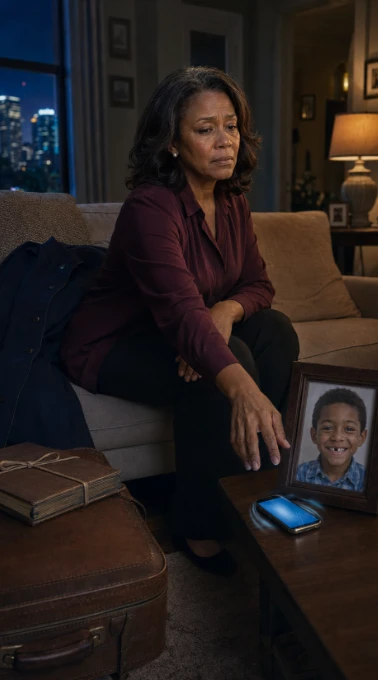
I had even brought the framed photograph that usually sat in my living room.
Robert at six years old.
Bright eyes. Missing front tooth. Mischievous smile.
He and Ethan looked so much alike that sometimes, when Holly posted a picture online, my breath caught in my throat. It felt as though time had folded itself, returning my little boy to me in another child’s face.
But Robert was not smiling now.
I swallowed the ache rising in my throat.
“I came to celebrate Ethan’s birthday.”
His fingers tightened around the door.
“Mom, I didn’t know you were actually coming.”
“You told me the date.”
“I mentioned the date.”
“I thought—”
The sharp clicking of high heels cut through my words.
Holly appeared behind him, her blonde hair perfectly smooth, her cream blouse untouched by the chaos of a children’s party. She stopped several feet away, crossed her arms, and stared at me with an expression that made me feel as if I had arrived carrying a disease instead of a gift.
“Robert,” she said, “did you invite your mother?”
“I told you I mentioned the birthday.”
Her face flushed.
“You said she wasn’t coming.”
“I didn’t say that.”
“You told me she understood boundaries.”
The children’s laughter weakened. The music continued, but the room behind them seemed to hold its breath.
I forced myself to remain calm.
“Holly, I’m not here to cause trouble. I only want to give Ethan his gift and wish him a happy birthday.”
Her eyes flicked toward the album.
For the briefest moment, something changed in her face.
It was not anger.
It was fear.
Then she looked past me, toward the street, before turning sharply back to Robert.
“Either she leaves,” Holly said, each word louder than the last, “or I leave. I am not sharing my house with this woman.”
The music stopped.
Somewhere inside, a child whispered, “What happened?”
I looked at Robert.
I had spent thirty years believing there were parts of a child that never disappeared. I believed the little boy who once climbed into my bed after nightmares still lived somewhere inside the man standing before me. I believed the child who carried my grocery bags, even when they dragged along the ground, would always remember how hard I had worked to keep food in our kitchen.
I waited for that boy to appear.
Instead, Robert looked over his shoulder again.
That was when I saw him.
An older man stood at the far end of the hallway, partly concealed by shadow. He had silver hair, a trimmed beard, and glasses with thin black frames. One hand rested against the wall.
He was too far away for me to see his face clearly.
But I saw him rub his left thumb over the metal band of his wristwatch.
Once.
Twice.
Three times.
A nervous habit.
A habit I had watched every morning for four years of marriage.
The older man saw me looking.
He stepped backward and disappeared.
My heart stumbled.
“Mom.”
Robert’s voice pulled my attention back to him.
His expression was not hard anymore.
It was terrified.
“Maybe,” he whispered, “it’s better if you go.”
The world did not collapse dramatically. There was no thunder, no scream, no sudden shattering of glass.
There was only a quiet sensation inside my chest, as though a thread that had been stretched for years had finally snapped.
I tightened my arms around the album.
“It’s fine, son.”
“Mom—”
“I said it’s fine.”
I gave him the same smile I had used when he broke my favorite lamp at nine years old. The same smile I had worn when I could not afford the bicycle he wanted for Christmas. The smile mothers learn to create when love requires them to hide pain.
“I’ll go.”
I turned before my tears could rise.
Behind me, the door began closing.
For one second, I heard rapid footsteps.
A child’s voice called, “Grandma?”
Then the door slammed.
I stood motionless on the path, staring into the humid Miami evening.
My grandson had known I was there.
Robert had still closed the door.
That night, I stayed in a small hotel near the bus terminal.
The room smelled of bleach and old cigarette smoke. The air conditioner rattled like a loose engine, and the curtains did not quite meet in the middle. Through the narrow gap, a red motel sign flashed against the wall every few seconds.
I placed my suitcase beside the bed.
The album remained unopened.
For a long time, I sat on the mattress in my traveling coat, listening to the building creak.
Then I cried.
Not politely.
Not quietly.
I cried for the twelve-hour journey. I cried for the unopened gift. I cried for Ethan calling after me. I cried for every Christmas Robert had spent with Holly’s family while I reheated soup alone in Dallas.
But most of all, I cried for the way my son had looked over his shoulder.
Robert had not been afraid of losing Holly.
He had been afraid of the man in the hallway.
I knew that gesture.
The rubbing thumb.
The watch.
James used to do it whenever he lied.
My husband had disappeared thirty years earlier on a cold October morning while I was seven months pregnant. He left behind three shirts, a cracked coffee cup, and an unpaid electricity bill.
A neighbor claimed she had seen him leaving with a younger woman.
I waited three days before accepting that he was gone.
Three days sitting near the telephone, telling myself that perhaps he had been in an accident. Perhaps he had suffered a head injury. Perhaps someone had stolen his wallet, and he was lying unidentified in a hospital.
On the fourth day, I found the note.
It contained only nine words.
I cannot live this life. Do not come looking.
There was no apology.
No explanation.
No money.
I had folded that note into a square and kept it inside an old jewelry box for nearly thirty years. I never showed it to Robert. I never told him his father had chosen another life before he was even born.
When Robert asked about James, I said only that his father had gone away.
I believed some truths were too heavy for children.
Now, sitting in that motel, I opened the photo album I had made for Ethan.
The first page showed Robert as a newborn, sleeping against my chest.
The second held his first school photograph.
The third showed him at six years old beneath the magnolia tree in Fair Park. He wore a red shirt and grinned around the gap in his teeth.
I removed the framed copy from my suitcase and placed it beside the album.
As I did, the backing loosened.
A second photograph slipped out.
I frowned.
The picture was old, its corners bent and yellow.
James stood beneath the same magnolia tree.
He was twenty-eight in the photograph, smiling reluctantly as he held six-year-old Robert’s red baseball cap.
Except James had vanished before Robert was born.
My hands went cold.
I turned the photograph over.
On the back, in handwriting I did not recognize, someone had written:
Fair Park. October 14. He watched from across the path.
Beneath those words was a date.
Robert’s sixth birthday.
I stared at it until the numbers blurred.
Someone had taken a photograph of James watching us six years after he supposedly disappeared.
I searched my memory.
That day at the park, I had felt watched. I remembered turning once and seeing a man near the food carts. He wore a baseball cap and sunglasses. When I looked again, he was gone.
I had dismissed the feeling.
A single mother learns to dismiss many things because there is never enough time to investigate every fear.
But someone else had seen him.
Someone had photographed him.
And somehow, that photograph had ended up behind the framed picture in my living room.
I studied James’s wrist.
He wore a silver watch with a dark face.
The same watch the older man at Robert’s party had touched.
A knock sounded at my motel door.
I froze.
It came again.
Three soft knocks.
I moved closer without making noise.
“Who is it?”
No answer.
I looked through the peephole.
The walkway was empty.
When I opened the door, I found a small blue plastic dinosaur on the ground.
A folded piece of paper had been wrapped around its tail.
My hands trembled as I opened it.
The message had been printed in uneven block letters.
GRANDMA, MOMMY SAID YOU HAD TO GO BECAUSE GRANDPA ALBERT WAS MAD. PLEASE COME BACK. ETHAN.
Below Ethan’s name was a crooked heart.
I sat on the floor with the note in my hands.
Grandpa Albert.
Holly’s father.
The man seated in the first row at the wedding while I sat in the third.
The man who had barely spoken to me.
The man who wore glasses, a silver beard, and a watch he touched when nervous.
I whispered his name into the empty room.
“James.”
I returned to Dallas the next morning.
The bus ride felt longer than the journey to Miami. I did not sleep. Each time I closed my eyes, I saw Robert standing in the doorway and the older man retreating into shadow.
At home, everything was as I had left it.
My coffee cup remained in the sink. A folded blanket rested on the sofa. The living room smelled faintly of lavender polish.
I placed Ethan’s note beside Robert’s photograph.
Then I took out the wedding album.
Seven years had passed since Robert married Holly, yet I remembered every detail of that day. I remembered the gold chandeliers, the expensive flowers, the string quartet, and the way Holly had introduced me to her friends.
“This is Elellanena,” she had said. “Robert’s mother. She works at a little school in Dallas.”
A little school.
Thirty years of teaching children to read had been reduced to something small and embarrassing.
I had smiled because Robert looked happy.
I had given them $20,000, money I saved over two years by tutoring after work and skipping vacations. I handed Robert the cash in a yellow envelope.
He cried.
“You are the best mother in the world.”
Three months later, I sat in the third row at his wedding.
Holly’s parents occupied the first.
I turned the album pages slowly until I found a photograph of Robert and Holly cutting their cake.
Behind them stood Albert and Martha.
Albert wore a black tuxedo, silver hair, and glasses.
I covered the lower half of his face with my hand.
The eyes were James’s.
The left eyebrow tilted higher than the right. A small crescent-shaped scar curved beside his temple, nearly hidden beneath makeup.
James received that scar when he fell through a glass door during the second year of our marriage.
I had driven him to the emergency room.
I had held his hand while the doctor placed seven stitches in his skin.
I had kissed the scar after we returned home.
Holly’s father was my missing husband.
My telephone rang at two o’clock the following morning.
I was sitting in the living room with the wedding album open on my lap. Sleep had become impossible.
When Robert’s name appeared on the screen, my chest tightened.
I answered.
“Mom?”
His voice cracked.
“Yes, son.”
“Are you alone?”
The question frightened me more than his crying.
“Yes.”
“Mom, I need your help.”
I heard a woman sobbing in the background.
Holly.
Another voice murmured something I could not understand.
Male.
Older.
“What happened?” I asked.
“I need fifty thousand dollars.”
I said nothing.
“Mom, did you hear me? I need $50,000. Tonight. It’s urgent.”
“What is it for?”
“I can’t explain.”
“You are asking for half my life savings.”
“I know.”
“Then explain.”
“I can’t!”
His voice rose, then immediately lowered.
“Please. You have always been there for me. This time too, right?”
The sentence struck me with almost physical force.
He had closed a door in my face seven days earlier.
Now he was using my lifelong devotion as collateral.
In the background, the older man spoke more clearly.
“Tell her it is life or death.”
Robert inhaled sharply.
“It’s life or death, Mom.”
I looked at the photograph of James beneath the magnolia tree.
I looked at Ethan’s blue dinosaur.
I looked at the message written in a six-year-old child’s uncertain hand.
Then I said five words.
“Albert is James. I know.”
Silence swallowed the line.
Holly stopped crying.
Robert made a sound as though the air had been knocked from his lungs.
In the background, something heavy crashed to the floor.
Then James spoke.
His voice had aged, but I recognized it instantly.
“Hang up.”
“Robert,” I said, “do not hang up.”
“Mom—”
“Is Ethan safe?”
A hand struck something near the telephone.
Robert cried out.
The connection ended.
I called back.
No answer.
I called again.
The phone went directly to voicemail.
For several seconds, I sat frozen.
Then I dialed the police.
The Miami police could not enter Robert’s house based only on my fear and an interrupted call.
They performed a welfare check.
No one answered.
The house appeared empty.
The party decorations were still visible through the windows.
Robert’s car was gone. Holly’s vehicle remained in the driveway. No signs of forced entry were found.
I told the officer about James.
I explained that he had disappeared thirty years earlier and was now living under another name.
The officer listened politely.
“Do you have proof that Albert Caine and your husband are the same person?”
“I have photographs.”
“Anything official?”
“No.”
“Fingerprints? Records? A recent identification?”
“No.”
He sighed.
“We will file the report. If your grandson is missing, one of his legal guardians needs to report it.”
“What if his legal guardians are in danger?”
“We need something more concrete.”
At nine that morning, my bank called.
A fraud specialist named Denise asked whether I had recently signed documents for a home equity loan.
“No.”
“Did you authorize your son, Robert Johnson, to borrow against your property?”
My mouth went dry.
“No.”
There was a pause.
“Mrs. Johnson, an application was submitted using your signature and Social Security number. The requested amount was fifty thousand dollars.”
I gripped the telephone.
“Where was the money supposed to go?”
“To an account belonging to a consulting company in Florida.”
“What company?”
“Caine Strategic Holdings.”
Albert Caine.
James.
The fifty thousand dollars Robert wanted was not a random amount.
Someone had already attempted to steal it from my house.
The bank had flagged the signature because it differed from documents I signed years earlier. The transfer was frozen pending verification.
“Who witnessed the application?” I asked.
The fraud specialist hesitated.
“Your son.”
I closed my eyes.
Robert’s signature appeared beneath mine.
He had not merely known about the attempt.
He had helped create it.
For several minutes after the call, I remained seated at my kitchen table, staring at the wall.
All my life, I had been afraid of becoming bitter.
I forgave unpaid debts. I forgave forgotten birthdays. I forgave careless words because I believed resentment harmed the person carrying it more than the person who caused it.
But forgiveness without truth is not mercy.
It is permission.
I telephoned a former student named Lena Ortiz.
Lena had entered my third-grade classroom twenty-two years earlier unable to read a complete sentence. Her family had moved between shelters. She arrived hungry most mornings and slept with her head on her desk.
I began bringing an extra sandwich.
Years later, she graduated from college and became a forensic accountant for a federal agency. She still sent me a card every Christmas.
When she answered, I said, “Lena, I need help.”
She did not ask whether it was convenient.
She said, “Tell me where you are.”
Lena arrived at my house that afternoon wearing a dark suit and carrying two laptops.
She listened without interrupting while I described the birthday, the man in the hallway, the hidden photograph, Ethan’s note, the telephone call, and the fraudulent loan.
When I finished, she studied the picture of James.
“Where did this come from?”
“I found it behind Robert’s childhood photograph.”
“Who had access to the frame?”
“Anyone who visited my house, I suppose. But almost nobody does.”
“Did Robert ever borrow it?”
I remembered something.
Two years earlier, Robert had visited Dallas alone for less than a day. He said he was attending a business meeting nearby. While he was at my house, he spent several minutes looking through old pictures.
He had held the framed photograph.
“This was always my favorite,” he said.
At the time, his interest had warmed me.
Now the memory felt different.
“Robert touched it,” I said. “Two years ago.”
Lena photographed every item and contacted the bank with my permission. She could not officially investigate the case herself because I was personally connected to her, but she helped me reach the appropriate fraud unit.
By evening, we had learned that Caine Strategic Holdings owned several shell companies.
One of them employed Robert as a regional director.
Another had purchased the Miami house where he lived with Holly and Ethan.
The deed was not in Robert’s name.
It belonged to a trust controlled by Albert Caine.
“Your son does not own his home,” Lena said. “He lives in a property controlled by this man.”
“James.”
“Possibly.”
“He is James.”
Lena tapped the wedding photograph.
“If he is, he has been using Albert Caine’s identity for decades.”
“Can you prove it?”
“We can try.”
The first major discovery came from an archived newspaper.
Thirty-one years earlier, James Johnson had worked as a junior accountant for a construction company in Dallas. Six months before he disappeared, the company reported that more than two million dollars had vanished through false vendor payments.
No arrests were made.
One employee was questioned.
James.
He disappeared before investigators could interview him a second time.
The younger woman seen leaving with him was never identified.
“Your husband did not simply abandon you,” Lena said.
“He ran from a financial crime.”
“And took someone with him.”
“Martha.”
We searched Martha Caine’s records.
Before marrying Albert, her maiden name had been Martha Bell.
She had worked as a secretary for the same construction company.
My stomach turned.
James and Martha had not run away because of romance alone.
They had disappeared together with stolen money.
Albert Caine’s identity first appeared in Florida records twenty-nine years earlier.
The original Albert Caine had died as an infant in Georgia.
James had stolen the identity of a dead child.
Under that name, he married Martha.
Holly was already two years old at the time.
She was Martha’s daughter from a previous relationship.
That meant Holly and Robert were not biologically related, but James had raised Holly as his own while ignoring the son he left behind.
I thought about the wedding.
James had sat in the first row beside Martha.
He watched his biological son get married while the woman who had raised that son alone sat three rows behind him.
“He knew who I was,” I whispered.
Lena looked at me.
“Yes.”
“He sat there and watched me.”
“Yes.”
“And Robert?”
“We do not yet know when Robert learned the truth.”
But in my heart, I already knew.
Before the wedding.
That was why he had looked ashamed during our two-minute dance.
That was why he could not meet my eyes when he explained that Holly wanted things “less traditional.”
He had known his father was sitting in the first row.
My son had danced with me for two minutes, then returned to the man who abandoned us.
A message arrived from an unknown number shortly after midnight.
Do not send money. Do not trust Robert. Come alone tomorrow at noon. Bayfront Park, north fountain.
A second message followed.
It contained a photograph of Ethan sleeping with a teddy bear tucked beneath his arm.
My teddy bear.
The one I knitted for his first birthday.
The bear Holly claimed she would “put away.”
I stared at the image.
Ethan’s cheek rested against the faded brown yarn. One of the ears had been repaired with blue thread.
He had not only received it.
He had loved it enough to wear it thin.
“Who sent this?” I typed.
The reply came immediately.
Holly.
Lena warned me not to go alone.
Federal investigators had now become involved because of the forged loan and James’s possible connection to the old embezzlement case. They arranged surveillance at the park.
At noon, I sat on a bench near the fountain.
The sky was painfully bright. Tourists walked past carrying drinks. Children chased pigeons. Every few seconds, I looked toward the paths, expecting to see Robert, James, or a police officer.
Holly appeared wearing sunglasses and a baseball cap.
She sat beside me without greeting.
For a long moment, neither of us spoke.
Then she removed her glasses.
A dark bruise colored the skin beneath her left eye.
I felt anger before sympathy.
“What happened?”
“Albert.”
“James.”
She flinched.
“Yes.”
“Where is Ethan?”
“With my mother.”
“Is he safe?”
“For now.”
“And Robert?”
Her mouth tightened.
“I don’t know anymore.”
I turned toward her.
“You spent seven years making me feel unwelcome. You embarrassed me at the wedding. You kept me away from my grandson. You stood in that doorway and demanded that I leave.”
“I know.”
“That is not an explanation.”
“No.”
“Then give me one.”
Holly looked toward the fountain.
“When I met Robert, I thought he was kind. Ambitious, but kind. My father gave him a position in the company. Robert admired him. He wanted his approval more than anything.”
“He knew Albert was James.”
“Not at first.”
“When did he learn?”
“Three months before our wedding.”
The yellow envelope.
The twenty thousand dollars.
My son had taken my savings while hiding the fact that he had found his father.
Holly continued.
“Albert told Robert that you drove him away. He said you were controlling, that you threatened to destroy his life, that you kept Robert from him.”
“And Robert believed him?”
“He wanted to.”
Those words hurt because they were true.
Robert wanted a version of the past in which his father had not rejected him.
James offered him one.
In James’s story, Robert was not an abandoned child. He was a stolen son. I was not the mother who sacrificed everything. I was the villain who kept father and child apart.
“What did James give him?”
“A job. Money. The house. Connections. Everything Robert thought he deserved.”
“And what did you do?”
Holly’s eyes filled with tears.
“At first, I believed Albert too. Robert showed me messages and documents. They were fake, but I didn’t know that. I thought you were manipulative. I thought every gift came with expectations.”
“The teddy bear?”
“I put it in Ethan’s crib that night.”
My throat tightened.
“Why did I never see it?”
“Because when you visited, I hid anything that might make you feel important. I was cruel.”
Her honesty silenced me.
“I could tell you Albert forced me,” she said. “But that would not be completely true. I looked down on you. I was ashamed of your house, your school, your clothes. I thought money made my family better than you.”
She wiped her cheek.
“I was wrong.”
“What changed?”
“Six months ago, I found a passport in Albert’s office. It had his photograph and the name James Johnson.”
She confronted Robert.
He admitted everything.
Then she discovered the companies were collapsing. James had been borrowing under false identities, laundering funds, and moving money into offshore accounts. Robert had signed documents for him.
“Why my house?”
“Your credit was clean. Your property was paid off. Albert said you would never notice until the loan was complete.”
“And Robert agreed?”
Holly closed her eyes.
“Yes.”
I stood so abruptly that a nearby pigeon flew away.
“My son forged my signature.”
“He witnessed it. Albert created the signature.”
“That makes no difference.”
“I know.”
“Why did you force me out of the party?”
Holly’s face changed.
“Because Albert had a gun.”
The sounds of the park seemed to fade.
“He came to the party unexpectedly,” she said. “He had discovered I copied financial records. He thought I had contacted the police. When you arrived carrying that album, he saw the photograph through the wrapping. He recognized the frame.”
“The photograph of Robert?”
“He knew another picture was hidden behind it.”
“Who put it there?”
“Robert.”
I sat again.
Holly explained that Robert had secretly photographed James in Fair Park when he was six.
Not personally.
A private investigator hired by my late father had taken the picture.
My father had suspected James was alive. Before dying, he gave Robert the photograph when Robert turned eighteen, but Robert never showed it to me.
“He kept it,” Holly said. “Years later, after he met Albert, he used it to confront him.”
“Why hide it behind the frame in my house?”
“Insurance. Robert told me that if something happened to him, you might eventually find it.”
“Then why did he participate in stealing from me?”
“Because fear and greed can live in the same person.”
She looked directly at me.
“Robert spent years benefiting from Albert. Then, when he discovered the full scale of the crimes, he tried to leave. Albert threatened Ethan.”
“The call?”
“Albert discovered Robert had been speaking to federal investigators.”
I stared at her.
“Robert was cooperating with them?”
“For almost five months.”
The revelation did not erase the forged loan.
It did not restore the missed Christmases or remove the image of the closing door.
But it complicated everything.
The boy I raised had betrayed me.
The man he became had also tried, too late and too secretly, to undo part of that betrayal.
“What was the fifty thousand dollars for?”
Holly took a shaking breath.
“It was not to save our house.”
“Then what?”
“It was Albert’s price for letting Robert live.”
James had discovered Robert’s cooperation the morning of Ethan’s birthday party.
He arrived armed and furious.
Holly wanted to cancel the party, but James refused. A crowded house provided cover. He instructed them to behave normally until he moved money and arranged transportation.
Then I appeared.
James saw me through the hallway.
Holly panicked.
She believed that if I recognized him, he would kill me before I could leave the house.
So she created a scene.
She made herself look cruel because cruelty was believable.
Robert understood and went along with it.
“He was not afraid I would leave,” Holly said. “He was afraid Albert would step into that doorway.”
I remembered Robert looking over his shoulder.
The terror in his eyes.
“Why didn’t Robert warn me afterward?”
“Albert took his phone.”
“The dinosaur?”
“Ethan heard us arguing. He slipped out through the back gate with one of the older children and followed you to the hotel with Martha’s driver.”
“Your mother helped him?”
“Martha has been helping Albert for thirty years, but she loves Ethan. She allowed him to leave the note.”
“Where is Martha now?”
“With Albert.”
“And Ethan?”
Holly hesitated.
“I thought he was with her.”
The words chilled me.
“You said he was safe.”
“He was when I left.”
Her phone rang.
She looked at the screen and went pale.
A video message had arrived.
Ethan sat in a chair inside an unfamiliar room. His hands were free, but he was crying silently. James stood behind him with one hand on his shoulder.
“Bring Elellanena,” James said in the recording. “Bring the money. No police.”
The camera moved.
Robert appeared on the floor nearby, blood on his shirt.
The video ended.
Holly made a broken sound.
I took the phone from her.
A location followed.
An abandoned marina south of the city.
Lena and the federal agents had monitored the meeting. They moved immediately.
But James’s message included a warning.
If he saw police vehicles, he would leave by boat with Ethan.
The agents wanted time.
I had none.
“That is my grandson,” I said.
One investigator stepped in front of me.
“And this man is armed.”
“He has spent thirty years believing everyone else will pay for his choices.”
“Mrs. Johnson—”
“He is asking for me.”
Holly touched my arm.
“He will kill you.”
I looked at the bruise beneath her eye.
“Then help me make sure he does not get another chance.”
The marina smelled of salt, rust, and gasoline.
The sun had begun to set, turning the water copper. Abandoned storage buildings stood along the docks with broken windows and peeling paint.
I carried a bag containing bundles of cut paper between two real stacks of currency.
A transmitter had been concealed beneath my blouse.
Agents surrounded the area at a distance, hidden inside maintenance vehicles and nearby buildings.
Holly walked several steps behind me.
We entered the largest warehouse.
James stood beside a speedboat.
Thirty years had changed him, but not enough.
The beard, glasses, and expensive clothes could not hide the man who once complained when dinner was five minutes late. They could not hide the scar near his temple or the slight curve in his left shoulder.
Robert sat against a support beam. Blood darkened one sleeve, but he was conscious.
Ethan stood beside Martha, clutching the knitted teddy bear.
When he saw me, he cried out.
“Grandma!”
James raised a pistol.
“Do not move.”
I stopped.
For the first time in thirty years, my husband and I looked directly at each other.
“Elena,” he said.
No one had called me that since my mother died.
“My name is Elellanena.”
A faint smile touched his mouth.
“You always hated when people shortened it.”
“You remember that, but not your son’s birth.”
Robert lowered his head.
James’s smile vanished.
“Where is the money?”
“Let Ethan go.”
“You are not in a position to negotiate.”
“I have spent my entire life negotiating with fear. I am finished.”
Martha tightened her grip on Ethan’s shoulder.
She looked older than she had at the wedding. The elegance was gone. Her hands trembled.
“You should have stayed in Dallas,” she whispered.
“I did stay in Dallas. For thirty years.”
James extended his hand.
“The bag.”
I lifted it slightly.
“Why fifty thousand?”
“Because that is what I need.”
“No. Why exactly fifty?”
His jaw tightened.
Behind him, Robert shifted.
James pointed the gun toward him.
“Do not.”
I understood then.
The money was not merely an escape fund.
It was a test.
If I brought it, James would know I was still willing to sacrifice myself for Robert. He could use that loyalty again. More loans. More signatures. More threats.
If I refused, Robert became disposable.
“You told him I kept you away,” I said.
James’s eyes narrowed.
“You poisoned him against me.”
“I told him the truth.”
“You left a pregnant wife without electricity.”
“You made me feel trapped.”
“I worked while you stole.”
“You always believed you were better than me.”
“No. I believed marriage meant you did not disappear with stolen money.”
His face hardened.
Robert spoke from the floor.
“She knows everything.”
James struck him with the pistol.
Ethan screamed.
Something inside me changed.
For years, I had confused love with endurance. I had thought strength meant absorbing every blow without returning one.
But strength was not silence.
Strength was deciding where the pain ended.
“You want the money?” I said.
James looked at me.
I opened the bag.
The top bundles of currency were visible.
His attention shifted for one second.
Holly moved.
She grabbed Ethan and pulled him away from Martha.
James swung the pistol toward them.
Robert lunged from the floor.
The gun fired.
The warehouse exploded with sound.
Robert fell.
Agents poured through the entrances shouting commands.
James grabbed me and pressed the gun beneath my jaw.
“Stay back!”
Red targeting lights moved across his chest.
Ethan screamed my name.
James dragged me toward the boat.
His breath was hot against my ear.
“You destroy everything,” he whispered.
“No,” I said. “I survived everything.”
He stumbled.
Martha had wrapped both arms around his legs.
For one impossible second, all three of us froze.
James looked down at her.
“What are you doing?”
Martha’s face crumpled.
“What I should have done thirty years ago.”
I drove my elbow backward.
James lost his grip.
Agents tackled him before he reached the boat.
The pistol skidded across the floor.
Holly ran toward Ethan.
I dropped beside Robert.
Blood spread across his shirt near his shoulder.
His eyes found mine.
“Mom.”
“I’m here.”
“I’m sorry.”
“Save your strength.”
“I knew he was alive.”
“I know.”
“I wanted him to love me.”
The words came from somewhere far younger than the man lying before me.
For an instant, I saw the six-year-old boy beneath the magnolia tree.
The child carrying bags larger than his arms.
The boy asking whether his mother would ever leave.
“I wanted him to choose me,” Robert whispered.
“And when he did?”
“I became someone I thought he would respect.”
Tears slid into his hair.
“I became him.”
I pressed my hands around the wound while paramedics rushed toward us.
“No,” I said. “You made terrible choices. But you are still here to answer for them.”
“Can you forgive me?”
It would have been easy to say yes.
It would have made the scene softer. It would have sounded like something a mother was expected to say beside an injured child.
But Robert was not a child.
And forgiveness offered too quickly becomes another lie.
“I love you,” I told him. “But I do not know yet.”
His eyes closed.
The paramedics lifted him onto a stretcher.
I stood with blood on my hands as James was led away in handcuffs.
He looked at me once.
I expected hatred.
Instead, I saw fear.
For thirty years, he had survived because everyone around him remained silent.
Now the silence was over.
Robert survived.
The bullet passed through his shoulder without striking an artery.
He was arrested after leaving the hospital.
His cooperation with federal investigators reduced the charges against him, but it did not erase them. He had knowingly signed fraudulent documents, helped move money, and participated in the attempt to borrow against my house.
He pleaded guilty.
James faced charges involving identity theft, kidnapping, assault, money laundering, fraud, and the old construction-company embezzlement.
Martha also faced charges, although her actions at the marina and later testimony were considered by the court.
Holly received limited immunity in exchange for providing records and cooperating with investigators. She filed for divorce from Robert.
For the first time in seven years, she brought Ethan to Dallas.
He walked into my house carrying the teddy bear.
“His name is Blue,” he announced.
The bear was brown, but I did not question a six-year-old’s logic.
“You kept him,” I said.
Ethan hugged the bear tighter.
“Mom said you made him before I was born.”
“I did.”
“He keeps bad dreams away.”
Holly stood near the doorway.
The same woman who once blocked me from her home now seemed uncertain whether she was welcome in mine.
I stepped aside.
“You can come in.”
Her eyes filled.
“Thank you.”
Trust did not return in a single afternoon.
Neither did affection.
But truth created a place where something new might eventually grow.
Ethan opened the photo album that never reached him at his birthday party. We sat together on the living-room rug while I told him stories about Robert as a child.
“That’s Dad?” he asked, pointing at the photograph beneath the magnolia tree.
“Yes.”
“He looks like me.”
“He does.”
“Was he nice?”
The question caught me.
“He was curious. Stubborn. Funny. He loved blueberry muffins.”
“Is he still nice?”
I looked at Holly.
She did not rescue me from the answer.
“Your father has done some things that hurt people,” I said. “He is trying to tell the truth now.”
Ethan considered this.
“Can someone be bad and good?”
“Yes.”
“At the same time?”
“Yes.”
“Is that why grown-ups are always tired?”
I laughed for the first time in weeks.
“Probably.”
That evening, after Ethan fell asleep on the sofa, Holly handed me the teddy bear.
“There is something inside it.”
She opened a seam beneath one arm and removed a tiny digital recorder.
“What is this?”
“Robert gave it to me three months before the birthday.”
She pressed a button.
Static filled the room.
Then Robert’s voice emerged.
“Mom, if you are hearing this, I failed to tell you the truth while I still had the chance.”
I stopped breathing.
The recording continued.
“I knew Dad was alive before my wedding. I believed everything he told me because his lies gave me something I wanted—a father who had not abandoned me.”
Robert paused.
“I accepted his money. I let Holly disrespect you. I allowed you to sit in the third row while he sat in the first. I knew who he was, and I said nothing.”
Holly lowered her eyes.
“I told myself I was protecting you from the truth. I was really protecting the life he gave me.”
Robert’s voice became uneven.
“When I discovered the companies were built on stolen identities and ruined lives, I tried to leave. He threatened Ethan. I began working with investigators, but I was too ashamed to tell you.”
Another pause.
“If he learns I am cooperating, he will use you. He knows you would give everything to save me.”
I closed my eyes.
“That is why I need you to do something I never allowed you to do.”
His next words were barely above a whisper.
“Choose yourself.”
The recording ended.
For a long time, neither Holly nor I spoke.
Then I noticed something stitched into the bear beside the recorder.
A small folded piece of paper.
I removed it.
It contained account numbers, dates, and names.
The complete map of James’s hidden financial network.
“Robert put this here?” I asked.
Holly shook her head.
“I thought he did.”
“Who else knew about the bear?”
“Only Ethan.”
We woke him gently.
He rubbed his eyes.
“Sweetheart,” Holly said, “did you put this paper inside Blue?”
Ethan nodded.
“Where did you get it?”
“Grandpa Albert dropped it.”
“When?”
“At my birthday.”
The final piece fell into place.
During the party, James had carried the list of accounts he intended to access before fleeing. When I arrived, his panic caused him to drop it.
Ethan found the paper.
He did not understand the numbers, but he understood that his grandfather wanted it.
So he hid it inside the safest thing he owned.
The teddy bear his grandmother had made for him.
The forgotten gift.
The bear I believed Holly had discarded.
The small piece of love that had remained inside their house even when I had been shut outside.
The evidence on that paper led investigators to more than twelve million dollars hidden across multiple accounts.
Most of the money was returned to victims and their families.
The old construction-company employees recovered pensions they had lost decades earlier. Several families saved their homes. Martha testified that James had planned to disappear again, abandoning all of them exactly as he had abandoned me.
Robert eventually received a five-year sentence.
I visited him once after his transfer.
We sat across from each other beneath fluorescent lights. He looked older, thinner, and strangely more like the boy I remembered.
“I listened to the recording,” I said.
He nodded.
“I meant every word.”
“Why didn’t you tell me directly?”
“Because I was a coward.”
“Yes.”
He accepted the answer.
“I thought becoming successful would prove he was wrong to leave me.”
“And did it?”
“No. It only proved I was willing to leave you too.”
His eyes filled, but he did not look away.
“I don’t expect you to forgive me.”
“That is the first honest thing you have expected from me in years.”
He almost smiled.
“Ethan asks about you,” I said.
“Is he okay?”
“He is learning that adults can make terrible choices and still tell the truth afterward.”
“Do you believe that?”
“I believe telling the truth is where responsibility begins. It is not where it ends.”
Robert nodded slowly.
When our time was over, he stood.
“Mom?”
“Yes?”
“That night at the door—I wanted to tell you to run.”
“I know.”
“I wasn’t choosing Holly over you.”
“Not that night.”
The words struck him.
Because we both understood.
That night, he had been afraid for me.
But the years before it belonged to him.
He had chosen wealth.
He had chosen admiration.
He had chosen his father’s lies because they were easier than his mother’s sacrifices.
One brave act could not erase seven years of cruelty.
But seven years of cruelty did not make every remaining act meaningless.
“I love you,” he said.
“I love you too.”
It was not forgiveness.
Not yet.
But it was true.
A year later, Ethan celebrated his seventh birthday in my backyard in Dallas.
There were blue and silver balloons tied to the fence.
Holly brought a chocolate cake with strawberries, Robert’s childhood favorite.
Martha was not there.
James would spend the rest of his life in prison.
Lena attended with her husband and two daughters. Several teachers from my school came. Children ran beneath the magnolia tree I had planted near the back fence.
Ethan opened his gifts at a picnic table.
When he reached mine, he carefully removed the paper.
Inside was a new photo album.
The first page held a picture of him at six years old, hugging Blue.
The second showed him and me baking blueberry muffins.
The third showed Holly sitting on my porch with a cup of coffee, laughing at something outside the frame.
The later pages were empty.
“What goes there?” Ethan asked.
“Whatever happens next.”
He considered this answer seriously.
“Even mistakes?”
“Especially mistakes.”
“Why?”
“Because families are not made only from their happiest moments. They are made from the truth about all of them.”
Ethan placed the album beside his teddy bear.
Then he wrapped his arms around me.
“Grandma?”
“Yes, baby?”
“Moms don’t leave, right?”
The question carried me back nearly forty years, to Robert standing beside my bed after a nightmare.
I once told him mothers never leave.
But life had taught me something more complicated.
Sometimes staying physically present is not enough.
Sometimes people remain in your life while abandoning your dignity, your trust, or your heart.
And sometimes leaving a doorway is the only way to return to yourself.
I kissed Ethan’s forehead.
“People sometimes leave,” I said. “But love should never ask you to disappear.”
He did not completely understand.
One day, he would.
As the sun set, the balloons moved gently above the fence. Children laughed. Holly carried empty plates toward the kitchen.
My telephone buzzed.
A scheduled message from the prison system informed me that Robert had completed another counseling program. Beneath the notification was a short note from him.
I am learning to become someone who does not need another person to become small.
I read it twice.
Then I put the phone away.
I did not rush to answer.
I did not feel guilty.
For most of my life, I believed motherhood meant giving until nothing remained. I believed love meant waiting beside closed doors. I believed patience could transform neglect into gratitude.
I had been wrong.
Love without boundaries becomes a place where cruelty learns to live comfortably.
My son had needed consequences more than he needed another rescue.
Holly had needed truth more than appearances.
Ethan had needed adults willing to end the secrets passed from one generation to another.
And I had needed five words.
Not because they punished Robert.
Not because they exposed James.
But because they marked the first moment in thirty years when I refused to be used.
“Albert is James. I know.”
Five words opened every locked room in our family.
They exposed the husband who vanished, the son who betrayed me, the woman who misjudged me, and the child who unknowingly saved us all.
Yet the greatest secret was not hidden in a false identity, a stolen bank account, or a recording sewn inside a teddy bear.
It was hidden inside me.
I had spent decades waiting for someone else to prove that my sacrifices mattered.
In the end, I discovered that my worth had never depended on whether my son opened the door.
I looked across the yard at Ethan laughing beneath the magnolia tree.
Then I walked toward him—not as a rejected mother, not as an abandoned wife, and not as a woman waiting to be chosen.
I walked toward him as Elellanena Johnson.
A teacher.
A grandmother.
A survivor.
And, at last, a woman who had chosen herself.