
The moment my eight-year-old son whispered, “I’m not hungry,” I knew someone at that table was going to lose far more than the price of dinner.
Noah was hungry.
He had been talking about Grandpa’s retirement celebration for an entire week. He had ironed his blue button-down shirt himself, leaving one stubborn crease near the pocket, and spent an hour drawing a card in careful block letters:
Happy Retirement, Grandpa. I’m proud of you.
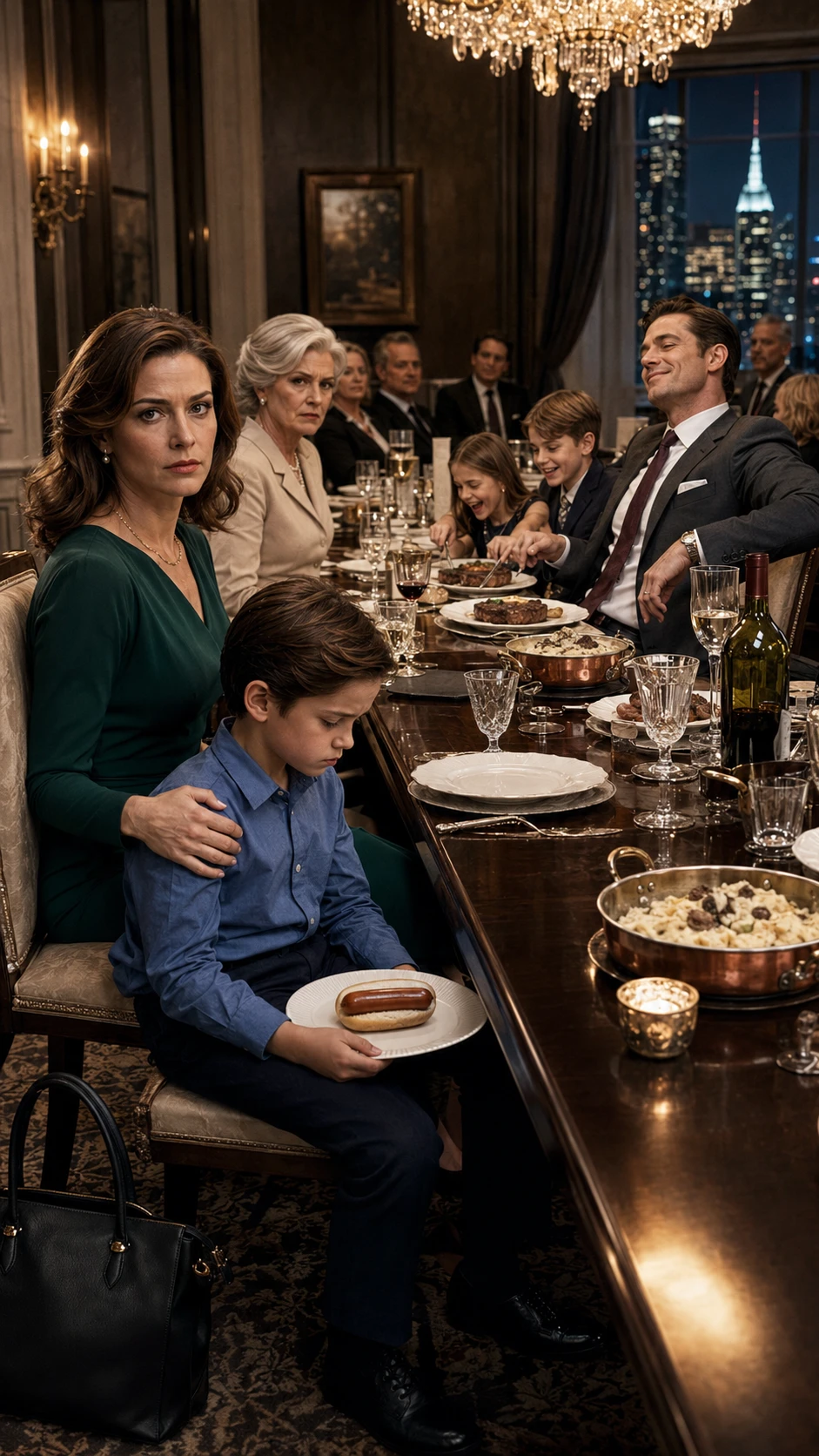
Yet in the chandelier-lit private dining room, while his cousins sliced into $120 steaks, Noah sat with a dry hotdog on a paper plate.
No fries. No garnish. No real plate.
Just a limp bun, a wrinkled sausage, and a smear of mustard that looked as careless as the people who had ordered it.
My brother Eric tapped the edge of the plate with two fingers.
“There,” he said, reclining in his chair. “We didn’t order for your son.”
His children laughed as butter melted over their steaks. Copper pans of truffle mashed potatoes moved around the table. Imported wine flashed ruby-red inside crystal glasses. Twenty-two relatives filled the room, all dressed as though they had come to celebrate love, loyalty, and family.
Not one of them spoke for Noah.
He looked at his cousins, then at me. His cheeks reddened.
“I’m okay, Mom,” he whispered. “I’m not that hungry.”
That was the moment something inside me stopped hurting and became cold.
Eric’s wife, Melissa, gave a little laugh.
“Kids are picky anyway.”
My father cleared his throat and hid behind the wine list.
My mother took a slow sip of water before looking directly into my eyes.
“Honestly, Claire, you know how these dinners are,” she said. “You should’ve packed him something.”
The words landed harder than a slap.
I placed my hand on Noah’s shoulder. Beneath my palm, he felt small and rigid, as though he were trying not to breathe too loudly.
“You don’t have to eat that,” I said.
Eric scoffed.
“Don’t start drama, Claire. He’s a kid. Kids eat hotdogs. He’ll survive.”
Around us, forks kept moving.
That was what stunned me most. Not Eric’s cruelty. I had known what he was for years.
It was the way everyone else chose comfort over decency.
They were willing to watch a child shrink into himself as long as their steaks stayed warm.
My gaze moved slowly around the room.
Premium menu. Imported wine. Custom dessert tasting. A three-tier retirement cake waiting near the kitchen doors.
All arranged by Eric, who had told everyone not to worry because “the family account” would cover everything.
The family account.
They loved that phrase.
Three years earlier, after Mom’s surgery, I had opened an emergency fund so none of us would panic over medical bills again. Every month, I deposited money.
Quietly.
Consistently.
Eric had never contributed a dollar.
Dad had never contributed.
Mom had withdrawn money twice and called it “reimbursement for stress.”
Still, when the family wanted luxury, my money became everyone’s money. But when my son needed a proper meal, responsibility suddenly belonged only to me.
A waiter entered carrying another bottle of wine—the absurdly expensive one Eric had ordered after joking that it cost more than my first car.
The timing was perfect.
I stood.
Chair legs scraped softly beneath me. Conversations faded. Forks stopped halfway to mouths.
Eric smiled wider, clearly expecting a sentimental toast.
I lifted my glass.
“Before dessert arrives,” I said, “I’d like to make one announcement.”
My mother’s eyes narrowed.
Dad finally lowered the wine list.
Noah looked up at me, startled.
I turned to the waiter.
“Please separate the checks. Everything ordered for my son and me goes on my card. Everything else goes to the person who ordered it.”
The waiter nodded.
Eric’s smile vanished.
“And please remove my card from the family account on file.”
The room went silent.
Eric shoved his chair backward.
“Claire,” he said, his voice low, “don’t do this here.”
I looked at Noah’s untouched hotdog, then at the steaks, wine, smug faces, and enormous cake.
I reached into my purse and pulled out my phone.
“Here is exactly where this needs to happen.”
I tapped the screen and turned it toward him.
At the top was the pending charge for that evening:
$13,684.52.
A murmur rippled through the table.
Eric’s jaw tightened. “It’s Dad’s retirement.”
“No,” I said. “It’s your performance.”
I swiped down.
There were charges for a ski resort, private-school tuition, designer luggage, a golf-club membership, jewelry, and a $28,400 transfer labeled FAMILY RETIREMENT GIFT.
Melissa stopped chewing.
My mother’s face went pale, but only for a second.
“You’re embarrassing your brother,” she snapped.
“No. The bank records are embarrassing him.”
Eric stood. “You gave us access.”
“I gave Mom access for medical emergencies.”
“She gave me the card.”
“And you treated it like an inheritance.”
Dad whispered, “Eric, sit down.”
But Eric did not sit. His expression hardened into the one he had worn since childhood whenever consequences approached.
“You always do this,” he said. “You act like you’re better than us because you have money.”
I almost laughed.
They had no idea how little this was about money.
“I froze the account at four this afternoon,” I said.
Eric stared at me.
The waiter quietly set the wine bottle down.
“So tonight’s charge won’t clear,” I continued. “Neither will the transfer. The bank’s fraud department already has the records.”
Several relatives began studying their plates. Others looked at Eric as if they had never seen him before.
Melissa leaned toward him.
“You said the retirement gift came from your bonus.”
Eric ignored her.
My mother rose abruptly.
“This is ridiculous. That fund belongs to this family.”
“No,” I said. “It belongs to the person whose name is on it.”
“We raised you!”
“And I supported you. Those are not the same transaction.”
Her mouth opened, but my father finally spoke.
“Enough.”
His voice was quiet, yet it carried across the room.
He placed the wine list on the table and looked older than he had an hour earlier.
“Claire is right,” he said.
My mother turned on him. “Robert—”
“I said she’s right.”
Eric stared at our father in disbelief.
Dad’s hands trembled as he folded them.
“I knew about some withdrawals,” he admitted. “Not all of them.”
A bitter taste rose in my throat.
“You knew?”
He looked down.
That tiny movement answered everything.
He had known enough to ask questions. Enough to stop it. Enough to warn me.
He had simply preferred peace.
“Why didn’t you tell me?” I asked.
“Because tonight was supposed to be my retirement announcement,” he said. “And I thought after tonight…things might settle.”
“Settle?” I repeated. “You watched your grandson get humiliated because you didn’t want to spoil dessert.”
Noah’s fingers closed around the handmade card on his lap.
Dad saw it and flinched.
Eric slammed his palm on the table.
“This whole thing is insane. Dad is retiring, I’m taking over the company, and I’ll repay the account.”
My mother seized the opening.
“Exactly. Eric will be president. Once the transition is complete, none of this will matter.”
For the first time that evening, I smiled.
It was not a kind smile.
Eric saw it and stopped speaking.
“What?” he demanded.
I unlocked a second folder on my phone.
Three years earlier, my father’s manufacturing company had been weeks from collapse. A failed expansion, two lost contracts, and a lender demanding immediate repayment had pushed it to the edge.
Nearly two hundred employees were about to lose their jobs and pensions.
Eric had been in the Bahamas at the time, posting photographs from a yacht.
Dad had called me at two in the morning.
I had invested through a holding company, purchased the lender’s debt, covered payroll, and acquired seventy-four percent of the business.
Dad had begged me to keep the arrangement private. He said Eric would be humiliated if people knew his younger sister had saved the company he expected to inherit.
So I had agreed.
I had protected my brother’s pride for three years.
Tonight, he had fed my son a hotdog on a paper plate.
“Eric,” I said, “you are not taking over Dad’s company.”
He laughed, but it came out thin.
“You don’t decide that.”
“Yes,” Dad said hoarsely. “She does.”
Every face turned toward him.
My mother gripped the back of her chair.
“What are you talking about?”
Dad closed his eyes briefly.
“Claire owns the controlling interest.”
The silence that followed felt physical.
Eric blinked. “No.”
I placed the corporate ownership document on the center of the table.
“North Star Holdings owns seventy-four percent,” I said. “Your promotion required its approval.”
Eric snatched up the document. His eyes raced across the page.
“You hid this from me?”
“I protected you from the truth,” Dad said. “There’s a difference.”
Eric looked at me with naked hatred.
“So this was your plan? Humiliate me in front of everyone?”
“My plan was to let Dad retire with dignity. Then you humiliated my child.”
I tapped another file.
“This morning, the board received the fraud report. Effective immediately, your company access is suspended pending investigation.”
Melissa pushed away from him as if the chair itself had burned her.
My mother whispered, “Claire, you can’t destroy your own brother.”
“I didn’t create the transactions.”
Eric’s voice cracked.
“You think you can steal my future?”
That sentence erased the last trace of pity I had left.
“Your future was never mine to fund.”
The dining-room door opened.
The restaurant manager entered with the final bill and two security officers behind him—not because I had summoned them, but because Eric had begun shouting and the staff had grown concerned.
He set the leather folder beside Eric.
“Sir,” the manager said, “the card provided for the event has been declined.”
Twenty-two relatives looked at the man who had promised them a free feast.
Eric stared at the bill as though it were a death sentence.
Then my mother turned to me, her voice suddenly soft.
“Claire, please. For your father.”
I looked at Dad.
He looked at Noah.
Slowly, my son placed the retirement card on the table, but he did not slide it toward his grandfather.
Dad’s eyes filled.
“Noah,” he said, “I’m sorry.”
Noah glanced at me before answering.
“You saw my plate.”
Four words.
That was all.
Dad lowered his head.
I picked up Noah’s paper plate and handed it to the waiter.
“Please bring my son anything he wants. On a real plate.”
The waiter crouched beside Noah.
“What would you like, young man?”
Noah thought for a moment.
“A cheeseburger,” he said quietly. “And fries.”
“Absolutely.”
As the waiter walked away, Eric gave a hollow laugh.
“You’ll regret this. When Dad’s gone, I’ll challenge the shares. Blood matters.”
I looked at him.
That was the final mistake he made that night.
“Read the last page,” I said.
His hands shook as he turned it over.
The ownership was not in my personal name.
North Star Holdings was owned by an irrevocable trust created three years earlier.
I was only the trustee.
The sole beneficiary’s full legal name appeared in bold at the bottom: