
The applause hit me like a slap.
Three hundred guests cheered beneath the glowing white wedding tent as my new daughter-in-law lifted her champagne glass and smiled toward the farmhouse on the hill.
“After the honeymoon,” Madison announced, “Daniel and I are moving into the ranch.”
For one breathless second, the meadow seemed to tilt.
The crystal chandeliers hanging from the tent poles blurred into streaks of gold. The string quartet kept playing, though the violin sounded suddenly thin and distant. Around me, neighbors, relatives, business associates, and people I had never met clapped as if they had just witnessed something beautiful.
My son did not look at me.
Daniel stared into his champagne glass as though my dead husband’s land had already changed hands—as though the ranch were another wedding gift waiting to be unwrapped.
That clapping stayed with me longer than Madison’s words.
It rolled across the meadow where Robert used to repair fence posts until sunset. Beyond the tent stood the barn he had painted the summer before his heart gave out. Farther up the slope was the farmhouse where his work gloves still hung beside the back door because I had never found the strength to move them.
And there stood Madison in lace and pearls, glowing as though the ranch had spent forty years waiting for her arrival.
“It’s going to be our first real home,” she continued. “A place where we can build our future.”
Our first real home.
Not my home.
Not Robert’s ranch.
Not the place I had kept alive through droughts, tax bills, broken pipes, aching knees, and grief so heavy that some mornings felt like walking through wet cement.
I sat near the back of the tent with my purse clutched in my lap. My fingers locked around the clasp until the metal left a crescent-shaped mark in my palm.
The woman beside me leaned closer.
“How sweet,” she whispered.
Sweet.
Madison had always been gifted at making greed sound like gratitude.
She called the barn “rustic charm,” the pasture “premium event space,” and my old kitchen “full of potential.” The first time Daniel brought her to Sunday supper, she toured the farmhouse in boots too polished for ranch dirt.
“This place has so much character,” she said.
“It has a mortgage history too,” I replied.
She laughed because she thought I was joking.
But Robert and I had not joked our way into that land. We had bled for it. We had signed papers that terrified us, stretched grocery money, sold horses we loved, and worked years longer than our bodies wanted to.
There had been winters when the pipes froze, summers when the creek nearly dried up, and entire months when we counted every dollar before buying groceries.
Robert once spent three nights sleeping in the barn because a mare was struggling through a difficult birth. I remembered carrying coffee to him before dawn, finding him covered in straw and blood with a newborn foal breathing against his chest.
He had looked up at me and smiled.
“This place gives back,” he said. “Not always when you want it to. But it gives back.”
Madison saw none of that.
She saw a backdrop.
A lifestyle.
A prize.
And somewhere along the way, Daniel had started seeing the ranch through her eyes.
At first, his comments had seemed harmless.
“Mom, those stairs are getting steep.”
“Mom, maybe you should think about moving into town.”
“Mom, the ranch is too much for one person.”
Then came the blue folder.
Daniel brought it to my kitchen table one Sunday and called it “estate-planning updates.” Madison sat beside him, turning her engagement ring around her finger while he explained that property could become complicated “at my age.”
At my age.
I skimmed the first page, closed the folder, and slid it back.
“If this is only to make things easier later,” I said, “then later can wait.”
Madison smiled.
But something behind her eyes sharpened.
Two weeks before the wedding, I found a copy of a property form in my mailbox. There were initials marked where mine should have been.
Close.
Not perfect.
Close enough for someone counting on an old widow not looking carefully.
I had placed that form in the bottom drawer of Robert’s desk and told myself I would confront Daniel after the wedding. I did not want to spoil his day over something that might have been a misunderstanding.
That was the lie I had chosen because the truth frightened me.
So when Madison raised her glass and announced my ranch to three hundred people as though it already belonged to her, every comment, every false concern, and every page in that blue folder suddenly made sense.
Daniel finally glanced at me.
Not like a son asking forgiveness.
Like a frightened boy hoping his mother would stay quiet until the guests went home.
I stood.
The chair scraped across the rented floor, slicing through the applause.
Madison’s smile flickered.
I walked past the gift table and the tower of ivory-wrapped presents. I passed the framed photograph of Robert that Madison had surrounded with white roses without asking me.
In the picture, Robert was leaning against the barn, sunburned and laughing, one hand resting on the fence post he had just repaired.
For a moment, I imagined him watching me.
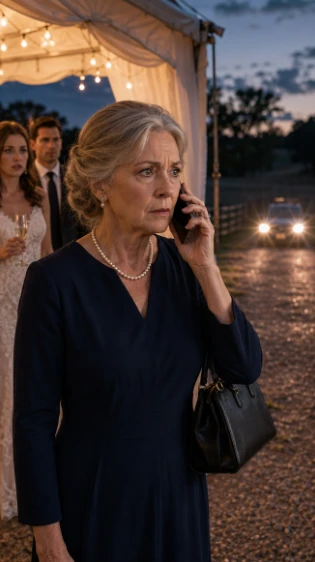
Then I stepped out into the cool evening air.
Behind me, the tent glowed against the darkening meadow.
People laughed.
Glasses clinked.
The band changed songs.
Everyone was still believing the pretty version.
I took my phone from my purse and called the county records office.
A woman answered on the fourth ring.
“County Recorder’s Office. Miriam Sloan speaking.”
I gave her my full name, my parcel number, and the address of the Reynolds horse ranch.
Then I asked, very calmly, “Has anyone filed transfer papers with my initials on them?”
The line went quiet.
Not the ordinary silence of someone searching a computer.
This silence had weight.
Keys clicked in the background.
“Mrs. Reynolds,” she said slowly, “can you confirm that you are currently at the property?”
“Yes.”
“And you did not personally authorize a deed transfer this morning?”
The music behind me seemed to fade.
“No.”
Another pause.
“Did you appear before a notary named Helen Baird?”
My heart gave one hard beat.
“Helen Baird died last November.”
Miriam inhaled sharply.
“Mrs. Reynolds, I think you need to hear what came across my desk at nine twelve this morning.”
My grip tightened around the phone.
“What was filed?”
“A quitclaim deed transferring four hundred and eighty acres, including the residence, agricultural buildings, water rights, and access easements, to an entity called R&R Legacy Holdings.”
I turned toward the tent.
Madison was visible through the opening, still holding her champagne glass.
Daniel stood beside her now. His face was pale.
“Who owns that company?” I asked.
“I’m pulling the registration.”
The clicking resumed.
Then it stopped.
“The managing members are listed as Daniel Reynolds and Madison Vale Reynolds.”
My knees nearly failed me.
I reached for the nearest fence post.
Miriam continued speaking, but for several seconds I could hear nothing except the rushing of blood in my ears.
“Mrs. Reynolds?”
“I’m here.”
“There is something else. Your parcel had a fraud-monitoring instruction attached to it.”
“I never requested one.”
“It was placed in the system eleven years ago by Robert Reynolds.”
The name struck deeper than the deed.
Robert had been dead for almost four years.
“Why would my husband do that?”
“I don’t know,” Miriam said. “But the instruction was very specific. Any transfer, lien, or encumbrance involving this property was to be manually reviewed before acceptance.”
I stared toward the barn.
Robert had never mentioned such an instruction.
“The document filed this morning carried an electronic notary credential that was reported inactive after Mrs. Baird’s death,” Miriam said. “The signatures also failed our preliminary comparison.”
“Then reject it.”
“We have placed it on administrative hold. I have also notified the county fraud investigator.”
As she spoke, headlights appeared at the far end of my gravel road.
A dark vehicle turned through the gate and began climbing toward the wedding.
Inside the tent, Madison raised her glass again, trying to recover the mood.
She had no idea who was coming up that road.
Or perhaps she did.
Because when she saw the headlights, her smile disappeared.
The vehicle stopped beside the horse trailers.
A woman in a dark suit stepped from the driver’s side. She was perhaps forty-five, with black hair pulled tightly behind her head and the steady expression of someone who did not waste time asking questions she could answer herself.
A uniformed deputy climbed out beside her.
The woman approached me and opened a leather identification case.
“Mrs. Reynolds? Detective Nora Ruiz, County Financial Crimes Unit.”
I lowered my phone.
“Miriam Sloan called you?”
“She called twenty minutes ago. We were already nearby.”
“Why?”
Her gaze moved past me toward the wedding tent.
“Because this property was flagged before today.”
A third person emerged from the rear seat.
He was an elderly man in a tan suit, moving carefully with a polished wooden cane. I recognized him before he reached us.
Samuel Pike had been Robert’s attorney for almost thirty years.
I had not seen him since the funeral.
“Sam?”
His face looked older than I remembered. His white eyebrows pulled together with worry.
“Eleanor,” he said. “I wish we were meeting under different circumstances.”
Before I could ask why he was there, Madison came hurrying from the tent.
The skirt of her wedding dress brushed over the grass. Daniel followed several steps behind her. Madison’s father, Grant Vale, came after them with a lawyer’s posture and a businessman’s expression of carefully measured irritation.
Madison stopped when she saw Detective Ruiz.
“What is going on?”
Ruiz did not answer immediately.
Her attention moved over Madison’s face, the champagne glass in her hand, and the dirt collecting along the hem of her expensive dress.
“Are you Madison Vale Reynolds?”
Madison straightened.
“Yes.”
“And you are Daniel Reynolds?”
Daniel nodded.
Grant stepped forward.
“I’m Grant Vale. Madison’s father. This is a private event.”
Ruiz looked at him.
“Then you should probably return to it, Mr. Vale.”
“I’m also counsel for Vale Development.”
“That does not make you counsel for either of these individuals.”
Madison turned to me.
“Eleanor, what did you do?”
The question was so perfectly wrong that for a moment I could only stare at her.
“What did I do?”
“Calling the police during our wedding?”
“I called the county records office.”
Daniel’s shoulders dropped.
Madison looked at him, then back at me.
“You misunderstood the announcement.”
“You announced that you were moving into my house.”
“Our house,” she said quickly. “Eventually.”
“No. You said after the honeymoon.”
Guests had begun gathering near the tent opening. The band stopped playing. Conversations quieted one by one until the meadow seemed to be holding its breath.
Daniel took a step toward me.
“Mom, please. We should discuss this inside.”
“You chose to discuss my property in front of three hundred people.”
“I didn’t know she was going to announce it.”
Madison’s head snapped toward him.
“What?”
He looked away.
Detective Ruiz removed a document from a folder.
“A quitclaim deed was filed this morning transferring the Reynolds ranch to R&R Legacy Holdings. The filing bears what appears to be Eleanor Reynolds’s signature and the notarization of Helen Baird.”
Madison’s face remained still, but her fingers tightened around the stem of her champagne glass.
Grant Vale stepped closer.
“That transfer was authorized.”
“No,” I said. “It wasn’t.”
Grant gave me the patient smile men like him used when they wanted women to question their own memories.
“Eleanor, you may not recall every page you signed.”
“I recall not signing away my home.”
“The documents were explained to you.”
“By whom?”
His smile thinned.
“Daniel.”
Every eye turned toward my son.
Daniel looked as though someone had pulled the ground out from under him.
“Dad—” Madison began.
“Don’t,” Grant said.
Detective Ruiz held up the deed.
“There is a more immediate problem. Helen Baird could not have notarized this document.”
Grant folded his arms.
“Electronic notarizations can be processed in advance.”
“Helen Baird died eight months ago.”
A murmur swept through the guests.
Someone dropped a glass inside the tent.
It struck the floor and shattered.
Madison’s champagne glass trembled.
Daniel closed his eyes.
“Furthermore,” Ruiz said, “the notary credential attached to this filing was reported compromised after Mrs. Baird’s death.”
“This is absurd,” Grant said. “A clerical error does not justify turning a wedding into a criminal spectacle.”
Ruiz looked past him toward the white tent, the flowers, and the hundreds of silent witnesses.
“I did not choose the venue.”
I almost admired the sentence.
Madison’s expression hardened.
“Eleanor signed the papers.”
“I did not.”
“You forget things.”
The words were soft, but everyone heard them.
Daniel looked at his wife.
“Madison.”
She ignored him.
“You left the stove burning in March,” she said. “You misplaced your medication twice. Daniel has been concerned for months.”
There it was.
Not merely theft.
A story they had been building about my mind.
Every harmless comment suddenly became evidence. Every moment of ordinary forgetfulness had been collected, polished, and placed into a narrative where I was no longer capable of managing my own life.
“I left a kettle on,” I said. “Once.”
“You also forgot an appointment.”
“With the dentist.”
Daniel stepped between us.
“Stop.”
Madison turned on him.
“You told me she was declining.”
The guests reacted as if a cold wind had moved through them.
My son looked at me.
For one second, I saw the child who used to run toward the porch with scraped knees. Then his expression collapsed beneath something darker.
Guilt.
Not confusion.
Not innocence.
Guilt.
Detective Ruiz noticed it too.
“Mr. Reynolds,” she said, “did you participate in preparing this deed?”
Daniel swallowed.
“I need to speak to my mother privately.”
“That was not my question.”
Grant moved toward him.
“Daniel, say nothing.”
Madison laughed once, sharply.
“Oh, now you want him quiet?”
Her father’s eyes flashed.
“Madison.”
She looked from Grant to Daniel, and I watched panic push through the cracks in her perfect bridal composure.
Then she turned toward the crowd.
“This was Daniel’s idea.”
Daniel’s face emptied.
Madison pointed at him with the hand holding her glass.
“He created the company. He brought me the documents. He said his mother would never give him what was already supposed to be his.”
The silence that followed seemed larger than the meadow.
Daniel whispered, “You’re lying.”
“Am I?”
“You forged her initials.”
“You gave me the copies.”
“Madison.”
“You said she would blame me because she never liked me.”
The champagne glass slipped from her hand.
It struck the grass without breaking, spilling a dark stain across the hem of her dress.
My son turned toward me.
“Mom, it’s not what it sounds like.”
I looked at him for a long time.
“Then make it sound different.”
He opened his mouth.
Nothing came out.
Behind him, the wedding cake stood beneath the tent, six white tiers untouched.
It was never cut.
By ten o’clock, the guests were gone.
Some left quietly. Others lingered near their cars, pretending to search for keys while watching deputies move between the tent and the farmhouse.
The caterers packed food into silver trays. The band dismantled its equipment without speaking. White roses lay crushed into the grass.
Madison and Grant were separated for questioning.
Daniel sat at my kitchen table in the same chair where he had placed the blue folder three weeks earlier.
His tie was gone. His collar hung open. He looked smaller than he had beneath the wedding lights.
Detective Ruiz sat opposite him. Samuel Pike stood near the window.
I remained by the stove because sitting felt impossible.
The farmhouse seemed to resist the strangers inside it. Robert’s clock ticked above the mantel. Wind pressed softly against the screen door. His gloves still hung beside it.
Daniel rubbed both hands over his face.
“I formed the company,” he said.
The words landed with no drama.
Perhaps some truths are too ugly to make noise.
“When?” Ruiz asked.
“Six months ago.”
“Before your engagement?”
“Yes.”
I closed my eyes.
Madison and Daniel had become engaged five months earlier.
“What was the purpose of the company?” Ruiz asked.
Daniel looked at me.
“To manage the ranch.”
“The ranch did not require your management.”
“I thought Mom would eventually agree.”
“You thought wrong,” I said.
His jaw tightened.
“Madison’s father said the property could generate income. Weddings, retreats, vacation rentals—”
“It already generated income. It was a working ranch.”
“Barely.”
The word came too quickly.
Robert’s clock ticked.
I looked at my son and felt something inside me become still.
“Barely?” I asked.
He stared at the table.
“You know what I mean.”
“No. Tell me.”
“Dad worked himself to death for this place.”
Samuel Pike shifted near the window.
Daniel continued before anyone could stop him.
“And now you spend every day preserving it exactly as he left it. The gloves. The barn. His coffee cup in the cabinet. It’s like the whole ranch became a museum to a man who isn’t coming back.”
The cruelty of it took my breath.
I wanted to strike him.
Instead, I looked toward Robert’s gloves.
“You are right about one thing,” I said. “He isn’t coming back.”
Daniel’s anger vanished as quickly as it had appeared.
“Mom, I’m sorry.”
“No. You’re frightened. That is not the same thing.”
Ruiz leaned forward.
“How did Madison obtain Mrs. Reynolds’s signature?”
Daniel stared at his hands.
“I scanned old documents.”
The room seemed to contract around me.
“What documents?” I asked.
“Tax forms. Insurance papers. Things Dad kept in the office.”
“You went through his desk?”
“I needed examples.”
“For a forgery.”
“I didn’t think she would actually file anything.”
Ruiz’s voice hardened.
“But you formed the company, scanned the signatures, supplied the parcel information, and discussed transferring the land.”
“I thought it would be temporary.”
“What would be temporary?”
Daniel hesitated.
“A financing arrangement.”
Samuel Pike turned from the window.
“What financing arrangement?”
Daniel looked at Grant’s empty chair as though the man might still rescue him.
“Vale Development has a resort project outside Bellweather. They needed additional collateral for a bridge loan. Grant said that if we temporarily moved the ranch into the holding company, he could package the properties together.”
My mouth went dry.
“You intended to mortgage my ranch for Madison’s father?”
“It wasn’t supposed to be a mortgage against the house.”
“The deed included the house.”
“I didn’t prepare the final version.”
“But you prepared everything that made the final version possible.”
Daniel lowered his head.
Detective Ruiz placed a small recorder on the table.
“Did Grant Vale promise you compensation?”
“He promised to clear my business debts.”
I stared at my son.
“What debts?”
Daniel’s face folded.
Two years earlier, he had launched a livestock-monitoring company. He told me investors had covered the losses when it failed.
They had not.
He owed banks, private lenders, and Grant Vale nearly two million dollars.
Madison had not simply entered his life at a charity horse show, as I had been told.
Grant had introduced them after Daniel approached him for money.
The romance had been built on a negotiation.
“How much were you supposed to receive?” Ruiz asked.
“Twenty percent of the resort company.”
“And Madison?”
“She would control R&R Legacy Holdings with me.”
“Fifty-fifty?”
Daniel hesitated.
“Sixty-forty.”
“In whose favor?”
“Madison’s.”
Despite everything, I almost laughed.
My son had tried to steal my ranch and had still negotiated himself into second place.
Samuel Pike walked to the table and placed both hands on the back of a chair.
“Daniel, did Grant know about the old loan?”
Daniel looked up sharply.
“What old loan?”
Something changed in Samuel’s face.
He glanced at me.
I understood then that there was more in my house than a forged deed.
There was something Robert had kept from me.
“Sam,” I said, “why were you in that vehicle?”
He removed his glasses.
“Because Miriam Sloan contacted me after she saw Robert’s fraud instruction.”
“That does not answer my question.”
He looked suddenly tired.
“Robert asked me to come if anyone ever attempted to transfer the ranch using Daniel’s authority.”
Daniel stood.
“What does that mean?”
Samuel did not look at him.
“It means your father expected this.”
The sentence struck all of us silent.
I gripped the edge of the stove.
“Expected what?”
Samuel looked toward Robert’s gloves.
“Not Madison,” he said. “Not this wedding. But something like this.”
Daniel’s chair scraped backward.
“That’s insane.”
“Sit down,” Ruiz said.
“My father trusted me.”
Samuel’s expression held a sadness deeper than anger.
“Your father loved you.”
“That isn’t what I said.”
“No,” Samuel replied. “It isn’t.”
Long after Detective Ruiz took Daniel to the sheriff’s office for a formal statement, I remained in the kitchen with Samuel.
The wedding tent glowed faintly through the windows. Half the lights had been switched off, leaving the meadow full of long shadows.
Samuel poured water into two glasses.
I did not touch mine.
“What did Robert know?” I asked.
Samuel sat across from me.
“Eleven years ago, someone submitted an inquiry to use part of the ranch as collateral for a commercial loan.”
“Who?”
“The inquiry came through one of Daniel’s early business ventures.”
I remembered the venture. He had been twenty-four and convinced he could turn discarded horseshoes into decorative furniture for luxury hotels.
Robert had given him eight thousand dollars.
The business lasted seven months.
“He told us it failed.”
“It did.”
“Did he try to mortgage the ranch?”
“Not exactly. He listed the ranch as a company asset on a preliminary financing statement.”
My hands went cold.
“He did not own it.”
“I know.”
“Did Robert confront him?”
“Yes.”
“Why didn’t he tell me?”
Samuel looked down.
“He believed Daniel had made a foolish mistake. He paid the outstanding balance and had the filing withdrawn.”
“How much?”
“Seventy-six thousand dollars.”
I stood so quickly my chair tipped.
Robert and I had sold six broodmares that year.
He told me the market was changing.
I remembered watching the trailers carry them away while Robert stood beside me with his hands in his pockets.
“He lied to me.”
“He was trying to protect you.”
“He protected Daniel.”
Samuel did not argue.
I paced to the screen door.
The gloves hung inches from my face.
Brown leather, worn smooth at the palms. One thumb was patched with gray thread because Robert refused to throw anything away that could still be repaired.
“What else?” I asked.
Samuel remained silent.
I turned.
“What else did my husband hide?”
“There is a safe-deposit box.”
“Where?”
“First County Bank.”
“What is inside?”
“I don’t know. Robert sealed it himself.”
“You were his lawyer.”
“And he was my client. He had the right to keep private property.”
“Why tell me now?”
“Because the access condition has been met.”
I stared at him.
“What condition?”
Samuel reached into his coat and removed a small brass key attached to a faded leather tag.
On the tag, in Robert’s handwriting, were three numbers.
317.
“He instructed me to give you this if Vale Development ever attempted to acquire or encumber the ranch.”
I took the key.
“Robert knew Grant Vale?”
“Very well.”
The name carried through the kitchen like smoke.
Grant had behaved at the wedding as though he knew the land, the documents, and the law better than I did.
Perhaps he did.
“How well?”
Samuel looked toward the dark window.
“Twenty-three years ago, Grant almost lost his company. Robert saved it.”
I laughed once, because the idea sounded absurd.
Robert distrusted developers. He said they could look at a hundred-year-old oak tree and see only the price of lumber.
“He would never have invested in Vale Development.”
“He did not invest.”
“What-year-old oak tree and see only the price did he do?”
“He made Grant a private loan.”
“How much?”
“Six hundred thousand dollars.”
The room went quiet except for the ticking clock.
“We never had six hundred thousand dollars.”
“You did after the North Creek land sale.”
I remembered the sale. Robert inherited eighty acres from his uncle. He told me the money went into retirement investments and ranch improvements.
Some of it had.
Not all.
“Why would he lend it to Grant?”
“Because Grant’s father had once helped Robert’s family keep this ranch.”
I knew that story. During the flood of 1972, Elias Vale brought tractors and men to reinforce the creek bank.
Robert never forgot a debt.
“Was the loan repaid?”
“Partially.”
“How much remains?”
Samuel looked at me.
“With interest and penalties, approximately four million dollars.”
I sat slowly.
“Grant owes me four million dollars?”
“He owes the Reynolds Family Trust.”
“I have never heard of the Reynolds Family Trust.”
“You were not meant to access it unless certain conditions occurred.”
Anger rose inside me again.
Robert had built secret rooms inside our marriage and left me to discover them after he was gone.
“What conditions?”
Samuel glanced at the brass key in my hand.
“Fraud against the ranch.”
At eight the next morning, Samuel and I stood inside First County Bank.
I had not slept.
The wedding dress Madison left in the bridal suite still hung upstairs. Daniel’s childhood photographs remained on my mantel. The blue folder sat sealed in an evidence bag.
Normal objects had become evidence of a life I no longer understood.
A bank employee led us through a steel door into a private room.
She placed Box 317 on the table and left.
My hands trembled as I inserted the brass key.
The lid opened with a metallic click.
Inside were four items.
A thick legal envelope.
A leather-bound ledger.
A flash drive.
And a letter with my name on it.
Eleanor.
Robert’s handwriting.
I touched the ink.
For four years, I had wanted one more word from him.
Now I was afraid to read it.
Samuel opened the legal envelope first.
The pages inside described a private loan from Robert Reynolds to Grant Vale, secured by fifty-one percent of the voting shares in Vale Development Corporation.
The agreement contained an acceleration clause.
If Grant Vale, his company, his heirs, agents, or affiliated entities attempted to acquire the Reynolds ranch through fraud, coercion, falsified documents, or undisclosed encumbrance, the remaining debt would become immediately due.
If unpaid within ten business days, the pledged shares would transfer to the Reynolds Family Trust.
Samuel read the provision twice.
Then he looked at me.
“Eleanor, yesterday’s filing triggered the clause.”
I stared at the pages.
“What does that mean?”
“It means Grant has ten business days to pay approximately four million dollars.”
“And if he cannot?”
“The trust takes control of his company.”
I thought of Grant beneath the wedding tent, telling Detective Ruiz that the transfer was authorized.
“He tried to steal my ranch to save a company Robert already had the power to take.”
Samuel nodded slowly.
“The irony would have pleased your husband.”
But I did not feel pleased.
I felt surrounded by ghosts and contracts.
I opened Robert’s ledger.
Every payment Grant had made was recorded in careful handwriting. Beside the final entry, dated nine years earlier, Robert had written:
Vale stopped paying. Daniel contacted him three months later. Watch both.
I read the sentence again.
“Daniel contacted Grant nine years ago?”
Samuel leaned closer.
“That is what it says.”
Daniel had claimed he met Grant only two years earlier.
I opened the letter.
Ellie,
If you are reading this, then one of two things has happened. Either Grant Vale has finally come back for the ranch, or Daniel has let desperation convince him that love excuses theft.
I had to stop.
The words blurred.
Samuel touched my shoulder, but I moved away.
I continued reading.
I hope I was wrong about both of them.
I need you to understand something before anger closes your heart. Daniel is our son. I have loved him from the first night he slept against my chest. But love cannot be allowed to turn blindness into kindness.
Years ago, Daniel used the ranch address and my name to secure financing. I paid the debt and removed the filing. I told myself he was young.
He did it again.
My breath caught.
A second attempt had occurred three years after the first. Daniel forged Robert’s signature on a personal guarantee connected to another failed business.
Robert had covered that debt too.
He had never told me.
I kept reading.
I did not tell you because I was ashamed. Not of Daniel. Of myself. I kept saving him from consequences and calling it fatherhood.
The third time, I changed calling it fatherhood.
The the trust.
If Daniel knowingly participates in any attempt to transfer, mortgage, or obtain the ranch without your freely given consent, he loses all beneficial interest in the land and in the Vale collateral.
Everything passes instead to the Reynolds Equine Recovery Foundation.
I had never heard of that foundation either.
Samuel explained that Robert had created it on paper shortly before his death. It would provide housing, employment, and equine therapy for women rebuilding their lives after financial abuse.
I pressed my hand over my mouth.
Robert’s younger sister had spent seventeen years married to a man who controlled every dollar she touched. She died before she found the courage to leave him.
The ranch had been intended to become a refuge if Daniel betrayed it.
Robert’s letter ended with one final paragraph.
Do not mistake forgiveness for permission.
If Daniel does this again, love him if you must.
But do not save him.
Robert
For a long time, I could not move.
Then Samuel pointed toward the flash drive.
“There may be more.”
The drive contained scanned records, correspondence, and one audio file.
Robert’s voice filled the small bank room.
Older.
Rougher.
Alive.
“Grant,” he said in the recording, “you stay away from my land and away from my son.”
Grant’s voice answered.
“Your son came to me.”
“I know.”
“He thinks you’re holding him back.”
“He thinks consequences are cruelty.”
“He wants what will be his eventually.”
“The ranch will never be his to sell.”
There was a pause.
Then Grant laughed softly.
“You can’t protect Eleanor forever.”
Robert’s reply came without hesitation.
“I don’t need forever. I only need enough time to make sure you regret trying.”
The recording ended.
Samuel and I sat in silence.
A moment later, my phone rang.
Detective Ruiz.
“We found something on Madison’s laptop,” she said. “You need to come to the station.”
Madison was no longer wearing her wedding dress when I saw her.
She sat behind the interview-room glass in gray sweatpants and a borrowed sweatshirt. Her makeup was gone. Without the pearls, lace, and controlled smile, she looked younger.
Daniel sat in a separate room.
Grant, lace, and controlled smile had already retained three attorneys.
Detective Ruiz led me into a conference room and placed a laptop on the table.
“We recovered messages between Madison, Grant, and Daniel.”
“Daniel told me Madison forged the signature.”
“She did.”
A small, ugly relief moved through me.
Then Ruiz continued.
“But she did it with material Daniel provided.”
“I know.”
“There is more.”
She opened an email dated nine years earlier.
It was from Daniel to Grant Vale.
The subject line read: Opportunity involving Reynolds acreage.
I read the message.
Daniel had described the ranch’s size, water rights, access roads, and estimated value. He wrote that Robert would never sell, but that “succession could create possibilities.”
Nine years earlier, Madison had not been in his life.
There was no bride to blame.
No engagement ring.
No persuasive woman whispering into his ear.
My son had offered Grant a path to the ranch long before he ever met Grant’s daughter.
“Madison wasn’t the beginning,” I whispered.
“No.”
Ruiz opened another file.
A voice recording began.
Daniel’s voice.
Calm.
Confident.
Nothing like the frightened man at my kitchen table.
“She already suspects you,” he told Madison.
Madison replied, “Because you keep making me ask questions.”
“That’s the point. If anything goes wrong, she’ll look at you.”
“You said she would sign.”
“She might. If she doesn’t, we have enough samples.”
A chair creaked in the recording.
Madison lowered her voice.
“What happens after the transfer?”
“We borrow against the ranch. Your father clears my debt. Then we trigger the old Vale agreement.”
My skin went cold.
Madison sounded confused.
“What old agreement?”
“Something my father set up. Grant thinks he buried it, but he didn’t.”
“You told Dad you didn’t know the details.”
“I told your father what he needed to hear.”
There was a pause.
“What are you planning, Daniel?”
His answer came softly.
“By the time they understand it, I’ll control the ranch and Vale Development.”
Madison laughed nervously.
“Your mother controls the trust.”
“Not after the competency petition.”
The room around me vanished.
Ruiz stopped the recording.
I could not breathe.
“Competency petition?” I whispered.
She opened the blue folder recovered from my kitchen.
The first pages contained estate-planning documents.
The later pages did not.
There was a draft petition requesting that Daniel be appointed conservator over my finances due to alleged cognitive decline.
Attached were statements about the forgotten dentist appointment, the kettle left burning, and medication I had supposedly misplaced.
Photographs had been taken inside my home.
A list described my behavior.
Confusion.
Isolation.
Fixation on deceased spouse.
Inability to maintain property.
At the bottom was a blank space for a physician’s signature.
“They weren’t just taking the ranch,” Ruiz said. “Daniel intended to have you declared incompetent after the deed was filed.”
I stared through the glass at my son.
He sat alone with his head bowed.
“He planned to betray Madison too?”
“Yes. Grant believed the ranch would save Vale Development. Madison believed she and Daniel would control the property. Daniel intended to trigger the old loan agreement, gain influence over the trust through a conservatorship, and take both.”
The scale of it was almost impossible to understand.
Daniel had not been manipulated into betraying me.
He had built the betrayal carefully enough to give everyone else a reason to trust him.
Grant thought Daniel was desperate.
Madison thought he was weak.
I thought he was my son.
We had all mistaken hunger for helplessness.
“Why did Madison announce the move?” I asked.
“Daniel encouraged her.”
“Why?”
“Public pressure. He believed that if three hundred witnesses heard the announcement, you would be too embarrassed to contradict them. If you objected later, they would claim you had forgotten promising the property.”
I thought of the applause.
The woman whispering, “How sweet.”
The entire beautiful wedding had been staged not merely as a marriage, but as evidence.
My son had turned celebration into a weapon.
Ruiz resumed the recording.
Madison said, “What if she refuses in front of everyone?”
Daniel answered, “She won’t. Mom would rather lose the ranch than make a scene at my wedding.”
I closed my eyes.
He had almost been right.
Ruiz paused the file.
“We need your cooperation.”
“You have the recordings.”
“We have conspiracy, attempted fraud, identity theft, and elder financial exploitation. But Daniel will argue that these conversations were hypothetical or that Madison manipulated the files.”
“What do you need?”
“Your testimony.”
I looked through the glass.
Daniel lifted his head.
Our eyes met.
Even through two panes of glass, I recognized the expression.
The same expression from the wedding.
Not remorse.
Calculation.
He stood and moved closer to the window.
His lips formed one word.
Mom.
For thirty-five years, that word had been enough to make me cross rooms, answer phones, forgive debts, cancel plans, and open doors.
That morning, for the first time, it sounded like a key he no longer had.
Grant Vale failed to pay the debt within ten business days.
His attorneys challenged the collateral agreement, the fraud provision, Robert’s signature, and the trust itself.
They lost every emergency motion.
The documents were valid.
The loan was real.
And the forged deed connected Vale Development directly to the attempted fraud.
Three weeks after the wedding, fifty-one percent of Vale Development’s voting shares transferred to the Reynolds Family Trust.
I became the controlling trustee of the company Grant had spent his life building.
Newspapers described it as a stunning corporate reversal.
They called me a ranch widow who had “unexpectedly acquired a development empire.”
They were wrong.
I had not acquired anything.
I had inherited the final move in a game Robert had begun years earlier.
Grant resigned before the board could remove him.
Madison accepted a plea agreement after turning over additional recordings and documents. She admitted forging my initials, using Helen Baird’s stolen notary credential, and helping prepare the competency petition.
Her cooperation reduced her sentence.
It did not erase it.
On the morning she was taken into custody, she asked to speak with me.
I almost refused.
Then I remembered Robert’s letter.
Do not mistake forgiveness for permission.
The visitation room smelled of disinfectant and old coffee.
Madison sat across from me behind thick glass.
For several seconds, neither of us lifted the telephone.
When we finally did, she spoke first.
“I’m sorry.”
I waited.
She looked down.
“I know that means nothing.”
“It means less than nothing when it arrives after evidence.”
Her eyes filled.
“I did love him.”
“Daniel?”
“Yes.”
“Did you love him when you forged my signature?”
She flinched.
“I thought the ranch would be his someday.”
“You did not want someday.”
“No.”
“Why?”
She wiped her cheek.
“My father’s company was collapsing. Daniel said we could save it.”
“And the conservatorship?”
Her face twisted.
“He told me it was temporary. He said you would fight the transfer because you were grieving and confused.”
“Did I seem confused to you?”
“No.”
“But you helped him build the story.”
She closed her eyes.
“Yes.”
I studied her.
Madison had been greedy, cruel, and willing to reduce my life to convenient symptoms.
But she had also believed she was Daniel’s partner.
She had not understood that he intended to discard her after she committed the crime that would make him rich.
“You stood in my meadow wearing a white dress,” I said, “and announced that you were taking my home.”
“I know.”
“Did you feel anything when you looked at me?”
Her answer came after a long silence.
“Powerful.”
The honesty surprised me.
“And now?”
“Stupid.”
I shook my head.
“No. Stupidity is touching a hot pan. You made choices.”
She pressed her fingers against the glass.
“I don’t expect you to forgive me.”
“That is the first sensible thing you’ve said.”
I placed the telephone back on its cradle.
As I stood, Madison spoke quickly.
“There’s something you don’t know.”
I lifted the receiver again.
“What?”
“Daniel told my father about the loan agreement years ago. Before he met me.”
“I know.”
“No. You don’t understand. Daniel didn’t discover the trust by accident.”
Her voice dropped.
“He found it in Robert’s office before Robert died.”
A chill moved through me.
“What are you saying?”
“Daniel knew his father had changed the inheritance.”
“How?”
“He read a draft.”
I tightened my grip on the telephone.
“Why would that matter now?”
Madison looked toward the guard.
“Because Daniel said Robert was going to tell you everything the night he died.”
The room seemed to lose sound.
“What everything?”
“About the forged guarantees. The trust. All of it.”
I stared at her.
Madison’s eyes held mine.
“Daniel was at the ranch that night.”
The official record said Robert had been alone.
He had called me from the barn shortly before seven, complaining of chest pressure. I was in town buying groceries. By the time I returned, he was unconscious beside the tack-room door.
Daniel told me he had been two hours away.
“Why are you telling me this now?”
“Because I thought Daniel loved me,” Madison whispered. “Then I heard what he told the detective.”
“What did he say?”
“That people see what grief teaches them to see.”
A guard approached.
Madison leaned toward the glass.
“Ask them to test Robert’s old medication.”
The line went dead.
Robert had been cremated.
There was no body to examine.
For two days, I told myself Madison was lying to hurt Daniel.
Then Detective Ruiz searched Daniel’s storage unit.
Inside a locked metal cabinet, investigators found Robert’s medical files, copies of the trust drafts, and a small plastic bag containing an amber prescription bottle.
Robert’s name was printed on the label.
The medication was nitroglycerin.
The bottle should have been beside him the night he died.
It had never been found.
Daniel claimed he took it from the farmhouse after the funeral because he could not bear to see his father’s name.
The laboratory found something else.
The tablets inside were not nitroglycerin.
They were ordinary breath mints, cut and shaped to resemble medication.
My world narrowed to the size of that bottle.
Investigators reconstructed the final evening.
Daniel’s phone had connected to a tower less than six miles from the ranch, not two hours away.
A deleted voicemail was recovered from Robert’s old cloud account.
It was recorded at 6:48 p.m.
Robert’s voice sounded strained.
“Daniel was here. We argued. He took my pills. Ellie, I’m trying to reach—”
The message ended.
Daniel had not poisoned his father.
He had done something quieter.
He had taken away the medicine that might have saved him.
He left Robert struggling for breath beside the barn.
Then he drove away and told himself that a weak heart had made the decision.
My husband’s heart had failed.
My son had made sure no help reached it.
Daniel was charged with murder.
The news broke on a cold Thursday morning.
Cameras gathered outside the courthouse. Commentators discussed inheritance, forged deeds, corporate control, and the wedding announcement that had exposed everything.
People asked how I had failed to see what my son had become.
I asked myself the same question every night.
The answer was never simple.
Daniel had once carried injured birds into the kitchen and begged me to save them. He had slept beside Robert’s hospital bed after knee surgery. He had cried at the funeral.
Perhaps all of those things were true.
Perhaps love and cruelty had lived inside him together.
That was the hardest truth.
Monsters in stories arrive already monstrous.
Real people arrive as babies.
You hold them.
Feed them.
Teach them to speak.
Years later, they use the words you gave them to lie.
Daniel asked to see me before the trial.
I went because I needed to look at him without glass between us.
We met in a secured interview room at the county jail. His wrists were cuffed to a metal ring on the table.
He had lost weight.
Gray showed at his temples.
For a moment, he looked like Robert.
The resemblance made me angry.
“Mom,” he said.
I sat opposite him.
“Do not call me that as a strategy.”
His eyes lowered.
“I never meant for Dad to die.”
“You took his medication.”
“He had another bottle.”
“You did not know that.”
“He was angry. He said he was cutting me out.”
“So you punished him.”
“I wanted time.”
“You drove away.”
“I panicked.”
“You erased your location.”
He looked at me.
“I was scared.”
“Robert was scared.”
His mouth tightened.
“I loved him.”
I thought of Robert gasping into the voicemail.
“Love without mercy is possession.”
Tears filled Daniel’s eyes.
It would have been easier if they looked false.
They did not.
“I made terrible mistakes,” he said.
“You made plans.”
“Madison pushed—”
“Do not.”
He stopped.
“Do not give that woman another ounce of blame that belongs to you.”
His shoulders sagged.
For the first time, I saw that he understood the old machinery had failed. No one was coming to pay the debt, withdraw the charge, rewrite the story, or tell me that saving him was motherhood.
“What will happen to the ranch?” he asked.
The question almost made me smile.
Even then.
Even in handcuffs.
“The ranch will never belong to you.”
He looked away.
“The trust clause?”
“Yes.”
“Dad hated me.”
“No.”
Daniel’s head snapped up.
“He expected me to fail.”
“He expected you to choose.”
“He set a trap.”
“Your father set a boundary. You crossed it.”
Silence settled between us.
“What about Vale Development?” he asked.
“It is being reorganized.”
“You don’t know how to run a development company.”
“No. But I know how to recognize rot.”
His jaw tightened.
I continued.
“Grant’s unfinished luxury resort is being sold. The proceeds will repay creditors and compensate families harmed by his fraudulent investments.”
“And the company?”
“It will become something else.”
“What?”
“The Reynolds Equine Recovery Foundation.”
He stared at me.
“You’re giving away everything.”
“No. I am putting it where you cannot reach it.”
He leaned forward until the chain between his cuffs pulled taut.
“That ranch was supposed to be mine.”
There it was.
The sentence beneath every lie.
I stood.
“No, Daniel.”
My voice did not shake.
“You were supposed to be worthy of it.”
Daniel pleaded guilty before the murder trial began.
The recovered voicemail, location data, medication bottle, and financial records left little room for another ending.
He received a sentence long enough that I would probably never see him free.
Madison served three years.
Grant served seven for conspiracy, fraud, and financial crimes connected to Vale Development.
The wedding photographs disappeared from social media, but copies still surfaced occasionally in news articles.
Madison raising her glass.
Daniel looking down.
Me sitting in the background with my purse clutched in both hands.
People often said they could see the truth in the photograph.
They could not.
No photograph contains the whole truth.
It only captures the instant before people understand what they are seeing.
A year after the wedding, we removed the white tent’s final anchor from the meadow.
In its place, construction began on three cottages for women and children rebuilding their lives after financial abuse.
The barn became a therapy center.
The old guesthouse became offices.
Vale Development’s former accountants helped create employment programs. Former resort designers planned accessible trails. The company that had tried to steal the ranch ended up paying to preserve it.
On opening day, sixty people gathered beneath the cottonwoods.
Not three hundred.
There was no champagne.
No lace.
No announcement about ownership.
A young woman named Claire stood beside a chestnut mare near the fence. She had arrived six months earlier with two suitcases and a daughter who had stopped speaking after years of watching her father control and terrorize their home.
That afternoon, the child whispered her first full sentence to the mare.
“You’re safe here.”
I turned away so no one would see me cry.
Samuel Pike stood beside me.
“Robert would have liked this,” he said.
“Yes.”
“Do you still feel angry with him?”
“For hiding the truth?”
Samuel nodded.
“Sometimes.”
Robert I deserved to know.
I loved one.
I had loved the other.
Love did not make either choice right.
After the ceremony, I walked alone to the farmhouse.
Robert’s gloves still hung beside the back door.
I had passed them thousands of times.
Some days, seeing them had comforted me.
Other days, they had accused me of continuing to live.
I lifted them from the hook.
Dust had settled into the creases. The leather was stiff. The gray thread along the thumb was beginning to loosen.
Inside the left glove, my fingers touched something.
A folded piece of paper.
I almost laughed.
Even after the safe-deposit box, the ledger, the letter, and the recordings, Robert still had one more secret.
The paper was old and soft from years inside the glove.
It contained only three lines.
Ellie,
If the gloves are finally moving, then so are you.
The ranch was never the thing I wanted you to keep.
It was yourself.
I sat on the back step and pressed the note against my chest.
For the first time since Robert died, I did not feel as though he were asking me to preserve anything.
He was asking me to let go.
That evening, I carried the gloves to the new therapy barn.
Claire’s daughter was helping brush the chestnut mare. I placed Robert’s gloves on a shelf beside the grooming tools, where they would be used instead of worshipped.
Outside, the sun lowered over the meadow.
New fence posts stood along the northern field.
Fresh paint shone on the barn.
Children laughed near the paddock.
The land looked different.
For years, I believed keeping the ranch alive meant preventing it from changing.
I had been wrong.
Survival was not the absence of change.
Survival was choosing what the change would become.
As I closed the barn door, headlights appeared at the far end of the gravel road.
For one terrible instant, I was back at the wedding.
Then the vehicle came closer.
It was a small blue car.
Claire stepped out with her daughter asleep in the passenger seat. She waved and held up a bag of groceries for the cottage kitchen.
Nothing was being taken.
No one was arriving with forged papers.
No one was coming to tell me my life had changed hands.
I stood beneath the porch light as the car approached.
The farmhouse windows glowed behind me.
Robert’s ranch was no longer a museum.
It was no longer an inheritance.
It was no longer a prize.
It was a promise.
And this time, I knew exactly whose name was written on it.
Not Daniel’s.
Not Madison’s.
Not even mine.
It belonged to every person who came through that gate believing they had lost everything—and discovered that losing the life someone else designed for them could be the beginning of their own.
The applause at the wedding had sounded like a slap.
The sound that filled the meadow now was quieter.
A horse breathing.
A child dreaming.
A screen door opening.
A woman coming home to herself.
And somewhere inside that ordinary music, I could almost hear Robert.
This place gives back.
Not always when you want it to.
But it gives back.