
The room went silent when my daughter-in-law pointed toward the revolving doors and told me I did not belong.
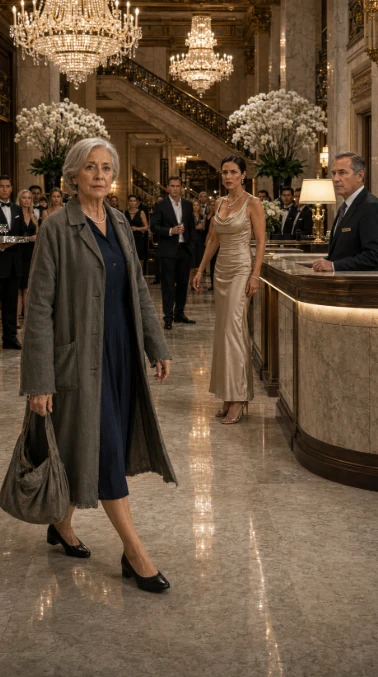
Not the ordinary kind of silence that follows an awkward remark. This silence moved through the Caldwell Grand like a sudden winter draft, extinguishing conversations one by one. Forks paused above porcelain plates. Champagne glasses stopped halfway to painted lips. Even the pianist beneath the eastern chandelier struck the wrong note and lifted his hands from the keys.
Vanessa stood before me in a champagne-colored satin gown, one jeweled arm extended toward the exit.
“Please leave,” she said. “You do not belong here.”
The diamonds at her throat caught the chandelier light, flashing like tiny knives.
Across the marble lobby, my son stood beside the grand staircase with an untouched glass of water in his hand. Michael’s fingers tightened around it until his knuckles turned white.
He looked at me.
Then, as he had done for six years, he lowered his eyes.
What Vanessa did not know was that I had arrived carrying something far more powerful than humiliation.
What Michael did not know was that I finally understood why he had invited me.
And before the evening ended, every investor, board member, executive, and carefully selected guest in that glittering hotel lobby would learn the truth about the Whitaker family.
Including me.
But Vanessa’s cruelty had not begun beneath the chandeliers of the Caldwell Grand.
It began with an apron.
Six years earlier, at our first Thanksgiving after Michael married her, Vanessa had greeted me at the door of their new home with a bright smile and a folded white apron.
“There you are,” she said, placing it in my hands before I had removed my coat. “I knew you’d save us.”
The dining room had already been decorated. Gold napkin rings gleamed beside crystal glasses. A centerpiece of dried oranges and eucalyptus stretched down the table. Vanessa’s friends were drinking wine in the living room while Michael adjusted the television for the football game.
In the kitchen, however, the turkey was still raw.
The potatoes had not been peeled.
The pies were frozen.
“I thought dinner was at four,” I said.
“It is.” Vanessa checked the slim gold watch on her wrist. “That gives us almost three hours.”
Us.
She kissed my cheek and disappeared into the living room.
I stood alone in the kitchen holding the apron.
At the time, I laughed.
I tied it around my waist, rolled up my sleeves, and began chopping onions.
That first Thanksgiving, everyone praised the meal. Vanessa accepted every compliment with a gracious smile.
When one of her friends asked where she had learned to make such tender turkey, Vanessa laughed and pointed toward me.
“Marion just loves helping.”
The room chuckled.
I smiled because Michael looked happy.
That was how it started.
Not with a demand, but with an assumption.
Not with open contempt, but with a smile that made refusal feel unkind.
By the sixth year of their marriage, the apron had become invisible—but somehow, I was still wearing it.
I cooked when Vanessa was busy.
I collected the children from school when meetings ran late.
I sat beside my feverish granddaughter in urgent care while Michael and Vanessa attended a corporate dinner that was supposedly impossible to miss.
I paid for summer camp when their credit card was declined.
I bought ballet shoes after my granddaughter, Lily, tried to hide the hole near her toes.
I filled their refrigerator after finding only mustard, wine, and half a carton of milk inside.
I paid for four new tires when Michael called and said the children were unsafe in the car.
Once, without telling anyone, I paid a mortgage installment that was already eleven days overdue.
I did not tell them because I knew Michael would be embarrassed.
At least, that was what I told myself.
The truth was more painful.
I did not tell them because I had slowly learned that my son’s embarrassment did not lead to gratitude. It led to distance. Every time I rescued him, he seemed to resent me for witnessing the fact that he needed rescuing.
Vanessa never treated my sacrifices as love.
To her, I was useful.
Available.
Obligated.
She called me when a child was sick, when a package needed collecting, when the washing machine overflowed, when the gardener failed to arrive, or when she required an extra pair of hands before one of her elaborate dinners.
But when she hosted investors, donors, or executives, I was rarely invited.
When family photographs were taken, I was positioned at the edge.
When someone asked about the early years of the company Michael now ran, Vanessa answered before I could speak.
“Michael built everything from nothing,” she would say.
That sentence always produced applause.
And I always remained silent.
Because the truth was complicated.
The company had not begun with Michael.
It had begun in a freezing garage with my late husband, Thomas, a secondhand desk, three folding chairs, and a delivery van that stalled whenever it rained.
Thomas had been a medical equipment salesman. I had worked as a hospital scheduling coordinator. We saw how often rural clinics waited weeks for critical supplies because distribution routes were designed around profit rather than urgency.
At night, after Michael had gone to bed, Thomas and I sat at our kitchen table drawing routes across county maps.
Thomas understood people. I understood systems.
He could persuade a surgeon to take his call during dinner. I could look at thirty delivery schedules and see where every wasted mile had been hidden.
Together, we created a regional medical logistics company.
We called it Whitaker Clinical Distribution.
Thomas became its public face because people trusted his broad smile and patient voice. I handled contracts, cash flow, route design, and compliance.
The first year, we nearly lost everything.
The second year, we made enough to hire six drivers.
By the fifth, we supplied forty-two clinics and four hospitals.
By the fifteenth, we had distribution centers in three states.
Michael grew up among warehouse shelves and cardboard cartons. He spent summers attaching labels to packages and riding beside his father in delivery vans.
Thomas dreamed of the day Michael would take over.
I dreamed of the day my son would understand that inheriting something was not the same as building it.
When Thomas became ill, Michael returned from business school and joined the company full-time. He was intelligent, charming, and impatient. He could walk into a conference room and convince people that growth was inevitable.
Thomas admired his confidence.
I worried about his hunger.
“You always expect the worst,” Thomas told me once.
“No,” I replied. “I prepare for what people become when no one tells them no.”
He kissed my forehead and laughed.
Thomas died eighteen months later.
The morning after the funeral, I found his black shoes beside our bedroom door. They were polished, ready for a day he would never live.
I sat on the floor and held them against my chest.
For weeks, I moved through the house like a guest.
Michael became chief executive officer. I remained chair of the family trust and retained voting authority over the largest block of company shares, but I stepped away from daily operations.
I told myself the company belonged to the next generation.
I told myself Thomas would have wanted me to trust our son.
Then Michael met Vanessa.
She was beautiful in the deliberate way some people are beautiful. Nothing about her seemed accidental. Her dark hair shone. Her clothes fitted perfectly. Even her laughter appeared measured for maximum effect.
She worked in corporate communications for a luxury real estate firm and knew how to transform ordinary ambition into an inspiring story.
Within a year of their wedding, the company’s plain blue logo had been replaced by silver lettering. The offices were redesigned. Executives received new titles. Michael appeared in business magazines beside headlines about innovation, legacy, and visionary leadership.
The company was renamed Whitaker Health Systems.
Thomas’s old photographs vanished from the lobby.
So did mine.
When I asked where they had gone, Vanessa smiled.
“We’re creating a forward-looking brand, Marion.”
“A company should know what it is looking forward from,” I said.
Her smile tightened.
After that, my invitations became less frequent.
Michael still called every Sunday at first.
Then every second Sunday.
Then mainly when something had gone wrong.
The first serious request came two years into the marriage.
“We’re temporarily overextended,” he told me. “It’s nothing dangerous. Just a timing issue.”
He needed eighty thousand dollars.
I asked for the company records.
His voice hardened.
“You either trust me or you don’t.”
I transferred the money.
Three months later, Vanessa posted photographs from a luxury resort in the Caribbean.
When I asked Michael about it, he said the trip had been paid for with reward points.
I knew he was lying.
I also knew he had learned to lie without pausing.
Still, I helped.
I helped because Lily was four and adored collecting smooth stones from my garden.
I helped because her younger brother, Noah, fell asleep whenever I rubbed circles across his back.
I helped because losing access to my grandchildren felt more frightening than losing money.
Vanessa understood that.
She never threatened me openly.
She did not need to.
Whenever I questioned an expense or disagreed with a decision, the children suddenly became busy.
A weekend visit would be canceled.
A school performance would be mentioned only after it happened.
A photograph would appear online showing everyone smiling somewhere I had not been invited.
Then Vanessa would call two weeks later and ask whether I could collect the children from school.
I always said yes.
Love became the rope they used to pull me wherever they wanted.
The worst part was not Vanessa’s behavior.
It was Michael’s silence.
He watched his wife interrupt me at dinner.
He watched her correct stories she had not been present to witness.
He watched her describe my work at the company as “supporting Thomas behind the scenes.”
Once, at a charity luncheon, an elderly former driver named Mr. Powell approached me and said, “None of us would have had jobs without Mrs. Whitaker’s route system.”
Vanessa laughed.
“Marion loves these old stories.”
Michael stared into his wine.
That night, I asked him why he had said nothing.
“What was I supposed to do?” he replied. “Create a scene?”
“You could have told the truth.”
“Why does everything have to become a competition with you?”
I looked at my son and felt something inside me crack.
“I am not competing with you, Michael.”
“It doesn’t feel that way.”
I left without saying goodbye.
The next morning, he sent flowers.
The card read: Let’s move forward.
There was no apology.
Only an instruction.
For years, I obeyed.
Then, three weeks before the anniversary dinner, Lily showed me a piece of paper that changed everything.
She was eleven by then, long-legged and observant, with Thomas’s habit of pressing her lips together when she was worried.
I had collected her and Noah from school because Vanessa was attending a board preparation meeting.
While Noah played outside, Lily sat at my kitchen table doing homework.
“Grandma,” she said, “what does incompetent mean?”
The knife in my hand stopped above an apple.
“Why are you asking?”
She reached into her school bag and removed a folded sheet of paper.
“I used Dad’s printer. This was mixed in with my report.”
I wiped my hands and unfolded it.
At the top were the words:
PETITION FOR EMERGENCY APPOINTMENT OF GUARDIAN AND CONSERVATOR.
My name appeared beneath them.
I read the first paragraph twice.
Then a third time.
The petition described me as confused, financially reckless, socially inappropriate, and increasingly unable to manage my own affairs.
It claimed I had wandered into private family events without invitations.
It claimed I had become obsessed with controlling Michael’s business.
It claimed I had given away money and later forgotten doing so.
Attached to the draft was a list of proposed witnesses.
Michael Whitaker.
Vanessa Whitaker.
Dr. Samuel Crane.
And a space reserved for “independent observations at the upcoming anniversary event.”
My hands became cold.
“Where did you find this?” I asked.
“I told you. Dad’s printer.”
“Did he know you took it?”
She shook her head.
Then she looked toward the hallway and lowered her voice.
“Grandma, Dad said something strange last night.”
“What did he say?”
“He told Mom she only had to make you lose control once.”
The kitchen seemed to tilt.
“Are you sure?”
Lily nodded.
“He said important people needed to see it.”
I folded the paper carefully.
“What did your mother say?”
“She said you never lose control.”
“And your father?”
“He said everyone does if you hurt them in the right place.”
I closed my eyes.
For six years, I had believed Michael’s silence was cowardice.
Standing in my kitchen with that petition in my hands, I understood that his silence might have been something else.
Preparation.
I did not confront him.
That was the first useful decision I had made in years.
Instead, I called Evelyn Grant.
Evelyn had been the company’s original attorney. She was seventy-two, sharp-minded, silver-haired, and incapable of pretending foolishness was complicated.
She arrived at my house that evening.
I placed the petition before her.
She read it without speaking.
When she finished, she removed her glasses.
“Do they know you have this?”
“No.”
“Good.”
“Why?”
“Because people become honest when they believe you are helpless.”
She asked whether Michael had access to my financial records.
I told her he did not.
Then I remembered the mortgage payment.
The camp fees.
The tires.
The company loan.
Evelyn’s eyes narrowed.
“Did you document those transfers?”
“Some.”
“Did Michael ever ask you to sign blank pages?”
I thought back to a hospital waiting room two years earlier. Michael had arrived with a folder and said several trust documents needed routine updates.
I had been sitting beside Noah, who had pneumonia.
I signed where Michael placed the markers.
My stomach turned.
Evelyn called a forensic accountant before leaving my house.
His name was Daniel Cho.
For the next two weeks, Daniel examined bank records, trust documents, corporate filings, insurance disclosures, loan agreements, and electronic authorization logs.
Each day revealed something worse.
Michael had used one of the pages I signed to create a broad financial power of attorney.
The document had later been altered.
My initials had been copied onto pages I had never seen.
A physician’s letter describing “possible age-related confusion” had been written by Dr. Samuel Crane, a man I had met only once at a fundraising dinner.
The eighty thousand dollars I transferred to the company had not covered a temporary cash shortage.
It had been routed through a consulting firm called North Vale Strategies.
North Vale had no employees.
Its registered address was a mailbox.
Its beneficial owner was hidden behind two limited liability companies.
Daniel found the owner on the ninth day.
Michael.
The money had been used to purchase additional company shares through a nominee account.
My son had taken money from me and used it to weaken my control over the business I had created.
That was only the beginning.
He had also borrowed against expected trust distributions.
He had forged board consents.
He had moved company funds into accounts Vanessa appeared to control.
“Appeared?” I asked Daniel.
He turned his laptop toward me.
“The authorizations use her credentials, but the access records came from Michael’s private office.”
“Vanessa knew nothing?”
“I did not say that.”
“What are you saying?”
“I’m saying someone may be preparing to make her look solely responsible.”
I stared at the screen.
Vanessa had been cruel to me. She had accepted my labor, mocked my clothing, and treated me as though my life existed for her convenience.
But cruelty was not proof of embezzlement.
“What else?” I asked.
Daniel hesitated.
Evelyn answered for him.
“There is a life insurance policy.”
The words hung in the room.
“On whom?”
“On you.”
I laughed once because the alternative was screaming.
“Michael is my only child. He would inherit anyway.”
“Not immediately,” Evelyn said. “And not everything. Your voting shares remain restricted under Thomas’s trust.”
“How much is the policy?”
“Five million dollars.”
I looked through the window toward my garden.
Thomas had planted a maple tree there during our first year in the house. Its branches were bare, black against the winter sky.
“Who bought it?”
“The premiums were paid by North Vale Strategies.”
Michael’s shell company.
“Who is the beneficiary?”
Evelyn’s expression told me before she spoke.
“Michael.”
For the first time since Thomas died, I wished he were sitting beside me—not to rescue me, but to explain how the laughing boy who once brought injured birds into our kitchen had become a man who placed a price on his mother’s death.
I pressed my palms against the table.
“What happens at the anniversary dinner?”
Daniel opened another file.
“Michael is announcing a proposed acquisition.”
“Of Whitaker Health Systems?”
He nodded.
“The buyer is Sterling North Capital. The board believes the transaction will solve the company’s liquidity problems.”
“What does Michael receive?”
“A large executive payout, a consulting contract, and accelerated shares.”
“And my voting block?”
“That is the obstacle. Unless you sign approval or are legally declared unable to control the trust.”
The invitation suddenly made sense.
Michael did not want his mother at his anniversary dinner.
He needed a confused old woman to appear at a private corporate event.
He needed witnesses.
He needed a scene.
“He invited me so Vanessa could throw me out,” I said.
Evelyn nodded grimly.
“And if you became angry, shouted, or refused to leave, the incident would support the petition.”
I remembered Lily’s words.
Everyone does if you hurt them in the right place.
Michael knew the right place.
He knew it was not my pride.
It was him.
The anniversary dinner was scheduled for Friday evening at the Caldwell Grand.
On Thursday morning, Evelyn and I met with the hotel manager, Mr. Harris.
He listened without interruption.
When we finished, he folded his hands on the polished desk.
“Mrs. Whitaker, what would you like us to do?”
“Nothing unusual,” I said. “Let the evening proceed.”
Evelyn turned toward me.
“Marion—”
“They expect me to walk into their performance,” I said. “So I will.”
Mr. Harris studied my face.
“And if they ask security to remove you?”
“They will not.”
“How can you be certain?”
I placed a document before him.
It was the original reservation agreement for the ballroom and lobby.
The dinner had been booked by Whitaker Health Systems.
The company required my trust’s authorization for extraordinary corporate events connected to a proposed sale.
Michael had forged that authorization.
Technically, the event itself was unauthorized.
But that was not why Mr. Harris’s posture changed.
Attached to the document was a letter from Wren Hospitality Group, the private investment company that had quietly acquired a controlling interest in the Caldwell Grand eighteen months earlier.
Mr. Harris looked at the signature.
Then at me.
“You are M. Wren?”
“Wren was my maiden name.”
Wren Hospitality was not enormous. It owned four hotels and stakes in several conference properties.
I had built it after Thomas died using income from patents I had retained separately from Whitaker Health Systems.
Michael believed those patents had expired.
He had never asked.
The Caldwell Grand had been my investment long before it became Vanessa’s preferred stage.
“I do not want special treatment,” I told Mr. Harris. “I want witnesses.”
He nodded.
“What should I do with the envelope?”
“Keep it in your office until I request it.”
Inside were copies of the forged documents, the forensic audit, the guardianship petition, the life insurance policy, and a formal notice suspending Michael’s executive authority pending a board investigation.
There was one additional document Evelyn insisted on including.
I had not yet read it.
She told me it came from a sealed file Thomas had left in her care.
“It can be opened only if someone attempts to use incapacity proceedings to seize control of the trust,” she explained.
“Thomas expected this?”
“He expected the possibility of many things.”
“What does it say?”
“I think you should read it when Michael does.”
I almost refused.
Then I saw something in Evelyn’s expression—not fear, exactly, but sorrow.
I allowed her to seal it inside the folder.
On Friday afternoon, I stood before my bedroom mirror.
My navy church dress lay across the bed.
Beside it rested my pearl necklace and the black heels I had kept wrapped in tissue since Thomas’s funeral.
I could have worn the midnight-blue gown hanging in the back of my closet.
I could have arrived in a chauffeured car.
I could have entered the hotel through the private owners’ entrance while Mr. Harris greeted me by name.
Instead, I chose my plain shoes, faded cloth bag, and old gray coat with worn cuffs.
Sometimes a woman dresses simply because she owns nothing better.
And sometimes she dresses exactly the way others have decided to see her.
The Caldwell Grand glowed against the evening sky.
Inside, crystal chandeliers spilled gold across the marble floors. Towering white orchids rose from black lacquered tables. Waiters moved soundlessly through the crowd carrying silver trays.
Investors, board members, attorneys, and executives filled the lobby.
A large display near the ballroom entrance read:
Whitaker Health Systems: Honoring the Past, Building the Future.
There were photographs of Michael beside new distribution centers.
Photographs of Vanessa at charity galas.
Photographs of their children.
There was one small picture of Thomas.
I was not visible anywhere.
Vanessa stood beneath the central chandelier in her champagne-colored satin dress, welcoming guests as though the entire evening belonged to her.
The diamonds around her neck had been purchased three months after I paid their overdue mortgage installment.
She saw me.
Her expression froze.
Her eyes traveled over my coat, shoes, and faded bag before darting toward the investors beside her.
She was not horrified that I had arrived.
She was horrified that I looked like the truth.
“Ma’am,” she announced, stepping in front of me, “this is a private event.”
Conversations stopped.
“Vanessa,” I said.
She gave a delicate laugh.
“I’m sorry, but you cannot simply wander in here.”
Across the lobby, Michael stood near the staircase holding an untouched glass of water.
Our eyes met.
For half a second, I saw fear.
Then it disappeared behind concern.
“Mom,” he said cautiously, “are you all right?”
There it was.
The performance had begun.
“I was invited,” I replied.
Vanessa’s smile sharpened.
“We have investors here. Board members. People who matter.”
I remembered every meal I had cooked.
Every bill I had paid.
Every child I had comforted.
Every time I had made myself smaller so they could pretend they had built their perfect life without me.
“I was invited,” I repeated.
Vanessa leaned closer, but her voice remained loud enough for the entire lobby.
“No, Marion. You were tolerated.”
The pianist missed a note.
Michael whispered, “Vanessa.”
But he did not step forward.
She pointed toward the revolving doors.
“Please leave. You do not belong here.”
For six years, I had protected her.
I had hidden their financial problems, covered their mistakes, and swallowed every insult because I loved my son and grandchildren.
But that night, something inside me became very still.
I turned away.
Vanessa smiled, believing she had won.
Michael raised his glass, hiding his relief.
But I did not walk toward the exit.
I walked to the front desk.
Mr. Harris had watched everything.
The moment I approached, he straightened.
“Mr. Harris,” I said, “please bring out the envelope I left in your office this afternoon.”
“Yes, Mrs. Whitaker.”
Vanessa blinked.
Michael’s face drained of color.
“What envelope?” Vanessa demanded.
Mr. Harris disappeared through the private side door.
Every investor, board member, and carefully chosen guest watched in silence.
A moment later, he returned carrying the sealed folder with both hands.
Not like ordinary paperwork.
Like evidence.
He placed it before me.
“Would you also like me to close the ballroom doors?” he asked.
“Yes.”
The ballroom doors closed with a low, final sound.
Vanessa looked from Mr. Harris to me.
“Why is he taking instructions from you?”
I removed my gloves.
“Because the Caldwell Grand is owned by Wren Hospitality Group.”
One of the investors near Michael frowned.
“What does that have to do with you?”
“My name before I married Thomas was Marion Wren.”
The investor’s mouth opened.
Another man whispered, “M. Wren.”
Michael stepped forward.
“That’s ridiculous.”
I looked at him.
“Is it?”
“Wren Hospitality is controlled by a private investment office.”
“Yes.”
“You own a few passive investments. That doesn’t mean—”
“I founded it.”
The silence changed.
Before, the guests had been silent because they had witnessed cruelty.
Now they were silent because they realized the woman in the worn gray coat owned the marble beneath their feet.
Vanessa’s face lost color.
“You never told us.”
“You never asked.”
Michael recovered quickly.
He placed his glass on a passing tray and adopted the calm expression he used during press interviews.
“Mom, this is exactly what I was worried about. You are confused. Tonight is our anniversary celebration.”
“And the announcement of a sale to Sterling North Capital.”
Several board members exchanged looks.
Michael’s jaw tightened.
“That information was confidential.”
“So was the petition asking a court to declare me incompetent.”
The words struck him physically.
His shoulders jerked.
Vanessa turned toward him.
“What petition?”
I opened the folder.
The first document was Lily’s printed page.
I held it up.
“This petition.”
Vanessa stared at the title.
Then at Michael.
“You said those were contingency papers.”
“They are,” he replied.
“You said your mother’s attorney recommended them.”
“I said we needed to prepare for possible deterioration.”
“You said she was forgetting things.”
Michael looked around the lobby.
“Not here.”
I almost laughed.
He had brought me there to be humiliated publicly.
Now he wanted privacy.
“You invited me here,” I said, “because you needed witnesses to see me arrive at an event where Vanessa would claim I had not been invited.”
“That’s absurd.”
“You needed me to become angry.”
“You are angry.”
“No, Michael. I am awake.”
I removed the invitation from my bag.
His handwriting appeared beneath the printed details.
Please come, Mom. It would mean a lot to me.
I placed it beside the petition.
“Your first problem,” I said, “is that you invited me in writing.”
A few guests lowered their eyes, embarrassed for him.
Michael’s face hardened.
“An invitation proves nothing.”
“No. But your messages do.”
I removed the next set of pages.
Vanessa stopped breathing.
They were transcripts recovered from Michael’s company phone backup.
One message read:
Make sure she comes through the main entrance.
Another:
Do not use her name at first. Treat her like she wandered in.
And another:
If she raises her voice, ask security to document everything.
Vanessa looked at him.
“You told me the board wanted her kept away from the investors.”
Michael said nothing.
“You told me she planned to sabotage the sale.”
“Vanessa—”
“You told me to say those things.”
“And you said them very well,” I replied.
She looked at me.
For the first time that evening, there was no elegance in her expression.
Only fear.
“I didn’t know about the petition.”
“But you knew I had been invited.”
Her lips parted.
I waited.
The entire lobby waited.
Finally, she whispered, “Yes.”
The admission hurt more than I expected.
Perhaps some foolish part of me had still hoped Michael had deceived her completely.
“Did you know I paid your mortgage when it was overdue?” I asked.
She glanced at Michael.
“What mortgage payment?”
“The one eleven days late.”
Michael spoke quickly.
“This has nothing to do with the company.”
“It has everything to do with the company.”
I removed Daniel Cho’s audit.
“Because the money you told Vanessa came from a performance bonus came from me.”
Vanessa turned toward Michael.
“You said the board approved an advance.”
“The details were complicated.”
“How many other details were complicated?”
I opened the audit.
“The eighty thousand dollars you requested from me was transferred through North Vale Strategies and used to purchase company shares.”
One of the board members stepped forward.
“North Vale is an outside consulting firm.”
“No,” I said. “It is a mailbox controlled by Michael.”
The man looked at Michael.
“Is that true?”
Michael’s voice became sharp.
“My mother does not understand corporate structuring.”
Daniel Cho emerged from the crowd.
Michael stared at him.
Daniel had been invited by Sterling North as an independent transaction adviser. Michael had spoken to him earlier that evening without realizing who had hired him.
Daniel handed copies of the audit to the board members.
“I understand it,” he said. “Mr. Whitaker diverted company funds through North Vale, falsified consulting invoices, and used nominee accounts to acquire shares.”
The chairman of the board, Robert Ellis, flipped through the pages.
“This shows Vanessa’s authorization.”
“It shows her credentials,” Daniel replied. “The access records originated from Michael Whitaker’s private office.”
Vanessa looked as though the marble floor had opened beneath her.
“You used my account?”
Michael leaned close to her.
“Stop talking.”
Her face changed.
For years, I had watched Vanessa speak to waiters, assistants, teachers, and me as though silence were something she could command.
Now Michael used the same tone on her.
And she recognized it.
“You told me finance had made an error,” she whispered.
“Vanessa.”
“You said I needed to sign the approvals because the auditors were behind.”
“Be quiet.”
She took one step away from him.
“No.”
The word was barely audible.
But it was the first honest thing she had said all night.
Michael looked around and realized control was slipping away.
He turned toward me.
“What do you want?”
The question was so familiar.
For years, whenever I expressed pain, Michael treated it as negotiation.
What did I want?
An apology?
Recognition?
Access to the children?
A chair at the table?
He could imagine only transactions.
“I wanted my son,” I said.
His expression flickered.
“Mom—”
“But I do not know where he went.”
The words landed harder than any accusation.
Michael’s face became cold.
“Then let’s stop pretending this is about family. You’ve always wanted the company back.”
“I never lost it.”
I removed the formal notice suspending his authority.
“As controlling trustee of the Whitaker family voting block, I am placing you on immediate administrative leave pending investigation.”
“You cannot do that.”
Robert Ellis read the notice.
“She can.”
“The board has to vote.”
“The board will vote,” I said. “After reviewing the audit.”
Michael scanned the guests as though searching for someone who still belonged to him.
His eyes settled on representatives from Sterling North.
“Our agreement protects me from removal during negotiations.”
A woman in a black suit stepped forward.
She was Clara Bennett, Sterling North’s managing director.
“There is no agreement,” she said.
Michael stared at her.
“We have a signed term sheet.”
“Subject to verification of ownership, financial representations, and executive conduct.”
“This is a family dispute.”
Clara held up the audit.
“This is fraud.”
Michael’s confidence finally fractured.
He looked toward the ballroom doors.
Two hotel security officers stood beside them.
Not blocking him.
Simply waiting.
Vanessa reached for one of the audit copies.
Her hands trembled as she turned the pages.
Then she stopped.
“What is this?” she asked.
Daniel answered.
“A series of transfers into an account identified as VMW Holdings.”
“My initials.”
“Yes.”
“I have never heard of it.”
Michael said, “Don’t be dramatic.”
She looked at him with dawning horror.
“You were putting money into an account with my initials.”
“For tax planning.”
“An account I couldn’t access?”
“It was for both of us.”
“No.” Her voice rose. “It was for you to blame me.”
No one moved.
Daniel spoke quietly.
“The documents assign full management responsibility to Mrs. Whitaker while granting beneficial control to Mr. Whitaker through North Vale.”
Vanessa’s eyes filled with tears.
“You were going to say I stole it.”
Michael’s mouth tightened.
“If you had followed instructions, none of this would matter.”
I watched the sentence enter her like a blade.
For six years, Vanessa had treated me as a servant because she believed she stood beside the most powerful person in the family.
Now she understood that she had never stood beside Michael.
She had stood in front of him, exactly where he needed the blame to land.
“I signed things,” she whispered.
“Yes,” Daniel said.
“Without reading them.”
“Yes.”
“Because he told me they were routine.”
Daniel did not soften his answer.
“You remain legally responsible for what you signed.”
Vanessa closed her eyes.
When she opened them, she looked at me.
“I was cruel to you.”
It was not an apology.
Not yet.
It was a fact she had finally become unable to avoid.
“Yes,” I said.
“I believed things he told me.”
“You also believed cruelty was useful.”
She flinched.
I continued.
“You knew I had been invited tonight. You knew I paid for things you later claimed Michael provided. You left me alone in kitchens while taking credit for meals I cooked. You used my grandchildren to punish me whenever I questioned you.”
Tears slipped down her face.
“I did.”
Michael laughed bitterly.
“Oh, please. Are we confessing personality flaws now?”
Vanessa turned toward him.
“You said she hated me.”
“She does.”
“No,” I said. “I hated what you did. That is not the same thing.”
Vanessa pressed a hand against her mouth.
Michael moved toward the folder.
“This ends now.”
He reached for it.
Mr. Harris stepped between us.
“Sir.”
Michael stopped.
Mr. Harris’s tone remained polite.
But the warning was unmistakable.
Michael looked at me over the manager’s shoulder.
“You have no idea what you’re destroying.”
“I know exactly what you tried to destroy.”
I removed the life insurance policy.
For the first time all evening, Michael looked truly afraid.
Vanessa saw the figure at the top of the page.
“Five million dollars?”
Michael said nothing.
“Who is insured?”
I handed the policy to her.
She read my name.
Then the beneficiary.
Her knees seemed to weaken.
“You insured your mother’s life?”
“It was part of an estate strategy.”
“She didn’t sign this.”
“She signed a power of attorney.”
“A forged power of attorney,” Evelyn said.
She stepped forward from beside the orchids.
Michael’s eyes widened.
He had not noticed her among the guests.
Evelyn handed Robert Ellis a certified report from a document examiner.
“The signature page was altered. The notary stamp was copied from an unrelated document.”
One of the investors swore under his breath.
Vanessa stared at Michael as though she had never seen his face before.
“Were you waiting for her to die?”
“No.”
“Then why buy this?”
“It protected the company.”
“It protected you.”
Michael’s eyes moved toward the security cameras near the ceiling.
He finally understood.
The entire confrontation had been recorded.
Not as proof of my instability.
As proof of his.
He stepped backward.
“You planned this.”
“I prepared for it.”
“You dressed like that deliberately.”
I looked down at my worn coat.
“Yes.”
A murmur moved through the lobby.
Vanessa whispered, “Why?”
“Because I needed you both to believe I was still willing to become small for your comfort.”
Michael’s face twisted.
“So this was a test?”
“No. A test is given before you know the answer.”
I looked at him.
“I already knew who you were.”
That was when Evelyn touched the final sealed document inside the folder.
“Marion,” she said quietly.
I had almost forgotten it.
Thomas’s document.
The one Evelyn had been instructed to release only if someone attempted to use incapacity proceedings to seize control of the trust.
My anger weakened beneath a sudden wave of grief.
“What is it?” Michael demanded.
Evelyn handed me the smaller envelope.
My name appeared on the front in Thomas’s handwriting.
For a moment, the lobby disappeared.
I was back at our kitchen table.
Thomas was laughing as he drew delivery routes across a county map. His sleeves were rolled to his elbows. A cup of coffee cooled beside his hand.
I ran my thumb across the ink.
Then I opened the envelope.
Inside was a letter and a trust amendment.
The letter began:
My dearest Marion,
I stopped reading.
The words blurred.
Evelyn touched my arm.
“You may take your time.”
“No,” I said.
Michael had used my love for privacy as a weapon.
I would not hide the truth now.
I read aloud.
“My dearest Marion, if you are reading this, someone has mistaken your kindness for weakness.”
The room remained completely still.
Thomas’s letter continued.
“I hope that person is not our son. But hope is not a plan, and love should never prevent us from protecting what we built.”
Michael looked toward Evelyn.
“What amendment?”
She did not answer.
I kept reading.
“From the beginning, you saw dangers I preferred to believe would never arrive. You protected the company from my optimism more times than anyone will know. This document is my attempt to protect you from yours.”
A broken laugh escaped me.
Even after death, Thomas knew me.
The next paragraph explained the amendment.
If any beneficiary of the Whitaker family trust attempted to have me declared incompetent for the purpose of gaining control over trust assets, that action would trigger an automatic forfeiture clause.
Michael’s face went blank.
“What does that mean?” Vanessa asked.
Evelyn answered.
“It means the moment Michael filed or materially prepared a fraudulent incapacity proceeding to seize voting control, he violated the trust’s protective covenant.”
“Prepared?” Michael said. “Nothing was filed.”
Evelyn removed a stamped document.
“It was filed at nine sixteen this morning.”
My head snapped toward her.
“What?”
She looked at Michael.
“His attorney submitted it under seal.”
I had believed the petition was still a draft.
Michael had invited me to the hotel after already asking a court to take control of my life.
“Who filed it?” I asked.
Evelyn named a law firm.
One of Michael’s board allies quietly stepped away from him.
Michael’s breathing became shallow.
“This is reversible.”
“No,” Evelyn said.
“What does forfeiture mean?”
“It means you lose your beneficial interest in the family trust.”
Michael laughed, but the sound contained no humor.
“You cannot remove an heir from an irrevocable trust.”
“Your father could,” Evelyn replied. “And he did.”
Michael looked at the papers.
“How much?”
“All of it.”
The words echoed through the lobby.
Vanessa stared at him.
Michael had spent years trying to seize my controlling shares.
By attempting to take them, he had disinherited himself.
His voice dropped.
“Where does my interest go?”
I looked at the amendment.
The answer was not what I expected.
Not to me.
Not directly to Lily and Noah.
Not to charity.
Thomas had written:
Any forfeited beneficial interest shall transfer in equal proportion to the permanent employee ownership trust and the protected education trusts established for the founder’s grandchildren.
Robert Ellis exhaled slowly.
The company’s longtime employees would receive the largest portion.
Lily and Noah would receive the rest through independent trusts neither parent could control.
Michael’s face collapsed.
“That company is mine.”
I heard Thomas’s voice in my memory.
Inheriting something is not the same as building it.
“No,” I said. “It never was.”
He turned toward the board.
“You need me. None of you can run it without me.”
Robert Ellis closed the audit.
“The company was running before you entered business school.”
“It was regional.”
“And profitable,” I said.
Michael pointed at me.
“You held it back.”
“I kept it alive.”
“You were afraid of growth.”
“I was afraid of growth financed by lies.”
He looked toward Clara Bennett.
“Sterling North still needs the distribution network.”
“We will not acquire a company under criminal investigation,” she replied.
“You’ll lose the deal.”
“There is another option.”
Everyone turned toward Daniel Cho.
He placed a second report on the front desk.
It contained a restructuring proposal I had authorized that morning.
Whitaker Health Systems would not be sold to Sterling North.
Instead, Wren Hospitality’s parent investment office would provide temporary financing while the company transitioned toward partial employee ownership.
The oldest distribution center would be modernized.
Rural clinic contracts Michael planned to cancel would remain active.
Executive bonuses would be suspended until debts were repaid.
Michael’s offices, cars, and consulting contracts would be eliminated.
The company would survive.
His empire would not.
“You cannot finance that,” Michael said.
Clara Bennett smiled faintly.
“She can.”
Michael stared at her.
Clara continued.
“Sterling North was not the only party conducting due diligence. Mrs. Whitaker’s investment office began purchasing the company’s distressed debt six months ago.”
My son looked at me as though I had struck him.
“You bought our debt?”
“Not all of it.”
Daniel corrected me gently.
“Almost all of it.”
For months, lenders had been preparing to sell Whitaker Health Systems’ loans at a discount because they feared default.
Through Wren Capital, I acquired them.
Every time Michael called to tell me the company faced a temporary crisis, I listened.
Then I investigated.
The debts he thought would force me to surrender control had quietly made me the company’s largest secured creditor.
Vanessa sank into a chair.
Michael’s voice became a whisper.
“You let me believe we were negotiating with banks.”
“You were negotiating with banks.”
“And they sold to you.”
“Yes.”
“Why?”
“Because unlike you, they read the financial statements.”
A few guests looked away to hide their reactions.
Michael’s face filled with hatred.
“You wanted me to fail.”
“No. I wanted you to stop.”
“You could have warned me.”
“I warned you for twenty years.”
He stepped closer.
“After everything I did for that company—”
“You mean everything the company did for you.”
His expression turned ugly.
For one terrifying second, I saw the boy he had been vanish completely.
Then Lily’s voice came from behind me.
“Dad?”
I turned.
Lily and Noah stood near the ballroom entrance beside their babysitter.
They were not supposed to be there yet. The children had been scheduled to arrive later for the anniversary photographs.
Lily held Noah’s hand.
Michael’s anger disappeared beneath a practiced smile.
“Sweetheart, go back outside.”
She looked at the papers on the desk.
“Did you try to take Grandma’s house?”
“No.”
Her eyes moved toward me.
“Grandma?”
I crossed the marble floor and knelt before them.
My knees protested, but I barely felt it.
“No one is taking my house.”
“Are you sick?”
“No.”
“Dad said you were forgetting us.”
The cruelty of that lie silenced even Vanessa.
I touched Lily’s cheek.
“I could never forget you.”
She threw her arms around me.
Noah joined her.
Over their shoulders, I saw Michael watching.
Something shifted in his face.
For one moment, I thought he might break.
I thought he might finally understand what he had traded away.
Then he looked toward the board instead of his children.
“What happens to my position?” he asked.
That was the last answer I needed.
Robert Ellis spoke.
“The board will convene immediately.”
Michael was escorted to a private conference room, not by police but by hotel security.
Vanessa remained seated near the front desk.
Her champagne gown pooled around her feet.
Without the posture, diamonds, and controlled smile, she looked younger.
And smaller.
“I am sorry,” she said.
I stood beside my grandchildren.
“For what?”
“For tonight.”
“That is not enough.”
She nodded.
“For every dinner. Every insult. Every time I made you feel unwelcome.”
“That is closer.”
“I thought you looked down on me.”
“Why?”
“Michael said you believed I married him for money. He said you called me shallow. He said you wanted him to leave me.”
“I never said those things.”
“I know that now.”
“Would it have justified how you treated me?”
She closed her eyes.
“No.”
I studied her.
Vanessa had been manipulated.
She had also been cruel because cruelty made her feel powerful.
Both truths could exist at once.
“What happens now?” she asked.
“You tell the investigators everything.”
“And the children?”
“That depends on whether you choose them or your pride.”
Her eyes moved to Lily and Noah.
“I choose them.”
“Then begin by telling the truth even when it humiliates you.”
She removed the diamond necklace from her throat.
Michael had told her it was purchased with his bonus.
Daniel later confirmed it had been bought with company funds.
She placed it on the front desk.
Then she removed the matching bracelet.
For the first time since I had known her, Vanessa was not arranging herself for an audience.
She was dismantling the costume.
The board meeting lasted fifty-three minutes.
Michael was removed as chief executive officer by unanimous vote.
His access to company systems was terminated.
The forensic audit was referred to state and federal investigators.
The sale to Sterling North was canceled.
By midnight, the anniversary banners had been taken down.
Employees began receiving notices that their jobs were secure.
Michael left through the hotel’s service entrance.
He did not say goodbye to his children.
Vanessa took Lily and Noah to her sister’s home.
I returned to my house alone.
The old gray coat still carried the scent of hotel flowers and cold air.
I hung it beside the door.
Then I sat at the kitchen table and finished reading Thomas’s letter.
The final paragraph was shorter.
If Michael has chosen power over family, do not blame yourself for failing to love him correctly. Love is not a key that opens every locked door. Sometimes it is the courage to stop knocking.
I cried until dawn.
Not because Michael had lost the company.
Not because he had tried to control my money.
Not even because he had placed a price on my death.
I cried because somewhere inside me, I had continued waiting for the child he once was to return.
Thomas’s letter gave me permission to stop.
The investigation lasted fourteen months.
Michael was charged with fraud, falsifying corporate records, identity theft, and conspiracy related to the guardianship petition.
Dr. Samuel Crane admitted Michael had paid him to write the medical letter without examining me.
The attorney who filed the petition claimed he had relied on false representations.
North Vale Strategies was dissolved.
The life insurance policy was canceled.
Michael eventually accepted a plea agreement.
He was sentenced to prison.
At the hearing, he looked older than his forty-two years.
Before he was taken away, he asked to speak with me.
We sat across from one another in a private room divided by a narrow table.
For several seconds, neither of us spoke.
Then he said, “Did Dad really write that clause?”
“Yes.”
“He never trusted me.”
“He loved you enough to protect other people from what you might become.”
Michael flinched.
“You always thought I was greedy.”
“I thought you were impatient.”
“You gave me responsibility and then stood behind me waiting for failure.”
“No. I stood behind you so long that you forgot I was holding up the roof.”
He looked down.
“I never planned to hurt you.”
“You planned to erase me.”
“I needed the shares.”
“You needed to win.”
His eyes filled, but I no longer knew whether the tears came from remorse or self-pity.
“Do Lily and Noah hate me?”
“They are hurt.”
“Will you tell them I love them?”
“No.”
He stared at me.
“You won’t?”
“When you are allowed to write to them, you may tell them yourself. Love should not always be delivered by someone else.”
For once, he had no answer.
I stood.
“Mom.”
I paused at the door.
“I’m sorry.”
I had waited years to hear those words.
When they finally came, they did not repair anything.
But neither did they mean nothing.
“I hope one day you understand what you are sorry for,” I said.
Then I left.
Vanessa pleaded guilty to lesser financial charges connected to the documents she signed. She avoided prison by cooperating fully, repaying assets, and completing community service.
She and Michael divorced.
The first year afterward was difficult.
Vanessa had never lived without appearances. She sold the large house and moved into a smaller rental near the children’s school. She found work at a nonprofit clinic, not in communications, but in administration.
She attended counseling.
She apologized often.
I accepted slowly.
Forgiveness, I learned, was not reopening every door.
Sometimes it was choosing not to stand outside the closed ones with anger in your hands.
The company changed too.
Robert Ellis served temporarily as chief executive while we searched for a permanent leader.
We restored Thomas’s photograph to the lobby.
Beside it, the employees placed one of me.
I asked them to remove it.
They refused.
The caption read:
MARION WREN WHITAKER — CO-FOUNDER, SYSTEMS ARCHITECT, AND FIRST CHAIR.
The employee trust purchased thirty percent of the company.
Drivers, warehouse staff, nurses, dispatchers, and longtime administrators received ownership units.
The rural clinic routes remained active.
Profits declined for two quarters.
Then they rose.
Not dramatically.
Honestly.
Lily and Noah’s trusts were managed independently. Neither Vanessa nor Michael could touch the money.
The Caldwell Grand remained part of Wren Hospitality.
Mr. Harris still straightened whenever I approached the front desk, though I repeatedly told him he did not need to.
One year after the anniversary dinner, the hotel hosted the company’s first employee ownership celebration.
There were no giant photographs of executives.
The walls displayed pictures of drivers, warehouse teams, clinic staff, and the original delivery van.
I wore the midnight-blue gown from the back of my closet.
Lily fastened my pearls.
“You look like a queen,” she said.
“No,” I replied. “Queens wear uncomfortable shoes.”
She laughed.
Downstairs, Vanessa waited near the ballroom entrance.
She wore a simple black dress with no diamonds.
For a moment, we looked at each other beneath the same chandelier where she had told me I did not belong.
“I still think about that night,” she said.
“So do I.”
“I wish I could take it back.”
“You cannot.”
“I know.”
“But you can decide what follows it.”
She nodded.
Then she handed me something folded.
The old white Thanksgiving apron.
I recognized a small stain near the pocket.
“I found it while packing the house,” she said.
I held it between us.
“I thought maybe we should throw it away.”
“No,” I said.
Her face fell.
I smiled slightly.
“We should use it.”
That Thanksgiving, Vanessa arrived at my house before sunrise.
She chopped onions.
She peeled potatoes.
She washed every dish she used.
When guests praised the meal, she pointed toward me.
“Marion taught me.”
Not Marion loves helping.
Not Marion saved us.
Marion taught me.
It was a small sentence.
But sometimes small sentences return what years of silence have stolen.
After dinner, Lily asked whether she could see the envelope from the hotel.
I had kept it in the locked drawer of Thomas’s desk.
We gathered in the study while I opened it.
Most of the documents had been transferred to investigators, but Thomas’s original letter remained inside.
As I lifted it, another piece of paper slipped from the envelope and fell to the floor.
I frowned.
I had never seen it.
The page had been folded twice and sealed along one edge.
On the outside, in Thomas’s handwriting, were the words:
For Marion only—after everything is over.
My hands began to tremble.
Vanessa offered to take the children downstairs.
“No,” I said. “They may stay.”
I opened the page.
The letter inside was dated three weeks before Thomas died.
It contained only four paragraphs.
The first thanked me for building a life with him.
The second apologized for the years he had allowed the world to believe the company’s best ideas were his.
The third explained that the protective trust amendment was not his idea.
I stopped.
Read the sentence again.
Then continued aloud.
You wrote the original clause yourself, Marion.
The room became silent.
I looked at Evelyn, who had joined us for dinner.
Her eyes filled with tears.
“What does that mean?” Lily asked.
I kept reading.
Years earlier, during the company’s first major expansion, I had drafted a series of emergency governance protections.
One clause stated that any beneficiary who used fraud, coercion, or false incapacity claims to seize control from another trustee would automatically forfeit his interest.
I had written it after watching another family business collapse during a bitter guardianship dispute.
Later, when Thomas created our family trust, he quietly incorporated my clause.
He had not invented the safeguard that defeated Michael.
I had.
Decades before my son tried to erase me, the younger woman I once was had already protected the older woman I would become.
The final paragraph read:
You will probably believe I saved you. I did not. You saved yourself years before you knew you would need saving. That has always been your gift. You build roads for people who have not yet reached the storm.
I could no longer speak.
Lily took the letter and finished the final sentence.
Do not let anyone tell your story as though you merely stood behind me.
For most of my life, I had believed Thomas was the visionary and I was the practical one.
He had been the voice.
I had been the structure.
He had inspired people.
I had protected them.
But as I sat in that study surrounded by my grandchildren, my attorney, and the woman who once tried to throw me out of my own hotel, I understood the final truth.
Michael had spent years trying to inherit his father’s power.
He had never realized the power had been mine.
Not because I owned the hotel.
Not because I controlled the shares.
Not because my signature could remove a chief executive or cancel a sale.
My power was the part of me everyone had mistaken for weakness.
I noticed what others ignored.
I prepared while others performed.
I protected people even when no one applauded.
And when the moment came to save my family from the man my son had become, I did not destroy him.
I simply stopped protecting him from the consequences of his own choices.
The following morning, I returned the old gray coat to its hook beside the door.
I did not throw it away.
The cuffs were still worn. The lining was frayed. One button hung by a thread.
But I no longer saw it as evidence of poverty, shame, or invisibility.
It had carried me into the Caldwell Grand on the night everyone finally saw me.
Not as Michael’s aging mother.
Not as Vanessa’s unpaid servant.
Not as Thomas’s widow.
But as Marion Wren Whitaker.
Founder.
Mother.
Grandmother.
Architect.
Owner of her own name.
And whenever I passed the coat, I remembered the moment Vanessa pointed toward the revolving doors and said I did not belong.
She had been wrong.
I belonged everywhere my courage had built a foundation.
The hotel.
The company.
The family.
The future.
I had always belonged.
They had simply been standing on everything I built, looking down at me, and never once thought to ask whose ground was beneath their feet.