
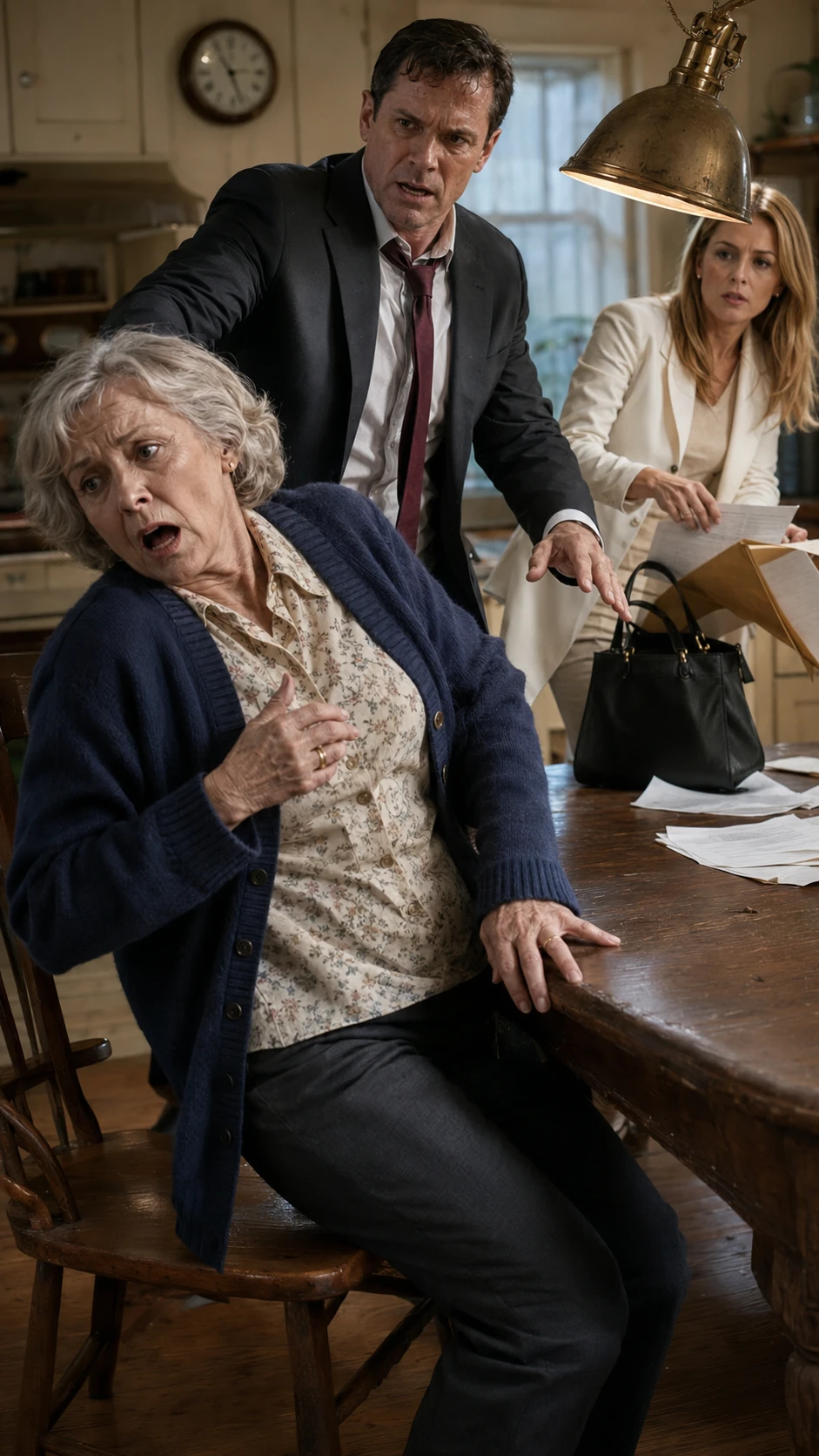
My son watched me struggle to breathe on the kitchen floor.
He did not kneel to help me.
He did not call an ambulance.
He stood beside the oak table where we had celebrated his birthdays, done his homework, and eaten nearly every Thanksgiving dinner of his childhood—and told me I should have obeyed him.
“Mother,” Daniel whispered, “you should have listened to me.”
A few feet away, his wife was stuffing my legal papers into her handbag.
My ribs felt as though someone had driven a blade between them. Every breath came shallow and sharp. The brass light above the table swung from the force of my body striking the wood, throwing shadows across Daniel’s face.
For one terrible second, I remembered him at six years old.
He had fallen from the old apple tree behind the equipment shed and scraped both knees. He had run toward me crying, arms open, certain that his mother could repair anything.
I had cleaned the blood from his skin.
I had carried him into this same kitchen.
Now he was looking down at me as though I were something that needed to be removed.
Melissa snapped her handbag shut.
“We need to go,” she said.
Daniel did not move.
His face was flushed, but his eyes were strangely cold.
I pressed one hand against my chest and tried to pull air into my lungs.
“Call an ambulance.”
“In a minute,” he said.
“Daniel.”
His name left my mouth as little more than a breath.
Outside, tires crunched across the gravel driveway.
Melissa froze.
Daniel turned toward the kitchen windows.
Red and blue light flashed across the glass, slid over the cabinets, and washed the room in sudden color.
“What did you do?” Melissa hissed.
I had no strength to answer.
Two uniformed officers came through the open front door. Behind them was Claire Bennett, my attorney, holding a black folder against her chest.
Daniel’s anger disappeared so quickly it frightened me more than the anger itself.
Claire saw me on the floor.
Her expression changed.
“Evelyn!”
She dropped to her knees beside me while one of the officers called for an ambulance. The other stepped between Daniel and the doorway.
Melissa tried to move her handbag behind her leg.
Claire noticed.
She noticed everything.
The open brown envelope on the table.
The loose pages scattered across the floor.
The torn corner of one document hanging from Melissa’s bag.
The overturned chair.
The blood on my lower lip.
And my son standing over me with his fists still clenched.
“Don’t move,” the officer told him.
Daniel raised his hands slowly.
“This is a family misunderstanding.”
Claire looked up at him.
“No,” she said. “It isn’t.”
She opened the black folder.
The first page she removed had Daniel’s name printed in large letters across the top.
The color drained from his face.
To understand why, you have to understand what Hartwell Farm meant to us.
And what my son had already done in order to take it from me.
Hartwell Farm covered six hundred and twelve acres of rolling wheat fields, pasture, woods, and low ground that flooded whenever the river rose too quickly.
It had never been easy land.
My husband, Samuel, used to say the farm had moods.
Some mornings it was generous. The wheat stood golden beneath the sunrise, the cattle moved quietly through the pasture, and the air smelled of damp soil and cut grass.
Other days, the farm seemed determined to test whether we deserved it.
We survived droughts, broken machinery, sick calves, falling grain prices, two floods, and one failed harvest so complete that Samuel and I sat in silence at the kitchen table because neither of us knew how we would pay the bank.
There was a foreclosure notice beside the coffee pot that morning.
It stayed unopened until noon.
Samuel finally picked it up, turned it over twice, and said, “Whatever is inside this envelope, we’ll face it together.”
That was how we lived.
Not bravely every minute.
Not without fear.
But together.
We sold one tractor, borrowed another, took night work, and negotiated with the bank until they gave us time. By the following harvest, the wheat came in strong enough to keep the farm.
Forty-two years after Samuel and I first walked onto the property as newlyweds, Hartwell Farm was worth approximately $3.8 million.
People heard that number and imagined wealth.
They did not imagine Samuel repairing a fence at two in the morning during freezing rain.
They did not imagine me delivering a breech calf by the light of a truck’s headlamps.
They did not imagine us calculating grocery money on the back of a feed receipt.
They did not imagine the years when everything we owned could have been taken by one bad season.
To me, the farm was not an investment.
It was a record of everything we had endured.
When Samuel died, I inherited the property outright.
Daniel seemed to believe he inherited it with me.
At first, I mistook his interest for concern.
He began visiting more often. He walked around the buildings with a notebook, photographed the barns, and asked questions about insurance, taxes, and mineral rights.
He said the farm was becoming too much for me.
He said he wanted to help.
I wanted to believe him.
A mother can overlook a great deal when the alternative is admitting her child no longer sees her as a person.
Daniel had always been ambitious.
Even as a boy, he hated losing. If another child finished a race before him, he would practice until dark. If he received the second-highest grade in class, he wanted to know who had beaten him.
Samuel admired his determination but worried about the hunger beneath it.
“There’s a difference between wanting to build something,” he once told me, “and wanting to prove you deserve more than everyone else.”
Daniel left the farm at eighteen and studied business administration. He moved to the city, married Melissa, and built a career selling commercial property.
For years, he complained that Samuel and I refused to “think strategically” about the land.
Samuel would laugh.
“Cattle don’t care about strategy,” he would say. “They care about water and decent fencing.”
After Samuel’s death, Daniel stopped laughing.
He began bringing proposals.
The old barn, he said, could be converted into a wedding venue.
The hills near the county road would be perfect for vacation cottages.
The eastern fields could be sold to a developer for townhouses.
He and Melissa arrived one Sunday with glossy images spread across a presentation board.
The pictures showed landscaped sidewalks, ornamental trees, decorative streetlamps, and rows of identical homes behind a gated entrance.
The artist had drawn happy couples walking dogs where Samuel’s best wheat had grown.
Melissa touched my arm.
“You wouldn’t have to worry about money ever again.”
“I don’t worry about money now,” I said.
Her smile tightened.
“You should. At your age, medical costs can appear unexpectedly.”
At my age.
She had a way of making seventy-one sound like a diagnosis.
Daniel pointed to the eastern boundary.
“We could sell only this section. You’d still have the house, the barns, and most of the pasture.”
“That section contains our best soil.”
“You don’t plant all of it anymore.”
“That does not make it useless.”
He leaned back and exhaled.
“Mom, land is valuable when you do something with it.”
I looked through the window toward the pasture.
Cattle moved slowly beneath the afternoon sun.
“We have been doing something with it for forty-two years.”
After that, Daniel’s visits changed.
He no longer asked what I wanted.
He explained what needed to happen.
He said the farm required professional management. He criticized my accountant. He questioned the men who leased two of my fields. He wanted access to my bank records and copies of every deed.
He spoke as though the future had already been decided and I was delaying the paperwork.
Then a surveyor stopped me outside the feed store.
His name was Paul Reddick. I knew his father and had known Paul since he was a teenager.
He tipped his cap when he saw me.
“Mrs. Hart, I’m glad I ran into you. I wanted to confirm the access point before we begin the boundary work.”
“What boundary work?”
He hesitated.
“The eastern parcel.”
My hands became cold around the feed-store receipt.
“I didn’t request a survey.”
Paul’s face changed.
“Daniel did. He said he was acting for you.”
The parking lot seemed to tilt beneath my feet.
“When?”
“About ten days ago.”
“Did he give you anything in writing?”
“He emailed a copy of a power of attorney.”
I had signed that document four years earlier before hip surgery.
Daniel had insisted.
He told me it was temporary protection in case I could not pay bills or make decisions while I recovered. I trusted him, and after the surgery I forgot the document existed.
Apparently, Daniel had not.
“Do not begin any work,” I told Paul.
“I won’t.”
“And send me everything my son gave you.”
He nodded.
That evening, I sat at my kitchen table beneath the brass light Samuel had installed in 1987 and opened the email Paul forwarded to me.
Daniel’s message was polite and professional.
It described me as “the elderly owner.”
It said the property would “soon undergo a transition in control.”
It instructed Paul to complete preliminary boundary work before the investors visited.
Investors.
Plural.
I called Daniel.
He did not answer.
I called again.
Nothing.
Melissa sent a message twenty minutes later.
Daniel is in a meeting. Is something wrong?
I typed three different replies and erased all of them.
Finally, I wrote:
Tell him to call me tonight.
He did not call.
The next morning, I went into his old bedroom.
I had left most of it unchanged after Samuel died. The baseball trophies were still on the shelf, along with a photograph of Daniel sitting on his father’s shoulders beside the wheat field.
Daniel had used the room as an office during his recent visits. I found nothing in the desk drawers.
Then I noticed several printed pages in the wastebasket.
They had been torn in half.
I fitted them together on the bed.
The first was an email exchange between Daniel and two development investors.
The second contained projected profits from the eastern acreage.
The third was a brochure for a luxury home outside the city.
Five bedrooms.
Heated pool.
Private theater.
Four-car garage.
Across the top, someone had written:
Purchase contingent on Hartwell transaction.
I sat on the edge of Daniel’s childhood bed, holding the two halves of that page.
Samuel’s photograph stared back at me from the shelf.
That was the moment I stopped pretending my son was trying to protect me.
He had already spent the farm in his imagination.
All that remained was removing the elderly owner who stood in his way.
I gathered every page and placed them in a grocery bag.
Then I called Claire Bennett.
PART 2: GREED SPEAKS THE LANGUAGE OF FAMILY
Claire had handled legal matters for Samuel and me for nearly twenty years.
She was fifty-three, calm under pressure, and nearly impossible to intimidate. Samuel used to say she could silence a room simply by taking off her glasses.
When I told her what Paul had said, she did not interrupt.
When I showed her the torn emails and the luxury-home brochure, she read every page twice.
Then she removed her glasses.
“Evelyn, does Daniel still possess a copy of your power of attorney?”
“Yes.”
“Does it contain an expiration date?”
“I don’t remember.”
She retrieved the original from her records.
It did not expire automatically.
It allowed Daniel to manage certain financial matters if I became incapacitated, but it did not give him ownership of the farm. More importantly, it did not authorize him to transfer the land for his personal benefit.
“He’s stretching the document beyond its purpose,” Claire said. “Possibly beyond the law.”
“I never told him he could survey the land.”
“I know.”
“He told those people control would change soon.”
“I saw that.”
“What does he mean?”
Claire looked at me carefully.
“That is what we need to determine.”
Over the next three days, we discovered how far Daniel had gone.
He had contacted two development companies.
He had requested estimates for road access, drainage, and utility installation.
He had sent photographs of the farm and maps showing potential subdivisions.
He had also contacted my credit union, asking what documents would be needed to transfer funds following the sale of inherited property.
The employee refused to give him account information, but she recorded the inquiry.
Daniel had not yet signed a deed or completed a sale.
He had done just enough to convince his investors that the land would soon be available.
And he had done it using my name.
“What happens now?” I asked.
“First, we revoke the power of attorney.”
We signed the revocation that afternoon.
Claire filed it with the county and delivered certified copies to the credit union, the surveyor, both development companies, and Daniel’s office.
But she did not stop there.
She asked me what I wanted for Hartwell Farm.
Not what Daniel wanted.
Not what an investor would pay.
What I wanted.
I looked through her office window at the bare branches lining the courthouse square.
“I want to live there for as long as I am able.”
“All right.”
“I want the land farmed.”
She nodded.
“And I don’t want anyone covering the eastern fields with concrete after I’m gone.”
Claire folded her hands.
“Then we should discuss a conservation agreement.”
A regional land conservancy had approached Samuel years earlier about preserving part of the farm. At the time, we could not afford to limit the property’s future value. We still owed too much money and needed every option available.
Now the circumstances were different.
Under the agreement Claire proposed, I would continue to own and use the farm. I could raise cattle, plant crops, repair buildings, and lease fields to other farmers.
But the eastern acreage could never be converted into a subdivision.
The restriction would remain attached to the land regardless of who inherited or purchased it.
The conservancy would compensate me for giving up the development rights. That money would provide for my retirement, medical care, farm maintenance, and a trust to protect the property after my death.
Daniel would not be able to cancel it.
Neither would Melissa.
Neither would the investors.
“Once it is recorded,” Claire said, “the eastern fields stay agricultural.”
I thought of Samuel standing in waist-high wheat, squinting against the sun.
“Do it.”
Claire studied me.
“You understand that this will substantially reduce the price a developer would pay for the farm.”
“I do.”
“Daniel may see it as money being taken away from him.”
“It was never his money.”
A faint smile touched her face.
“No. It wasn’t.”
We met quietly at the county office.
Then at my credit union.
Then at the offices of the land conservancy.
I signed my name beneath Samuel’s again and again, because his name remained part of the property’s legal history even though his hand could no longer hold a pen.
Every signature hurt.
Not because I doubted the decision.
Because I wished he had been beside me when I made it.
Claire also revised my estate plan.
For years, my will had left nearly everything to Daniel.
That will had been written when I believed he would protect the farm because he loved it.
Now I knew he intended to destroy the farm because he loved what it was worth.
I did not completely remove him at first.
Despite everything, he was still my only child.
The new documents created a preservation trust. After my death, the farm would be managed independently and leased to working farmers under strict conservation terms. Daniel could receive limited income from the trust if he respected its conditions, but he would never control the land or sell it for development.
Claire questioned that decision.
“He has attempted to misuse your authority.”
“I know.”
“He has discussed your property as though your death or incapacity were a business event.”
“I know.”
“You are still protecting him.”
“I’m his mother.”
“That does not require you to reward him.”
“I’m not rewarding him. I am leaving one door unlocked.”
Claire looked unconvinced.
I understood why.
But grief had already taken Samuel from me. I was not yet ready to accept that greed might take my son too.
Daniel received the certified revocation notice at his office on a Wednesday morning.
He called me seventeen times before noon.
I answered the eighteenth.
“What have you done?” he demanded.
His voice was so loud I held the phone away from my ear.
“I revoked a document you were misusing.”
“I was trying to help you.”
“You ordered a survey without my permission.”
“It was preliminary.”
“You contacted developers.”
“I was exploring options.”
“You told them control of my property would change.”
Silence.
Then he said, “You are twisting my words.”
“I read your words.”
Another silence.
I could hear traffic in the background.
He had likely stepped outside his office.
“Mom, you don’t understand how much work I’ve put into this.”
“I did not ask you to do any work.”
“I had investors ready.”
“For land that does not belong to you.”
“It will belong to me eventually.”
The sentence struck harder than shouting would have.
Not because it surprised me.
Because he finally said the truth aloud.
“Eventually,” I repeated.
“You know what I mean.”
“Yes,” I said. “I believe I do.”
He lowered his voice.
“Melissa and I have made plans.”
“I saw the house.”
His breathing stopped for half a second.
“What house?”
“The one with the heated pool and four-car garage.”
“That has nothing to do with the farm.”
“Purchase contingent on Hartwell transaction.”
“You went through my things?”
“You left the pages in my house.”
“I was using that room as an office.”
“You were using my property to plan the sale of more of my property.”
His voice hardened.
“You are behaving irrationally.”
There it was.
The second stage of removing an elderly obstacle.
First, describe her as old.
Then call her confused.
Then call her irrational.
“I know exactly what I am doing,” I said.
“You’re being manipulated by that attorney.”
“Claire is protecting me.”
“From your own son?”
“Yes.”
He hung up.
Melissa arrived at the farm the following evening.
She brought soup from an expensive market in the city and placed it in my refrigerator as though performing kindness for an audience.
Then she sat across from me.
“You frightened Daniel.”
I almost laughed.
“He is not frightened of me.”
“You humiliated him in front of his business partners.”
“He humiliated himself.”
“He has worked for months to create an opportunity for this family.”
“For your family.”
“We are your family.”
“I am aware.”
Her eyes moved around the kitchen.
She had never liked the room. She thought the cabinets were outdated and the counters too narrow.
Once, during Christmas dinner, she suggested tearing down the wall between the kitchen and dining room to create what she called a better flow.
Samuel had glanced at the solid timber wall and said, “It has been flowing perfectly well since 1912.”
Melissa had not laughed.
Now she placed both hands on the table.
“You have no idea what Daniel is facing.”
“What is he facing?”
“He made commitments.”
“With whose permission?”
“He believed you would agree.”
“Then he should not have made them before asking me.”
“He is your son.”
“That is not a legal authority.”
Her expression cooled.
“This is not about legality.”
“No. It is about ownership.”
“It is about loyalty.”
“Loyalty does not require me to surrender my home.”
“No one is asking you to surrender it.”
“You intend to sell the eastern fields.”
“You would still live here.”
“With two hundred townhouses beyond my kitchen window.”
“The world changes, Evelyn.”
“Not every change is an improvement.”
She stood.
“Daniel was right. Claire is filling your head with fear.”
“Claire did not contact a surveyor behind my back.”
Melissa picked up her coat.
As she reached the door, she turned.
“You need to be careful.”
“Is that concern or a threat?”
Her polished smile returned.
“Concern, of course.”
After she left, I locked the door.
Ten minutes later, I found a voicemail from Daniel.
His voice was quiet.
More dangerous than before.
“You’re forcing me into a position I don’t want to be in. Fix this before somebody gets hurt.”
I played the message twice.
Then I forwarded it to Claire.
The following morning, she called me.
“We are making a formal report.”
“Daniel was angry.”
“He said somebody could get hurt.”
“He did not say he would hurt me.”
“Evelyn.”
The way she said my name made me stop defending him.
Claire contacted the county sheriff’s office and provided copies of the emails, the unauthorized survey request, the credit-union inquiry, the revoked power of attorney, and the voicemail.
An investigator took a preliminary report for suspected financial exploitation.
No charges had been filed.
But Daniel’s name was now attached to an official record.
Claire also arranged for two officers to accompany her when she formally delivered the final legal notices to him.
“We can meet him at his office,” she said.
“No.”
“Evelyn.”
“He will hide behind business language there. He will act reasonable. I want him to hear the truth in the house where his father raised him.”
Claire was silent.
“I’m going to tell him about the conservation agreement,” I continued. “Then you can arrive with the notices.”
“You will not give him original documents.”
“I understand.”
“You will give him copies in a brown envelope. The filed originals stay with me.”
“Yes.”
“And I will arrive at three-thirty. Not three-forty. Not when you call me. Three-thirty.”
“I understand.”
“If Daniel appears agitated, you do not argue with him. You walk outside.”
I almost told her that my son would never physically harm me.
The voicemail prevented the lie from leaving my mouth.
Instead, I said, “All right.”
Claire hesitated.
“There is one more document.”
“What document?”
“The formal notice confirming that Daniel’s financial authority has been revoked and that further attempts to act in your name may be referred for criminal investigation.”
“Will that be necessary?”
“I hope not.”
She placed it in a black folder.
Across the top of the document, in bold type, were the words:
NOTICE OF REVOCATION AND FORMAL DEMAND TO CEASE FINANCIAL ACTIVITY
FORMER AGENT: DANIEL HART
I read it twice.
Then I closed the folder.
At three-fifteen the next afternoon, Melissa walked into my kitchen wearing a white designer coat.
Daniel was nowhere in sight.
PART 3: THE BROWN ENVELOPE
Melissa removed her gloves one finger at a time.
The gesture was slow and deliberate, as though she had come to negotiate a business acquisition rather than speak with her mother-in-law.
“Where is Daniel?” I asked.
“He thought it would be better if we spoke first.”
“Why?”
“Because you seem determined to turn every conversation with him into a confrontation.”
I glanced at the clock.
3:17.
Claire would arrive in thirteen minutes.
I had placed the brown envelope at the center of the table. It contained copies of the conservation agreement, the map of the protected acreage, and the preservation trust summary.
None of the originals were in the house.
Melissa noticed the envelope immediately.
She sat beneath the brass light.
I remained standing for a moment, studying her.
She was beautiful in the way magazine advertisements were beautiful—carefully arranged, polished, and untouched by ordinary life. Even on the farm, she wore cream-colored trousers and shoes too delicate for mud.
Samuel had tried to welcome her.
I had too.
But Melissa never understood why we valued things that could not be displayed.
She saw the worn table and imagined replacing it.
She saw the old barn and imagined event fees.
She saw six hundred acres and imagined dividing them into smaller pieces.
I sat across from her.
“The farm was appraised at $3.8 million,” I said.
Her eyes brightened before she could stop them.
“So Daniel was right.”
“About the appraisal.”
She leaned forward.
“What have you decided?”
“I signed a conservation agreement covering the eastern fields.”
For a second, she did not understand.
Then she reached for the envelope.
“What does that mean?”
“It means the land can still be farmed, but it cannot be developed.”
“Temporarily?”
“Permanently.”
Her fingers tightened around the envelope.
“You can’t do that.”
“I already did.”
She tore open the flap and began flipping through the pages.
“The county accepted this?”
“The agreement has been recorded.”
Her eyes moved faster.
She found the map, then the compensation summary.
“What is this payment?”
“The conservancy is purchasing the development rights.”
Her face lifted.
“How much?”
“That is not your concern.”
“It is Daniel’s concern.”
“No.”
“It affects his inheritance.”
“I will use any money I receive for my retirement, future medical care, farm expenses, and the conservation trust.”
The warmth disappeared from her face.
“You selfish old woman.”
Her words struck the room like a slap.
I had known Melissa did not love me.
I had not realized how much she resented my continued existence.
“You promised Daniel this farm,” she said.
“I promised he would inherit whatever remained after my death.”
“You knew what he expected.”
“I am still here.”
“You don’t need this entire property.”
“That is not your decision.”
“You live in six rooms. You barely use two of them.”
“I use the land.”
“You rent half of it to other farmers.”
“To keep it productive.”
“You are sitting on millions of dollars because of sentiment.”
“I am preserving the work of my life.”
“Your life is almost over.”
The clock ticked behind her.
3:22.
The cruelty of her sentence did not surprise me as much as the confidence.
She believed time itself had taken her side.
She believed my age was an argument she could win.
“I may live another twenty years,” I said.
She laughed once.
“Doing what?”
“Whatever I please.”
She gathered the papers into a stack.
“These documents need to be reviewed.”
“They have been reviewed.”
“By Daniel’s attorney.”
“Daniel has no authority over them.”
“He is your only child.”
“He is not my owner.”
Melissa stood so quickly that her chair scraped across the floor.
“You are destroying his future.”
“No. I am preventing him from selling mine.”
She grabbed her phone.
I heard the faint click of a call connecting.
“Daniel,” she said. “Come inside.”
My stomach tightened.
“He is here?”
“He has been waiting in the driveway.”
I rose.
Claire had told me not to argue if Daniel became agitated.
I looked toward the back door.
Melissa moved between me and it.
“Sit down.”
“This is my house.”
“And you are not thinking clearly.”
There it was again.
Not thinking clearly.
“You have the documents,” I said. “You can leave.”
“I’m not leaving until this is fixed.”
“It cannot be fixed.”
Her face twisted.
“You planned this.”
“Yes.”
“You tricked us.”
“No. I protected myself from you.”
The front door slammed open.
Daniel entered breathing hard.
He was not wearing a coat despite the cold. His tie hung loose, and his hair was damp around the temples.
Melissa rushed toward him and held up the papers.
“She’s taking everything from us.”
Not protecting herself.
Not preserving the farm.
Taking from them.
Daniel stared at me.
I had seen my son angry many times.
I had seen him throw a baseball glove after losing a game. I had watched him argue with Samuel about leaving the farm. I had heard him shout through the phone after I revoked his authority.
This was different.
His expression was stripped of every familiar thing.
“You signed the sale?” he asked.
“No.”
He looked at the papers in Melissa’s hands.
“What did you sign?”
“A conservation agreement.”
“For which land?”
“The eastern fields.”
His jaw tightened.
“All of them?”
“Yes.”
“You can’t develop any of it?”
“No.”
He turned toward the window as if he could see the townhouses disappearing from the pasture.
“How much did they pay you?”
“That is private.”
“How much?”
“Enough to care for myself and protect the farm.”
He crossed the kitchen slowly.
I could smell cold air and sweat on his clothes.
“You ruined us.”
“No,” I said. “I stopped you.”
His mouth opened, but no words came.
Melissa touched his arm.
“The papers might not be final.”
“They are,” I said.
Daniel looked at me again.
“What about my power of attorney?”
“Revoked.”
“When?”
“Before the agreement was recorded.”
“You had no right.”
The absurdity of that sentence left me almost calm.
“I had every right.”
“I spent six months building this deal.”
“You spent six months trying to sell something that belonged to me.”
“You told Dad you wanted the farm to stay in the family.”
“I did.”
“I am the family!”
“You planned to break it apart.”
“I planned to make it valuable.”
“It was valuable before you brought investors here.”
“To you!” he shouted. “It was valuable to you. Do you have any idea what I could have done with that money?”
There it was again.
Not what we could have done.
What he could have done.
I looked at the clock.
3:27.
Three minutes.
“Leave my house.”
Daniel stepped closer.
“Call Claire.”
“She is already coming.”
A flicker of uncertainty crossed his face.
Melissa clutched the papers.
“Why?”
“To deliver legal notices.”
Daniel stared at me.
“What notices?”
“You will learn when she arrives.”
He pointed at the envelope.
“Give me the originals.”
“Those are copies.”
“Where are the originals?”
“Filed.”
“With the county?”
“Yes.”
He dragged both hands through his hair.
Then he began pacing.
“You don’t understand what you’ve done. The investors can come after me.”
“For promising them my property?”
“I gave them a timeline.”
“Without my consent.”
“I put money down on the house.”
“That was your choice.”
“We could lose the deposit.”
“That was your risk.”
Melissa stepped toward me.
“You knew about the house.”
“I found the brochure.”
“And you did this anyway?”
The question revealed more than she intended.
She did not deny the farm had been used to secure their future.
She was furious because I had refused to finance it.
“I did this because of the house,” I said. “Because of the survey. Because of the investors. Because you were making plans for my death while I was still preparing my own breakfast every morning.”
Daniel’s face changed.
“That’s not fair.”
“Neither was calling me an obstacle.”
His eyes widened.
“You read the emails.”
“Yes.”
“You had no right to go through my correspondence.”
“You printed it in my house.”
“You invaded my privacy.”
“You tried to sell my land.”
His voice dropped.
“I was preparing for the future.”
“No. You were waiting for me to disappear.”
The clock ticked once.
Then again.
3:29.
Daniel moved so quickly I did not understand what was happening until his hands struck me.
He grabbed my upper arms and shoved.
My hip hit the edge of the table.
The impact spun me sideways.
The oak corner drove into my ribs with a sound I felt more than heard.
A white flash filled my vision.
Then the floor came up beneath me.
For several seconds, I could not breathe at all.
My mouth opened.
Nothing entered.
The brass light swung overhead.
Somewhere above me, Melissa said, “Daniel.”
Not in horror.
In warning.
He stood frozen beside the table.
I pressed one hand to my chest and tried again.
A thin breath came through.
Pain tore across my side.
“Call an ambulance,” I whispered.
Daniel looked toward the clock.
3:30.
Then he crouched beside me.
For one foolish instant, I thought he was going to help.
Instead, he leaned close enough that I could see a small scar beneath his chin from the day he fell out of the apple tree.
“Mother,” he whispered, “you should have listened to me.”
Behind him, Melissa stuffed the documents into her handbag.
I watched her fold the map, force it beneath her wallet, and pull the zipper closed.
“Those are mine,” I said.
“They’re evidence that you were pressured,” she replied.
“By whom?”
“Your attorney.”
Daniel rose.
I tried to push myself up.
The pain drove me back down.
“Ambulance,” I said again.
“In a minute,” Daniel answered.
The first sound outside was not an ambulance siren.
It was tires on gravel.
Then red and blue lights filled the kitchen windows.
PART 4: THE BLACK FOLDER
Officer Mason entered first.
I knew him by sight. His family had lived in the county for years, and his father had purchased hay from Samuel.
Behind him came a younger officer whose name I did not know.
Claire followed them through the doorway.
She was carrying the black folder.
Daniel stepped away from me.
Melissa moved her handbag behind her leg.
Claire saw me and dropped the folder onto the table.
“Evelyn!”
She knelt beside me without touching my ribs.
“Can you breathe?”
“Not well.”
Officer Mason called for medical assistance while the younger officer moved toward Daniel.
“What happened here?”
Daniel raised his hands.
“She fell.”
I stared at him.
He did not look at me.
Claire did.
“Evelyn, did you fall?”
“No.”
The word came out weak but clear.
“My son pushed me.”
Melissa shook her head.
“She lost her balance during an argument.”
“I saw him,” I said.
Daniel’s face tightened.
“Mom, be careful.”
Claire looked up sharply.
“Do not speak to her.”
“This is a family misunderstanding.”
Officer Mason stepped between Daniel and me.
“Sir, move toward the counter.”
“You don’t need to treat me like a criminal.”
“Move toward the counter.”
Daniel obeyed.
The younger officer noticed the scattered papers.
“What was the argument about?”
“My farm,” I said.
Melissa tried to edge toward the hall.
Officer Mason pointed to the handbag.
“Ma’am, put that on the table.”
“It’s my purse.”
“Put it on the table.”
She hesitated.
Daniel looked at her.
That single glance was enough.
The officer saw it.
“So did Claire.”
Melissa placed the bag on the table.
The zipper was not completely closed. A corner of the conservation map protruded from the opening.
Claire rose slowly.
“Those papers belong to my client.”
“Evelyn gave them to me,” Melissa said.
“I gave her copies to read,” I replied. “She put them in her bag after Daniel pushed me.”
Officer Mason opened the bag far enough to see the brown envelope.
Melissa’s face reddened.
“I was preserving evidence.”
“Evidence of what?” Claire asked.
“Undue influence.”
Claire’s expression became almost pitying.
“You believe stealing documents from an injured woman demonstrates concern for her welfare?”
“I was not stealing.”
The ambulance siren sounded in the distance.
Daniel kept looking at the black folder.
He knew it contained something meant for him.
“What did you bring?” he asked.
Claire turned toward him.
“A formal notice.”
“Of what?”
“Your revoked authority.”
“I already received a revocation.”
“You received the basic filing. This notice concerns your continued financial activity after Evelyn withdrew her authorization.”
His eyes narrowed.
“I haven’t done anything illegal.”
Claire opened the folder.
She removed one document and held it where he could see the first page.
Across the top, in bold letters, was his name.
NOTICE OF REVOCATION AND FORMAL DEMAND TO CEASE FINANCIAL ACTIVITY
FORMER AGENT: DANIEL HART
Every trace of rage vanished from his face.
His shoulders lowered.
His mouth opened slightly.
For the first time that afternoon, he looked afraid.
“What is that?” Melissa asked.
Claire did not look away from Daniel.
“It confirms that Daniel has no authority to negotiate, contract, borrow, transfer, survey, pledge, or communicate on Evelyn’s behalf.”
“I know what a revocation is,” Daniel said.
“Then you also know why the effective date matters.”
She turned the document so he could see the filing stamp.
Daniel stared at it.
Claire continued.
“The revocation became effective before your most recent communication with the investors.”
Melissa looked at him.
“What communication?”
He said nothing.
Claire removed copies of several emails from the folder.
“Yesterday, after receiving notice that his authority had ended, Daniel contacted both developers again. He told them the revocation resulted from temporary confusion and that he expected to regain control of the property.”
Melissa’s eyes widened.
“You said the attorneys were handling it.”
“I was trying to keep the deal alive.”
Claire’s voice remained calm.
“You also submitted a letter to the lender financing your proposed house. In that letter, you represented that proceeds from the Hartwell Farm transaction were still expected.”
Daniel’s gaze moved toward the officers.
“That is a private financial matter.”
“It became relevant when you used Evelyn’s property as the basis for your statement.”
“I never pledged the farm as collateral.”
“Not successfully.”
The last word landed hard.
Claire placed another page on the table.
“The credit union flagged your inquiry. The surveyor preserved your instructions. The developers provided your emails after receiving the revocation. Evelyn preserved your voicemail.”
Melissa turned toward Daniel.
“What voicemail?”
He did not answer.
Officer Mason looked at Claire.
“What did he say?”
Claire glanced at me.
I nodded.
She read from the transcript.
“You’re forcing me into a position I don’t want to be in. Fix this before somebody gets hurt.”
Silence filled the kitchen.
The ambulance came closer.
Daniel’s voice lost its certainty.
“I was speaking figuratively.”
“Were you speaking figuratively when you pushed your mother into the table?” Officer Mason asked.
“I did not mean for her to fall.”
The younger officer spoke for the first time.
“That is different from saying you did not push her.”
Daniel closed his eyes.
Melissa backed away from him.
“You told me she fell.”
He looked at her sharply.
“You were standing right here.”
“I was looking at the papers.”
“You saw what happened.”
“I saw you touch her. I didn’t see how hard.”
His face twisted.
“You called me inside.”
“Because she had signed away the development rights, not because I wanted you to attack her.”
The alliance between them cracked in less than thirty seconds.
Greed can imitate loyalty while everyone expects to profit.
The moment consequences arrive, the performance ends.
Paramedics entered with a stretcher.
One knelt beside me and asked where I hurt.
“My ribs.”
“Did you strike your head?”
“I don’t think so.”
“Any loss of consciousness?”
“No.”
As they prepared to move me, Daniel stepped forward.
“Mom.”
Officer Mason blocked him.
“Stay where you are.”
Daniel looked past the officer.
The fury was gone.
Now he looked like a frightened boy wearing an expensive suit.
“I’m sorry.”
I searched his face for the child I remembered.
The boy who followed Samuel through the barn.
The teenager who promised he would make us proud.
The young man who stood beside me at his father’s funeral and held my hand while the coffin was lowered.
I found traces of all of them.
But traces were not enough.
“Are you sorry I am hurt?” I asked. “Or sorry the police saw what you became?”
He flinched.
I had my answer.
The paramedics lifted me.
Pain exploded through my side.
I cried out before I could stop myself.
For the first time, Daniel tried to move toward me with genuine panic.
Officer Mason caught his arm.
“Daniel Hart, turn around and place your hands behind your back.”
Melissa covered her mouth.
Daniel stopped struggling.
“You’re arresting me?”
“You are being detained while we investigate an assault on an elderly person and attempted removal of her property.”
“She is my mother.”
Officer Mason pulled one of Daniel’s wrists behind him.
“That makes this worse, not better.”
The handcuffs closed.
Daniel looked at me as the paramedics wheeled me through the doorway.
“Mom, tell them this is a misunderstanding.”
I stared at him.
His voice rose.
“Tell them!”
Claire walked beside the stretcher.
Before we reached the ambulance, I heard Melissa speaking rapidly to the younger officer.
“I did not know he would touch her.”
Then Daniel shouted from inside the kitchen.
“You put the papers in your bag!”
Their voices followed me into the cold afternoon.
Accusation.
Denial.
Fear.
The sound of two people discovering that the future they had built on my silence was collapsing.
Inside the ambulance, Claire sat beside me.
“You were right,” I whispered.
“This is not the time.”
“I kept leaving the door unlocked for him.”
She took my hand.
“That was hope, Evelyn. Not weakness.”
“I should have seen him.”
“You saw him when it mattered.”
The paramedic secured an oxygen mask over my face.
Before the doors closed, I looked toward the farmhouse.
Daniel stood at the kitchen window with his hands cuffed behind his back.
Red and blue light passed over his face.
For once, Hartwell Farm did not belong to his future.
It belonged to mine.
PART 5: WHAT REMAINED
I had three fractured ribs, a severe contusion along my left side, and a small cut inside my lip.
The doctors kept me in the hospital overnight because breathing had become difficult and they wanted to monitor my lungs.
Every cough felt like punishment.
Every movement reminded me of Daniel’s hands.
Claire stayed until nearly midnight.
She sat in the chair beside my bed, answering calls and organizing the facts with the same calm precision she brought to everything.
Daniel had been arrested.
Melissa had not.
Not that night.
She gave a statement claiming she had not expected violence and had taken the documents only because she believed Claire had manipulated me.
The officers photographed the kitchen, collected the torn envelope, and preserved the copies found in her bag.
The filed originals remained safe.
The conservation agreement remained valid.
The eastern fields remained protected.
Daniel’s investors learned the truth before sunset.
There would be no subdivision.
There would be no Hartwell transaction.
There would be no development money to finance his luxury home.
The following morning, a nurse helped me sit up.
Outside the window, pale winter sunlight spread across the hospital parking lot.
Claire entered carrying coffee and another black folder.
I looked at it.
“I’m beginning to dislike those.”
“This one is less dramatic.”
She sat beside me.
“What happened to Daniel?”
“He was released after posting bond. He is prohibited from contacting you or entering the farm while the case is pending.”
“And Melissa?”
“She returned to the city.”
“Did she take the house?”
“The luxury house was never theirs. They had placed a deposit on a purchase agreement contingent upon financing.”
“They lost it?”
“That appears likely.”
I closed my eyes.
Part of me felt satisfaction.
Another part remembered Daniel building forts beneath the kitchen table.
Justice does not erase love.
It forces love to look at the truth.
“What happens with the financial investigation?”
“The sheriff’s office and the county prosecutor will review the emails and representations he made after his authority was revoked. The assault is separate.”
“Will he go to prison?”
“I cannot promise an outcome.”
“Would you want him to?”
Claire considered the question.
“What I want does not matter.”
“It matters to me.”
“I want him held responsible. What form that takes will depend on the evidence, the prosecutor, the court, and what Daniel chooses to admit.”
I looked down at my hands.
They were thinner than they had been when Samuel and I bought the farm. The veins stood clearly beneath the skin. There were spots across my knuckles and a scar near my thumb from a barbed-wire cut thirty years earlier.
Old hands.
Not useless hands.
Not confused hands.
Not dead hands.
“I need to change the trust,” I said.
Claire did not pretend to misunderstand.
“You want Daniel removed?”
“Yes.”
“Completely?”
I thought of the door I had left unlocked.
Then I remembered him crouching beside me while I begged for an ambulance.
“Yes.”
Claire opened the folder.
“I prepared the amendments in case you reached that decision. You do not need to sign them today.”
“I do.”
“You are in pain.”
“I am also clear.”
She held my gaze for several seconds.
Then she nodded.
The revised plan removed Daniel as a potential beneficiary and barred him from serving as trustee, manager, agent, executor, or representative in any matter concerning the farm.
After my death, Hartwell Farm would remain in the preservation trust.
Working farmers would be able to lease the land under long-term agreements.
A portion of the conservancy payment would fund scholarships for local students studying agriculture, veterinary medicine, soil management, or environmental conservation.
The rest would cover my care and preserve the property.
Daniel would receive nothing from the land.
Not because I stopped loving him.
Because love without boundaries had become the weapon he used against me.
I signed each page slowly.
My ribs hurt every time I leaned forward.
Claire witnessed my signature.
When it was finished, I rested against the pillows.
“Samuel would have hated this,” I said.
“The trust?”
“What Daniel became.”
“Yes.”
“He would have blamed himself.”
“Would he have been responsible?”
“No.”
“Then neither are you.”
That was easy for Claire to say.
It took me months to believe it.
I returned to Hartwell Farm six days later.
Claire drove me because I could not comfortably turn the steering wheel.
The kitchen had been cleaned, but I could still see the place where I fell.
One chair leg was cracked.
The table had a fresh dent along the edge.
Claire offered to have someone replace it.
“No.”
“It may not be stable.”
“Then we repair it.”
The carpenter reinforced the damaged leg and sanded the sharp edge smooth.
The dent remained.
I wanted it to.
Not every scar needs to be hidden.
Some scars are proof that the thing survived.
Daniel sent letters through his attorney.
The first was an apology filled with explanations.
Pressure from investors.
Financial mistakes.
Fear of losing the house.
Frustration over the conservation agreement.
He said he had only meant to stop me from walking away.
He said he never intended for me to fall.
He said Melissa had exaggerated the urgency.
He said grief over Samuel had affected all of us.
He said many things.
He did not say:
I believed your life was less important than my plans.
The second letter was shorter.
It asked me to tell the prosecutor that the shove had been accidental.
The third asked whether I would reconsider removing him from the trust.
I stopped reading after that.
The criminal case did not become the dramatic courtroom battle people might imagine.
There were hearings, negotiations, statements, medical records, emails, and legal arguments.
Daniel eventually admitted that he pushed me during the argument and delayed calling for medical help. He also acknowledged that he continued communicating with investors after receiving notice that his authority had been revoked.
The final agreement included a criminal conviction, supervised probation, mandatory counseling, financial penalties, and a strict protective order.
The court also prohibited him from acting in any financial or fiduciary role for me.
Some people believed the punishment was too light.
Others believed I had gone too far by cooperating with the prosecution against my own son.
A woman at church told me, “A family matter should stay inside the family.”
I asked her, “Which part? The fraud, the theft, or the broken ribs?”
She never mentioned it again.
Melissa filed for separation before Daniel’s case ended.
I did not celebrate.
Their marriage had been built around an image of success neither of them could afford. When Hartwell Farm stopped being the foundation of that image, they began blaming each other for every crack.
Melissa claimed Daniel had misled her about the investment.
Daniel claimed Melissa had pressured him to secure the luxury house.
Perhaps both statements contained some truth.
Neither excused what happened in my kitchen.
One year after the assault, I stood in the eastern field with Claire and representatives from the land conservancy.
They installed a small bronze marker near the stone entrance.
HARTWELL FARM
AGRICULTURAL LAND PRESERVED IN PERPETUITY
IN HONOR OF SAMUEL AND EVELYN HART
The wind moved across the young wheat.
For a moment, the field looked exactly as it had when Samuel was alive.
I could almost see him walking toward me, one hand raised against the sun.
Claire stood nearby while a photographer from the county newspaper took pictures.
“Are you happy?” she asked after the others moved away.
I watched the wheat bend and rise.
“Some days.”
“Today?”
“Today, I’m grateful.”
“For the trust?”
“For the fact that he failed.”
Claire did not ask which he I meant.
Daniel had failed to take the farm.
He had failed to turn me into a signature waiting to disappear.
He had failed to make age sound like surrender.
But he had also failed himself.
That remained the hardest truth.
Several months later, a letter arrived without an attorney’s name on the envelope.
Daniel’s handwriting covered the front.
I left it unopened beside the coffee pot.
The sight reminded me of the foreclosure notice Samuel and I had once been too afraid to read.
Whatever is inside this envelope, we’ll face it together.
I could hear his voice as clearly as if he stood behind me.
But Samuel was gone.
This time, I had to face it alone.
I opened the letter.
Daniel did not ask for money.
He did not mention the trust.
He wrote that he had begun counseling and finally understood why I had believed he was waiting for me to die.
Then he admitted that, in some ways, he had been.
Not consciously, he claimed.
Not with hatred.
But he had treated my death as a date on a financial calendar.
He had allowed the future value of the farm to become more real to him than the living mother who owned it.
Near the end, he wrote:
I kept saying the farm was my inheritance. I understand now that your values were the inheritance, and I rejected them because they could not buy the life I wanted.
I read that sentence several times.
Then I folded the letter.
I did not call him.
Forgiveness and access are not the same thing.
Remorse does not rebuild trust overnight.
A person can change and still be required to live with the locked door his own actions created.
I placed the letter in a drawer beneath Samuel’s old account books.
Perhaps one day I would answer.
Perhaps I would not.
That choice belonged to me.
Two spring seasons have passed since Daniel pushed me into the table.
I still live at Hartwell Farm.
I lease the northern fields to a young couple named Isaac and Lena Moore. They work harder than anyone I have met since Samuel died. Their little boy follows them through the barn in red rubber boots and asks questions about every animal he sees.
The old barn has not become a wedding venue.
The eastern fields have not become townhouses.
There are no decorative streetlamps, no gated entrance, and no rows of identical roofs where the wheat grows.
The brass light still hangs above my kitchen table.
The repaired chair remains in its place.
And the black folder is locked in a fireproof cabinet in Claire’s office.
People sometimes ask whether I regret protecting the farm at the cost of losing my son.
They misunderstand what happened.
I did not lose Daniel because I protected Hartwell Farm.
I protected Hartwell Farm because Daniel had already chosen to lose me.
The land was appraised at $3.8 million.
But its real value was never written in that report.
Its value was in the nights Samuel and I refused to surrender.
In the harvests that saved us.
In the fences rebuilt after storms.
In the meals shared around a scarred oak table.
In the right to grow old without being treated like an obstacle.
Daniel believed inheritance meant waiting long enough for something to become his.
He was wrong.
An inheritance is what one generation is trusted to protect for the next.
And when my son proved he could not be trusted, I made sure the land would outlive his greed.
The wheat still rises every spring.
The cattle still move through the pasture at dusk.
And every morning, I stand at my kitchen window with a cup of coffee and watch the sun spread across the eastern fields.
They are still mine.
They are still alive.
And they will never belong to the people who tried to bury my future before I was gone.