
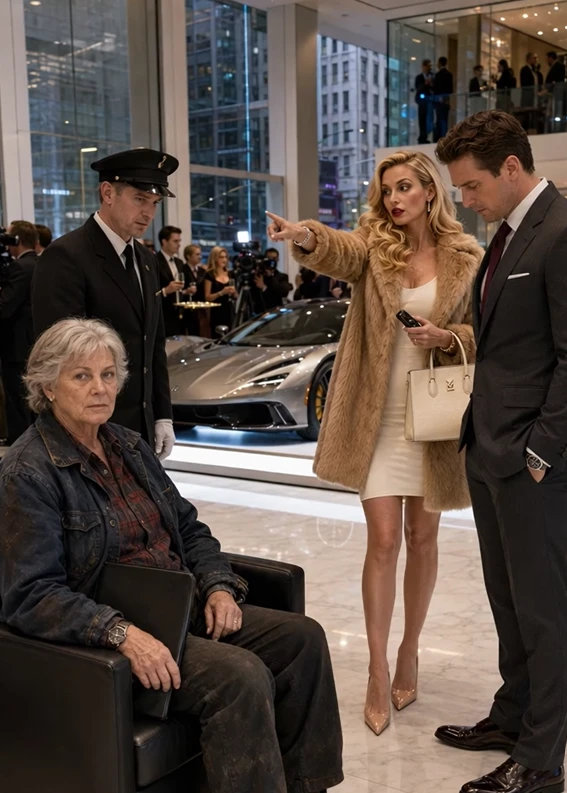
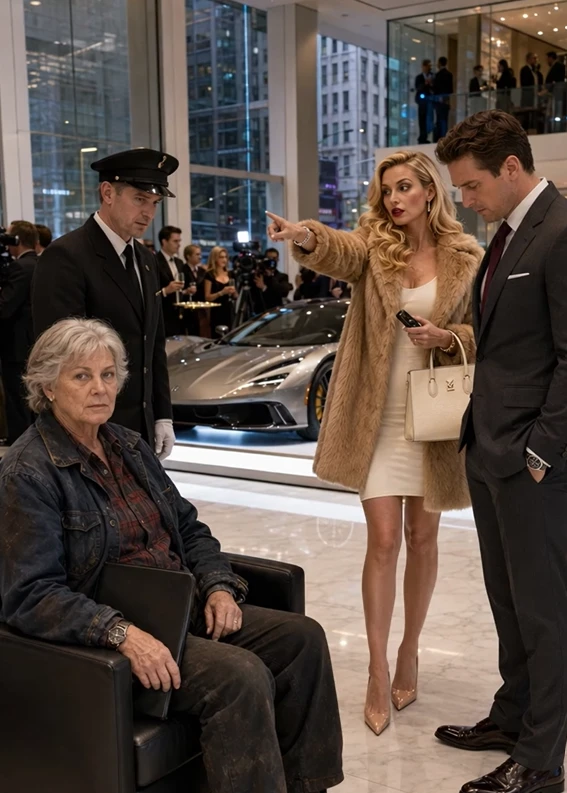
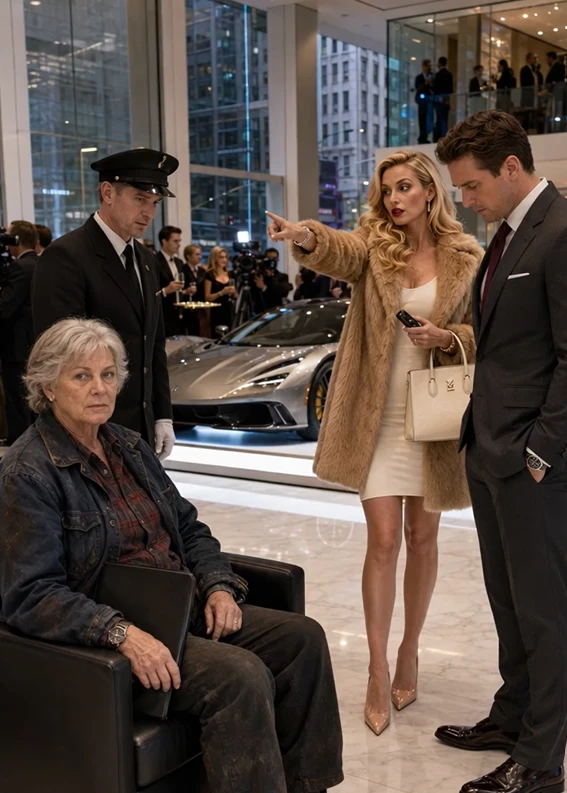
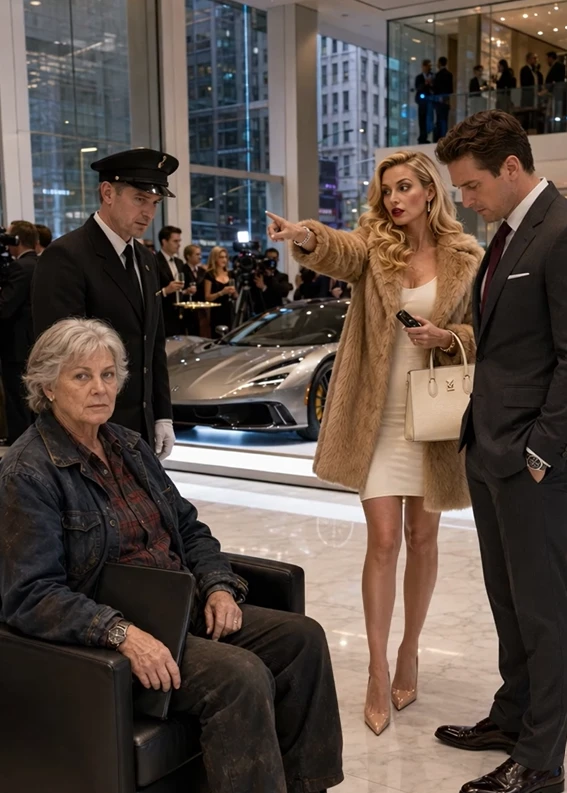
“Take her key fob and lock her out of the VIP suite. She looks like a valet driver who took a wrong turn into the showroom.”
My daughter-in-law did not bother lowering her voice.
Brittany’s words traveled across the floor-to-ceiling glass of the flagship Manhattan dealership, cutting through the quiet jazz, camera shutters, and murmured conversations of wealthy buyers.
She stood beside a silver Aureon Spectra, a six-figure electric supercar displayed beneath a circle of white lights.
A white mink coat rested across her shoulders. She had charged it to my son’s corporate account three weeks earlier and categorized it as a “brand presentation expense.”
Around her waited city officials, influencers, investors, reporters, and customers whose watches cost more than the first house my husband and I had bought.
I sat in a leather armchair near the service corridor wearing a faded flannel shirt, a grease-stained denim jacket, and work boots that had crossed more garage floors than Brittany had ever seen.
I had driven two hours in my old Ford pickup to bring my son, Tyler, the original title deed to his first repair shop.
He had called me the previous evening.
“We need it for an administrative review, Mom,” he had said. “Nothing serious.”
But Tyler’s voice had tightened around the word administrative.
So I brought the deed.
I did not give it to him.
Not yet.
Brittany waved one manicured hand in front of her nose.
“Honestly, Tyler, I don’t know why you let her come. She is ruining the entire aesthetic.”
Several guests laughed.
A camera operator turned toward me, livestreaming every second.
Brittany smiled directly into the lens.
“Someone call security before the mayor arrives.”
I looked at my son.
Tyler stood beside her in an Italian suit and polished black shoes. At thirty-eight, he had his father’s height, his dark hair, and the same small crease between his eyebrows whenever he was frightened.
He knew who I was.
He knew I had operated a commercial fleet company for thirty years.
He knew my money had opened his first shop, financed his first dealership, and covered payroll when his expansion nearly collapsed.
Most importantly, he knew I controlled the company beneath everything Brittany was celebrating.
Still, he lowered his eyes.
He said nothing.
A security guard began crossing the marble floor.
Brittany snapped her fingers at a valet.
“Give her twenty dollars and tell her to wait by the curb.”
That was the moment my disappointment became something colder.
I had defended Tyler through failed ventures, unpaid loans, and promises he made faster than he could keep them.
I had told myself that silence meant uncertainty.
Now I understood.
Silence was sometimes a decision made by people who wanted the benefits of betrayal without accepting responsibility for it.
I lifted my black coffee, took one final sip, and stood.
“You’re right, Brittany,” I said. “Image is everything in the automotive business.”
The room quieted.
I removed a black leather folio from inside my jacket and placed it on the armchair.
Then I called my managing director and activated the speaker.
“Harrison.”
He answered immediately.
“Yes, Mrs. Vance?”
“You know the master distribution rights and the property lease for this Manhattan location?”
“Yes. Vance Commercial Holdings owns the real estate and controls the regional Aureon franchise license.”
Brittany’s smile weakened.
I continued.
“Terminate the franchise agreement. Lock the inventory. Revoke Brittany’s ambassadorship and suspend every corporate card associated with this dealership.”
The jazz continued playing for three confused notes before someone shut it off.
Brittany stared at me.
“What did you say?”
Harrison’s voice came clearly through the phone.
“Understood. Inventory-control protocols are activating now. No vehicle may leave the premises without authorization.”
Across the showroom, the supercars’ display screens went dark.
A line of electronic clicks traveled through the room as every demonstration vehicle entered security mode.
Brittany rushed toward the silver Spectra and pulled its door handle.
It did not open.
“You can’t do this!” she shouted. “My investors are arriving.”
“I am the investor.”
Her face became white.
“Vance Commercial Holdings isn’t some outside group,” I said. “It is my company. I own the land beneath this building, the franchise rights above it, and the credit facility that paid for your coat.”
Her phone began vibrating.
Once.
Then again.
Then continuously.
CORPORATE CARD DECLINED.
AMBASSADOR ACCESS REVOKED.
DEALER ACCOUNT SUSPENDED PENDING AUDIT.
The livestream camera operators slowly lowered their equipment.
I touched Tyler’s shoulder.
He flinched.
“You should have spoken before the cars did.”
Then I picked up my folio and headed toward the front doors.
Behind me, Brittany screamed my name.
I stopped but did not turn around.
“This event is not over,” I said. “It has only moved to the boardroom.”
The Company Beneath the Dealership
My name is Margaret Vance.
Long before anyone called electric vehicles luxurious, my husband, Owen, and I operated twelve diesel delivery trucks from a corrugated-metal garage in New Jersey.
Owen could diagnose an engine problem by listening to it idle.
I handled routes, contracts, insurance, and every number that decided whether we ate well or postponed another bill.
Our first winter nearly destroyed us.
Three trucks failed in the same week. A customer delayed payment. The bank refused another loan.
I took night shifts dispatching taxis while Owen rebuilt transmissions until dawn.
We survived.
Then we grew.
Twelve trucks became fifty.
Fifty became four hundred.
By the time Tyler entered high school, Vance Fleet Services operated one of the largest independent commercial fleets in the Northeast.
Owen believed electric vehicles would transform transportation before most manufacturers took them seriously.
He invested in charging systems, battery diagnostics, and technician training. When a small European automaker named Aureon sought an American fleet partner, Owen volunteered our company.
We tested their early commercial vehicles through snow, heat, and relentless urban mileage.
Our reports helped make their technology viable.
In return, Vance Commercial Holdings received long-term regional distribution rights, preferred shares in Aureon’s American division, and control over future dealership franchises.
Tyler knew some of this.
He never cared enough to learn all of it.
He wanted the glamorous side of the industry—the showrooms, launches, press interviews, and customers arriving in tailored suits.
Owen gave him the original repair garage when Tyler was twenty-five.
Not the land.
Not the master deed.
Only the right to operate there.
Tyler transformed it into Vance Motor Works. I financed the equipment and retained ownership through the family trust.
His business succeeded.
Then Brittany appeared.
She was beautiful, quick-witted, and fluent in the language of visibility.
She taught Tyler to replace repair shop with automotive experience center.
She arranged social campaigns and luxury partnerships.
Within four years, one location became six dealerships.
The sixth was Manhattan.
Brittany called it their empire.
I never corrected her.
That was my mistake.
The Missing Numbers
Harrison arrived twenty minutes after the shutdown, accompanied by Vance Commercial’s attorney, Diane Flores, and Aureon North America’s compliance director.
The remaining guests were asked to leave.
Several influencers continued filming from the sidewalk until the dealership’s privacy glass turned opaque.
Inside the boardroom, Brittany stood at the window with her arms folded.
Tyler sat at the table.
I remained near the door.
Harrison placed a stack of reports before us.
“Over the past eleven months,” he said, “the dealership network accumulated $18.4 million in undisclosed liabilities.”
Tyler looked at Brittany.
“You said it was six.”
Her expression did not change.
“The expansion required aggressive capital.”
“Whose capital?”
“Investors’.”
Harrison opened the first report.
The Manhattan dealership had purchased vehicles using Vance Commercial’s credit line, then pledged the same inventory as collateral to a private investment group called Northbridge Automotive Partners.
That meant Brittany had promised vehicles owned by my company to another lender.
She had also pledged the Manhattan lease, three suburban dealership properties, and the regional franchise license.
None belonged to her.
“Those documents are preliminary,” Brittany said.
“They carry Tyler’s signature,” Diane replied.
I looked at my son.
His eyes remained on the table.
“What did you think you were signing?”
“A bridge-financing agreement.”
“Did you read it?”
“Brittany’s attorneys reviewed it.”
“Did you?”
He said nothing.
Again.
Brittany turned toward me.
“You built a company by taking risks. Do not pretend you never used leverage.”
“I used assets I owned.”
“We were about to own them.”
“No. You were about to lose them.”
Northbridge’s loan contained an accelerated-default clause.
If the dealerships missed one quarterly target—or if the master franchise provider suspended support—Northbridge could seize the pledged assets.
Brittany’s expansion projections were impossible.
The dealerships were already heading toward default.
“You designed this to fail,” Harrison said.
Brittany laughed.
“Why would I destroy my own company?”
Before he could answer, the boardroom doors opened.
A broad-shouldered man in a navy overcoat entered with two attorneys.
Brittany’s face changed.
“Dad?”
Graham Cole had been introduced to me as a retired investment adviser.
He was actually the controlling owner of Northbridge Automotive Partners.
Tyler stood.
“Your father is our investor?”
Brittany looked furious—not ashamed, but furious that the truth had arrived before she controlled it.
Graham removed his gloves.
“This meeting should be private.”
“It is,” I said. “The private owner is here.”
The Marriage Behind the Loan
Northbridge had funded Brittany’s luxury campaigns, showroom renovations, and rapid expansion.
Then it converted every expense into dealership debt.
The jewelry, private flights, launch parties, and mink coat had not been signs of success.
They were weights placed onto a structure designed to collapse.
Once the network defaulted, Graham planned to seize the dealership assets for a fraction of their value.
Tyler stared at his wife.
“You married me before Northbridge made its first loan.”
Brittany’s jaw tightened.
“That is irrelevant.”
“Did you know Dad wanted the franchise before you met me?”
She did not answer.
Graham did.
“Aureon’s regional license is exceptionally valuable.”
Tyler looked between them.
“You targeted me.”
Brittany finally lost her calm.
“Do not act innocent. You wanted to be important. I gave you a brand, a profile, and a life people envied.”
“You gave me debt.”
“I gave you relevance.”
Her words struck Tyler harder than any insult I could have delivered.
She had not loved his talent.
She had recognized his hunger to be admired.
Then she had turned it into collateral.
But Tyler was not merely a victim.
I placed the competency affidavit in front of him.
He stared at it.
“What is this?”
“You signed it Tuesday.”
Brittany had prepared a petition claiming I was no longer capable of managing Vance Commercial Holdings.
According to the document, I displayed memory loss, irrational attachment to outdated vehicles, social isolation, and impaired judgment.
My old truck appeared in three photographs as evidence.
So did my work clothes.
Tyler’s signature supported every claim.
“I was told this protected the company if you became ill,” he whispered.
“Did I seem ill while you watched your wife order security to remove me?”
His face crumpled.
“No.”
“Yet you remained silent because her investors were watching.”
He closed his eyes.
The Vance Family Trust contained a protective clause Owen had insisted upon after Tyler’s second failed venture.
If Tyler attempted to seize control of trust assets through fraud, coercion, or a false claim of incapacity, his future voting interest would be suspended.
Management authority would transfer to the Vance Employee Mobility Trust.
The technicians, sales staff, mechanics, administrators, and drivers would become the controlling beneficiaries of the dealership network.
Tyler looked at me in disbelief.
“You’re giving my company to the employees?”
“It was never entirely yours.”
Why They Needed the Original Deed
Graham straightened his cuffs.
“This is an unfortunate family dispute, but Northbridge retains enforceable rights against Tyler’s personal assets.”
“That is why you asked him to obtain the original title deed,” I said.
The first Vance garage occupied an unremarkable industrial lot beside the river.
Public records valued it at less than four million dollars.
But the original deed included attachments never digitized by the county.
One was a sealed property covenant.
Another was a map showing a fireproof archive beneath service bay three.
Brittany’s attention moved to the folio in my hands.
She knew exactly what it contained.
Owen had stored decades of Aureon test reports inside that archive.
Most concerned battery performance, charging failures, and vehicle safety.
One file concerned an accident that killed him.
Six years earlier, Owen had been testing an early electric delivery van when its battery-control system failed. The vehicle caught fire after striking a barrier.
Aureon settled privately with our family.
The report blamed a manufacturing defect.
Owen’s private records suggested something else.
A supplier had knowingly substituted an unapproved cooling component.
The supplier was Cole Advanced Systems.
Graham’s former company.
He had signed the certification.
Harrison placed a recovered email on the screen.
Brittany had written to her father:
Once I obtain the original deed, I can access the founder archive. We destroy the test files before Margaret realizes what they contain.
Tyler’s face went blank.
“You knew your father’s company caused Dad’s accident?”
Brittany stepped backward.
“It was not that simple.”
“He died.”
“The component passed initial testing.”
“You married me to reach those records.”
“I married you because we were useful to each other.”
Tyler stared at the woman he had allowed to humiliate his mother.
For the first time, he seemed to understand the full cost of his silence.
Brittany had not merely wanted the dealership.
She wanted the evidence hidden beneath the first shop.
Northbridge’s plan served two purposes.
Seize Aureon’s regional network.
Destroy the files that could connect Graham to Owen’s death.
The Title Deed’s Final Page
I opened the folio.
“The records are no longer beneath the shop.”
Graham’s confidence vanished.
“Where are they?”
“With federal transportation investigators.”
Two agents entered the boardroom.
Diane had notified them when Tyler first asked me to deliver the original deed.
I knew the deed itself was not required for any ordinary financing review.
That request told me someone wanted the attachments.
The agents approached Graham.
He turned on Brittany.
“You said Margaret knew nothing.”
“You told me the archive was inaccessible without the deed!”
Their alliance lasted exactly as long as their confidence.
One agent placed Graham under arrest for conspiracy, evidence tampering, financial fraud, and false safety certification.
Brittany was informed that she was under investigation for fraudulent collateralization, conspiracy, and attempted destruction of evidence.
Before the agents reached her, she looked at Tyler.
“Say something.”
He stood motionless.
The irony was almost cruel.
Hours earlier, he had remained silent while she humiliated me.
Now she wanted his voice to save her.
He finally spoke.
“Did you ever love me?”
Brittany’s eyes hardened.
“I loved what we could become.”
“That isn’t an answer.”
“It is the only honest one you’re going to get.”
The agents led her away.
Graham followed.
The boardroom fell silent.
Tyler sat down heavily.
I removed the original title deed and opened it to the final page.
Owen had added a handwritten codicil to the family property trust.
I had known about the employee clause.
I had not known about the rest.
Harrison read it aloud.
If Tyler preserves the company’s independence, respects its workers, and treats the family’s history as responsibility rather than entitlement, he may eventually inherit executive control.
If he abandons those duties in pursuit of status, the original garage shall transfer permanently to the Vance Technical Foundation.
The foundation’s first director was also named.
Elena Ruiz.
Tyler looked confused.
“Elena from the Queens service center?”
Elena was thirty-one, the daughter of a Vance Fleet mechanic who had died in the same vehicle fire as Owen.
She began sweeping floors at sixteen, earned engineering degrees at night, and developed a battery-fire containment system now used across our commercial fleet.
Brittany had repeatedly blocked her promotion.
“She doesn’t have the right image for luxury clients,” Brittany once wrote.
Owen had met Elena when she was a teenager.
He paid for her first technical course anonymously.
Before his death, he named her as the person who should lead the company if Tyler ever valued appearances more than competence.
The original shop would become the Owen Vance Institute for Electric Vehicle Safety, with Elena as director.
The archive Brittany wanted to destroy would become its research library.
Tyler’s empire had not been taken from him and handed to a stranger.
It had passed to the person who had quietly performed the work he treated as beneath him.
What Happened After the Showroom Went Dark
Brittany’s appointment as brand ambassador was terminated before sunset.
Aureon canceled the Manhattan launch and issued a statement supporting the investigation.
Northbridge collapsed when lenders discovered most of its collateral claims were fraudulent.
Graham was later convicted of financial conspiracy, falsifying safety documents, and obstruction.
His original certification in Owen’s accident became central evidence.
Brittany accepted a plea agreement and testified against him.
She claimed her father had pressured her to pursue Tyler.
Messages showed she had participated willingly.
Her marriage ended before sentencing.
Tyler was not charged in the safety conspiracy.
But he had signed false financial documents and the petition questioning my capacity.
He paid civil penalties, lost his executive role, and surrendered every voting interest under the trust.
The employee trust retained him as a sales consultant for one location.
No private office.
No corporate card.
No special parking space.
Elena became chief operating officer of the dealership network and director of the new safety institute.
The Manhattan showroom remained closed for six weeks.
When it reopened, the mink coats and influencer walls were gone.
A glass partition allowed customers to watch technicians working in the service laboratory.
Beside the silver Spectra stood a display honoring the mechanics, engineers, and drivers who had tested the technology.
My denim jacket hung behind glass.
I objected.
Elena ignored me.
Beneath it, she placed a small plaque:
THE WOMAN THEY MISTOOK FOR THE VALET OWNED THE ROAD THAT BROUGHT THEM HERE.
Three years later, I returned to the original repair shop for the institute’s first graduation ceremony.
The building still smelled of rubber, oil, and metal.
Students in blue uniforms stood beside charging systems and open battery packs.
Tyler waited near service bay three.
He wore work trousers and a plain gray shirt.
His polished shoes had been replaced by steel-toed boots.
“Mom,” he said.
“Tyler.”
He glanced toward the framed title deed.
“I used to think Dad gave me this place because he believed I was special.”
“He gave you an opportunity.”
“I turned it into proof that I was better than where I came from.”
“Yes.”
He accepted the answer.
That was new.
“I’m sorry I let her speak to you that way.”
“You did more than let her speak.”
“I know. I chose the room over you.”
The honesty mattered.
It did not restore what he had lost.
But it was the first repair he completed without asking me to provide the parts.
“Will I ever get the company back?” he asked.
“No.”
His face tightened, but he nodded.
“Will you ever forgive me?”
“Possibly.”
He looked toward the students.
“I’m teaching an introductory sales ethics class next month.”
I raised an eyebrow.
“Are you qualified?”
“Probably not yet.”
For the first time in years, I laughed with my son.
Elena called everyone toward the ceremony.
Before joining them, Tyler touched the old title deed’s frame.
“I spent years believing this paper represented ownership.”
“What do you think it represents now?”
“A warning.”
He was finally learning.
Brittany had believed image was everything.
She believed wealth wore mink, arrived with cameras, and never smelled of engine oil.
She saw a woman in a grease-stained jacket and assumed I could be handed twenty dollars and sent to the curb.
What she failed to understand was that real ownership rarely needs to announce itself.
It is built through long nights, paid debts, protected workers, and names signed only after the person holding the pen understands every line.
I had driven to Manhattan carrying the deed to my son’s first shop.
By the time I left, the dealership lights were dark, the fraudulent empire was collapsing, and the truth beneath service bay three was finally on its way to investigators.
Tyler lost the company he had treated like a stage.
Brittany lost the future she had designed as a theft.
And the people whose hands were stained with grease inherited the business they had actually built.
Brittany was right about one thing.
Image mattered—but when the showroom went dark, only the work remained.