
My Family Demanded the House I Built as My Sister’s Wedding Gift. By Midnight, the Deed Revealed They Needed My Land to Complete a Forty-Million-Dollar Sale.
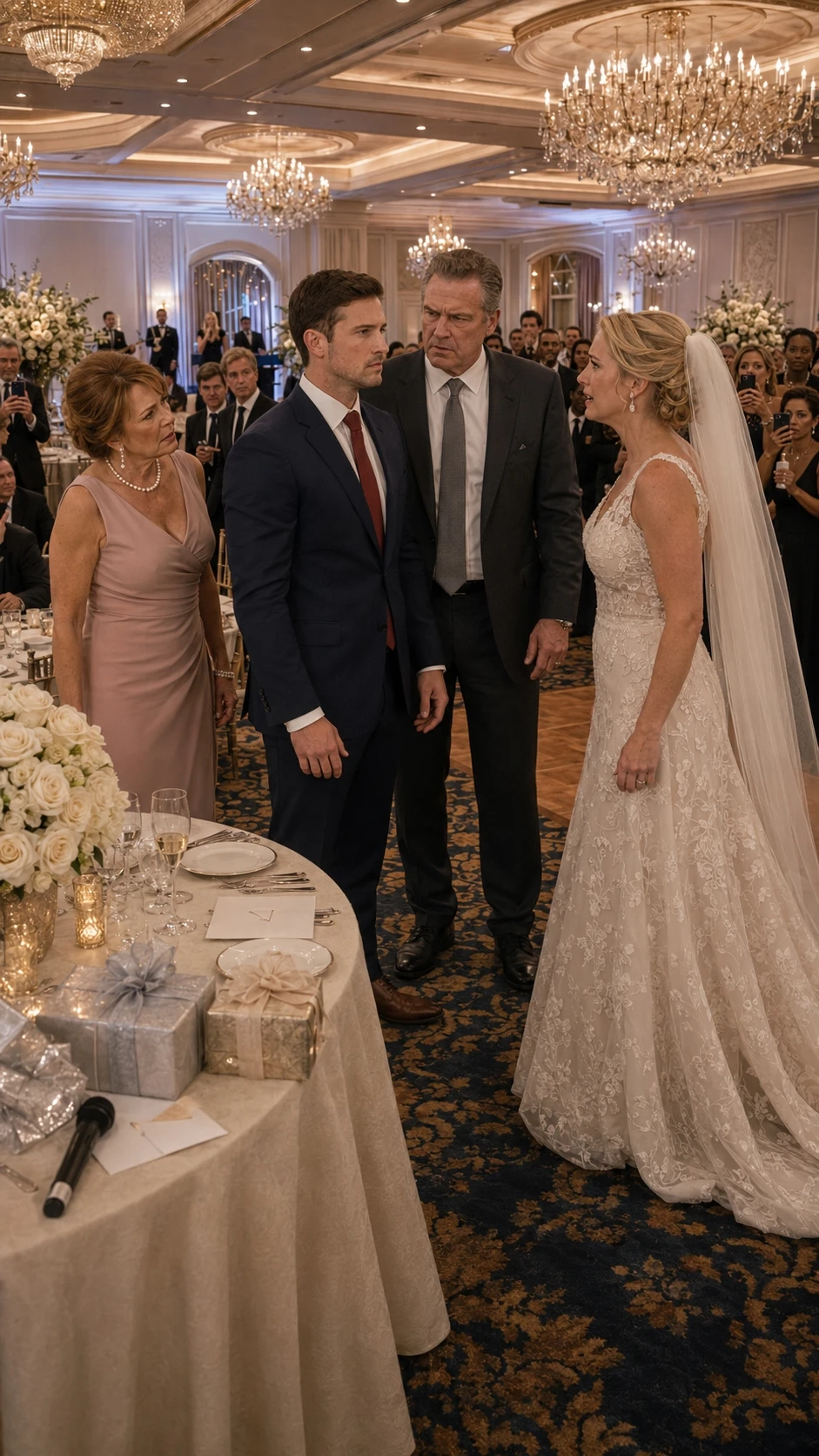
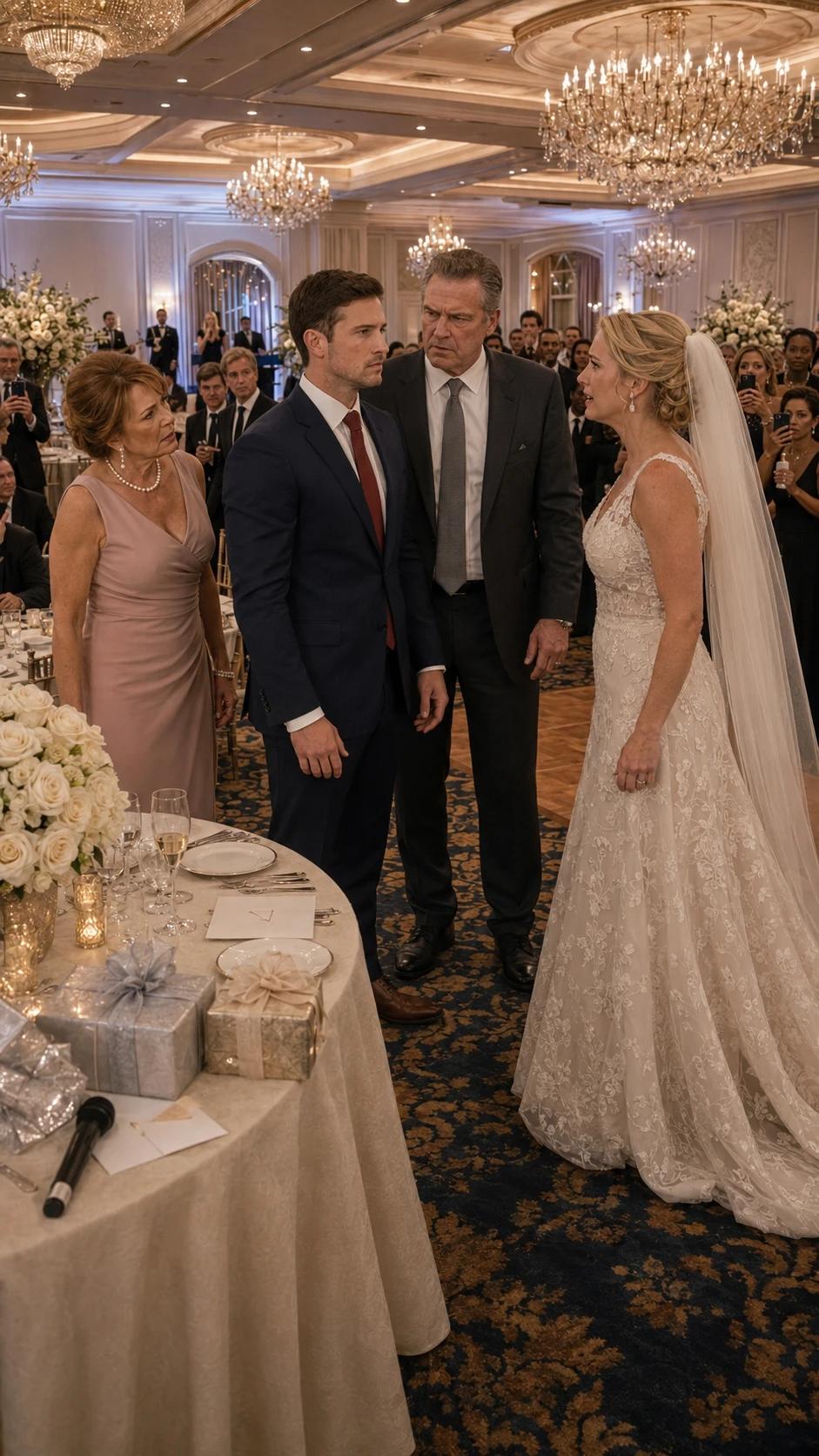
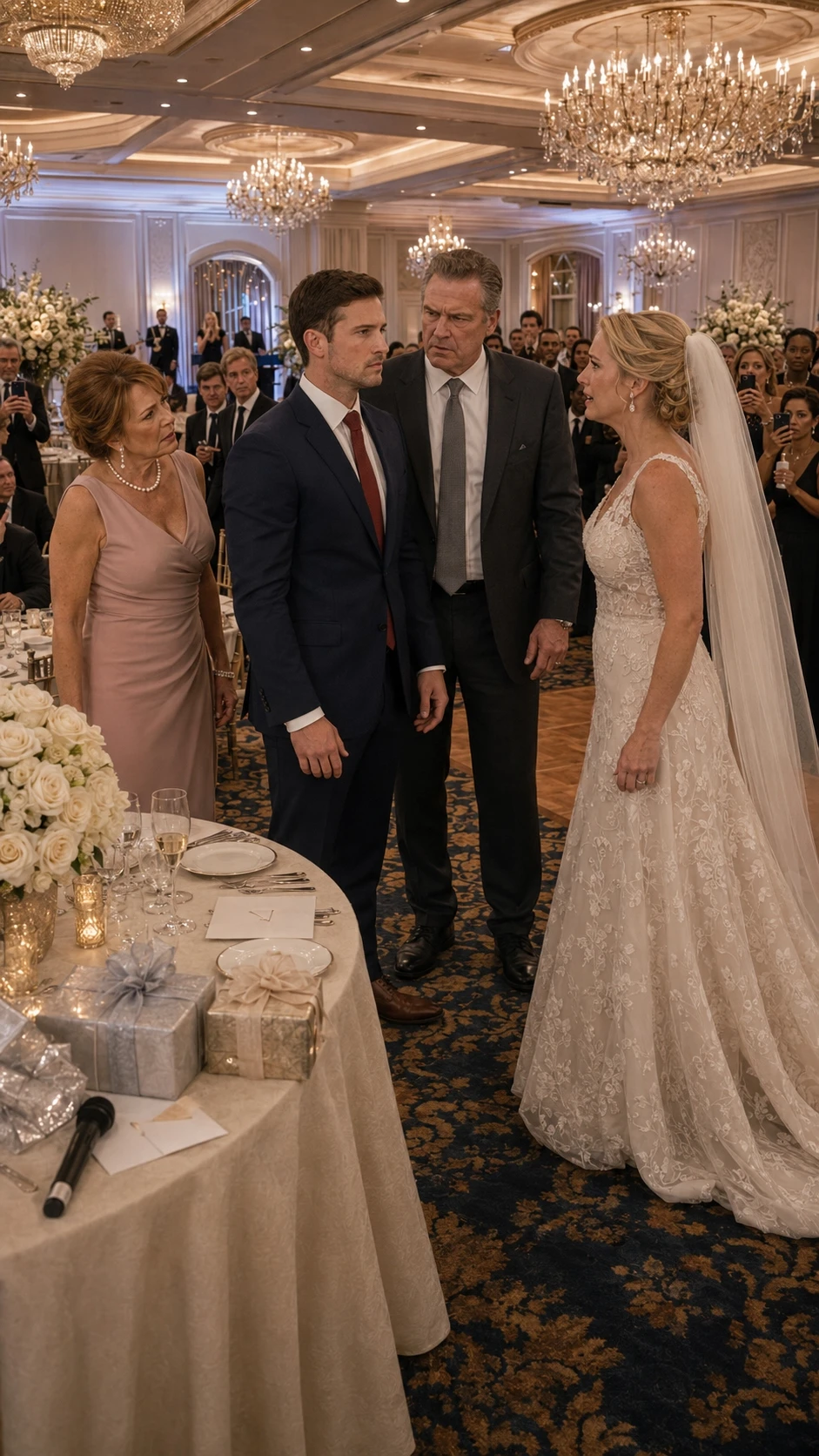
The ballroom went silent when my father lifted the microphone and announced that my sister’s final wedding gift would be the house I had built with my own hands.
Not sold.
Not shared.
Given away.
To Lucy.
The live band had stopped playing. One hundred and seventy-five guests sat beneath the chandeliers of the Riverside Grand Hotel, champagne glasses suspended near their mouths as my father stood beside the wedding cake with a folded document in one hand.
“Family,” he said, smiling toward the crowd, “is measured by sacrifice.”
My mother stood behind him, nodding solemnly.
Lucy remained near the head table in her white gown. Her new husband, Caleb Grant, rested one hand against her back, performing concern so perfectly that I almost admired him.
Almost.
My father continued.
“Ethan has been blessed with more space than one unmarried man could ever need. Lucy and Caleb are beginning their life together. Tonight, he has the opportunity to prove what kind of brother he is.”
A bridesmaid carried a silver tray toward me.
On it rested a pen.
And a deed.
That was the scrape of silver I had heard moments earlier.
They had not planned to ask me privately.
They had planned to make refusal feel like a public crime.
My mother took the microphone.
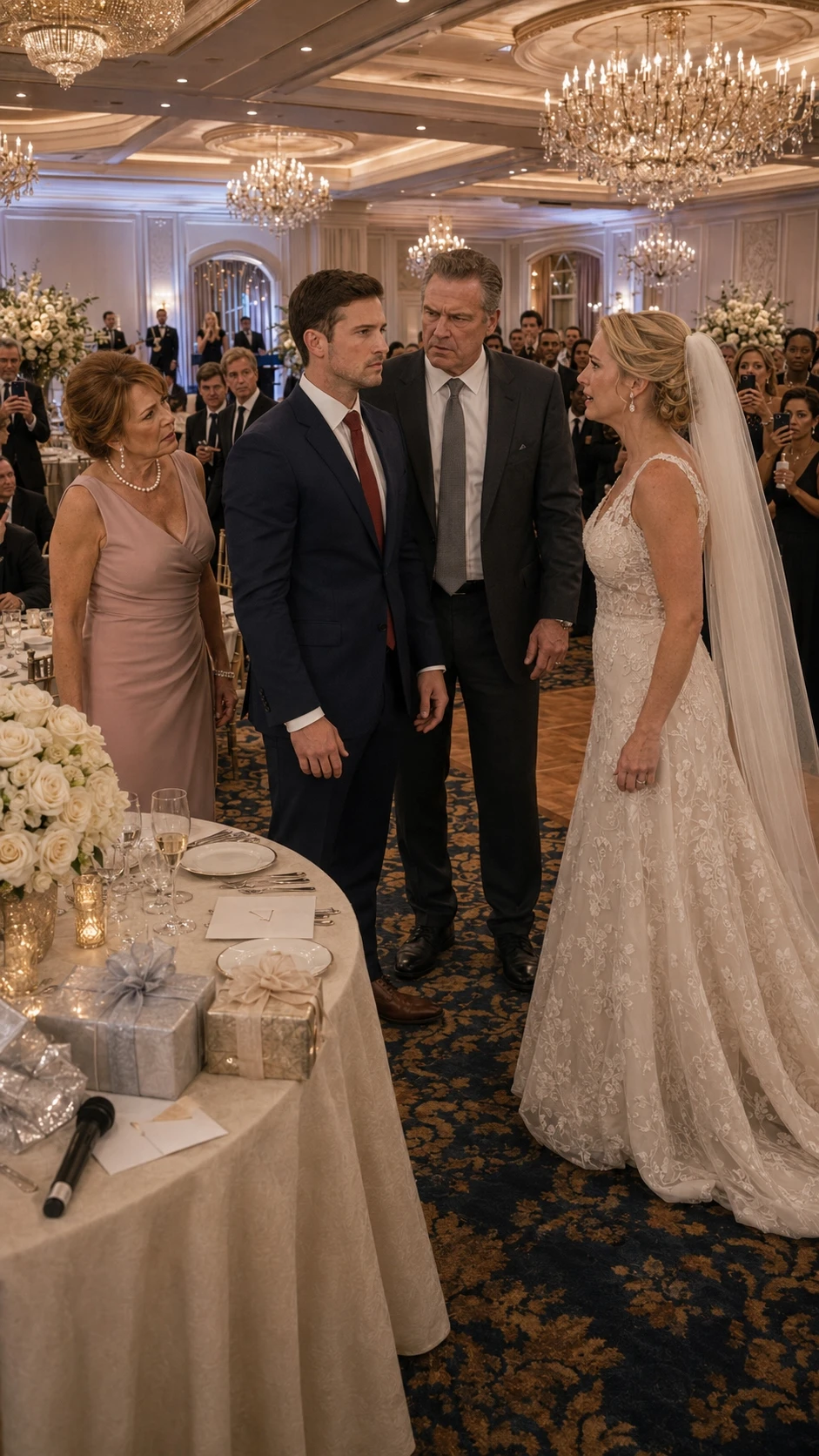
“Ethan, sweetheart, come sign it. Your grandmother would have wanted the land to support the whole family.”
The nearest guests turned toward me.
Some smiled encouragingly.
Others raised their phones.
I looked at Lucy.
“You knew about this?”
Her lips trembled.
“Mom and Dad said you would understand.”
“Did they tell you I agreed?”
She looked away.
That was answer enough.
I stood slowly.
The house they wanted sat on two acres outside Ashford, land my grandmother had left to me when I was twenty-three.
There had been no house then.
Only weeds, an abandoned chicken shed, and a collapsing well cover.
For two and a half years, I worked construction by day and built my own home by night.
I poured the footings with Walter Jensen, my retired neighbor, holding the level beneath a work light while winter wind cut through our coats.
I framed the walls.
Ran the wiring.
Installed the plumbing.
Refinished the floors twice because the first coat showed streaks in the afternoon sun.
Every room contained something of me.
Blood beneath the porch where a nail tore my palm.
A burn mark behind the stove.
My grandmother’s measurements written in pencil inside the pantry.
The county valued the property at $375,000.
But no assessment could measure what it meant.
I had not inherited a dream.
I had inherited dirt and built proof that my life belonged to me.
“No,” I said.
The microphone amplified the silence.
My father’s smile tightened.
“What?”
“I’m not giving Lucy my house.”
A murmur moved through the tables.
My mother pressed one hand to her chest.
Lucy’s eyes filled with tears.
“You won’t help me?”
“I gave you four thousand dollars for this wedding.”
“This isn’t about money,” my mother said.
“It is a request for property worth hundreds of thousands of dollars. It is exactly about money.”
My father descended from the platform.
“After everything we’ve done for you?”
“You lent me eight thousand dollars for foundation materials.”
“We helped you get started.”
“I repaid the loan in eight months, including the interest you added.”
His jaw hardened.
“Your grandmother’s land should have been divided.”
“She left it to me in a recorded will.”
“Because you manipulated her.”
I laughed in disbelief.
“I repaired her roof, drove her to appointments, and bought groceries when you stopped visiting. Is that the manipulation you mean?”
My mother stepped closer.
“Do not rewrite history at your sister’s wedding.”
“You brought my house to her wedding.”
Caleb finally spoke.
“Ethan, no one is trying to take advantage of you.”
The sentence was too smooth.
Too prepared.
I looked at him properly for the first time that evening.
His tuxedo was custom-made. His watch cost more than my truck. He worked for Grant Meridian Development, a company that purchased farmland, rezoned it, and replaced trees with luxury subdivisions bearing names like Meadow Haven.
Three tables behind him sat his father, Douglas Grant, beside two attorneys and a man I recognized from county-planning meetings.
Martin Shaw.
Regional director of Crescent Land Holdings.
Why was a developer attending my sister’s wedding?
Lucy had worked in corporate finance for six years, but she had never mentioned knowing him.
Caleb gestured toward the deed.
“It’s a family transfer. Lucy would preserve the home.”
“Then why is a commercial real-estate attorney holding the notary stamp?”
Every head turned toward the woman seated beside the gift table.
She quickly closed the small case in front of her.
My father gripped the microphone more tightly.
“You’re embarrassing your sister.”
“No,” I said. “I’m interrupting something.”
My friend Jordan Lee sat near the back of the room.
He was a real-estate attorney and the only guest I had personally invited. He had arrived late and slipped into an empty chair without attracting attention.
Now he stood.
“May I see the document?”
My father stepped between him and the tray.
“This is a family matter.”
“A deed is a legal matter.”
Caleb’s father rose.
“There is no need for outside interference.”
Jordan looked at me.
“You haven’t signed anything related to your property recently?”
“No.”
“Any options, easements, purchase rights, or gifts?”
“No.”
My mother laughed nervously.
“Ethan is overly suspicious.”
Jordan took out his phone.
“Then no one should object to letting him review the legal description.”
The notary looked toward Caleb.
That small glance told me she was not acting independently.
Lucy wiped beneath one eye.
“Please, Ethan. We can talk about the paperwork later.”
“Why does it have to be signed tonight?”
No one answered.
I turned toward Martin Shaw.
“Why are you here?”
The developer lifted both hands.
“I’m a friend of the Grant family.”
“I saw you at the Ashford zoning hearing last month.”
His expression remained neutral.
That meeting concerned a proposed development on sixty-three acres bordering my grandmother’s land.
Crescent Land Holdings wanted to build two hundred luxury homes, a shopping plaza, and a private school.
The proposal had stalled because the existing county road could not handle the traffic.
They needed another access point.
My property sat between the development tract and the state highway.
A cold understanding began forming inside me.
Jordan reached the silver tray before my father could stop him.
He lifted the deed and read the first page.
Then the second.
His expression changed.
“Ethan, this does not transfer only the house.”
My father stepped toward him.
“Give me that.”
Jordan moved away.
“It transfers Lot Seven, all attached access rights, utility corridors, ingress and egress easements, and development participation interests.”
Lucy blinked.
“What development interests?”
Caleb touched her arm.
“It’s standard language.”
“No,” Jordan said. “It isn’t.”
I looked at my parents.
“What have you done?”
My mother began crying.
My father’s voice dropped.
“We were trying to secure everyone’s future.”
“By taking mine?”
“The land is worth more as part of a larger project.”
“How much more?”
He said nothing.
Jordan photographed the deed and sent it to someone at his office.
Seconds later, his phone rang.
He listened for less than a minute.
Then he looked at me.
“Crescent has an option to purchase the surrounding sixty-three acres. It expires at midnight.”
The ballroom clock showed 8:16 p.m.
“They cannot close unless they control your highway access,” he continued. “The county rejected every alternative route.”
Martin Shaw rose.
“This conversation involves confidential business information.”
“Then confirm the number,” I said.
His lips tightened.
“What number?”
“The purchase.”
Caleb’s father answered before Martin could stop him.
“Ethan, everyone benefits if the project proceeds.”
“How much?”
Lucy looked at her new husband.
“Caleb?”
He would not meet her eyes.
Jordan received another message.
He turned the screen toward me.
A preliminary sale agreement had been filed with the planning commission as part of Crescent’s financing package.
If the access parcel transferred before midnight, Crescent would pay Grant Meridian Development $41.8 million for the assembled land and entitlements.
My house was the final piece.
They had not wanted it because Lucy needed a yard.
They needed it because without my two acres, forty million dollars could not cross the highway.
Lucy stared at Caleb.
“You said we were going to live there.”
“We could have for a while.”
“For a while?”
My mother stepped toward her.
“Sweetheart, the development would give you financial security.”
“What development?”
My father lowered the microphone.
“After the transfer, Lucy and Caleb would sell the land with the adjoining parcels.”
“So Ethan loses his house?” Lucy asked.
“He would be compensated later.”
“How much?”
No one answered.
I took the document from Jordan.
Attached behind the deed was a distribution agreement.
Crescent’s forty-one-million-dollar payment would not go directly to Lucy.
It would be divided among several limited-liability companies.
Grant Meridian received twenty-eight million.
My parents’ company, Miller Family Investments, received four million.
Caleb’s private entity received eight million.
Lucy received $250,000.
I looked at her.
“Did you know?”
Her face had gone white.
“No.”
Caleb leaned toward her.
“It’s an initial distribution. We would share everything after marriage.”
Jordan turned another page.
“No, you wouldn’t.”
A separate post-closing agreement placed Caleb’s proceeds inside a premarital holding company.
Lucy had signed a prenuptial agreement that morning waiving any claim to assets held there.
Her new husband planned to receive eight million dollars from my land while she received a fraction and no house.
The public wedding gift was a temporary transfer designed to place the property in Lucy’s name just long enough for her to sign it away.
Lucy looked at Caleb as if the man standing beside her had changed shape.
“You told me Ethan’s house would be ours.”
“It would have complicated the deal if I explained every detail before the ceremony.”
“Our ceremony?”
“Lucy—”
“You used our wedding to take my brother’s land?”
Her bouquet slipped from her fingers.
My father reached for her.
“This is still good for you.”
She recoiled.
“You knew?”
My mother cried harder.
“We wanted to help you start your life.”
“With two hundred and fifty thousand dollars while Caleb gets eight million?”
“Money is not the point,” my father said.
For the first time that evening, guests openly laughed.
It was not warm laughter.
It was the sound people make when a lie has become too ridiculous to carry politely.
Walter Jensen called me at 8:31.
Jordan had sent him a photograph of the legal description.
Walter’s voice was urgent.
“Ethan, don’t sign anything.”
“I won’t.”
“There’s something your grandmother never told your parents.”
“What?”
“Your two acres aren’t merely the access parcel.”
Walter had been a county civil engineer before retiring. Thirty years earlier, he helped my grandmother fight the first developer who attempted to buy her land.
The state highway entrance crossed a drainage structure built partly on her property.
Because she paid for the original culvert and access lane, the recorded deed granted her parcel permanent control over any commercial expansion using it.
Even if the house were transferred, a separate transportation consent right remained with the named beneficiary in her will.
Me.
The deed on the silver tray could take the house.
It could not activate the road.
Crescent needed my separate notarized consent.
“They don’t know,” Walter said. “The document was recorded in the old engineering archive, not the modern title index.”
My parents and Caleb had planned all of this without understanding the final protection my grandmother placed around the land.
Even if public pressure forced me to surrender my home, the forty-million-dollar development still could not proceed without my second signature.
I looked toward the clock.
8:34.
“Can you send the record?”
“It’s already on the way.”
Five minutes later, Jordan opened the scanned consent covenant.
Martin Shaw read it over his shoulder.
His face collapsed.
“This wasn’t disclosed.”
Caleb’s father snapped, “You conducted the title review.”
“The parcel report did not include archived transportation agreements.”
My father stepped toward them.
“You told us the deed was enough.”
Martin turned on him.
“You represented that your son had agreed to cooperate.”
My father looked at me.
“Ethan, listen. You can still sign the consent. We’ll increase your share.”
“What was my original share?”
Silence.
“There wasn’t one, was there?”
My mother whispered, “We were going to help you afterward.”
“You were taking my house, collecting four million dollars, and planning to decide afterward what part of my own property I deserved.”
My father’s voice hardened.
“You would never have built it without the land your grandmother gave you.”
“And Lucy would never receive this wedding without the four thousand dollars I gave her. Should I claim the cake?”
Several guests laughed again.
He raised the microphone.
“This man is choosing a house over his family!”
I walked toward him.
“No. You chose money over every person in this room.”
I pointed toward Lucy.
“You used your daughter as a temporary titleholder.”
Toward Caleb.
“You sold your bride a future that disappeared after midnight.”
Toward my mother.
“You turned Grandma’s gift into something you thought you could redistribute.”
Then I looked at the guests.
“And you brought all of us here because you believed enough witnesses could convert coercion into generosity.”
My father lowered the microphone.
“What do you want?”
“Nothing.”
“Name a price.”
“No.”
“Five million.”
Caleb’s father stared at him.
“You don’t have authority to offer that.”
My father ignored him.
“Six.”
“No.”
His face reddened.
“You would destroy this entire transaction out of spite?”
“I’m not destroying anything.”
I lifted the unsigned deed.
“I’m declining to donate my life to it.”
At 9:07, Crescent Land Holdings formally withdrew from the closing.
Without the consent right, the development financing collapsed.
Grant Meridian’s option on the surrounding acreage expired at midnight.
But the consequences were worse than a lost deal.
My parents had borrowed against their retirement accounts and mortgaged their own home to invest in Miller Family Investments.
They expected four million dollars from the closing.
Caleb’s father had used company funds to secure the neighboring land options.
When the transaction failed, Grant Meridian lost nearly six million dollars in nonrefundable deposits.
Caleb had personally guaranteed part of the loss.
That was why the signature had to happen at the wedding.
Not next week.
Not after a proper family discussion.
Before midnight.
They had spent money they did not possess on the assumption that I could be publicly broken.
Lucy walked away from the altar before the legal marriage certificate was filed.
The ceremony had occurred, but the officiant had not yet submitted the license.
She refused to sign the final documents.
Caleb insisted they were already married.
Lucy removed her ring and placed it inside his champagne glass.
“Then you can marry the development.”
She left the ballroom wearing her wedding gown and my old work jacket over her shoulders.
I gave it to her because the night had turned cold.
I did not forgive her in that moment.
But I also did not leave her alone with people who had just used her name.
The forged transfer attempt did not disappear.
The notary surrendered her commission after admitting Caleb’s father had paid her to witness a signature she expected me to provide under pressure.
My parents claimed the deed was only a draft.
The attached filing instructions proved otherwise.
They avoided prison because nothing was ultimately recorded, but they faced civil fraud claims from Grant Meridian and Crescent.
Caleb and his father were removed from their company after investors discovered they had concealed the transportation covenant and misrepresented control of my property.
Grant Meridian entered restructuring.
My parents sold their large suburban home to satisfy part of the judgment.
For the first time, they learned the difference between losing something through misfortune and risking it because they believed someone else would surrender first.
Lucy called me three months later.
“I’m not asking for the house,” she said.
“That’s an encouraging beginning.”
“I should have asked questions.”
“Yes.”
“I knew Mom and Dad planned to pressure you.”
I remained silent.
She continued.
“I told myself you could afford to be generous because you were always the one who recovered.”
That hurt because it was honest.
“I’m sorry,” she said. “Not only because Caleb lied to me. I’m sorry because before I knew about the sale, I still thought your house should become mine.”
“Why?”
“Because they trained me to believe responsible people existed to catch everyone else.”
I looked around the living room I had framed with my own hands.
“And I helped train you by always catching.”
“I know.”
Trust did not return during that call.
But truth arrived.
That was enough for a beginning.
Lucy found a smaller apartment, returned to work, and spent two years paying back the wedding vendors my parents had left unpaid.
She visited occasionally.
She never again discussed my property as though my death were simply a delayed distribution date.
I kept the house.
The hardwood floors still caught the afternoon light.
The tomato plants beside the porch returned every summer.
Walter and I installed a new workshop behind the garage.
On the wall, I hung the bent framing square my grandmother gave me when I began construction.
Beneath it, I placed a copy of the transportation covenant.
I eventually rejected Crescent’s development permanently.
Instead, I negotiated with the county to preserve the surrounding acreage as a mixed-use community with smaller homes, walking trails, and trade-school workshops.
The project included twelve affordable houses built by apprentices.
I taught framing on Saturdays.
Each student learned the rule my electrical instructor once repeated until I hated hearing it:
Do it right, or it becomes someone else’s problem.
My family had tried to make their greed my problem.
I declined.
Years later, my father asked to visit.
He stood on the porch looking older and smaller than the man who held the microphone.
“I lost almost everything,” he said.
“You risked almost everything.”
His mouth tightened.
“Do you enjoy correcting me?”
“No. I need the words to remain accurate.”
He looked toward the workshop.
“Your grandmother never told me about the consent right.”
“Would it have changed what you did?”
He considered lying.
Then stopped.
“No.”
That answer was the closest he had come to an apology.
“I believed the family’s need was greater than yours.”
“Lucy did not need my house.”
“We needed the sale.”
“Yes.”
He stared at the floorboards I had installed alone.
“Can you forgive me?”
“Partly.”
“Will you ever trust me again?”
“No.”
He nodded slowly.
For once, he accepted that forgiveness did not include restoration of authority.
At Lucy’s second wedding five years later, there were forty guests in a public garden.
No chandeliers.
No investors.
No microphones beside the cake.
Her husband, Nathan, taught middle-school science and owned nothing more impressive than a dependable truck and a patient smile.
Before the ceremony, Lucy handed me a small box.
Inside was the silver pen from her first wedding.
“I kept it,” she said. “To remember what I almost asked you to sign.”
I closed the box.
“You didn’t ask alone.”
“But I stood there.”
“Yes.”
She nodded.
No excuses.
Then she hugged me.
That time, I hugged her back.
The house still stands on my grandmother’s two acres.
It was never merely lumber, tile, and wiring.
It was the physical record of every evening I chose patience over comfort.
My parents saw an asset.
Caleb saw access.
Crescent saw a road.
Lucy saw stability she had been taught to expect from someone else.
Only my grandmother had seen the danger clearly enough to place one final protection inside an archive everyone overlooked.
My father believed the ballroom would make me weak.
He believed one hundred and seventy-five witnesses would transform theft into sacrifice and coercion into family loyalty.
Instead, the audience watched the entire story unravel.
The gift was not for Lucy.
The house was not intended to remain a home.
The wedding was not chosen because it was meaningful.
It was chosen because a forty-million-dollar option expired at midnight.
My family asked me to surrender the house I had built because they believed love made my boundaries negotiable.
By the time the ballroom clock struck twelve, they had lost the development, the money, the marriage, and the illusion that the responsible son would always sacrifice himself so everyone else could keep pretending they had earned more.