
My mother-in-law tried to take my newborn son before the anesthesia had fully worn off.
She did not ask.
She did not hesitate.
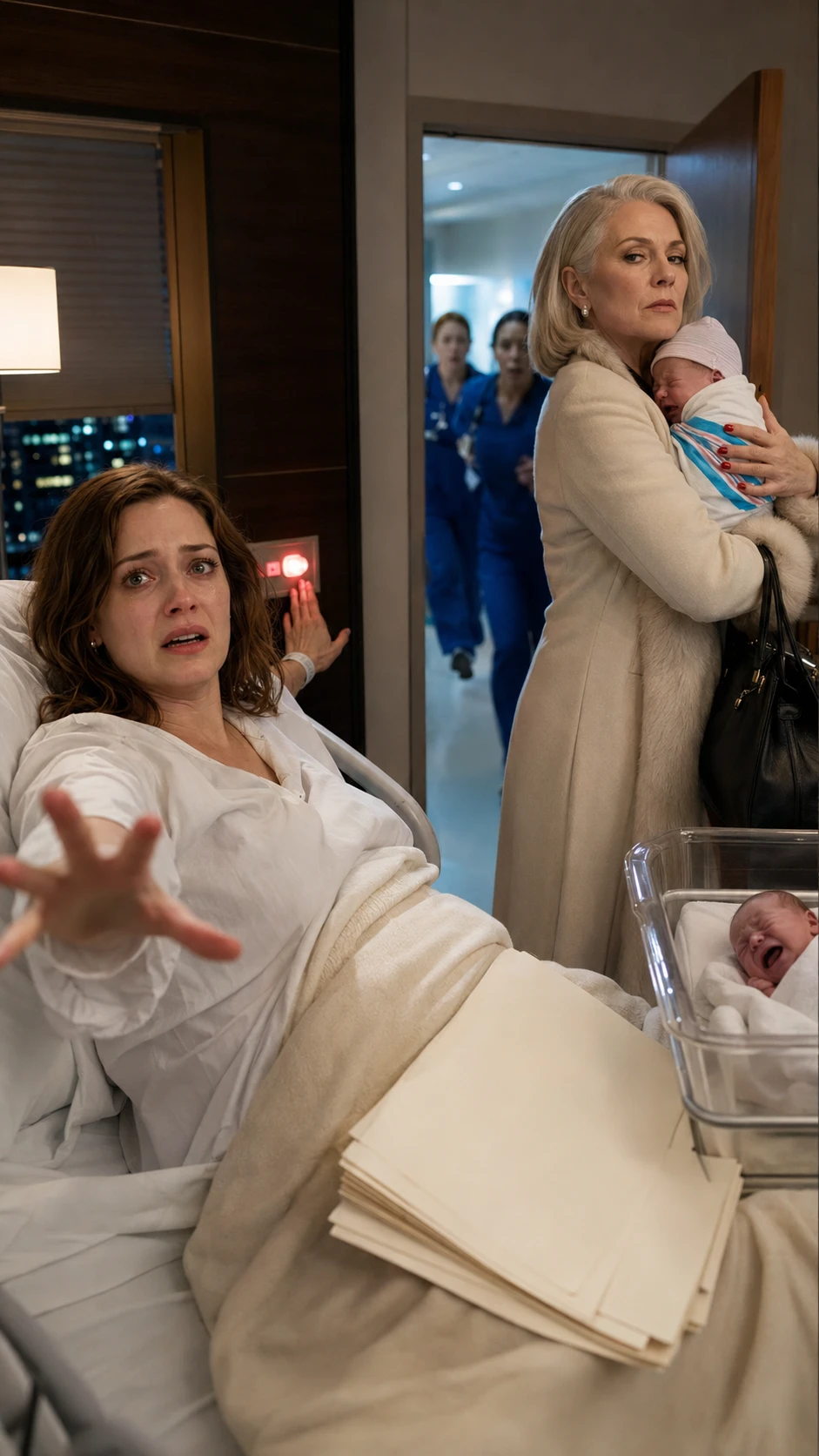
She walked into my recovery room, dropped adoption papers across my legs, and told me I could keep my daughter.
The recovery suite at St. Mary’s Medical Pavilion was quiet enough that I could hear both of my babies breathing.
Soft lights glowed along the walls. The blinds had been lowered over the floor-to-ceiling windows, turning the city outside into blurred streaks of silver and gold. A private nurse station stood just beyond the door.
Earlier, three enormous flower arrangements had arrived.
I had asked the nurses to remove them.
One had come from the governor’s office. Another had been sent by the hospital board. The third carried no card, only twelve white orchids arranged in a crystal vase I recognized from my father’s home.
Too many questions would have followed if Margaret had seen them.
For five years, my mother-in-law had believed I was simply Olivia Carter—the quiet woman her son had married against her advice. She thought I had no family worth mentioning, no career she respected, and no money of my own.
She believed I lived comfortably because Ethan allowed it.
I had never corrected her.
Arrogant people reveal themselves most honestly when they think they already understand your place in the world.
Only hours earlier, the doctors had rushed me into an emergency C-section after Noah’s heart rate began to fall.
I remembered bright lights.
Voices moving too quickly.
Ethan gripping my hand while someone placed a mask over my face.
Then pain, pressure, terror—and finally two thin cries rising through the operating room.
Twins.
Noah first.
Nora forty-seven seconds later.
Now they slept in matching bassinets beside my bed, wrapped so tightly in white blankets that only their small pink faces were visible.
Every few minutes, I looked at them just to make sure they were still there.
Ethan had gone downstairs with Dr. Patel to sign discharge documents and speak with the pediatrician about Noah’s monitoring results. He had kissed my forehead before leaving.
“Ten minutes,” he had promised.
Margaret arrived in the seventh.
The door opened so hard it struck the stopper behind it.
She entered wearing black heels, a cream coat trimmed with fur, and the expression of someone arriving to correct an inconvenience.
Her perfume reached me before her voice did.
She looked at the private room, the polished furniture, the adjoining family lounge, and the discreet brass plaque beside the door.
Her mouth tightened.
“A private recovery suite?” she said. “Unbelievable.”
I was exhausted, shaking and stitched together beneath the blankets. I had neither the strength nor the patience to pretend her presence pleased me.
“I just gave birth to your grandchildren.”
“That does not make you special.”
She closed the door behind her.
No congratulations.
No concern about the emergency surgery.
She did not ask whether the babies were healthy.
Her eyes moved directly to the bassinets.
Then she reached into her handbag and removed a thick stack of papers held together by a silver clip.
She tossed them onto my blanket.
“Sign these.”
The weight of the papers landed over my incision.
Pain flashed through me so sharply that I gasped.
Margaret noticed.
She did not apologize.
I lifted the first page with unsteady fingers.
At the top, in cold black letters, were the words:
VOLUNTARY RELINQUISHMENT OF PARENTAL RIGHTS.
For several seconds, I could not make sense of what I was reading.
My vision blurred. The medication made the sentences drift across the page.
Then I saw Noah’s name.
My newborn son’s full legal name.
My hands went cold.
“What is this?”
Margaret sighed as though I were delaying a meeting.
“Karen cannot have children. You know what she has been through.”
I stared at her.
Karen was Ethan’s older sister. After years of treatments, two miscarriages, and a failed adoption attempt, she had stopped attending baby showers. She rarely spoke to me during my pregnancy.
I had mistaken her distance for grief.
Margaret moved closer.
“It is tragic,” she said. “But now we have a solution.”
The meaning reached me slowly.
Then all at once.
“You’re talking about my son.”
“I’m talking about what is best for this family.”
She tapped one manicured fingernail against the papers.
“Karen will raise the boy. You can keep the girl.”
The room seemed to tilt.
Outside the suite, a cart rolled past. Somewhere down the hall, a machine chimed.
Inside my room, my mother-in-law stood over my bed and divided my children as if she were separating furniture after a divorce.
“You prepared these before I gave birth.”
“Obviously.”
“You knew I was having twins.”
“We all knew.”
“You put my son’s name on legal documents before I had even held him.”
Margaret’s expression hardened.
“Do not make this uglier than it needs to be. Karen has a proper home. She and Michael can give the boy stability, tradition and a respectable family name.”
“He already has a home.”
“With you?”
The contempt in those two words was almost physical.
She looked around the room again.
“Ethan may enjoy rescuing you, Olivia, but children require more than sentiment. You have contributed nothing to this family. You have no real profession. No connections. No history anyone can verify.”
My heart was pounding now.
Not because she had insulted me.
Because she had planned this.
The documents were not an impulsive act by a grieving woman. They had been prepared, printed and brought to the hospital while my body was still numb from surgery.
“Where is Karen?”
“She is waiting.”
“Waiting where?”
“That does not concern you.”
I reached for the nurse-call button.
Margaret saw the movement and caught my wrist.
Her fingers closed around the plastic hospital band.
I looked down at her hand.
“Let go of me.”
“You are medicated. You are emotional. Sign the papers now, before you turn this into something Ethan will regret.”
She released me only when Noah began to stir.
His face tightened. A small sound escaped him.
Margaret turned toward his bassinet.
“Don’t.”
She ignored me.
I tried to sit up, but a wave of pain tore across my abdomen. My arms collapsed beneath me.
Margaret lifted Noah.
He woke immediately and began to cry.
The sound went straight through me.
“Put him back.”
“He will settle.”
“Put my son back in his bassinet.”
“You are upsetting him.”
She pressed him against her coat and turned toward the door.
That was when I hit the emergency button.
Not the ordinary call button.
The red one beneath it.
An alarm sounded at the nurse station.
Nora began crying too.
The door opened within seconds. My nurse, Camille, rushed in, followed by another nurse and a young security officer.
Margaret raised her voice before anyone could ask what was happening.
“She’s confused,” she said. “The anesthesia is affecting her. I’m the baby’s grandmother.”
“She took my son,” I said.
My voice came out weaker than I wanted.
Camille moved to the bassinet and checked Nora while the security officer looked between Margaret and me.
Margaret held Noah with practiced confidence.
“My daughter is adopting him,” she said. “The paperwork is right there. Olivia agreed weeks ago, but she has become unstable since the surgery.”
“I agreed to nothing.”
“She is emotional.”
“She walked in and demanded that I surrender my child.”
“You see?” Margaret said to the officer. “She is becoming hysterical.”
The officer took one uncertain step toward my bed.
For one terrible moment, I understood exactly what Margaret was building.
A polished older woman in expensive clothes.
A medicated patient struggling to sit upright.
A crying infant in the wrong arms.
She did not need her story to be true.
She only needed it to look calmer than mine.
Then more footsteps sounded in the hall.
Three additional officers entered, led by Chief Daniel Ruiz.
I knew Daniel.
He had been head of security at St. Mary’s for eight years. Before that, he had spent two decades in city law enforcement.
Margaret did not know that.
She kept speaking.
“This is a private family matter. My son will confirm everything. Please remove Olivia’s phone before she embarrasses herself.”
Daniel’s eyes moved across the room.
The adoption papers.
My empty bassinet.
Margaret holding Noah.
Then me.
He looked at my face for a long second.
His attention dropped to the hospital identification band around my wrist, the same one Margaret had grabbed moments earlier.
The band contained my complete legal name.
Not the shortened name I used in ordinary life.
Not the name Margaret knew.
Daniel went still.
His eyes returned to mine.
“Mrs. Ashford?”
Margaret stopped talking.
The young officer beside him straightened.
I saw the instant recognition move through the room.
Ashford.
That one name changed everything.
Daniel stepped toward Margaret.
His voice was quiet, but no one could have mistaken it for a request.
“Ma’am, give the baby back.”
Margaret gave him the smile she used on waiters, receptionists and anyone else she expected to manage.
“You don’t understand. This woman is my daughter-in-law.”
“I understand exactly whose room you entered.”
“She is not well.”
Daniel held out his arms.
“Give me the infant.”
Margaret tightened her hold on Noah.
That was her final mistake.
Daniel’s expression changed.
“Lock down the maternity floor,” he ordered.
One officer immediately reached for his radio.
Another moved between Margaret and the door.
Her smile disappeared.
“What are you doing?”
Daniel did not look away from her.
“Activating the infant-security protocol.”
“This is absurd.”
“You attempted to remove a newborn from his mother’s room after she told you not to touch him.”
“He is my grandson.”
“That does not make him yours.”
Margaret’s face lost its color.
Daniel reached for Noah again.
This time, she surrendered him.
Camille took him and brought him straight to me.
The moment his warm body touched my chest, I began to shake.
Not delicately.
Not beautifully.
My whole body trembled with pain, rage and delayed terror.
I pressed my lips to his forehead.
“I’ve got you,” I whispered. “I’ve got you.”
Daniel picked up the adoption papers.
He read the first page, then the second.
His jaw hardened.
“Who prepared these?”
Margaret lifted her chin.
“You have no authority to interrogate me.”
Daniel looked toward the officers.
“Preserve the corridor footage. No one deletes or overwrites anything. Contact hospital legal, administration and the police liaison.”
Then he looked at me.
“Do you want her removed from the building?”
Margaret let out a short laugh.
“Olivia does not make decisions here.”
I met her eyes over my son’s head.
For five years, she had mistaken my silence for dependence.
My privacy for shame.
My patience for weakness.
I adjusted Noah against my chest, ignoring the fire beneath my stitches.
“Yes,” I said. “Remove her.”
Margaret stared at me.
I was not finished.
“Locate Karen Whitmore. Do not allow her onto this floor until we determine how deeply she was involved.”
Daniel nodded once.
“And Chief?”
“Yes, ma’am?”
“Call Mara Levin.”
Margaret’s forehead creased.
She did not recognize the name.
Daniel did.
Mara was the chief legal officer for Ashford Health.
The company that owned St. Mary’s Medical Pavilion.
The company I controlled.
“I’ll call her personally,” he said.
Only then did Margaret begin to understand that she had not walked into the room of a powerless woman.
She had walked into mine.
And the door had just locked behind her.
PART 2: THE NAME I NEVER GAVE HER
Margaret demanded to call Ethan.
Daniel allowed it.
She stood between two security officers near the window, holding her phone with both hands. Her voice rose each time the call went unanswered.
“He is with a doctor,” I said.
She glared at me.
“You planned this.”
The accusation was so absurd that Camille stopped adjusting Nora’s blanket and looked at her.
“I planned an emergency C-section?”
“You planned to humiliate me.”
“I did not invite you here.”
“You made these people treat me like a criminal.”
“You picked up my son and walked toward the door.”
“I was taking him to his aunt.”
“He is four hours old.”
“He belongs with family.”
“He was in a room with his mother and sister.”
Margaret’s mouth tightened.
In her mind, I had never counted as family.
That had been true from the first day Ethan introduced us.
He and I had met at a literacy fundraiser in Boston. He was a structural engineer overseeing the renovation of several public libraries. I had attended on behalf of the Ashford Foundation.
I introduced myself as Olivia Carter.
Carter was my mother’s surname, and it was the name I had used socially since college. It gave me something I had rarely possessed growing up: the chance to enter a room without everyone already having an opinion about me.
Ethan did not learn about Ashford until our third date.
He had stared at me across a table in a small Italian restaurant and asked, “Ashford as in Ashford Health?”
“Yes.”
“The hospital group?”
“Yes.”
“The foundation that paid for half the library project?”
“Yes.”
Then he had laughed.
Not greedily.
Not nervously.
He had leaned back in his chair and said, “I spent forty minutes explaining donor tax credits to you.”
“You were very thorough.”
“You already knew everything I was saying.”
“I liked listening to you.”
That was the moment I began falling in love with him.
Ethan never asked me for money. He never treated my family name like a winning lottery ticket. When we married, we kept the ceremony small and private.
He understood why.
My father had spent most of his life in public. His success built hospitals, funded research centers and placed our surname on buildings in six states.
It also attracted people who wanted access.
Some wanted investments. Some wanted contracts. Some wanted favors. A few wanted far worse.
After a kidnapping threat when I was twenty-one, my father changed everything about our security. My photographs disappeared from company websites. Interviews became rare. Public events were carefully controlled.
By the time I met Margaret, most people knew the Ashford name without knowing my face.
Ethan agreed not to tell his family until I was ready.
At first, I believed I would tell them after the wedding.
Then Margaret called my dress “surprisingly tasteful for someone without a mother to guide her.”
I postponed it.
Later, she accused me of marrying Ethan because I wanted financial security.
I postponed it again.
Every insult became an experiment.
I wanted to know whether she could respect a woman she believed had nothing to offer her.
The answer arrived slowly and then all at once.
She could not.
Margaret admired status the way some people admired art. She collected wealthy acquaintances, mentioned expensive restaurants before anyone asked, and measured human value by proximity to power.
Because she thought I had none, she felt free to show me exactly who she was.
Ethan had asked me more than once to let him tell her.
I always refused.
“Knowing my name won’t make her kinder,” I told him. “It will only make her more careful.”
I had wanted her genuine character.
Now I was holding the proof of it against my chest.
Daniel finished speaking into his radio.
“The pediatric wing and every exit are secured,” he told me. “No one matching Karen Whitmore’s identification has entered the building today.”
Margaret lowered her phone.
“That is because Karen is waiting at home.”
My stomach turned.
“Waiting for what?”
She said nothing.
“For my son?”
“He would have had everything.”
“He has everything he needs.”
“With a mother who lies about her identity?”
The words struck harder than I expected.
Not because she was right.
Because I knew she would use them against Ethan.
The door opened before I could answer.
Ethan rushed into the room with Dr. Patel behind him.
His face changed the moment he saw the officers.
Then he saw Margaret.
Then the documents in Daniel’s hand.
Then Noah pressed against my chest while I fought to control my shaking.
“What happened?”
Margaret moved first.
“Thank God. Ethan, tell these people to release me. Olivia has had some kind of reaction to the medication.”
Ethan came straight to me.
He touched Noah’s back and then my face.
“Liv?”
“Your mother brought adoption papers.”
His hand stopped against my cheek.
“What?”
“She said Karen was taking Noah.”
Margaret stepped toward him.
“Do not let her distort this.”
Daniel blocked her path.
Ethan looked at the papers.
Chief Ruiz handed them to him.
I watched my husband read.
His eyes moved rapidly at first. Then more slowly.
He turned a page.
At the bottom was Karen’s signature.
His sister had signed three days before my delivery.
Ethan looked at his mother.
“You knew about this?”
“I arranged it.”
“You arranged for my son to be adopted?”
“For Karen.”
“Without speaking to me?”
“You would have become emotional.”
“He is my child.”
“And Karen is your sister.”
Ethan stared at her as if language had stopped making sense.
Margaret softened her voice.
“You know what she has suffered. You know what motherhood means to her. Olivia has two babies. Karen has none.”
The room went silent.
Ethan looked toward the bassinets.
Nora had settled again beneath Camille’s hand. Noah’s cries had weakened into small, exhausted sounds.
“They are not objects,” Ethan said.
“No one said they were.”
“You just used one child to subtract the other.”
“That is not what I meant.”
“It is exactly what you meant.”
Margaret’s composure cracked.
“You have always been too sentimental. Someone has to make difficult decisions for this family.”
“You do not make decisions about my children.”
“I am trying to protect them.”
“From what?”
Her eyes moved to me.
That was enough.
Ethan stepped between us.
“Do not.”
Margaret’s voice sharpened.
“She has lied to all of us.”
Ethan looked at my wristband.
Then at Daniel.
Understanding moved across his face.
“You called Mara.”
“I did,” I said.
He closed his eyes briefly.
Not because my identity had been exposed.
Because he knew the reason.
Margaret noticed.
“What is Mara?” she demanded. “Who is Ashford?”
No one answered immediately.
For the first time since she entered the room, uncertainty appeared in her eyes.
The door opened again.
Mara Levin walked in wearing a navy suit beneath an open raincoat. Her gray hair was pulled into a low knot, and she carried a leather folder under one arm.
She took in the room with one glance.
Then she crossed to my bed.
“Olivia, are you and the babies safe?”
“We are now.”
Mara looked at Margaret.
“Mrs. Whitmore, my name is Mara Levin. I am chief legal officer for Ashford Health.”
Margaret’s gaze flicked toward me.
Mara continued.
“Ms. Ashford is the chair of our board and controlling trustee of the health system that owns this hospital.”
The color drained from Margaret’s face.
Ethan sat on the edge of my bed and took my hand.
Margaret looked from him to me.
Then at the private suite.
Then at the discreet security camera above the door.
For years, she had told me I was fortunate her son supported me.
Now she was beginning to realize that the apartment Ethan and I lived in, the investment accounts funding our children’s futures, and the private medical care surrounding us had never come from him alone.
But the revelation did not satisfy me the way I once imagined it might.
I felt no triumph.
Only exhaustion.
Margaret recovered quickly.
People like her often do.
Her shoulders lowered. Her expression softened. Her voice became almost gentle.
“Olivia,” she said, “why didn’t you tell me?”
I looked at the adoption papers in Ethan’s hands.
“Because I wanted to know how you treated people you believed could do nothing for you.”
Her face tightened.
“That is unfair.”
“No. What you did was unfair.”
“I would never have acted this way if I had understood the situation.”
“I know.”
The words cut through the room.
Margaret blinked.
“That is exactly why I never told you.”
Mara opened her folder.
“Before we continue, there is another issue.”
She placed a printed security still on the table beside my bed.
The image showed Margaret entering the maternity wing.
Behind her, partially hidden near the elevator, stood Karen.
Margaret had lied.
Karen had not been waiting at home.
She was inside the hospital.
And security had just found her.
PART 3: WHAT KAREN KNEW
Karen was brought into the room twelve minutes later.
She was not handcuffed. She had not attempted to enter the secured corridor after the lockdown began. An officer had found her sitting inside the ground-floor café with a blue diaper bag at her feet.
The bag entered the room before she did.
I noticed it immediately.
New.
Monogrammed.
A silver letter N had been stitched across the front.
Karen stopped in the doorway when she saw Ethan.
Her eyes moved to Margaret.
Then to the babies.
Then to me.
“Oh God,” she whispered.
Ethan stood.
“What did you do?”
Karen’s face crumpled.
“I didn’t know Mom was going to take him.”
The words landed like another set of papers across my body.
Not I didn’t know anything.
Not This is a mistake.
She had said she did not know Margaret would take him.
Meaning she had known something.
Ethan understood too.
“How much did you know?”
Karen gripped the strap of the diaper bag.
“Mom said Olivia had agreed.”
“I did not,” I said.
Karen looked at me.
Her eyes were red-rimmed, but there were no tears yet.
“She said you didn’t want twins.”
“I never said that.”
“She said the pregnancy had been too difficult and you were afraid you couldn’t manage two babies.”
“I never said that either.”
Karen turned toward Margaret.
“You told me she had already discussed it with Ethan.”
Margaret’s expression hardened.
“This is not the time to fall apart.”
“You said they wanted the girl.”
“I said Olivia would be more comfortable raising one child.”
“You said Noah was going to be ours.”
At the sound of his name, I pulled my son closer.
Karen noticed.
Shame moved across her face.
Ethan pointed at the papers.
“You signed these three days ago.”
Karen began to cry.
“I thought you both knew.”
“Then why didn’t you call me?”
“I tried.”
“You sent me a message asking whether the scheduled delivery date had changed. That was not a conversation.”
“Mom said you were struggling with the decision.”
“And you believed her?”
Karen’s eyes dropped.
That was the question she could not answer.
Because believing Margaret had been convenient.
Karen’s pain was real. I knew that.
I had seen what infertility had done to her marriage, her friendships and the way she moved through rooms filled with children. I had watched her excuse herself from Thanksgiving dinner when Margaret asked when she planned to “give the family a proper grandchild.”
But suffering did not erase responsibility.
Grief could explain why she wanted to believe my son was being offered to her.
It could not explain why she signed papers without hearing the offer from my own mouth.
I looked at the diaper bag.
“What is inside?”
Karen flinched.
“Olivia—”
“What did you bring for my son?”
She did not move.
Daniel took the bag from her and placed it on a chair.
He opened it in full view of everyone.
Inside were newborn clothes, formula bottles, diapers, a knitted blue blanket and a small wooden plaque.
WELCOME HOME, NATHANIEL.
The name struck me strangely.
Not Noah.
Nathaniel.
Karen had already renamed him.
My throat closed.
She had prepared a different identity for my child before he had taken his first breath.
Ethan picked up the plaque.
His hands shook.
“You changed his name.”
“Michael and I liked Nathaniel.”
“He already has a name.”
“I know that now.”
“You knew it yesterday.”
Karen covered her mouth.
Margaret finally lost patience.
“This performance is pointless. Karen, stop apologizing as though wanting a child makes you a monster.”
“Wanting one doesn’t,” I said. “Preparing to take mine does.”
Margaret turned on me.
“No one was taking anything. You were going to sign.”
“I said no.”
“You were not thinking clearly.”
“I was clear enough to press the emergency alarm.”
“You humiliated your husband’s family because you wanted to prove that you could.”
I felt something inside me become still.
Until then, part of me had been responding as a frightened new mother.
The pain, the medication and Noah’s crying had made every second feel unstable.
But Margaret’s words gave me clarity.
This had never been about Karen’s grief alone.
It was about control.
Margaret believed family was a hierarchy. She stood at the top. Ethan and Karen were extensions of her. Their spouses, their homes and even their children existed beneath her authority.
My secrecy had offended her long before she knew what I had kept hidden.
She could not control what she could not measure.
I looked at Karen.
“When did your mother first mention this?”
Karen wiped her cheeks.
“After the ultrasound.”
“Which ultrasound?”
“The one where you learned you were having a boy and a girl.”
I remembered that afternoon.
Margaret had invited us to dinner. She had toasted “the Whitmore heir” while referring to Nora as “the bonus.”
I had corrected her.
“They are both our heirs,” I had said.
She had laughed as if I were making a joke.
Karen continued.
“Mom said twins would overwhelm you. She said Ethan was already working too much and you had no family nearby.”
“What did you say?”
“I told her it was insane.”
Margaret made a disgusted sound.
“At first,” Karen added quickly. “I said it was insane at first.”
“And later?”
Karen looked at Noah.
“Later, she said you were considering it.”
“Did she ever show you a message from me?”
“No.”
“A recording?”
“No.”
“An email?”
“No.”
“Did you ever hear me agree?”
“No.”
Each answer made her voice smaller.
Mara spoke from beside the window.
“Who drafted the documents?”
Karen looked at Margaret.
Margaret remained silent.
“Mrs. Whitmore?” Mara asked.
“A family attorney provided a template.”
“Name?”
“That is privileged.”
“You are not the attorney’s client in a matter involving another person’s parental rights unless an engagement exists. Does it?”
Margaret’s silence answered.
Mara continued.
“These forms are not completed correctly. They would not transfer custody. They do, however, show planning and intent.”
Margaret folded her arms.
“Intent to create a lawful adoption.”
“An adoption requires informed, voluntary consent,” Mara said. “It does not begin with someone lifting an infant from a hospital bassinet after being told no.”
Karen sank into a chair.
“Mom said Olivia would sign once she saw how happy I was.”
I stared at her.
There it was.
The full truth.
Karen had not believed I had already agreed.
Not completely.
She believed Margaret could pressure me until my refusal no longer mattered.
“You knew I might say no,” I said.
Karen closed her eyes.
“Yes.”
Ethan turned away from her.
The single word seemed to break something in him.
His mother had created the plan.
His sister had allowed herself to benefit from it.
And both had expected him to forgive them because they called it family.
Karen stood and moved one step toward me.
“Olivia, I am sorry.”
Daniel shifted between us.
I did not ask him to move.
“You are sorry because it failed,” I said.
“No.”
“You were downstairs with an empty car seat.”
Her face collapsed.
I had guessed.
The look in her eyes confirmed it.
Daniel glanced toward the officer by the door.
“Was a vehicle checked?”
“Yes, Chief. There is an infant seat installed in the rear passenger side.”
Karen began shaking her head.
“Mom told me we were bringing him home.”
“You came prepared to leave with my child.”
“I thought you would agree.”
“Because your happiness would be standing in front of me?”
“I wasn’t thinking.”
“You were thinking. You bought clothes. You packed formula. You installed a car seat. You chose a new name.”
I could hear my heart beating.
“You thought about everything except me.”
Karen sobbed.
Margaret stepped toward her.
“Do not let her speak to you like that.”
Ethan turned.
“No, Mom. You do not get to stop this.”
“I was protecting your sister.”
“You used her grief.”
“I gave her hope.”
“You gave her my son.”
“I tried to give her a family.”
Ethan’s voice broke.
“She already was our family.”
Margaret stared at him.
He pointed toward me and the bassinets.
“This is my family. Olivia. Noah. Nora. You entered their hospital room and treated them like pieces you could rearrange.”
“I am your mother.”
“And she is their mother.”
For the first time, Margaret seemed frightened by him.
Not by security.
Not by Mara.
Not even by the Ashford name.
By the possibility that she had finally pushed her son beyond obedience.
Ethan walked to the door and opened it.
“Take Karen downstairs,” he told Daniel. “I need to speak to my mother alone.”
I tightened my hold on Noah.
“No.”
Everyone looked at me.
I was exhausted. My incision throbbed. My mouth was dry, and my body begged me to close my eyes.
But I was not going to disappear from the confrontation that had begun over my children.
“No private conversation,” I said. “Not about this.”
Ethan looked ashamed.
“I wasn’t trying to exclude you.”
“I know. But she has spent years speaking differently when I’m not in the room. Today, everything is said in front of me.”
He nodded.
Margaret drew herself upright.
“Fine. Then let us speak honestly.”
She looked directly at me.
“You may own hospitals, Olivia. You may have money and lawyers and people who rush when you press a button. But none of that changes what you are.”
I waited.
“A liar,” she said. “An outsider. A woman who concealed herself from her husband’s family because she enjoyed judging us.”
Ethan started to speak.
I lifted one hand.
Margaret had finally reached the argument she believed would save her.
So I let her finish.
“You deceived me for years,” she said. “And now you are using your power to destroy us over a misunderstanding.”
I looked down at Noah.
His tiny fist had worked free of his blanket and closed around my finger.
Then I looked back at her.
“You are right about one thing.”
Margaret’s eyes sharpened.
“I did judge you.”
The room became very quiet.
“I judged you when you insulted waiters. When you mocked Karen’s infertility during arguments. When you told Ethan that marrying me had lowered his prospects. When you came into my home and opened my mail. When you called my pregnancy an opportunity to restore the Whitmore name.”
Her confidence began to fade.
“I judged every one of those things.”
I shifted against the pillows, swallowing the pain.
“But I never punished you for them. I never used my money to silence you. I never threatened your home, your reputation or your children.”
I looked at the papers.
“You came here today and tried to take mine.”
Margaret’s mouth opened.
I did not allow her to interrupt.
“So now you will learn the difference between being judged and being held accountable.”
PART 4: THE PRICE OF HER CERTAINTY
Mara asked whether I wanted the police called.
I said yes.
Margaret laughed when I answered.
It was a brittle sound.
“You are going to have your children’s grandmother arrested?”
“I am going to document what happened.”
“For picking up a baby?”
“For refusing to return him. For trying to leave with him. For bringing coercive documents into the room of a medicated surgical patient.”
“You are exaggerating.”
“The cameras will show whether I am.”
That silenced her.
St. Mary’s did not place cameras inside patient rooms, but the hallway outside my suite had recorded Margaret’s arrival, Karen’s presence near the elevator and every second between the alarm and the lockdown.
The security officers had body cameras.
The nurses had witnessed my refusal.
The papers carried dates, signatures and Noah’s name.
The truth did not depend on my wealth.
That mattered to me.
I did not want Margaret punished because my surname could frighten people.
I wanted her held responsible because what she had done was wrong.
Two city officers arrived and took statements separately.
Dr. Patel delayed my examination until Noah and Nora were settled. Camille remained beside me the entire time, occasionally reminding me to breathe more slowly.
Ethan sat near the window while an officer questioned Margaret in the family lounge.
He looked older than he had that morning.
I knew he was replaying every moment when he had minimized her behavior.
Every dinner he had ended early instead of confronting her.
Every time he had said, “That’s just how she is.”
I reached for him.
He came to my bedside immediately.
“I’m sorry,” he said.
“You did not bring those papers.”
“I kept asking you to tolerate her.”
“Yes.”
“I told myself she was difficult, not dangerous.”
“So did I.”
He looked toward the bassinets.
“I should have protected you sooner.”
I squeezed his hand.
“I need you to protect us now.”
His eyes returned to mine.
“What do you need?”
“Do not make me responsible for repairing what she broke.”
He understood.
“No private calls asking me to forgive her. No messages through Karen. No holiday invitations because enough time has passed.”
“No.”
“Do not tell me she is still your mother as though that changes what happened.”
“I won’t.”
“I’m not asking you to stop loving her.”
His face tightened.
“I’m asking you not to use that love to make us unsafe.”
He bowed his head over our joined hands.
“I choose you.”
The words were quiet.
I believed him.
But belief after betrayal is not a finish line.
It is the beginning of work.
When the police finished their initial interviews, Margaret was informed that she would be removed from the hospital and that the report would be forwarded for review.
She was also served with a formal notice banning her from all Ashford Health facilities except in a verified medical emergency.
That part came from hospital administration, not from me personally.
Her conduct had triggered an infant-security lockdown, disrupted patient care and placed staff in danger.
Still, she blamed me.
At the door, she turned toward Ethan.
“You are allowing your wife to exile your mother.”
Ethan stood beside my bed.
“You exiled yourself when you picked up my son.”
“I was helping Karen.”
“You were hurting Olivia.”
“You never cared this much when she lied to us.”
“She did not lie to me.”
Margaret froze.
Ethan continued.
“I have known who she was since our third date.”
The last piece of certainty left her face.
“You knew?”
“Yes.”
“And you let me think—”
“I let you think exactly what you chose to think.”
“I welcomed her into this family.”
“You tolerated her because you believed she was beneath you.”
“That is not true.”
“You said she contributed nothing. You called her dependent. You told Karen that Olivia should be grateful we allowed her to carry the Whitmore name.”
Margaret looked at me.
I could almost see the calculations taking place.
How much did I own?
How influential was I?
What access had she lost?
What opportunities might she have had if she had behaved differently?
Her regret was arriving, but it had nothing to do with Noah.
That realization hurt less than I expected.
Perhaps because it confirmed what I had known all along.
Margaret stepped away from the officers.
“Olivia, surely we can resolve this privately.”
“No.”
“Families make mistakes.”
“You planned this for months.”
“I was desperate for Karen.”
“You were certain I could be pressured because you thought I had no one.”
She looked around the room—the officers, Mara, Camille, Ethan.
“I see now that I was mistaken.”
“That is the problem.”
Her forehead creased.
“You should have seen that I was a person before you knew I was an Ashford.”
She had no answer.
The officers escorted her out.
The click of the door closing behind her was softer than I expected.
Afterward, the room felt enormous.
Karen remained in a conference room downstairs while the police completed her statement. She was not removed in custody, but her involvement was documented.
Before leaving the hospital, she asked to speak to me.
I refused.
Not forever.
Just then.
I did not owe immediate access to the woman who had packed a bag for my child.
That evening, after the babies had been fed and examined, Ethan found an envelope at the nurse station.
Karen had left it for us.
Inside was a single sheet of paper.
She wrote that Margaret had begun talking about Noah months earlier. At first, Karen had rejected the idea. Then she had started imagining it.
She imagined a nursery.
A first Christmas.
A little boy calling her Mom.
Each time guilt appeared, Margaret told her that I was overwhelmed, that Ethan secretly wanted only one child, and that the arrangement would save everyone.
Karen admitted she never fully believed those claims.
She believed them enough to avoid asking questions.
That was worse in some ways.
A person deceived by a perfect lie is a victim.
A person who refuses to examine a convenient lie becomes a participant.
At the bottom, Karen wrote:
I turned your son into an answer to my pain. I am ashamed of that. I will not ask you to forgive me.
Ethan read the letter twice.
Then he folded it and placed it back in the envelope.
“What do you think?” he asked.
“I think she told the truth too late.”
“Do you think she meant the apology?”
“Yes.”
He looked surprised.
“Meaning it doesn’t undo anything.”
“No.”
We sat quietly.
From the bassinet beside me, Nora made a small squeaking sound in her sleep.
Ethan smiled despite himself.
Then his eyes filled.
“I almost lost them.”
“No,” I said. “We stopped her.”
He looked at me.
The distinction mattered.
Margaret had not been defeated because Daniel recognized my name.
The name changed how quickly the room understood the danger, but it had not created my refusal.
I had said no before anyone knew who I was.
I had pressed the alarm.
I had demanded that Noah be returned.
Power had entered the room later.
A mother had acted first.
Near midnight, after Ethan fell asleep in the chair beside me, I received a message from an unknown number.
I knew who it was before I opened it.
You have torn this family apart. When your children grow up, they will learn what kind of woman their mother is.
There was no apology.
No concern for the babies.
Only another threat disguised as judgment.
I took a screenshot and forwarded it to Mara.
Then I blocked the number.
For years, I had kept my identity hidden because I wanted to know whether Margaret could love me without it.
That night, I understood I had been asking the wrong question.
The question was not whether she could love me.
It was whether I would continue offering access to someone who had repeatedly shown that she could not.
My answer was no.
PART 5: THE FAMILY WE CHOSE
We brought Noah and Nora home five days later.
No reporters waited outside.
No photographs appeared online.
St. Mary’s respected my privacy, and the police report remained confidential while the incident was reviewed.
The only public statement came from the hospital administration. It explained that an unauthorized person had triggered an infant-security response and that all newborns had remained safe.
Margaret’s name was not included.
Neither was mine.
For once, the Ashford name did not become a weapon or a shield.
It remained what it should have been all along: irrelevant to whether my children belonged to me.
At home, the first weeks blurred into feedings, healing and sleep measured in fragments.
Ethan took leave from work.
He learned to prepare bottles with one hand while holding Nora against his shoulder. He sang badly to Noah at three in the morning. He tracked medications, diaper changes and my pain levels in a notebook he carried from room to room.
He also began therapy.
Not because I demanded it.
Because he realized that loving his mother had trained him to excuse behavior he would never have accepted from a stranger.
Margaret called him from seven different numbers.
He blocked each one.
She contacted relatives, telling them I had manipulated him, used my money to intimidate her and turned a misunderstanding into a criminal matter.
Several believed her.
One aunt sent Ethan a message asking whether “Olivia’s hormones” had caused him to overreact.
He replied with four sentences:
My mother entered my wife’s hospital room with documents prepared to remove our son. Olivia refused. My mother picked up the baby and attempted to leave. This is not a misunderstanding, and it will not be debated.
Then he stopped answering.
The review resulted in a formal warning and a trespass order. The prosecutor did not pursue the most serious charge because Noah had been recovered before Margaret left the secured floor, but the incident remained documented.
Mara helped us obtain a protective order restricting Margaret from approaching me or the children.
I did not celebrate.
Justice rarely feels like celebration when it involves someone who once sat at your dinner table.
It feels like changing locks.
Saving messages.
Checking cameras before opening the door.
It feels like grief with paperwork.
Karen separated from Margaret almost immediately.
For years, Margaret had used Karen’s infertility as both a wound and a leash. She reminded Karen of every treatment she had paid for, every appointment she had attended and every holiday she had “endured” without grandchildren.
After the hospital incident, Karen finally saw that Margaret’s help had always carried ownership inside it.
Three months passed before Karen contacted us again.
This time, she did not send a gift.
She did not ask for photographs.
She did not call Ethan.
She wrote directly to me.
Her letter was six pages long.
She described the moment Margaret first suggested taking Noah. She admitted that she had felt horrified—and then hopeful. She explained how hope became fantasy, how fantasy became entitlement, and how entitlement allowed her to sit downstairs with an empty car seat while I recovered from surgery.
She did not ask to meet the babies.
She asked whether, someday, I might allow her to apologize to my face.
I read the letter after midnight while Noah slept against my shoulder.
Ethan waited beside me.
“What do you want to do?” he asked.
“Not today.”
He nodded.
Six more months passed.
By then, Noah crawled toward anything dangerous with astonishing speed, and Nora had discovered that dropping food from her high chair made adults react.
They were different in every possible way.
Noah laughed with his entire body.
Nora studied people before deciding whether they deserved her smile.
Sometimes I wondered how Margaret had looked at them as newborns and decided one could be taken without destroying the other.
Then I remembered that she had not looked at them as people.
Only roles.
The boy.
The girl.
The heir.
The consolation.
One rainy afternoon, Ethan and I agreed to meet Karen in Mara’s office.
Neutral ground.
No children.
No promises.
Karen arrived early.
She looked thinner than I remembered. She wore no makeup and carried nothing in her hands.
When I entered, she stood.
“Thank you for coming.”
I sat across from her.
Ethan remained beside me, but he did not speak for her.
Karen’s eyes filled almost immediately.
“I rehearsed this,” she said. “Now everything sounds inadequate.”
“Then don’t rehearse.”
She nodded.
For several seconds, she stared at her hands.
“I knew you had not agreed.”
The bluntness surprised me.
She continued before I could respond.
“Not for certain. Mom kept telling me you would. She told me you were weak, that you depended on Ethan and that you would sign if we presented it as decided.”
Her voice shook.
“I knew that was coercion. I changed the word in my head. I called it persuasion because I wanted the result.”
I said nothing.
“I hated myself for wanting your child,” she said. “Then I told myself I didn’t want your child. I wanted the child who was supposed to become mine.”
“There was no such child.”
“I know.”
“You renamed him.”
Karen covered her face briefly.
“I had the plaque destroyed.”
“That does not remove the fact that you made it.”
“No.”
She lowered her hands.
“I am in therapy. Michael and I have stopped pursuing adoption. We realized we were treating parenthood like something we were owed.”
I believed she was telling the truth.
Believing her did not make me ready to trust her.
“Why are you here?” I asked.
“To accept whatever boundary you set.”
“And if the boundary is that you never see Noah or Nora?”
She inhaled unsteadily.
“Then I will live with it.”
Ethan looked at her.
For the first time, she did not look to him for rescue.
That mattered.
“I’m not forgiving you today,” I said.
“I understand.”
“I may never allow you to be alone with them.”
“I understand.”
“You will not send gifts unless we agree. You will not ask relatives for photographs. You will not use Ethan to negotiate access.”
“I won’t.”
“And if you speak to Margaret about our children—”
“I don’t speak to her.”
“That is your decision. I am telling you ours.”
Karen nodded.
“If she receives information about Noah or Nora through you, all contact ends.”
“I understand.”
I studied her.
Pain had made Karen vulnerable to Margaret’s plan.
But pain had not forced her to sign.
That choice belonged to her.
So did the work of becoming someone safer.
“I’m not promising a relationship,” I said. “I’m allowing one conversation.”
Tears slipped down her cheeks.
“Thank you.”
The meeting ended without an embrace.
No dramatic forgiveness.
No instant repair.
Healing is not always a door swinging open.
Sometimes it is a lock turning once, cautiously, while the chain remains in place.
Margaret never apologized.
A year after the hospital incident, she violated the protective order by appearing outside Ethan’s office.
She claimed she only wanted to give him birthday gifts for the twins.
He did not go downstairs.
Security removed her, and the violation was documented.
That evening, she left one final voicemail before he changed his number.
“You will regret choosing her over your own blood.”
Ethan listened once.
Then he deleted it.
“She still thinks that’s what happened,” he said.
“What?”
“That I chose you over my family.”
He looked across the living room.
Noah was pushing a wooden truck along the rug. Nora sat beside him, stealing the blocks he attempted to load into it.
Ethan smiled.
“I chose my family over her control.”
Two years after the day Margaret entered my hospital room, we returned to St. Mary’s for the dedication of a new maternal recovery wing.
I had approved the project before my pregnancy, but the experience changed its design.
Every room included clearer visitor restrictions, improved emergency controls and an advocate available to patients facing family coercion.
The wing was not named after me.
It was named the Eleanor Carter Center, after my mother.
Margaret had once mocked me for having no mother to guide me.
She had never known that my mother’s foundation funded shelters, clinics and legal services for women across the country.
She had never bothered to ask.
After the ceremony, Daniel Ruiz found us near the garden courtyard.
Noah and Nora were holding Ethan’s hands, each pulling him in a different direction.
Daniel smiled.
“They’ve grown.”
“They do that despite my objections,” I said.
He laughed.
Then his expression became more serious.
“I think about that day sometimes.”
“So do I.”
“I almost didn’t recognize you.”
“You recognized the situation. That mattered more.”
He shook his head.
“I should have trained the first officer better. He hesitated.”
“He was trying to understand.”
“He saw a calm woman holding a baby and a patient in distress.”
“Yes.”
Daniel looked toward the new wing.
“That is why the changes matter.”
I watched Nora release Ethan’s hand and run toward the window. Noah followed immediately, convinced that anything his sister discovered must belong equally to him.
“They were never in danger of being separated after that day,” I said.
Daniel glanced at me.
“No.”
I was not speaking only about security.
Margaret had tried to divide my children before they were old enough to open their eyes.
She had called one valuable and the other sufficient.
She had believed my exhaustion would make me obedient, my lack of status would make me invisible, and my love for Ethan would make me tolerate anything done in the name of his family.
She had been wrong about all three.
Later, as we prepared to leave, I stood for a moment outside the recovery suite where it had happened.
Another patient occupied it now. A small sign on the door requested privacy.
I could still remember the papers striking my blanket.
Noah crying against Margaret’s coat.
The pain when I tried to rise.
The terrible second when the first officer seemed unsure whom to believe.
And Daniel’s voice when he read my wristband.
Mrs. Ashford?
For a long time, I thought that was the moment everything changed.
It was not.
Everything changed seconds earlier, when Margaret reached for my child and I found the strength to say no.
The name brought power into the room.
But I had already become dangerous to her before anyone spoke it.
I had become a mother who understood that politeness was not peace.
Silence was not safety.
And family was not a word anyone could use to demand my surrender.
Ethan called to me from the elevator.
Noah stood beside him, pressing the button repeatedly. Nora was in his arms, waving at me impatiently.
I walked toward them.
The elevator doors opened.
As I stepped inside, Noah reached for my hand.
I gave it to him.
Then the doors closed on the room where Margaret Whitmore had tried to take my son—and discovered that the woman she considered powerless had never needed a famous name to protect what was hers.