
The moment my daughter-in-law announced she was bringing twenty-five people into my home for Christmas, I knew she had already made one dangerous mistake.
She believed my silence meant agreement.
It did not.
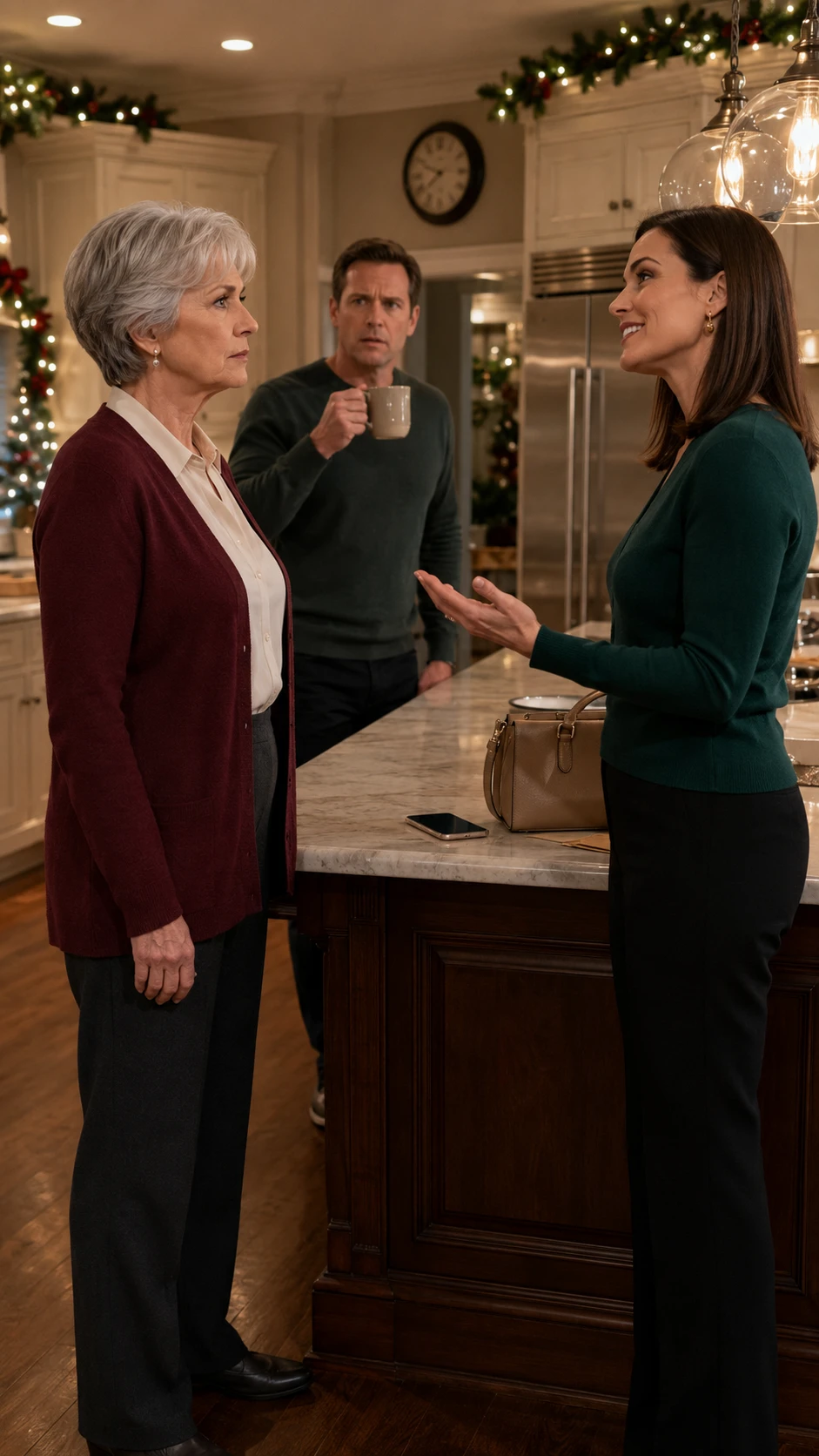
“My whole family is coming here for Christmas,” Emily said with a bright smile. “It’s only twenty-five people.”
I smiled back just as warmly.
“Perfect. I’ll be in the Caribbean. You can cook, clean, and host them yourself.”
Then I folded my arms.
“I’m not your maid.”
The color disappeared from her face.
My son, Daniel, froze beside the kitchen island with his coffee halfway to his mouth. The refrigerator hummed loudly in the sudden silence.
“Mom,” he said slowly, “what exactly is happening?”
“Your wife invited twenty-five people into my house without asking me.”
Emily gave a nervous laugh.
“They’re not strangers. They’re my family.”
I looked around the kitchen.
The kitchen I had cleaned after every holiday.
The kitchen where I prepared meals nobody remembered but everyone expected.
The kitchen where, five Christmases in a row, I cooked until my feet swelled while Emily photographed the finished table and posted captions about our beautiful family traditions.
“That doesn’t make the house yours,” I said.
Her smile faded.
Daniel turned toward her.
“You already invited them?”
Emily hesitated.
Only for a second.
But that second told us everything.
The invitations had been sent. Travel arrangements had been made. Her relatives were already planning around a home that did not belong to them.
She had even promised her mother the upstairs guest suite.
All before speaking to me.
“It’s Christmas,” Emily said. “Family should be together.”
“I agree.”
Relief crossed her face.
Then I continued.
“Just not when one person is expected to sacrifice everything while everyone else enjoys it.”
Daniel looked down.
I could almost see the memories returning.
The polished silver.
The decorated tree.
The fresh sheets in every bedroom.
The three days of cooking.
The dirty pans waiting after everyone drove away.
Last Christmas, Daniel had found me asleep at the kitchen table with a dish towel still in my hand.
He covered me with a blanket.
Then he went home without washing a single plate.
“A few weeks ago, I booked a Christmas cruise,” I said.
His head rose.
“You booked a cruise?”
“Yes. It leaves December twenty-second.”
Emily’s mug struck the counter with a sharp ceramic click.
“You planned a vacation without telling us?”
The irony was so complete that I almost laughed.
“For five years, I planned every Christmas down to the smallest detail. No one asked whether I needed help. You simply assumed I would handle it.”
Emily’s eyes filled.
“So you’re abandoning us?”
“No. I am giving you precisely what you requested.”
I pointed toward the room around us.
“You want Christmas here? Have Christmas here. Buy the food. Prepare the bedrooms. Cook for twenty-five people. Clean the bathrooms. Entertain the children. Wash the dishes.”
The clock continued ticking.
For once, no one expected me to fill the silence.
Then Daniel spoke.
“Mom’s right.”
Emily turned sharply.
“You’re taking her side?”
“I’m saying we should have asked her.”
Before she could respond, her phone vibrated on the counter.
Once.
Twice.
Three times.
She grabbed it too quickly.
But not before I saw the first message preview.
MOM: Everyone is thrilled about the house. I told them we can stay through New Year’s.
Daniel stepped closer.
“Stay?”
Emily locked the screen.
“It’s only a few extra days.”
Another message appeared.
MOM: Your uncle confirmed the moving truck can arrive on the twenty-third.
The room became still.
Daniel’s expression changed.
“What moving truck?”
Emily backed away from the counter.
I looked from her face to the phone in her hand.
Then I noticed something beneath her purse.
A thick cream envelope.
Not a Christmas card.
Not a shopping receipt.
The return address belonged to Marco Bellamy, Real Estate Counsel.
And suddenly I understood that Christmas was not the only thing Emily had arranged without asking.
She had been preparing for something much larger.
The Envelope She Forgot
Emily shoved the envelope into her purse.
“It concerns my mother’s lease.”
“What lease?” Daniel asked.
“She has to leave her apartment.”
“You told me the building was renewing it.”
“Things changed.”
“Then why is a moving truck coming here?”
Her expression sharpened.
“Because my family needs somewhere stable.”
Daniel looked at me.
I saw panic beginning behind his eyes.
He had entered the kitchen believing we were discussing holiday guests.
Now he realized his wife had arranged permanent residents.
“Emily,” he said, “did you tell your mother she could move in?”
“I told her we would help.”
“This isn’t our house.”
Her gaze moved toward me.
“It will be eventually.”
There it was.
No hesitation.
No embarrassment.
She said it as though my death were not a tragedy, only a delayed transfer date.
I held her eyes.
“Leave.”
“Margaret—”
“Take your purse and leave my house.”
Daniel flinched.
“Mom, let’s calm down.”
“I am calm.”
That frightened them more than shouting would have.
Emily seized her purse and marched toward the garage.
Daniel remained behind.
“Did you know?” I asked.
“About her mother? She mentioned something temporary.”
“The moving truck?”
“No.”
“The attorney?”
“No.”
He rubbed both hands across his face.
“I’ll talk to her.”
“You have spent eight years talking to her after she makes decisions. Perhaps try speaking before the next one.”
He left without answering.
Twenty minutes later, I noticed the cream envelope still beneath the stool.
Emily had grabbed her purse but left the document behind.
It was addressed to:
Daniel and Emily Hayes — Hale Family Residence Conversion
My maiden name was Hale.
I opened it.
The first page was called a Multigenerational Occupancy Agreement.
It granted Emily’s mother, Donna, and up to twelve additional relatives immediate residency beginning December twenty-third.
The second page gave Daniel and Emily authority to manage repairs, insurance, household expenses, and “future disposition.”
The third page contained a draft power of attorney appointing Daniel financial guardian if I became “unavailable, medically impaired, or voluntarily absent for more than fourteen consecutive days.”
My cruise lasted sixteen days.
They intended to use my vacation as evidence that I had abandoned the property.
The fourth page was a deed transferring my home into an LLC called Hale Family Living Partners.
My signature appeared at the bottom.
I had never signed it.
Neither had Daniel.
His name was printed beneath a blank line.
Emily planned to obtain his signature later.
Then I found Marco’s cover letter.
Once the family establishes physical occupancy, resistance becomes more difficult. The Christmas gathering provides witnesses that Margaret consented to the arrangement. Her extended travel supports the claim that she no longer wishes to maintain the residence personally.
My fingers went cold.
The twenty-five guests were not simply guests.
They were intended to become witnesses.
The moving truck was not carrying Christmas decorations.
It was bringing furniture.
And my cruise was not an inconvenience to Emily’s plan.
It was the center of it.
The Apartment Deposit
For months, Daniel and Emily had complained that money was tight.
Then Daniel mentioned an apartment deposit had drained their savings.
I assumed they were helping Donna secure a smaller place.
The envelope contained the receipt.
But the apartment was not for Donna.
It was a luxury unit downtown leased solely in Emily’s name.
The term began February first.
A second document showed the intended owner structure of Hale Family Living Partners.
Emily had told Daniel the LLC would protect the home for their children.
In reality, Donna held sixty percent.
Emily held thirty-five.
Daniel held five.
My son would be personally responsible for property taxes and renovation debt but possess almost no control.
There was also a private sale option.
Once Donna’s relatives established residency and I was placed under guardianship, the LLC could sell the house and surrounding seven acres to a developer for $8.6 million.
Emily’s projected share would fund her new apartment and a consulting company.
A draft divorce petition sat behind the sale agreement.
She intended to leave Daniel after the property transferred.
My house was not merely a future inheritance in her mind.
It was her exit strategy.
At 9:14 that evening, I called my attorney, Ruth Kaplan.
She arrived before ten.
Ruth had helped my late husband, Thomas, purchase the house thirty-nine years earlier. She was seventy-six now, with silver glasses and the patient voice of someone accustomed to watching liars believe paperwork belonged to whoever held the pen.
She read the documents twice.
Then she asked, “Does Daniel know the deed is still held by the Hale Residence Covenant?”
“I’m not sure Daniel knows what he signed last week.”
“He signed something?”
I showed her an email Emily had forwarded to me accidentally days earlier.
Daniel had electronically approved “holiday insurance updates.”
Ruth opened the signature record.
His approval had been attached to a guardianship affidavit describing me as physically weak, forgetful, and incapable of maintaining the property.
“He signed this without reading it,” I whispered.
“That does not make the signature imaginary.”
I closed my eyes.
Thomas had warned me about Daniel.
Our son was kind when kindness required no conflict.
But whenever love demanded that he disappoint someone, he became silent.
Emily had learned to use that silence like a blank check.
What Thomas Had Protected
The house did not belong to me in the simple way Emily believed.
Thomas and I had placed it inside the Hale Residence Covenant six years before he died.
I remained the sole lifetime occupant and controlling trustee.
No one could establish residency, transfer title, borrow against the property, or remove me without my written consent and independent legal review.
After my death, Daniel was scheduled to become the covenant’s family representative.
But Thomas included one condition.
If Daniel ever participated in an attempt to pressure me from the house, declare me incompetent for financial gain, or establish unauthorized family occupancy, his position would be permanently revoked.
The future control would pass to my grandchildren, Sophie and Caleb, through an independent trust.
The house itself would eventually become a temporary residence for widows and older adults displaced by relatives.
Thomas had written:
A home should protect the person living inside it, not reward the relative waiting outside it.
Ruth turned to the final page.
“There is more.”
Thomas had created a separate investment fund for Daniel worth $5.4 million.
Daniel would receive it at forty-five if he respected my autonomy and remained free from property coercion.
He was forty-four.
His birthday was seven months away.
The guardianship affidavit had already triggered the trust review.
If investigators concluded he knowingly participated, the inheritance would transfer to the grandchildren and the residence foundation.
“Should I cancel the cruise?” I asked.
Ruth looked at me.
“No.”
“You expect me to leave while they attempt this?”
“You are not abandoning the house. You are taking a documented vacation.”
A small smile touched her face.
“And they have already provided the date on which they intend to commit the fraud.”
The Moving Truck
I boarded the cruise on December twenty-second.
Before leaving, I changed the locks, installed security cameras, and delivered written notice to Daniel, Emily, Donna, and Marco that no one had permission to occupy or alter the property.
Emily sent a single response.
This is exactly the kind of paranoid behavior we were worried about.
Ruth forwarded it to the county’s elder-exploitation investigator.
At 9:07 the next morning, while my ship moved south along the Atlantic coast, the cameras showed a moving truck entering my driveway.
Donna arrived first.
Behind her came Valeria, Uncle Alex, four cousins, six children, Marco, two laborers, and a locksmith.
Twenty-five people in total.
Emily stood on the porch holding the invalid occupancy agreement.
The locksmith examined the new lock.
“You said the owner approved this.”
“She did.”
Daniel arrived ten minutes later.
He stepped from his car, saw the truck, and stopped.
“What are you doing?”
Emily marched toward him.
“Your mother changed the locks.”
“She sent notice.”
“She cannot leave us stranded after inviting everyone.”
“She didn’t invite anyone.”
Donna joined them.
“Daniel, this is embarrassing. My family drove for hours.”
For once, my son did not stare at the ground.
He looked toward the security camera above the door.
Then at the forged agreement.
“Where is Mom’s signature?”
Emily pointed toward the bottom.
“That isn’t hers.”
Donna’s face changed.
Emily lowered her voice.
“You already signed the care affidavit.”
Daniel stared at her.
“What care affidavit?”
“The holiday insurance form.”
His breathing stopped.
Before he could answer, two sheriff’s vehicles entered the driveway.
Ruth stepped out of the first.
A county investigator and process server followed.
Marco attempted to walk away.
The investigator blocked him.
Emily raised the papers.
“We have legal occupancy rights.”
Ruth accepted the agreement.
“No, you have evidence.”
The moving-truck crew closed the cargo doors.
Donna began shouting that her lease had ended and she had nowhere to go.
Ruth handed her a copy of the landlord’s statement.
Donna’s lease had not ended.
Emily had forged her termination notice and paid the penalty from Donna’s savings account.
Donna stared at her daughter.
“You said the building was sold.”
“I was trying to help everyone.”
“You took money from my account?”
“It was temporary.”
The plan began consuming its own participants.
Christmas on the Screen
Because I had not yet crossed into international waters, Ruth arranged for me to join the confrontation by video.
My face appeared on Daniel’s tablet while everyone stood in the cold driveway.
Emily looked at the screen.
“You set us up.”
“No. I told you not to enter my house.”
“You left for sixteen days.”
“I took a vacation.”
“You abandoned the property.”
“I have owned and maintained it for thirty-nine years. A cruise is not abandonment.”
Donna lifted the LLC agreement.
“Emily said the house was becoming a family asset.”
“It is protected for my grandchildren and, eventually, for displaced older adults.”
Emily’s face drained.
“What?”
Ruth read the covenant clause aloud.
Daniel listened without moving.
Then came the separate inheritance.
Five point four million dollars.
His future fund.
His disqualification review.
Emily turned toward him.
“You had five million coming?”
Daniel looked at her slowly.
“My mother almost lost her home.”
“That money could have fixed everything.”
He stared at the moving truck, the forged papers, and the family standing behind his wife.
“Everything for whom?”
Ruth produced the apartment lease and divorce petition.
Emily stepped backward.
Daniel read the first page.
Then the second.
“You were leaving me after the sale?”
“It was only a contingency.”
“You gave your mother sixty percent of the house.”
Donna seized the document.
“You told me I would control it.”
“You would have.”
“Until the developer bought it.”
Emily’s relatives began shouting over one another.
Some believed they were moving in permanently.
Others had been promised cash after the sale.
One cousin thought he was being hired as property manager.
Marco had drafted different agreements for each person.
But the final operating document gave him authority to collect a $900,000 transaction fee before any family member received money.
He had been using Emily.
Emily had been using Donna.
Donna had been using her relatives as witnesses.
And Daniel had allowed his signature to become the bridge connecting all of them to my home.
The Christmas Dinner That Never Happened
The sheriff ordered everyone off the property.
The moving truck left.
Donna returned to her apartment after her landlord agreed to restore the lease.
Marco was arrested months later for forgery, attempted elder exploitation, conspiracy, and fraud connected to three other properties.
Emily was charged as well.
Investigators found drafts of similar guardianship petitions involving two elderly clients of Marco’s office.
My house was intended to become their largest success.
Daniel was not criminally charged with drafting the scheme.
But he had signed the false affidavit.
The trust committee determined that he had failed Thomas’s condition.
The $5.4 million inheritance transferred permanently to Sophie and Caleb’s protected trusts and the future residence foundation.
Daniel learned of the final decision on Christmas Day.
He called me aboard the ship.
For several seconds, neither of us spoke.
The Caribbean sun shone across the deck. Somewhere nearby, a steel band played a Christmas song.
“I lost Dad’s fund,” he said.
“Yes.”
“I didn’t know what I signed.”
“You knew Emily wanted control of the house.”
“I thought you would eventually agree.”
“I had already said no.”
He began crying.
“I didn’t want anyone angry.”
“So you allowed them to become angry with me.”
“I’m sorry.”
“Are you sorry you signed or sorry you lost the money?”
The silence answered before he did.
“Both,” he whispered.
It was not a perfect apology.
It was honest enough to begin with.
The House After Emily
Emily and Daniel separated before the criminal case ended.
The luxury apartment lease revealed how long she had planned to leave.
Their marriage collapsed beneath documents Daniel had once refused to read.
He moved into a modest rental near his children’s school.
I did not pay his deposit.
When he asked whether he could stay in my guest room temporarily, I said no.
“Mom, it’s empty.”
“So was my Christmas calendar before Emily filled it.”
He flinched.
I softened my voice but not the answer.
“You need to learn that available space is not an invitation.”
He nodded and found another solution.
That mattered.
Emily accepted a plea agreement requiring restitution and community service. She lost her real-estate license and was prohibited from acting as a caregiver or fiduciary for vulnerable adults.
Donna stopped speaking to her for nearly two years.
I did not celebrate their pain.
But I stopped mistaking consequences for cruelty.
Daniel’s Second Christmas
The following year, Daniel called in October.
“Are you hosting Christmas?”
“No. I’m taking Sophie and Caleb to Vermont.”
He laughed faintly.
“Another escape?”
“A vacation.”
“Right.”
He hesitated.
“I’m cooking dinner at my apartment on the twenty-sixth. Four people. Me and the kids. You’re invited.”
“Who is cooking?”
“I am.”
“Who is cleaning?”
“I am.”
“Did you ask the children before making plans?”
“Yes.”
I smiled.
“I’ll come.”
The meal was imperfect.
The turkey was dry.
The potatoes were lumpy.
Daniel forgot cranberry sauce.
But when dinner ended, he stood and began clearing plates before anyone asked.
Sophie brought me tea.
Caleb fell asleep on the sofa.
No one assigned me work.
No one discussed my house.
Later, Daniel placed a folder beside my coat.
My heart tightened.
“It isn’t paperwork,” he said quickly.
Inside were receipts from the financial-accountability program he had completed, proof of restitution payments, and a handwritten letter.
I thought silence kept peace. It only protected the person willing to ignore everyone else’s no.
I folded the letter carefully.
“You understand that the inheritance will not return.”
“I know.”
“And you will never control the residence covenant.”
“I know.”
“Then why show me this?”
“Because I want to become someone Dad would have trusted even if there is nothing left to inherit.”
That was the first thing he said that required no reward.
The Final Christmas House
I lived in my home for another seventeen years.
I hosted Christmas only when I chose.
Some years I cooked.
Some years we ordered food.
Some years I left town.
No one confused my generosity with employment again.
After my death, the Hale Residence Covenant transformed the house into Thomas House, temporary accommodation for widows, older adults, and grandparents escaping financial coercion.
The kitchen remained intact.
The long dining table became a place for legal clinics and community dinners.
Sophie served on the board.
Caleb managed the gardens.
Daniel volunteered but held no financial authority.
Above the front door, the foundation displayed the cream legal envelope Emily had left beneath her purse.
Beside it was a photograph of my cruise ship sailing beneath a clear December sky.
A plaque carried the words:
HER VACATION WAS NOT ABANDONMENT.
HER SILENCE WAS NOT AGREEMENT.
HER HOME WAS NOT AN INHERITANCE WAITING TO HAPPEN.
Emily believed inviting twenty-five people would make her plan look like family consensus.
She thought a moving truck could transform guests into residents.
She believed my absence would make my voice easier to replace.
Most of all, she believed Christmas gave her the right to disguise entitlement as tradition.
She was wrong.
A house does not belong to the person who makes the biggest holiday plans inside it.
It belongs to the person whose no still matters after everyone else has already packed.