
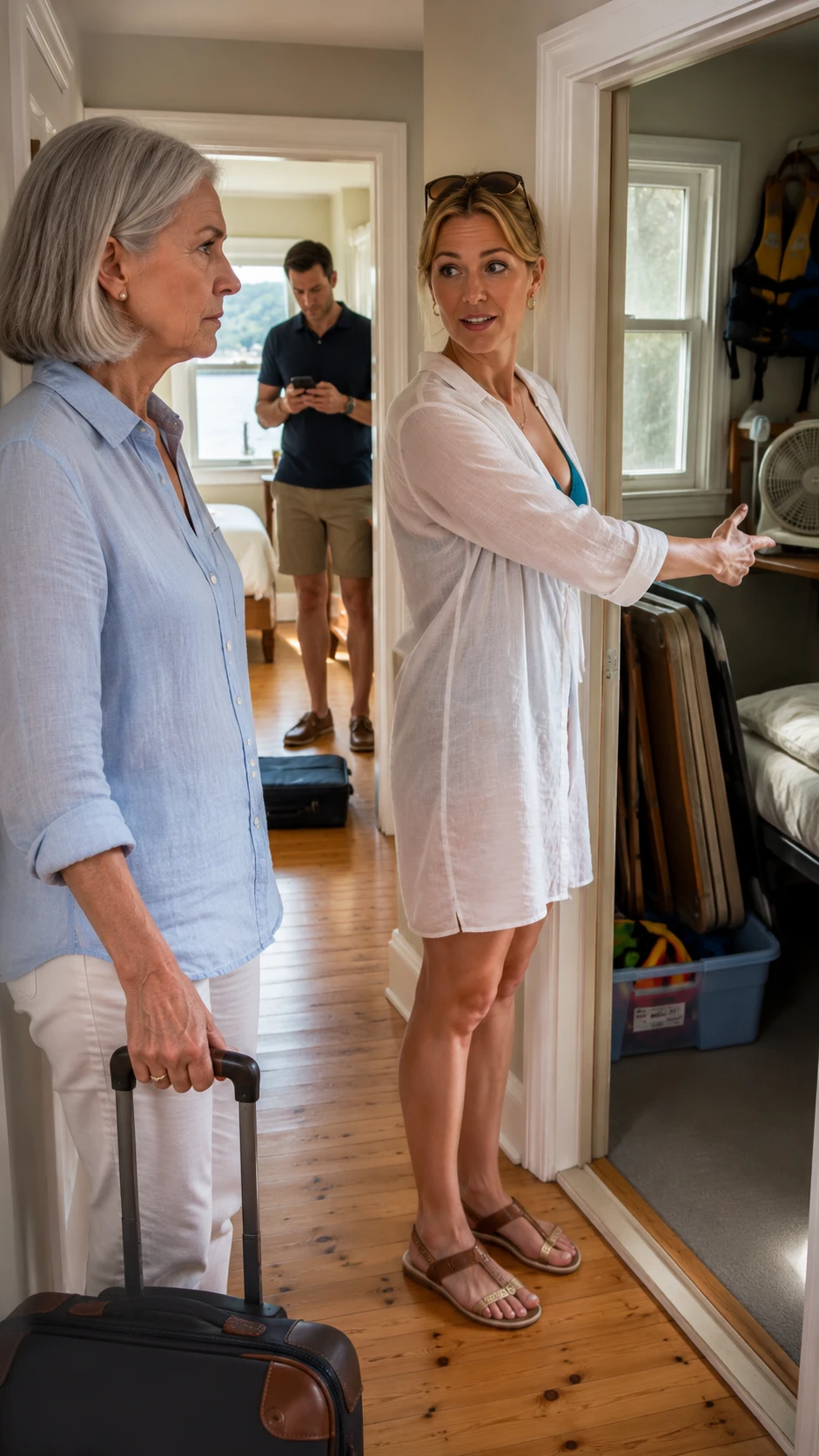
At my own lake house, my daughter-in-law pointed to the little room beside the tool shed and said, “That’s your room for the week.”
She said it with a smile.
That was almost the worst part.
The room was eleven feet by nine, with a narrow daybed pushed against the wall and one small window facing the gray boards of the shed. An old box fan sat on a chair in the corner. It rattled above the second setting and smelled faintly of dust when I turned it on.
It was not a guest room.
It was a storage room that happened to contain a bed.
Two folded card tables leaned behind the door. There were life jackets in a plastic bin beneath the window. Someone had moved the Christmas decorations to the closet, leaving barely enough room for the one suitcase I had brought.
My room was at the other end of the hall.
Two windows over the lake. The king bed my husband and I had once shipped up in pieces because it would not make the turn on the staircase any other way. A reading chair beside the window. A cedar chest at the foot of the bed, still holding three of Paul’s flannel shirts because I had never found a good enough reason to remove them.
That room was where every summer morning of my marriage had begun.
I had paid for it.
And the roof above it.
And the deck outside it.
And the upstairs leak that turned into a renovation no one had warned me would cost that much.
I had opened the house every spring and closed it every fall for twenty-nine years. I knew every board that creaked, every cabinet I had repainted, every latch that stuck in damp weather.
I knew where Paul had carved our initials beneath the dock railing after too much wine on our fifteenth anniversary.
I knew which window swelled shut after three humid days.
I knew the soft place in the upstairs hallway where Daniel had dropped a bowling ball when he was twelve and lied about it until he was nineteen.
I am not a woman who gets turned around inside a house she built her life into.
Brooke was standing in the doorway, waiting for me to accept the arrangement she had made.
Behind her, I could see my son’s suitcase on the floor of my bedroom.
His shoes were beside my reading chair. Brooke’s makeup case was open on my dresser. One of Paul’s framed photographs had been moved from the nightstand to the top of the cedar chest, turned slightly toward the wall.
“You’ll like it down here,” Brooke said. “It’s close to the downstairs bathroom.”
I looked at her.
She was wearing a white linen cover-up over her swimsuit, her blond hair twisted into a clip, sunglasses resting on top of her head. She held herself with the relaxed confidence of someone who believed the difficult part was already over.
“The downstairs bathroom,” I repeated.
“Yes. I just thought it would be easier for you.”
“For me.”
“Especially at night.”
I was sixty-eight years old.
I walked four miles three mornings a week. I still climbed the extension ladder to clean the gutters because the man I hired always missed the back corner. I had driven three hours that morning, unloaded my own luggage, and carried two grocery bags into the kitchen while Brooke explained to Lily where she wanted the beach towels stored.
But suddenly stairs had become a concern.
Not when Brooke wanted me to bring down extra sheets from the linen closet.
Not when she asked me to check the roof after the spring storms.
Only when my bedroom became convenient for her.
“I see,” I said.
Brooke’s smile tightened.
“I know it’s a change,” she said. “But Daniel and I thought—”
Daniel had not thought.
That was clear from the way he was standing at the end of the hallway pretending to study something on his phone.
He looked up when he heard his name.
“Mom,” he said. “Hey. You made good time.”
“I did.”
He glanced toward the little room, then toward the corner room, and I watched the truth move across his face.
He knew.
Maybe not before they arrived. Maybe not when Brooke first carried their bags upstairs. But he knew now, and he had decided not to interfere.
That hurt more than the room.
Brooke stepped aside so I could enter the storage room.
“I put fresh sheets on the daybed,” she said. “And there’s another blanket in the closet somewhere.”
Somewhere.
I set my purse on the bed.
Then I walked back through the hall and into the living room.
Brooke followed me.
She sat on the couch and picked up her glass of rosé as if the matter had been settled. Lily ran in through the screen door a moment later, leaving wet footprints across the pine floor.
“Grandma!” she cried. “The water is warm!”
She was nine years old, sun-browned and bright-eyed, with strands of dark hair stuck to her cheeks.
“I’ll come see it in a minute,” I told her.
“Can we swim to the platform?”
“After you put on your life jacket.”
“I’m a good swimmer.”
“You are. Put it on anyway.”
She grinned and ran toward the mudroom.
Still happy.
Still unaware.
Brooke watched the wet footprints spreading across the floor.
“Lily, towel,” she called.
Then she looked at me and said, very lightly, “I really do think you’ll be more comfortable closer to the downstairs bathroom.”
That was the moment.
Not because it was loud.
Because it was so calm.
The worst family power plays almost always arrive dressed as consideration.
“I appreciate the thought,” I said. “But I’ll be taking the corner room.”
Brooke blinked.
“Daniel and I are already in there.”
“Yes,” I said. “I noticed.”
“We’ve unpacked.”
“I noticed that too.”
“It’s only for the week.”
“Yes.”
She waited.
When I did not add anything, she gave a small laugh.
“Does it really matter that much?”
I looked through the open screen door at the lake.
A speedboat cut a white line across the far end of the water. Someone’s radio played faintly from two docks down. The kitchen smelled of cut lemons and the basil plant I had put in the window twenty years ago and replaced every spring since.
“Yes,” I said. “It matters.”
Daniel finally put his phone away.
“Mom, maybe we can just—”
“I am not asking the two of you to sleep outside. There are three proper guest rooms upstairs.”
“They’re smaller,” Brooke said.
I turned to her.
“So is the room you chose for me.”
Her face changed.
Only for a second.
The smile disappeared, and beneath it I saw anger. Not embarrassment. Not confusion.
Anger.
Then the pleasant expression returned.
“We just thought, as the family gets older, it makes sense to adjust certain things.”
The family.
As though I were not standing inside the sentence.
“I’ll move my suitcase later,” I said.
Brooke set her glass down.
“I wish you wouldn’t make this into something unpleasant.”
There it was.
The handoff.
She had made the decision. She had taken the room. She had explained why I should be grateful.
But if I objected, I was the one making things unpleasant.
I had lived long enough to recognize that trick.
“I’m going to take a walk to the dock,” I said.
Daniel followed me as far as the kitchen.
“Mom.”
I stopped but did not turn around.
“It’s the first afternoon.”
“I’m aware.”
“We don’t want to start the week badly.”
I looked back at him.
He had Paul’s eyes. That had always been dangerous for me. Even when Daniel was small, one worried look could soften every firm decision I had made.
But Paul had never looked away while someone diminished me.
That difference mattered now.
“I didn’t start anything,” I said.
Outside, the path to the dock was the same one I had walked for twenty-nine summers.
Warm boards.
Long grass brushing my calves.
Cedar in the air.
The lake was that particular July blue-green that never looks quite real from a distance.
I stood at the end of the dock and listened to the water tapping against the posts.
Then I opened the app for the house.
The smart lock had been Daniel’s idea two years earlier. Easier than hiding a key beneath the ceramic frog, he had said. Safer too.
He was listed as a secondary administrator because I had trusted him.
Brooke had apparently been using his access. The activity log showed the door opening and closing throughout the previous afternoon, almost a full day before I arrived.
They had come early.
I had told them I would meet them at noon on Saturday. They had entered Friday afternoon without mentioning it, given themselves time to unpack, move my belongings, and establish the week before I got there.
I removed Daniel’s administrator access.
Then I changed the entry code.
The lock confirmed the update with a cheerful green symbol.
I looked at that little green circle for several seconds.
Then I called my son.
“I’ve taken the corner room,” I said when he answered. “And I’ve updated the code.”
Silence.
The faint clink of dishes came through the phone.
“Why would you change the code?”
“I’ll give you the new one after we talk.”
“Mom, we’re staying here.”
“I know.”
“Our things are inside.”
“I know that too.”
Another silence.
Then he lowered his voice.
“This is getting out of hand.”
“No,” I said. “It has been out of hand for some time. I’ve only just stopped pretending otherwise.”
Eight minutes later, he was walking down the dock rubbing the back of his neck.
He had done that since he was a boy whenever he already knew he was about to disappoint me.
He sat in the folding chair beside mine but did not look at me.
“Brooke was only trying to be practical,” he said.
“Was she?”
“She thought the stairs might bother you.”
“She has watched me carry kayaks up from the shore.”
“She didn’t mean anything by it.”
“Then moving rooms should be easy.”
He exhaled.
“It’s the first day, Mom. I don’t want the week to start badly.”
I looked across the water.
The wrong person is almost always asked to keep things pleasant.
Not the person who crosses the line.
The person who notices.
The person who objects.
The person who finally says no.
“The room is only the part you can see,” I told him.
He stopped rubbing his neck.
“What does that mean?”
“It means this isn’t the first decision the two of you have made about my house without asking me.”
“That’s not fair.”
“Isn’t it?”
“We’re family.”
“Yes.”
“You told us to treat this place like home.”
“I did. I did not tell you to treat me like a guest.”
He looked back toward the house.
Brooke was standing at the living-room window, a pale shape behind the screen.
Watching us.
“Come find me tonight after Lily is asleep,” I said. “You and I need to talk about a few things that should have been said a long time ago.”
Daniel looked at me.
Then he looked toward the house again.
For the first time that afternoon, he stopped defending the room.
PART 2: THE THINGS I HAD LET SLIDE
Brooke prepared dinner as though nothing had happened.
That was one of her talents.
She could reset the surface of a room without resolving anything beneath it.
By six thirty, salmon was on the grill, potatoes were roasting, and a bowl of salad sat in the center of the table. She had folded the napkins into neat rectangles and placed a sprig of rosemary on each one.
She had also replaced my blue woven placemats with pale straw ones I had never seen before.
“They were on sale,” she said when she noticed me looking. “The blue ones felt dated.”
The blue ones had been a gift from Paul.
Not an important gift. Not an anniversary or birthday gift. He had bought them from a craft market because I had admired the color and then pretended not to want them.
That was how many of the things in the house had arrived.
A lamp I paused beside.
A bowl I picked up twice.
A wind chime I said was too expensive.
Small evidence that someone had been paying attention.
“Where are the old ones?” I asked.
“In the pantry, I think.”
“You think?”
“I was organizing.”
I opened the pantry.
Every shelf had been rearranged.
The canned goods were labeled. Snacks were placed in clear plastic bins. My baking supplies had been moved to the top shelf, where I would need a stool to reach them.
The blue placemats were folded behind a case of bottled water.
I took them out and returned to the table.
Brooke watched me replace the straw mats one by one.
“Seriously?” she asked.
“They’re mine.”
“I didn’t throw them away.”
“No. You only decided I should no longer see them.”
Daniel came in carrying a platter from the grill.
“Can we please not do this during dinner?”
Lily looked from one adult to another.
“Do what?”
“Nothing,” I said. “Your father is worried the potatoes will get cold.”
That made her laugh.
Daniel did not.
Dinner passed in careful pieces.
Lily told me about summer camp and the girl in her group who could hold her breath underwater for almost a minute. Daniel talked about a new project at work. Brooke discussed the weather forecast and the possibility of rain on Tuesday.
No one mentioned the bedrooms.
No one mentioned the code.
Then Lily asked, “Is Aunt Melissa still coming Wednesday?”
The table went still.
Brooke’s fork stopped halfway to her mouth.
I looked at her.
“Melissa is coming?”
“My sister,” Brooke said quickly. “Just for one night.”
“You didn’t mention that.”
“I thought Daniel did.”
Daniel looked down at his plate.
“I must have forgotten.”
“With her boys?” Lily asked.
Brooke gave her daughter a warning glance.
Lily noticed too late.
“And Kevin,” she added quietly.
Four additional people.
In my house.
Without asking me.
Brooke reached for her wine.
“It’s only one night,” she said. “The boys can take the bunk room, and Melissa and Kevin can use the yellow room.”
“The yellow room is where Daniel and you will be sleeping.”
Her expression hardened.
“I thought we were still discussing that.”
“We are not.”
Daniel put down his fork.
“Mom.”
“No guests,” I said, “unless you ask me first.”
“She’s my sister.”
“I know who she is.”
“We’ve been coming here for years.”
“She has been invited here for years.”
Brooke leaned back.
“So now she needs formal permission?”
“Yes.”
The answer seemed to shock her.
Not because the rule was unreasonable.
Because she had not expected me to say it aloud.
“This is exactly what I was afraid of,” she said.
“What were you afraid of?”
“That after Paul died, you would start using the house to control everyone.”
Daniel closed his eyes.
Lily stared at her mother.
The room seemed to shrink around us.
Paul had been gone three years.
A heart attack in October. Sudden, ordinary, devastating. He had been standing in our kitchen at home complaining that the coffee tasted weak. Forty minutes later, there were paramedics on the floor and a police officer asking me whether I had someone to call.
The lake house was the one place where his absence did not feel empty.
It felt occupied.
His tools were still arranged above the workbench. His handwriting remained on masking-tape labels in the basement. One of his old fishing lures was caught in a branch near the shoreline because he had refused to cut the line and had spent half a summer insisting he would retrieve it.
Brooke knew that.
She also knew I had continued inviting them every year.
I had paid for groceries.
I had watched Lily while they went into town.
I had given Daniel a key code and told him he could use the house on weekends when I was not there.
Control was not the problem.
The lack of it was.
“I have not used this house to control you,” I said.
Brooke’s face flushed.
“But you could.”
There it was.
Not what I had done.
What she feared I might do.
Daniel looked at his wife.
“Brooke, stop.”
“No. I’m tired of pretending this isn’t hanging over everyone. We all know this place matters to the family.”
“It matters to me too,” I said.
“I didn’t say it didn’t.”
“You spoke as though I were standing between the family and the house.”
She looked away first.
Lily’s lower lip trembled.
I stood and gathered the plates.
“Grandma, are you mad?”
I looked at her.
“Not at you.”
“Is Aunt Melissa coming?”
“That is a conversation for the adults.”
Brooke pushed her chair back.
“See? Now Lily has to be disappointed because you need to prove a point.”
I set the plates down.
“No. Lily is disappointed because you promised something that was not yours to promise.”
Silence.
A boat engine started somewhere across the lake.
The sound carried through the open windows, then faded.
Daniel rose from the table.
“I’ll help with the dishes.”
Brooke laughed once, without humor.
“Of course you will.”
She walked out through the screen door.
A moment later, we heard the bedroom door close upstairs.
Lily began gathering silverware.
“I can help too,” she said.
I touched her shoulder.
“You can go finish your book.”
“Are you and Mom fighting?”
“Your mother and I disagree about something.”
“Is it because of your room?”
Daniel looked at me.
I looked at him.
Lily continued before either of us answered.
“Mom said you wouldn’t care because you only sleep in there.”
Daniel’s face changed.
“Lily,” he said.
“What?”
“Go read, sweetheart.”
“But she did.”
“I know. Go on.”
Lily carried her plate to the sink and left the kitchen.
Her footsteps went up the stairs.
Daniel stood with both hands braced against the counter.
I filled the sink with water.
He spoke without looking at me.
“Brooke gets ahead of herself.”
“That is one way to describe it.”
“She likes to plan.”
“In my home.”
“She sees this as a family place.”
“So do I.”
He turned.
“What do you want me to say?”
“The truth would be a beginning.”
He stared at me.
Then he looked toward the ceiling, toward the room where his wife was waiting.
“I’ll move our things,” he said.
I should have felt victorious.
I felt tired.
“Thank you.”
We washed the dishes without speaking.
Later, after Lily was asleep and the house had gone quiet, Daniel found me sitting in the reading chair in the corner room.
Their suitcases were gone.
My belongings had been returned from the storage room, although not unpacked. Brooke’s cosmetics had been cleared from the dresser. Paul’s photograph was back on the nightstand.
The room still felt disturbed.
Not damaged.
Entered.
Claimed.
Daniel stood in the doorway.
“You said we needed to talk.”
I pointed to the chair near the window.
He sat.
For a while, neither of us said anything.
The lake was black glass beyond the windows. A line of lights shone from houses on the opposite shore.
“When did Brooke start calling this place ‘our lake house’?” I asked.
Daniel frowned.
“What?”
“I’ve heard her say it to friends.”
“She doesn’t mean ownership.”
“What does she mean?”
“That we’re all part of it.”
“Last March, she emailed me a summer calendar with two weeks already blocked off for your family.”
“We were trying to organize.”
“She asked me to choose from the dates left over.”
Daniel looked down.
“In May, she sent me photographs of white kitchen cabinets and said we should modernize before the next season.”
“The cabinets are old.”
“I painted them myself.”
“I know.”
“Do you?”
He was quiet.
“Last year,” I continued, “she moved the framed photograph of your father and me from the living room to the hallway because she said the family wall should focus on the grandchildren.”
“That wasn’t meant as an insult.”
“She replaced it with three photographs of Lily and one of the three of you.”
“You have pictures everywhere.”
“That is not the point.”
“Then tell me the point.”
I leaned back.
“The point is that every change is small enough to defend.”
He said nothing.
“A placemat. A photograph. A week on a calendar. A cabinet color. A bedroom. Each one can be explained. Each one can be called practical or modern or better for Lily.”
I felt my throat tighten, but I kept my voice steady.
“And because each thing is small, I have let them slide. I have told myself Brooke is enthusiastic. That you are busy. That I should be grateful you still want to come here.”
“Mom—”
“But the small things all move in the same direction.”
He looked at me then.
“What direction?”
“Toward my disappearance.”
His face went pale.
“That’s not fair.”
“It is exactly fair.”
“No one wants you to disappear.”
“Then why am I being removed from my own room?”
“It was one bad decision.”
“It was a very honest decision.”
He stood and walked to the window.
“You think Brooke is waiting for you to die?”
The words were brutal in the quiet room.
I let them remain there.
“I think both of you have begun treating my absence as a future event worth preparing for.”
Daniel turned.
“That is a terrible thing to say.”
“It is a terrible thing to feel.”
He stared at me.
I could see the boy he had been and the man he had become layered together.
The boy who hated conflict.
The man who still believed silence made him innocent.
“I have never thought that,” he said.
“Perhaps not in words.”
“I love you.”
“I know.”
“Then how can you accuse me of something like this?”
“Because love does not excuse cowardice.”
He flinched.
I had not meant to say it so sharply.
But once spoken, it felt true.
“You knew she put me in that room,” I said. “You saw my suitcase there. You saw your things in my bedroom. You knew it was wrong.”
“I didn’t want a fight.”
“So you chose the person least likely to create one.”
He looked away.
That was answer enough.
A floorboard creaked in the hall.
Brooke was standing outside the room.
I did not know how long she had been listening.
Her arms were folded across her chest.
“What exactly are you accusing me of?” she asked.
PART 3: THE INVENTORY OF SMALL ERASURES
Brooke entered the room without waiting for an answer.
She had changed into gray pajama pants and one of Daniel’s old college shirts. Without the linen cover-up, the wineglass, and the careful smile, she looked younger.
Also angrier.
“You think I’m waiting for you to die so I can take your house?” she asked.
“I think you have become too comfortable making decisions about something that does not belong to you.”
“That is not the same thing.”
“No. It is the behavior that creates the feeling.”
Daniel stepped between us, not physically but with his voice.
“Let’s slow down.”
Brooke turned on him.
“You let her say all of that?”
“I’m sitting right here,” I said.
“I know.”
“Then speak to me.”
She looked at me.
For several seconds, neither of us moved.
“I have spent years trying to make this place work for everyone,” she said finally. “I plan meals. I wash sheets. I pack for Lily. I make sure we bring what the house needs. I’m the one who remembers sunscreen and groceries and batteries and the fact that the downstairs shower drain clogs.”
“I have never denied that you work.”
“But you act like I’m some intruder.”
“You entered my house a day early without telling me.”
“Daniel has access.”
“Had.”
Her eyes narrowed.
“You changed his access?”
“I removed his administrator privileges.”
“That’s unbelievable.”
“No. It’s a lock setting.”
“You’re punishing us.”
“I am correcting an arrangement that no longer feels appropriate.”
Daniel rubbed both hands over his face.
Brooke began pacing.
“We have treated this house like family because you told us to. Now suddenly every little thing is evidence against me.”
“Not every little thing.”
“Placemats, Helen. You brought up placemats.”
My name sounded strange in her mouth.
She had called me Mom after the wedding, then stopped a year later when we disagreed about whether six-month-old Lily should sleep beneath three heavy blankets.
I had not objected.
Another small thing I had let slide.
“It was never about the placemats,” I said.
“Then what do you want from me?”
“I want you to stop erasing me while calling it helpful.”
Her mouth opened.
Then closed.
Daniel sat on the edge of the cedar chest.
Brooke looked around the room.
At the photographs.
At the folded quilt.
At the water beyond the windows.
“You have no idea what it’s like,” she said.
“What what is like?”
“To come into a family where everything already has a history.”
Her voice changed.
Not softer, exactly.
Less polished.
“You and Paul had your traditions. Daniel had all his childhood stories. Every room had some meaning before I ever walked into it. Every Christmas ornament had an explanation. Every recipe had a correct way to make it. Every time I suggested something different, someone told me how it had always been done.”
I listened.
There were truths in what she said.
Truths I had not noticed because they had not been painful to me.
“My family moved six times before I was sixteen,” she continued. “We rented. We never painted because we knew we’d have to paint it back. We never planted anything. We never had one place where everyone returned.”
Daniel looked at her.
She did not look back.
“When I married into this family,” she said, “this house was the first place that felt permanent.”
I understood then.
Not enough to excuse her.
Enough to see her.
She had not grown up with cedar chests, carved initials, and summer traditions. She had grown up packing.
She had mistaken claiming for belonging.
“You wanted a place that could not be taken from you,” I said.
“Yes.”
“So you began taking it from me.”
Her eyes filled, but her expression stayed hard.
“That’s not what I was doing.”
“It may not be what you told yourself.”
“I was trying to be part of it.”
“You do not become part of a family by removing someone else’s place.”
Daniel whispered her name.
She shook her head.
“You’ve never really liked me.”
“That is not true.”
“You tolerate me because I’m Daniel’s wife and Lily’s mother.”
“I have welcomed you into this house for eleven summers.”
“And reminded me every summer that it is yours.”
“Because it is.”
The words landed between us.
Brooke laughed bitterly.
“There it is.”
“Yes,” I said. “There it is.”
I stood.
“My ownership is not an insult to you.”
“You use it like one.”
“No. You experience it as one because it limits what you believe you should be allowed to do.”
Daniel rose too.
“Mom, maybe it would be better if we got a hotel.”
Brooke turned on him.
“You want to leave?”
“I want everyone to calm down.”
“There are no hotels nearby in July.”
“There’s the lodge across the highway.”
“It’s full.”
“I can call.”
I shook my head.
“You do not need to leave.”
Brooke stared at me.
“But there will be rules.”
She crossed her arms.
“Of course there will.”
“Yes. There should have been rules before.”
I counted them without raising my voice.
“You ask before arriving early. You ask before inviting guests. You do not move my personal things. You do not plan renovations. You do not assign bedrooms. And no one uses this house when I am not here until I decide I am comfortable with that again.”
Daniel looked at me sharply.
“You’re taking away our weekends?”
“I am taking back access to my property.”
“Because of one room?”
“Because the room exposed a pattern.”
Brooke stepped closer.
“And if we don’t agree?”
“Then you leave tomorrow.”
Her face changed again.
This time, the anger gave way to disbelief.
I had always made room.
At holidays. At the lake. In plans. In conversations.
They had confused accommodation with surrender.
“You would make your granddaughter leave?” Brooke asked.
“No. I would require her parents to choose whether they can respect the person hosting them.”
“That is the same thing.”
“It is not.”
“You know she loves it here.”
“So do I.”
Brooke’s voice rose.
“You’re using Lily.”
“No. You are.”
Daniel moved between us.
“Enough.”
The word came out louder than I had ever heard him speak to his wife.
Brooke froze.
He looked frightened by his own voice.
Then he turned to me.
“We understand the rules.”
Brooke stared at him.
“You don’t speak for me.”
“No,” he said. “But I should have spoken sooner.”
The room went silent.
Daniel’s face was pale, but he did not look away from her.
“I knew Mom would hate that downstairs room,” he said. “I knew before she arrived.”
Brooke’s jaw tightened.
“You agreed it was practical.”
“I agreed because I didn’t want to argue with you.”
“So now this is all my fault?”
“No.”
He glanced at me.
“That’s the problem. I kept acting like it was no one’s fault.”
Brooke looked from him to me.
Then she walked out.
The door slammed hard enough to shake the photograph on the nightstand.
A second later, we heard another door close across the hall.
Daniel remained beside the cedar chest.
“I’m sorry,” he said.
It was the first apology of the day.
I believed he meant it.
I also knew it was not enough.
“Go to your wife,” I said.
He hesitated.
“Go.”
When he left, I closed my bedroom door.
I unpacked my suitcase slowly.
Sweaters in the left-hand drawer.
Nightclothes in the right.
Toiletries beside the sink.
Shoes under the chair.
Small acts of return.
Then I picked up Paul’s photograph.
It had been taken on the dock twelve years earlier. He was wearing a faded red cap and holding a fish too small to justify his expression of triumph.
“You would have hated this,” I whispered.
But that was not entirely true.
Paul hated conflict too.
The difference was that he hated seeing me hurt more.
He would have made a joke first. Then he would have carried Daniel’s suitcase into the yellow room himself.
I set the photograph back down.
The following morning, I woke before sunrise.
For several seconds, I did not know why my chest felt tight.
Then I heard the box fan rattling across the hall.
Daniel and Brooke had put Lily in the yellow room and taken the downstairs room themselves.
I got up and opened the curtains.
Mist lay across the lake. The dock appeared and disappeared beneath it.
This was the view Brooke had decided I did not need.
I made coffee and carried it outside.
Lily found me half an hour later.
She wore pink pajamas and one untied sneaker.
“Why do you have one shoe on?” I asked.
“I couldn’t find the other one.”
“That seems like a weak reason.”
She smiled and climbed into the chair beside me.
For a while, we watched the mist lift.
Then she said, “Mom cried last night.”
“I’m sorry you heard that.”
“Dad said grown-ups have misunderstandings.”
“Sometimes.”
“Are we going home?”
“I don’t know.”
She picked at a loose thread on her pajama cuff.
“Mom said this house would be ours someday.”
I did not move.
Lily looked at me quickly.
“She didn’t say soon.”
“I know.”
“She said because Dad grew up here.”
“I understand.”
“And because I’m the only grandkid.”
The lake blurred for a moment.
I blinked until it cleared.
Children rarely understand the weight of the truths they carry into a room.
“When did she tell you that?” I asked.
“In the car yesterday.”
“What were you talking about?”
“Which bedroom I could have when I’m older.”
I closed my eyes.
The room was only the part I could see.
Behind it was a future already being furnished.
Brooke had not merely placed me downstairs.
She had been walking through my life with a measuring tape, deciding what would belong to whom when I was gone.
Lily leaned against me.
“Are you mad again?”
“No, sweetheart.”
“Mom said Grandma would want us to have it.”
I put my arm around her.
“That may be true someday.”
“Then why are people fighting?”
“Because someday is not today.”
She considered that.
Then she nodded.
Children understand more than adults when the truth is stated plainly.
From the kitchen window, I saw Brooke standing at the counter with her phone pressed to her ear.
The screen was open, and her voice carried faintly through the screen door.
“She changed the code,” she said. “Like we’re strangers.”
I stood.
Brooke saw me through the window.
Her voice stopped.
I walked inside.
She lowered the phone.
“It’s Melissa,” she said.
“I assumed.”
Brooke waited.
I poured more coffee.
Then I looked at her.
“For the moment,” I said, “you are guests.”
PART 4: THE QUESTION BENEATH THE QUESTION
Daniel came down to the dock just before noon.
Brooke had taken Lily into town for groceries, although the refrigerator was already full.
I suspected they both needed distance.
He carried two mugs of coffee and handed one to me.
I accepted it.
For a while, we watched a family of ducks move through the reeds.
Then he asked, “Are you planning to sell the house?”
That was the different question.
Not whether I would let them back inside.
Not whether they could keep the room.
Whether the future they had begun relying on was about to disappear.
“I have not decided to sell,” I said.
His shoulders lowered slightly.
“But I have thought about it.”
He stared at me.
“Since when?”
“Since I realized the house was becoming something people valued more than the person who owns it.”
“That isn’t true.”
“Isn’t it?”
He looked out at the water.
“Brooke shouldn’t have told Lily the house would be ours.”
“No.”
“She says she was trying to explain family traditions.”
“She was assigning property.”
“I know.”
I took a sip of coffee.
It was too strong. Daniel had always made it too strong, just as Paul had.
“Your father wanted this place to stay in the family,” I said.
Daniel’s voice softened.
“I know.”
“He also wanted me to enjoy it for the rest of my life.”
“I know that too.”
“Do you?”
He flinched.
I did not enjoy hurting him.
That was part of what had allowed the problem to grow.
Every correction had felt like cruelty because I knew exactly where his tender places were. He was my son. I had bandaged his knees, waited through his fevers, sat awake the first night he borrowed the car.
But protecting a grown child from discomfort can become another way of abandoning him.
“I have an estate plan,” I said. “The house is addressed in it.”
He looked at me.
“I’m not asking what’s in your will.”
“You have both been behaving as though you already know.”
“That’s Brooke.”
“No. It is you too.”
He started to object.
I raised a hand.
“You let her reserve weeks without asking. You gave her the access code. You arrived early. You unpacked in my room.”
“I carried the bags she told me to carry.”
“You are forty-two years old.”
His face reddened.
“I know.”
“Do you?”
He looked down at his coffee.
When he spoke again, his voice was quieter.
“We’ve been under pressure.”
I waited.
He rubbed the back of his neck.
“The company cut bonuses last year. Our mortgage payment went up after the refinance. Lily’s school is expensive. Brooke’s mother may need help soon.”
I listened.
None of those things surprised me individually. Together, they formed a weight he had not told me he was carrying.
“What does that have to do with my bedroom?”
“Nothing directly.”
“Then what does it have to do with the house?”
He stared across the lake.
“I think Brooke sees this place as the one thing in our future that’s secure.”
There it was.
Not greed exactly.
Fear wearing greed’s coat.
“She talks about Lily having summers here,” he continued. “About us retiring here someday. About keeping it the way Dad wanted.”
“Your father never said he wanted me removed from the picture.”
“I know.”
“But Brooke began planning as though the difficult part was simply waiting.”
Daniel closed his eyes.
“She doesn’t want you to die.”
“People can love you and still arrange themselves around what they expect to receive after you are gone.”
He set his mug on the dock.
“I should have stopped it.”
“Yes.”
“I thought if I challenged every little thing, she’d say I was choosing you over her.”
“Were you?”
“No.”
“Then why would asking her to respect me be a betrayal of her?”
He had no answer.
The duck family disappeared into the reeds.
Daniel leaned forward, elbows on his knees.
“When Dad died, everything changed,” he said.
“Yes.”
“You got quieter.”
“I was grieving.”
“I know. But Brooke thought you were pulling away.”
“Did either of you ask?”
He looked at me.
“No.”
“I did not pull away. I stopped doing all the work.”
“What work?”
“The calls. The invitations. The reminders. The pretending not to notice when plans were made without me. Your father kept the family moving toward one another. After he died, I wanted to know whether anyone would move toward me.”
Daniel’s eyes filled.
I looked away to give him privacy.
Months had passed when I had deliberately not called first.
Daniel had eventually sent messages.
Photos of Lily.
Questions about the furnace.
Requests for lake-house dates.
Rarely a question about how I was sleeping or what it felt like to eat dinner alone after forty-three years of marriage.
I had not held that against him at first.
Grief makes everyone clumsy.
But clumsiness repeated long enough begins to resemble choice.
“I’m sorry,” he said.
“I know you miss him too.”
“I do.”
“But you still had Brooke and Lily. I went home to an empty house.”
His jaw tightened.
“I should have been there more.”
“Yes.”
The answer was not kind.
It was honest.
A breeze moved across the dock, lifting the edge of the towel beside my chair.
“I don’t want this house to break the family,” he said.
“The house is wood and glass. It has no such power.”
“You know what I mean.”
“I do. And I am telling you the house did not create this. It revealed it.”
Daniel picked up his mug.
“What happens now?”
“You and Brooke decide whether you can stay here without acting as owners.”
“And if we can?”
“You stay through Sunday.”
“And after that?”
“After that, you will no longer have permanent access. When you want to use the house, you will ask.”
His face tightened, but he nodded.
“I’ll give you a temporary code for this week.”
He nodded again.
“What about Melissa?”
“She is not coming Wednesday.”
“Brooke already canceled.”
“Good.”
He stood.
Then he paused.
“Are you cutting me out of your will?”
I looked up at him.
Fear had made him a boy again.
That hurt.
Not because he asked.
Because somewhere along the way, my love had become tangled with what I might leave behind.
“I am not discussing my will with you today,” I said.
He swallowed.
“But I will tell you this. No one will inherit this house by rehearsing my absence.”
He went back toward the house alone.
That afternoon, Lily and I took the canoe along the eastern shore.
The water was quiet beneath the cliffs. Dragonflies skimmed the surface. She sat in front with a red paddle that was too large for her and splashed more water into the canoe than she moved behind us.
“Grandpa used to let me steer,” she said.
“Grandpa once steered us into a buoy.”
“He said the buoy moved.”
“Your grandfather said many things.”
She laughed.
We reached the small cove where Paul used to fish for bass.
Lily set down the paddle.
“Are you going to die soon?”
My hands tightened around mine.
“No.”
“How do you know?”
“I don’t know for certain. No one does. But I am healthy, and I plan to be here for a long time.”
She nodded.
“Mom said old people think about where things go.”
“Sometimes.”
“Do you?”
“Yes.”
“Where will this go?”
She meant the lake.
The dock.
The house rising through the trees.
“All of it,” she said.
“Someday, I’ll make the decision I believe is right.”
“Will you tell me?”
“When you’re old enough.”
“I’m almost ten.”
“Exactly.”
She considered that answer, then dipped her fingers into the lake.
“I don’t want your room.”
I looked at the back of her head.
“No?”
“It smells like your soap.”
“That is a serious problem.”
“And the sunrise wakes you up.”
“It does.”
“I want the bunk room.”
“Then the bunk room remains a strong possibility.”
She smiled.
I paddled us back toward the dock.
From the water, I could see Brooke sitting alone on the steps.
She watched us approach.
When we were close enough, she stood and caught the rope.
“Did you have fun?” she asked Lily.
“We saw a turtle.”
“A huge one,” I said.
“It was medium,” Lily corrected.
Brooke helped her out of the canoe.
Then she looked at me.
“Can we talk?”
I stepped onto the dock.
“After dinner.”
Her mouth tightened, but she nodded.
At seven, the four of us sat around the table.
The blue placemats were still there.
Brooke had made pasta. She did not serve wine.
Lily talked about the turtle until Daniel asked whether she wanted to watch a movie upstairs.
She understood she was being dismissed, but she did not argue.
When her footsteps faded, Brooke folded her hands.
“I canceled Melissa,” she said.
“Daniel told me.”
“I moved everything back where it was.”
“I noticed.”
“I shouldn’t have changed things without asking.”
“No.”
She looked at Daniel, then at me.
“I shouldn’t have taken your room.”
“No.”
Her eyes sharpened.
“You could make this easier.”
“I have made it easy for years.”
“That isn’t what I meant.”
“I know.”
She took a breath.
“I am apologizing.”
“You are listing actions.”
“What else do you want?”
“I want you to understand what made them possible.”
Her expression cooled.
“And what is that?”
“You stopped seeing me as the living center of my own life.”
Daniel remained silent.
Brooke’s eyes filled again.
“I never wanted to hurt you.”
“I believe that.”
She looked surprised.
“Then why are we still doing this?”
“Because intent is not the same as impact.”
She looked down at her hands.
I continued carefully.
“You wanted permanence. I understand that now. You wanted a place your daughter could return to. You wanted roots you did not have growing up.”
Brooke’s chin trembled.
“But you tried to create those roots by planting them in soil that was already mine.”
She closed her eyes.
“For you to feel secure,” I said, “I was required to become smaller. Older. Less present. Easier to move.”
“I thought the downstairs room would be better for you.”
“At some point, perhaps you even believed that.”
Her eyes opened.
“But before you considered what would be better for me, you considered what you wanted.”
No one spoke.
The refrigerator hummed.
A moth tapped against the window.
Finally, Brooke said, “I thought if we made this place ours too, then no one could decide we didn’t belong.”
“You belong because you are family. Not because you control the bedrooms.”
“What if you change your mind about us?”
“That is the risk of every relationship. You cannot eliminate it by taking possession.”
She wiped beneath one eye.
“My mother used to promise we would stay,” she said. “Every time we moved, she said the next place would be permanent.”
Daniel reached for her hand.
She let him take it.
“I know that is not your fault,” she said. “But when I came here, I wanted Lily to have what I didn’t.”
“I want that too.”
Brooke looked at me.
“Then why does it feel like you’re keeping us outside?”
“Because a boundary feels like rejection when you are used to crossing it.”
She looked away.
I let the silence remain.
Then I said, “You may stay through Sunday.”
Daniel exhaled.
Brooke nodded once.
“You will use the yellow room. Lily can stay in the bunk room. You will ask before inviting anyone. Nothing in this house gets moved or replaced without my agreement.”
“All right,” she said.
“And after Sunday, you no longer have open access.”
Her face tightened.
Daniel squeezed her hand.
Brooke looked at him.
Then back at me.
“All right.”
I took out my phone and generated a temporary entry code.
It would expire Sunday at six in the evening.
I wrote it on a piece of paper and slid it across the table.
Brooke stared at the numbers.
“That feels very formal,” she said.
“Yes.”
She looked up.
“For now,” I said, “formal is safer than assumed.”
PART 5: THE ROOM FACING THE WATER
The next two days were not comfortable.
They were honest.
That was better.
Brooke asked before using the last of the blueberries.
Daniel knocked before entering my room.
When Brooke wanted to move two chairs onto the deck for sunset, she asked whether I minded.
At first, every question sounded pointed.
Then gradually, they began to sound normal.
Permission is humiliating only when you believe you are entitled to the answer.
On Wednesday morning, Brooke found me in the pantry moving the baking supplies back to the lower shelf.
“I can do that,” she said.
“I know.”
She stood in the doorway.
“I put them up there because Lily gets into the chocolate chips.”
“There is a child lock in the drawer.”
“I didn’t know.”
“You could have asked.”
“Yes.”
She took the flour from my hands and set it on the lower shelf.
Together, we restored the pantry.
Not exactly as it had been.
Better in one or two places.
Brooke showed me that the cereal boxes fit more neatly if we turned the clear bin sideways. I showed her where Paul had installed an extra shelf behind the canned goods.
Neither of us treated the adjustment as surrender.
That afternoon, rain moved across the lake in a silver wall.
Lily built a fort in the living room. Daniel made popcorn. Brooke sat at the table with a book and occasionally looked toward me as if expecting another confrontation.
There was none.
Conflict does not need to occupy every hour in order to remain real.
Sometimes the hardest part comes after the argument, when everyone must decide whether the truth will change their behavior.
That evening, Daniel joined me on the porch.
“I called the locksmith,” he said.
I looked at him.
“Why?”
“The old side-door key. Brooke had a copy made last year.”
I had not known that.
Anger rose.
Then I saw his face.
He was not defending it.
He was telling me.
“I asked her to give it back,” he continued. “She did. I thought you should change that lock anyway.”
“Thank you for telling me.”
“I should have told you when she made it.”
“Yes.”
He nodded.
“I know.”
We listened to the rain striking the roof.
“I wasn’t thinking about your will,” he said.
I turned toward him.
“Not at first. Not consciously.”
I waited.
“But when you changed the code, I panicked.”
“Why?”
“Because I realized I had been treating access like proof.”
“Proof of what?”
“That I still had a place here. With you. With Dad, somehow.”
My anger softened.
Not disappeared.
Softened.
“You do have a place with me,” I said.
“I haven’t acted like it.”
“No.”
He gave a small, painful smile.
“You’re not making this easy.”
“I am finished making difficult things easy enough to ignore.”
He nodded.
“I miss him.”
“I know.”
“I thought coming here would keep everything the same.”
“Nothing stayed the same.”
“I know that now.”
He looked through the screen toward the dark lake.
“After Dad died, Brooke started talking about fixing the house up. I let her because it felt better than talking about him being gone.”
That made sense.
Painfully.
Plans had become their anesthesia.
Renovations. Calendars. Future summers. Rooms for a life that had not yet happened.
“If the house changed,” I said, “perhaps the loss felt like progress.”
“Maybe.”
“But you cannot build your way around grief.”
“No.”
He leaned back.
“I’m sorry I left you alone in it.”
My throat tightened.
“You were grieving too.”
“That doesn’t mean I couldn’t have called.”
“No.”
“I’m sorry.”
This time, the apology reached further.
I placed my hand over his.
He turned his palm upward and held on.
On Thursday morning, Brooke knocked on my bedroom door.
I was sitting in the reading chair with coffee.
“Come in.”
She entered carrying Paul’s photograph.
For one terrible second, I thought she had moved it again.
Then I saw the crack in the frame.
“I knocked it off the dresser the first day,” she said. “When I was unpacking.”
I took it from her.
A thin line ran through the lower corner of the glass.
“Why didn’t you tell me?”
“I was embarrassed.”
“So you turned it toward the wall.”
She nodded.
Another small mystery explained.
Another choice made worse by concealment.
“I ordered replacement glass,” she said. “But I canceled it because I realized I should ask before changing anything.”
Despite myself, I almost smiled.
“Replacement glass would be acceptable.”
“I thought so. But I wanted to ask.”
“Thank you.”
She remained standing.
“I owe you a better apology.”
I set the photograph on my lap.
Brooke looked out at the lake.
“I knew you would not want the downstairs room.”
There it was.
No explanation.
No defense.
Just the truth.
“I told myself it would be easier for you,” she continued. “But I knew.”
I waited.
“I wanted this room. I wanted the view. I wanted to wake up here with Daniel and feel like it was ours.”
Her voice broke slightly.
“And when I saw your things, I thought moving them for one week wasn’t a big deal.”
“To you.”
“No. To me.”
She looked at the photograph in my hands.
“I think I have been waiting for permission to belong here. And because no one gave me the exact kind I wanted, I started acting as if I already had it.”
“I invited you.”
“I know.”
“I included you.”
“I know.”
“But it was not ownership.”
“No.”
She sat in the chair opposite me.
“I’m sorry I treated your life like the waiting room for mine.”
The sentence hurt.
It was also the first time I believed she fully understood.
“Thank you,” I said.
She wiped her eyes.
“I don’t expect you to trust me immediately.”
“Good.”
A surprised laugh escaped her.
Then I smiled too.
Not because everything was repaired.
Because repair had finally begun.
“I do want Lily to have summers here,” Brooke said.
“So do I.”
“I want her to remember this place.”
“She will.”
“I don’t want her memories to depend on what happens after you’re gone.”
“They should not.”
She looked at me.
“What can we do?”
It was the first time she had asked.
Not what she could plan.
Not what she could take over.
What we could do.
“We can start with this summer,” I said. “Not the imagined ones.”
She nodded.
“And next year?”
“You ask.”
“All right.”
“And perhaps next year, I say yes.”
She let out a breath.
“All right.”
I handed her the photograph.
“Take this into town. The hardware store should be able to replace the glass.”
She accepted it carefully.
“I’ll bring it straight back.”
“I know.”
On Friday evening, the four of us ate dinner on the deck.
The sky turned pink over the lake. Lily had corn stuck between her teeth. Daniel burned one side of the chicken and insisted it was “smoke-charred.” Brooke asked whether Melissa and her family might visit for lunch the following month.
She asked.
I checked the calendar.
Then I said yes.
Brooke smiled.
It was not triumph.
It was gratitude.
There is a difference.
On Sunday morning, I woke in the corner room before everyone else.
The first light entered through both windows, pale gold across the floorboards.
For years, Paul had complained about that light.
Then he would refuse to close the curtains.
He said a lake sunrise was too expensive to waste.
I lay still beneath the quilt and listened to the house.
Pipes ticking.
A gull calling from the dock.
The faint creak of someone crossing the upstairs hall.
Then came a knock.
“Grandma?”
“Come in.”
Lily opened the door.
Her hair was tangled, and she carried Paul’s repaired photograph against her chest.
“Mom said I could bring this back.”
She handed it to me.
The new glass caught the sunrise.
“Thank you.”
Lily climbed onto the bed.
“Are you still mad?”
“Not the way I was.”
“Are we still family?”
“Yes.”
“Even when people fight?”
“Especially then, if they tell the truth afterward.”
She considered this.
“Dad says we have to ask before we come next time.”
“That’s right.”
“Can I ask now?”
I smiled.
“You may.”
“Can we come next summer?”
“Next summer is a long way away.”
“That’s not an answer.”
“You sound like your grandfather.”
“Is that good?”
“Usually.”
She crawled beneath the quilt beside me.
Together, we watched the sunlight move across the lake.
A few minutes later, Daniel appeared in the doorway carrying two mugs of coffee.
Brooke stood behind him with a plate of toast.
Neither entered.
They waited.
Daniel lifted one mug.
“May we come in?”
I looked around the room.
At Paul’s photograph.
At my books beside the chair.
At the cedar chest holding the pieces of a life that remained mine to carry.
Then I looked at my family standing in the doorway.
“Yes,” I said. “You may.”
They came inside.
Not as owners.
Not as strangers.
As family.
At six that evening, their temporary code expired.
Daniel loaded the last suitcase into the car. Brooke checked the kitchen twice and asked whether I wanted the leftover fruit.
Lily hugged me so tightly that my glasses shifted.
“We’ll call when we get home,” Daniel said.
“I’d like that.”
He kissed my cheek.
Brooke stood beside the passenger door.
“Thank you for letting us stay.”
The words were simple.
They mattered.
“Thank you for listening,” I said.
She nodded.
Then they drove up the gravel road and disappeared through the trees.
The house became quiet.
Not empty.
Quiet.
I walked down to the dock with a glass of iced tea and sat at the end where Paul and I had watched nearly three decades of sunsets.
The week had not ended perfectly.
Brooke was still proud.
Daniel was still conflict-averse.
I was still angry about more than one room.
But the truth had been spoken.
The code had changed.
The rules had changed.
Most importantly, I had changed.
For years, I had believed love meant leaving every door open.
Now I understood that a door without a lock is not necessarily welcoming.
Sometimes it is simply unprotected.
The lake darkened from blue to silver.
Behind me stood the house I had built a life into.
Someday, it would belong to someone else.
That was the nature of houses.
And families.
And time.
But someday was not today.
The room facing the water was still mine.
The house was still mine.
The life inside it was still mine.
The lake was still there.
So was I.