
The U-Haul was blocking my driveway.
For several seconds, I sat behind the wheel of my car and tried to convince myself that it had stopped at the wrong house.
The truck’s rear doors were open. A metal ramp stretched across my lawn. Cardboard boxes crowded the walkway, and a pink floral crib mattress leaned against the side of my garage.
My front door stood wide open.
Through the living-room window, I could see two strangers carrying a black metal bed frame toward the staircase.
I checked the brass numbers beside the garage, even though I had installed them myself.
1287 Hawthorne Lane.
My house.
The house Amanda and I had spent five years saving to afford.
The house where we had eaten takeout on the bare floor the night we received the keys because we could not afford both furniture and closing costs.
The house where Amanda had painted the upstairs office after three consecutive night shifts, falling asleep on the drop cloth with blue paint in her hair.
Someone was moving into it.
I got out of the car.
The afternoon was warm, but my hands felt cold.
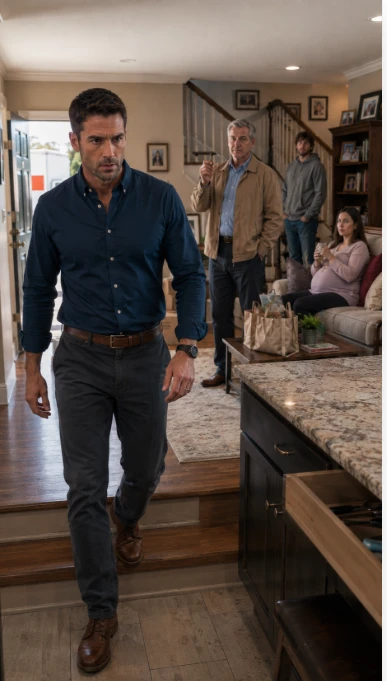
As I approached the front door, I saw my younger brother Kevin standing near the stairs with his hands in the pockets of his gray hoodie. His pregnant wife, Brianna, was sitting on Amanda’s couch, eating a sandwich while several shopping bags covered the coffee table.
My father stood in the middle of my living room.
Raymond Reynolds was pointing toward the upstairs hallway and giving instructions to the movers as though he owned the place.
When he saw me, he did not flinch.
He did not apologize.
He looked mildly inconvenienced.
“Trevor,” he said. “You’re home early.”
There are moments when anger arrives like fire.
This was not one of them.
What came over me was colder.
I looked at the open door, the boxes, the strangers on the stairs, and finally my father’s composed face.
“How did you get in?”
He reached inside his beige jacket and produced an old brass key.
He held it between two fingers.
“Had this made when we helped you move in,” he said. “Never know when family might need access.”
The key swung gently beneath his hand.
It made a tiny metallic sound.
That sound changed something in me.
For years, I had believed my father kept the key because he worried about emergencies. A fire. A burst pipe. Amanda or me getting locked out.
But as he stood there directing movers through my home, I finally understood what the key meant to him.
It was not responsibility.
It was not protection.
It was permission he had granted himself.
I walked past him without speaking.
“Trevor,” Kevin called.
I ignored him and went upstairs.
The door to my office was open.
My desk had been shoved against the wall. My computer monitors were stacked sideways on the floor. Cables hung across the carpet like severed vines.
Amanda’s nursing journals had been removed from the bookshelf and piled beneath the window. Her handwritten notes, reference guides, and certification materials had been thrown together without any order.
She had spent years building that system.
After difficult hospital shifts, she sometimes sat in that room until dawn, studying new procedures because she was terrified of becoming the kind of nurse who stopped learning.
To my family, it was clutter.
In the center of the room, where my chair had been that morning, stood a half-assembled white crib.
Kevin stopped behind me.
I could hear him breathing.
“Look,” he said, “we were going to explain.”
I stared at the crib.
One side rail had not yet been attached. A plastic bag of screws lay on the carpet beside it.
“You were going to explain after you moved in?”
“Brianna’s seven months pregnant.”
“I know.”
“We can’t be homeless with a baby coming.”
“I offered you two thousand dollars for a deposit.”
“That wouldn’t have solved everything.”
“It would have paid the deposit on the apartment you showed me.”
Kevin shifted his weight.
Behind him, one of the movers appeared at the doorway carrying a box labeled KITCHEN.
I pointed toward the hall.
“Take that downstairs.”
The mover looked at Kevin.
Kevin glanced at the half-built crib and shrugged.
“Brianna needs the natural light.”
That sentence did it.
Not the U-Haul.
Not the copied key.
Not even my father’s calm expression.
Brianna needs the natural light.
They had already evaluated the rooms.
They had already assigned themselves space.
They had already decided Amanda’s work could be swept into a corner because their needs were more important.
This was not a desperate request made badly.
This was an occupation.
I turned around and walked downstairs.
Dad had moved closer to the kitchen. He wore the patient expression he used when he believed everyone else was being emotional.
“We’ll all sit down,” he said, “and be reasonable.”
I went to the kitchen island.
“Trevor,” Brianna said, “stress isn’t good for the baby.”
I looked at her.
She lowered her sandwich.
My father continued speaking.
“No one is saying this has to be permanent. They need a few months. You have the room. Amanda is barely home anyway.”
That last sentence made Kevin glance away.
Dad knew exactly what he was doing.
He had transformed Amanda’s sacrifice into evidence that she did not deserve space in her own house.
I opened the wide drawer beneath the island.
Inside, beneath a stack of appliance manuals, was a thick legal folder Amanda had placed there three nights earlier.
I pulled it out.
The folder was dark blue.
Across the front, in block letters, was the name:
EVELYN MERCER REYNOLDS—PETITION TO VACATE PRESUMPTION OF DEATH AND FREEZE DISPUTED ASSETS.
I set it on the island beside the copied key.
My father stopped talking.
For the first time since I had entered the house, his expression changed.
The color drained from his face.
Kevin came down the stairs.
“What is that?” he asked.
Dad moved toward the island.
I placed my hand on the folder.
“Don’t.”
His eyes met mine.
Something frightened had appeared behind them, but he covered it quickly.
“This has nothing to do with what’s happening here.”
“It has everything to do with what’s happening here.”
Kevin leaned over the first page.
His eyes traveled across the printed heading.
Then he looked at me.
“Why is Amanda’s name written there?”
Dad reached for the folder.
I pulled it away.
Kevin read the line aloud.
“‘Amanda Reynolds, registered nurse, affiant and temporary fiduciary for Evelyn Mercer Reynolds.’” He frowned. “Who is Evelyn Mercer?”
I watched my father.
His jaw tightened.
“You know who she is,” I told Kevin.
“No, I don’t.”
“Yes, you do.”
He looked between Dad and me.
I felt the old pressure building inside my chest. The pressure created by years of silence, half-truths, and carefully edited memories.
Then I said the words that had seemed impossible even after I had seen the proof.
“Evelyn Mercer Reynolds is our mother.”
Kevin stared at me.
Brianna slowly placed her sandwich on its wrapper.
One of the movers stopped halfway down the staircase.
Kevin gave a confused laugh.
“That’s not funny.”
“I’m not joking.”
“Mom died.”
“No,” I said. “She didn’t.”
The room became very quiet.
Even the truck outside seemed to fall silent.
Kevin turned toward Dad.
Raymond’s face was composed again, but now I could see the effort beneath it.
“Tell him,” I said.
Dad exhaled through his nose.
“Trevor has been manipulated by a sick woman.”
“My wife met her.”
“Your wife met someone claiming to be Evelyn.”
“She had medical records. Identification. Photographs. Letters. A marriage certificate. Her original Social Security card.”
“Documents can be fabricated.”
“She knew about the scar on my left knee.”
Dad’s eyes flickered.
I continued.
“She knew how I got it. She knew what song she used to sing when Kevin was afraid of thunderstorms. She knew about the blue mark under the kitchen table in our old house—the one she made when she dropped a jar of paint and told us not to tell you.”
Kevin’s face had gone pale.
I had told him about the thunderstorm song two nights earlier, but he had refused to listen.
Now he looked at our father.
“Dad?”
Raymond folded his arms.
“This is exactly why I didn’t want either of you involved.”
“Involved in what?” Kevin asked.
“A delusion.”
I opened the folder.
The first page was a sworn affidavit signed by Amanda.
Beneath it was a copy of a petition filed in county court.
The petition asked a judge to reverse a legal declaration made fourteen years earlier—a declaration stating that Evelyn Mercer Reynolds was presumed dead.
The next page contained a photograph.
My mother stood beside Amanda in a hospital courtyard.
She was older than the woman in my memories. Her hair was almost entirely gray, and deep lines framed her mouth.
But the shape of her eyes was the same as mine.
Kevin took the photograph.
His fingers trembled.
“No,” he whispered.
Dad moved toward him.
“Give me that.”
Kevin backed away.
“Is this her?”
My father’s silence lasted less than two seconds.
It was enough.
Kevin’s mouth opened, but no sound came out.
Dad’s expression hardened.
“You have no idea what she did.”
“What did she do?” I asked.
“She left us.”
“That isn’t what happened.”
“That is exactly what happened.”
I turned to Kevin.
“Dad told us she died in a car accident while she was receiving treatment in Arizona. There was no car accident.”
Kevin stared at the photograph.
I remembered the memorial service.
I had been seventeen.
Kevin had been thirteen.
There had been a closed casket covered with white lilies.
Dad had told us the accident had been too severe for us to see her body. He said the coffin had been transported from Arizona at great expense. He made sure everyone understood how much he had sacrificed to bring her home.
I remembered standing beside that coffin, unable to cry because grief had not yet become real.
The coffin had been empty.
Amanda and I had confirmed it with the funeral-home records.
There had been no body.
Only Raymond’s instructions, a sealed container he claimed held personal effects, and a payment made in cash.
Dad looked toward the movers.
“You two need to step outside.”
They did not argue.
They set down the bed frame and left through the front door.
Dad waited until they were gone.
Then he lowered his voice.
“Your mother was unstable. She disappeared. She wanted nothing to do with any of us.”
“That’s a lie,” I said.
“She had every opportunity to contact you.”
“She wrote to us.”
Kevin looked up sharply.
“What?”
I removed copies of six letters from the folder.
Each envelope had been addressed to either Kevin or me.
Each had been returned to our mother.
Across the front, in thick black ink, someone had written:
REFUSED BY RECIPIENT. DO NOT CONTACT AGAIN.
The handwriting belonged to my father.
I knew because I had spent my childhood staring at his notes on report cards, permission slips, birthday cards, and lists of chores taped to the refrigerator.
Kevin recognized it too.
His face twisted.
Dad shook his head.
“You don’t understand the situation.”
“She wrote forty-three letters,” I said. “Those are only the copies her lawyer has processed.”
Kevin’s voice cracked.
“You told her we refused them?”
“I protected you.”
“From our mother?”
“From a woman who abandoned her family.”
“Then why tell us she was dead?”
Dad slammed his hand against the island.
Brianna jumped.
“Because she was dead to us!”
The shout echoed through the house.
For a heartbeat, no one moved.
Dad had always been careful with language. He avoided direct admissions. He made accusations sound like concerns and commands sound like advice.
But anger had stripped away the polish.
Kevin stared at him.
“You knew she was alive.”
Dad looked toward the open front door.
Outside, a car door closed.
A moment later, Amanda walked into the house.
She was still wearing navy hospital scrubs beneath a gray coat. Her dark hair was pulled into a loose knot, and exhaustion shadowed her eyes.
Behind her came Madison, our cousin.
And behind Madison were two police officers.
Amanda took in the boxes, the displaced furniture, and the copied key lying beside the legal folder.
Then she looked at me.
“Are you all right?”
“I am now.”
Dad straightened.
“What is this?”
Amanda stepped farther inside.
“This is what happens when someone enters our home without permission.”
“I have a key.”
“You had an unauthorized copy.”
“I’m his father.”
“That does not make you an owner.”
One of the officers asked who lived in the house.
Amanda and I answered at the same time.
“We do.”
Kevin opened his mouth.
I looked at him.
He closed it again.
Amanda removed her phone from her coat pocket.
“Our doorbell camera recorded Raymond entering with the copied key,” she said. “It also recorded him telling the movers that he was the homeowner.”
Dad’s gaze snapped toward her.
“You’ve been watching me.”
“No,” Amanda said. “We’ve been protecting ourselves.”
The officer requested the key.
Dad did not move.
The officer asked again.
After several seconds, Dad picked it up and placed it in the officer’s hand.
That small surrender seemed to cost him more than an apology ever could.
The second officer spoke to the movers outside. They confirmed Raymond had hired them and represented himself as the property owner.
Brianna stood from the couch.
Her face was flushed.
“I thought Trevor agreed,” she said.
Kevin looked at her.
“What?”
She turned toward him.
“You told me your dad had spoken to Trevor.”
“I said Dad was handling it.”
“You said we had permission.”
“I thought we would once we got here.”
Brianna stared at him with open disbelief.
“You moved our baby’s crib into someone else’s house because you thought permission would appear afterward?”
Kevin rubbed both hands over his face.
Dad stepped toward him.
“Don’t let them divide this family.”
Amanda’s eyes narrowed.
“You did that years ago.”
Dad pointed at the folder.
“You have no idea what she is capable of.”
“I know exactly what Evelyn is capable of,” Amanda replied. “She survived you.”
The first officer asked Raymond to leave.
Dad looked at me.
The old disappointment returned to his face.
It was the expression he had used throughout my childhood whenever I failed to make his life easier.
“Your mother would be ashamed of this.”
The words no longer found a soft place in me.
They struck something solid.
I stepped close enough that only he and Kevin could hear me clearly.
“You don’t get to speak for her anymore.”
The officer escorted him outside.
As he passed Amanda, he stopped.
“You should be careful,” he said quietly. “Evelyn destroys everything she touches.”
Amanda held his gaze.
“No, Raymond. She just survived everything you touched.”
He was led to the patrol car.
They did not arrest him that afternoon. The copied key complicated the immediate issue, and the officers explained that the district attorney would decide whether the evidence supported charges for unlawful entry, criminal trespass, misrepresentation, or attempted theft.
But they ordered him off the property.
They also documented every box, every moved object, every displaced journal, and the half-assembled crib upstairs.
The movers returned Kevin and Brianna’s possessions to the truck.
Brianna stood in the driveway with one arm beneath her stomach, watching strangers carry her future back out of our home.
Kevin came to me before leaving.
His face looked younger than it had that morning.
“Is she really alive?”
“Yes.”
“Have you seen her?”
“Twice.”
His eyes filled.
“You saw Mom twice and didn’t tell me?”
“I tried. You told me Dad said Amanda was manipulating me.”
Kevin looked toward the patrol car.
Dad sat inside, facing forward.
“When can I meet her?”
“That isn’t my decision.”
“She’s my mother too.”
“She is. But she gets to decide who feels safe.”
The word safe seemed to wound him.
He nodded slowly and climbed into the passenger seat of the U-Haul.
Brianna did not join him.
She called her sister and left in another car.
The truck pulled away without her.
When the street was quiet again, Amanda and I stood in the doorway.
Our living room looked as if a storm had passed through it.
She leaned against me.
“I should have changed the locks.”
“So should I.”
“No,” she said. “We should have believed ourselves sooner.”
That night, we removed the crib.
We restored the desk, reorganized Amanda’s journals, and carried every box back downstairs.
At midnight, I found a deep scratch across the wood beneath one of my computer monitors.
I ran my finger along it.
Amanda touched my shoulder.
“We can repair that.”
“I know.”
But I was not looking at the scratch.
I was thinking about the empty coffin.
Amanda had met my mother six weeks earlier.
At 3:12 in the morning, an ambulance brought a sixty-two-year-old woman into the emergency department after she collapsed at a bus station.
She was dehydrated and disoriented. She carried no phone, but inside her handbag was an identification card bearing the name Evelyn Mercer.
Amanda was assigned to monitor her.
At dawn, while helping the woman sit upright, Amanda noticed a silver locket around her neck.
The locket opened when its chain caught against the hospital gown.
Inside was a faded photograph of two boys.
One was about nine years old.
The other was five.
Amanda recognized me immediately.
She had seen the same photograph in my father’s house.
When Evelyn became fully conscious, Amanda asked how she knew the boys.
The woman began crying.
“The older one is Trevor,” she said. “The little one is Kevin.”
Amanda told me later that the sound she made was not like ordinary crying.
It was the sound of someone discovering that hope could still hurt.
Hospital privacy rules prevented Amanda from contacting me without permission.
Evelyn refused at first.
She said Raymond had warned her that approaching us would ruin our lives. She believed we had rejected her letters and chosen him.
Amanda did not pressure her.
She simply showed Evelyn a photograph from her phone—one taken at our wedding.
Evelyn stared at it for nearly a minute.
Then she touched the screen above my face.
“He looks like Michael,” she whispered.
Amanda thought Michael was a relative.
She would not understand the significance of the name until much later.
Evelyn agreed to meet me in a lawyer’s office.
The first time I saw her, I did not recognize her until she smiled.
Then I was seven years old again, running through sprinklers while she watched from the porch.
I remembered the shape of that smile.
I remembered her hands fastening the buttons of my school shirt.
I remembered waking from a nightmare and seeing her sitting beside my bed, humming.
I also remembered the last morning she lived with us.
Dad said she had gone to visit an aunt.
Then he said she had entered a treatment center.
Months later, he said she had chosen not to return.
Four years after that, he told us she had died.
When I sat across from her in the lawyer’s office, I wanted to embrace her and accuse her at the same time.
“Why didn’t you come back?” I asked.
She looked down at her hands.
“I tried.”
She had left because Dad’s control had become dangerous.
He monitored her calls, restricted her access to money, and threatened to claim she was mentally unstable if she sought custody.
During their final year together, she documented bruises, hidden debts, and accounts opened in her name.
She planned to take us with her.
Dad discovered the plan.
According to Evelyn, he locked her in the bedroom for two days and threatened to have her arrested for kidnapping if she touched us.
She escaped only after a neighbor heard glass breaking and called the police.
But Dad reached the authorities first.
He told them she was experiencing a psychiatric crisis.
Because Evelyn had once been treated for postpartum depression, he used her medical history as a weapon.
No charges were filed.
She entered a confidential shelter.
Dad petitioned for emergency custody.
He submitted statements claiming she had threatened herself and the children.
By the time she found legal assistance, he had moved us and changed our telephone number.
He returned her letters.
He intercepted messages sent through relatives.
Then, years later, he filed a petition asking the court to declare her legally dead, claiming she had disappeared without contact.
He used that declaration to collect a life-insurance policy and take control of disputed family assets.
Evelyn did not learn that she was legally dead until thirteen years later.
By then, she had spent so long believing we hated her that she was afraid to reopen the wound.
“Why now?” I asked.
She looked at Amanda.
“Because your wife looked at me as though I was a person before she looked at me as though I was your mother.”
That was why Amanda’s name appeared on the petition.
Evelyn did not trust anyone carrying the Reynolds name.
Not yet.
She named Amanda as temporary fiduciary and authorized representative while the court reviewed her legal status and froze the assets Raymond had acquired through the declaration of death.
The folder had been placed in our kitchen because we planned to meet Evelyn’s attorney that weekend.
We had not told Raymond.
But someone had.
Two days after the attempted move, Madison came to our house.
She sat at the kitchen island and wrapped both hands around a cup of coffee she never drank.
“My mother told him,” she said.
Madison’s mother, Aunt Laura, was Dad’s younger sister.
Laura had known Evelyn was alive.
Not the whole time, but long enough.
Seven months earlier, Evelyn’s attorney contacted her while investigating the letters and the declaration of death.
Laura panicked.
Instead of speaking to us, she confronted Raymond.
He convinced her Evelyn was attempting to extort the family.
Laura then warned him that attorneys were asking questions.
“That’s how he knew there was a case,” Madison said. “But he didn’t know Amanda was involved until last week.”
“How did he find that out?”
Madison swallowed.
“He followed her.”
Amanda went still beside me.
Madison explained that Dad had seen Amanda leaving the office of Evelyn’s attorney.
He then called Kevin and claimed I was preparing to sell the house and abandon the family.
He told Kevin that if he moved in before any legal order was issued, the property would become more difficult to seize or transfer.
“That makes no sense,” I said.
“It didn’t have to,” Amanda replied. “It only had to sound legal enough for Kevin.”
Madison nodded.
“There was something else. Uncle Raymond thought Evelyn had given you original documents. He believed they were in the office.”
The nursery had been a distraction.
The movers gave Dad access to every room.
The boxes allowed him to remove anything without attracting suspicion.
He had not merely been trying to house Kevin.
He had been searching our home.
Amanda stood so abruptly that her chair scraped the floor.
She went upstairs.
I followed.
We searched every drawer, shelf, and storage box.
At first, nothing appeared missing.
Then Amanda opened the small lockbox where we stored passports and birth certificates.
The lock had been forced.
Our documents remained inside.
But an envelope Evelyn had given us was gone.
It contained copies of bank records connecting Raymond to the insurance payment he received after declaring her dead.
Amanda immediately called the police.
The home cameras showed Dad entering the office alone for forty-seven seconds while the movers were downstairs.
When he returned, his jacket pocket bulged.
The district attorney approved a search warrant three days later.
Police searched Dad’s house.
They found the envelope in a locked desk.
They also found stacks of our mother’s letters.
Some were unopened.
Others had been read and carefully resealed.
In a metal file cabinet, investigators discovered copies of school records, medical reports, and court documents Dad had used to portray Evelyn as unstable.
They found the receipt from the funeral home.
They found the empty-container order.
And inside a safe, they found the life-insurance payment.
Not the money itself.
That had disappeared years ago.
But Dad had kept a photocopy of the check.
Maybe he saw it as a trophy.
Maybe he believed he would never be questioned.
Raymond Reynolds was arrested on a Monday morning.
The charges began with unlawful entry and theft.
They quickly expanded to insurance fraud, forgery, obstruction, perjury, and fraudulent conversion of trust assets.
Kevin called me eleven times that day.
I answered the twelfth.
“Did you know they were going to arrest him?”
“I knew they were investigating.”
“You could have warned me.”
“Why?”
“He’s our father.”
“He searched my house and stole evidence.”
“He says the evidence was his.”
“It wasn’t.”
Kevin breathed heavily into the phone.
“Brianna left.”
“I’m sorry.”
“She thinks I’m like him.”
I said nothing.
“Do you?”
The honest answer was complicated.
Kevin had spent his life learning Dad’s method: need something, apply pressure, call it family.
But he had also been thirteen when our mother vanished. He had grown up inside the same lie.
“You can decide whether you become like him,” I said.
“I didn’t know he was looking for documents.”
“You knew you didn’t have permission to move into my house.”
Silence.
“I thought you’d give in.”
“I know.”
That answer hurt him more than anger would have.
Before hanging up, he asked again to meet Evelyn.
I promised to tell her.
She refused.
Not forever.
But for now.
She said Kevin’s presence felt too closely connected to Raymond.
Kevin did not take it well.
He accused Amanda of turning Evelyn against him.
He accused me of controlling access to our mother.
Then, for three weeks, he disappeared.
The preliminary hearing was held in November.
Raymond entered the courtroom wearing a dark suit and the expression of a man attending someone else’s trial.
He looked older than he had in my living room, but not defeated.
His attorney argued that Evelyn had voluntarily abandoned her family and that the declaration of death had been obtained in good faith after years without contact.
Then Evelyn entered.
The entire courtroom seemed to shift.
She wore a simple navy dress. Her silver hair was tied at the back of her neck.
Amanda walked beside her.
When Dad saw them, his mask cracked.
Only for a moment.
But I saw it.
So did the prosecutor.
Evelyn testified for nearly three hours.
She described the control, the threats, the returned letters, and the years spent moving between shelters and temporary apartments.
Dad’s attorney tried to expose contradictions in her memory.
He asked why she had not contacted the police.
She answered calmly.
“I did. Raymond told them I was ill.”
He asked why she had not appeared in court during the declaration-of-death proceedings.
“I was never notified.”
He asked why she had waited so long to find her children.
Her voice trembled.
“Because I believed they had begged me to leave them alone.”
The prosecutor displayed one of the returned envelopes.
Across it was Dad’s handwriting.
DO NOT CONTACT AGAIN. THE BOYS KNOW WHAT YOU DID.
Dad did not look at Evelyn.
Then the prosecutor introduced the funeral records.
The empty coffin.
The insurance check.
The forged declaration stating Dad had made diligent efforts to locate his missing wife.
The judge ordered all disputed assets frozen.
Dad was denied access to financial accounts connected to Evelyn’s estate.
When the hearing ended, he approached me before the deputy could stop him.
“You think she came back because she loves you?” he whispered. “She came back for the money.”
I looked at the woman waiting beside Amanda.
My mother appeared exhausted and terrified.
Yet she had entered a courtroom to face the man who had erased her.
“No,” I said. “You’re the one who came for the money.”
Dad smiled thinly.
“You still don’t know the truth.”
The deputy pulled him away.
For the next several weeks, those words followed me.
You still don’t know the truth.
Dad had built his power from selective truth.
He rarely invented a story from nothing. He took one real detail, surrounded it with lies, and waited for everyone else to surrender.
I wondered what detail he still possessed.
I soon found out.
Kevin arrived at our house two nights before Christmas.
Snow had begun falling, softening the street and covering the repaired scratches on the porch.
When I opened the door, he looked terrible.
His beard had grown unevenly. His hoodie was stained. He carried a long cardboard box beneath one arm.
“I need to talk to you.”
“Amanda’s sleeping.”
“I won’t stay long.”
I let him inside.
He stood in the living room and looked toward the stairs.
The office had been restored. The crib was gone. The walls remained the pale blue Amanda had chosen.
Kevin placed the box on the coffee table.
“I found this in Dad’s storage unit.”
“You went into his storage unit?”
“He asked me to clear it before the court froze everything.”
“And you agreed?”
“He said there were personal things.”
I stared at him.
Kevin looked ashamed.
“I know.”
“What’s in the box?”
He opened it.
Inside were dozens of photographs, letters, and old legal documents.
On top lay a birth certificate.
My name appeared on the first line.
Trevor Michael Mercer.
Not Trevor Raymond Reynolds.
Mercer.
I picked it up.
The father’s name was Michael Andrew Mercer.
The mother’s name was Evelyn Jane Mercer.
My hands began to shake.
“That has to be fake.”
Kevin sat on the edge of the couch.
“I thought so too.”
Beneath the birth certificate was a marriage license for Michael Mercer and Evelyn Hart.
Dated three years before I was born.
Then a death certificate.
Michael Mercer had died when I was eleven months old.
Cause of death: injuries sustained in a construction accident.
Two years later, Evelyn married Raymond Reynolds.
There was also a petition for stepparent adoption.
It had never been completed.
Raymond was not my biological father.
He had never legally adopted me.
Yet he changed my surname, presented himself as my father, and allowed every official record afterward to assume the relationship was lawful.
Kevin watched me process it.
“Dad knew.”
“Of course he knew.”
“He said Michael was dangerous. He said Mom lied about who your father was.”
I looked at the photograph beneath the documents.
A young man stood beside my mother.
He had dark hair, deep-set eyes, and an angular face.
My face.
On the back, Evelyn had written:
Michael holding Trevor on the day we brought him home.
I sat down.
All my life, Dad had treated me like a debt that refused to disappear.
He praised Kevin for small victories and expected perfection from me.
When Kevin failed, he needed help.
When I failed, I was ungrateful.
When I succeeded, I was reminded that family shared everything.
The truth did not excuse him.
But it revealed the shape of his resentment.
I had been the child of the man who came before him.
The child connected to assets he could not legally claim.
Kevin reached into the box again.
“There’s more.”
He handed me a ledger.
Michael’s parents had established a trust for me before they died. Evelyn had served as trustee.
The trust owned a small construction company, two rental properties, and a parcel of land.
After Evelyn disappeared, Raymond used the declaration of death to gain control of the trust.
He sold the business.
He liquidated one property.
He transferred the other through a shell company.
“What parcel of land?” I asked.
Kevin looked toward the floor.
“Read the address.”
I did.
My breath stopped.
1287 Hawthorne Lane.
Our house.
The house Amanda and I had saved five years to purchase had once been owned by my biological father’s family.
The shell company had sold it to a property investor.
It changed hands twice before Amanda and I saw the listing.
Dad had known the address from the moment we bought it.
That was why he had insisted on helping us move.
That was why he had copied the key.
That was why he had walked through the living room, studying the walls and stairs.
He had not seen our house as mine.
He had seen it as property that should have belonged to him.
Kevin covered his face.
“He promised me half.”
“Half of what?”
“Anything recovered from the trust.”
The room seemed to narrow around us.
“He told you about the trust?”
“Not everything. He said Mom stole money from the family. He said you and Amanda were helping her take assets that should go to both of us.”
“And you believed him.”
“I wanted to.”
“You moved into my house because he promised you part of it.”
Kevin’s eyes filled.
“Yes.”
The answer landed harder than any excuse.
He had known more than he admitted.
Perhaps not about the empty coffin or the stolen letters.
But he knew Dad wanted the property.
He knew the move was part of a larger plan.
“Why bring me this?”
“Because Brianna gave birth yesterday.”
I stared at him.
“A girl.”
“Is she healthy?”
“Yes.”
His voice broke.
“She’s perfect.”
Despite everything, relief passed through me.
“What did you name her?”
“Lily.”
It had been our mother’s favorite flower.
Kevin wiped his eyes.
“I held her, and I kept thinking about what Dad did. How he decided what we were allowed to know. Who we were allowed to love. What belonged to whom.”
He pushed the box toward me.
“I don’t want her growing up thinking love means taking whatever you can get away with.”
I closed the lid.
“Have you shown this to anyone else?”
“No.”
“You need to give it to the prosecutor.”
“I will.”
“And you need to tell the truth about the U-Haul.”
His shoulders dropped.
“I know.”
“Everything.”
“Yes.”
“If you lie to protect yourself, you become him.”
Kevin looked toward the stairs.
“I already became him.”
“No,” I said. “You copied him. What you do next decides whether you stay that way.”
He nodded.
The following morning, Kevin met with the district attorney.
He admitted Raymond had promised him an interest in the house if he helped establish residence before the court froze the trust assets.
He admitted the eviction had been exaggerated.
Kevin and Brianna had been behind on rent, but their landlord had offered a payment plan.
Raymond convinced them to reject it.
He said moving into my house would force me to negotiate.
More importantly, it would give Raymond access to the office where he believed Evelyn’s evidence was stored.
Kevin agreed to testify.
In exchange, prosecutors reduced the charges connected to the unlawful entry.
Brianna allowed him to visit Lily, but she did not take him back.
Not then.
She told him that forgiveness required more than regret after consequences arrived.
For once, Kevin did not argue.
The criminal trial began the following spring.
By then, investigators had traced years of transfers from my trust into accounts controlled by Raymond.
They discovered that much of the money I had loaned Kevin over the years had indirectly covered debts Dad created.
Raymond had encouraged Kevin’s dependence because it kept both of us in predictable roles.
Kevin needed rescuing.
I did the rescuing.
Dad controlled the guilt that connected us.
The prosecution called it financial coercion.
Evelyn called it Raymond’s favorite architecture.
“He built rooms inside people,” she said. “Then he convinced them the doors were locked.”
Kevin testified for two days.
Dad never looked at him.
When I took the stand, the prosecutor asked about the copied key.
“What did the defendant tell you when you asked how he entered?”
I repeated his words.
“Never know when family might need access.”
“And did you consider that key permission to enter?”
“No.”
“Did you give your brother permission to move into the house?”
“No.”
“Did you give the defendant permission to search your office?”
“No.”
Dad’s attorney rose for cross-examination.
“Mr. Reynolds—”
“My legal surname is Mercer-Reynolds now.”
He paused.
“Mr. Mercer-Reynolds, isn’t it true that you accepted substantial financial benefits connected to Evelyn Mercer after reconnecting with her?”
“No.”
“Your house was once held by a trust established for you.”
“I paid for my house through a bank mortgage.”
“Yet you now claim an interest in the trust.”
“I claim an interest in the truth.”
He approached the witness box.
“You resent my client.”
“Yes.”
The honesty surprised him.
“For raising you?”
“For lying to me.”
“For providing food, shelter, and education?”
“For turning basic parental responsibilities into an invoice he presented whenever I said no.”
The courtroom went silent.
Dad finally looked at me.
I did not look away.
The evidence lasted nearly three weeks.
The jury deliberated for less than six hours.
Raymond was convicted of fraud, perjury, forgery, obstruction, theft, and multiple financial crimes.
The unlawful-entry charge was included as part of a broader burglary conviction because the prosecution proved he entered our house intending to steal legal evidence.
He was sentenced to eleven years in prison.
Before deputies led him away, the judge asked whether he wished to speak.
Dad stood.
He looked at Evelyn, then Kevin, then me.
“I did what was necessary to hold my family together.”
Evelyn shook her head.
“You held us,” she said. “You never held us together.”
Those were the last words she ever spoke to him.
The civil case took another year.
Some of the stolen assets were impossible to recover.
The construction company had been dissolved.
One rental property had been sold and demolished.
Much of the insurance money had been spent.
But the court restored my legal interest in the remaining trust and awarded Evelyn control over funds frozen during the investigation.
Amanda refused compensation for serving as temporary fiduciary.
Evelyn insisted on paying her one dollar.
Amanda framed it.
Kevin found steady work with a commercial electrician. He attended counseling and parenting classes without being ordered to do so.
Brianna eventually allowed him longer visits with Lily.
Their future remained uncertain, but Kevin stopped demanding certainty from other people.
He learned to wait.
He learned to ask.
Most importantly, he learned that a need was not the same thing as a right.
My relationship with Evelyn developed more slowly.
There was no magical return to childhood.
We could not recover the birthdays, graduations, illnesses, or ordinary afternoons stolen from us.
Sometimes I resented her for staying away.
Sometimes she resented me for resembling Michael so strongly that looking at me reopened grief.
We argued.
We apologized.
We began again.
One Sunday afternoon, nearly two years after the U-Haul appeared in my driveway, Evelyn came to our house carrying a small wooden box.
Amanda made tea.
We sat together in the restored office.
Sunlight filled the room.
Evelyn ran her hand across the windowsill.
“Your father built this,” she said.
I stiffened automatically.
“Raymond?”
“No. Michael.”
She opened the wooden box.
Inside was an old photograph.
A younger Evelyn stood in the unfinished room beside a dark-haired man holding a hammer. The window behind them was unmistakable.
The same tall frame.
The same view of the maple tree in the backyard.
“This house existed when Michael was alive?”
“It belonged to his parents. He renovated the upstairs before you were born.”
I studied the photograph.
On the wall behind him, written in pencil between exposed wooden beams, was a sentence:
For Trevor, wherever he goes, may he always have a room that is his.
My throat tightened.
“Is that still in the wall?”
“Yes.”
“How do you know?”
“Because I wrote the second half.”
She handed me another photograph.
In it, Evelyn stood beside Michael, adding words beneath his.
And may no one enter without being invited.
Amanda covered her mouth.
For a moment, none of us spoke.
Then Evelyn reached into the box and removed an envelope.
“The court returned this to me after the trust investigation.”
Inside was a purchase agreement from five years earlier.
The year Amanda and I bought the house.
Our original offer had not been the highest.
I remembered the real-estate agent telling us that the seller had chosen us because of a personal letter Amanda attached to the application.
At the time, we believed we had been lucky.
The seller was listed as Hawthorne Residential Holdings.
The signature beneath it belonged to a lawyer representing the Mercer Family Trust.
I looked at Evelyn.
“You owned it?”
“Not directly. The trust recovered partial control years before I found you. I could not approach you without risking Raymond learning where I was. But when your offer arrived…”
Her voice faded.
Amanda’s letter had described us sitting in the empty living room during the viewing.
She wrote about wanting a home built on kindness rather than status.
She wrote that we could not offer the most money, but we would care for every room.
Evelyn had recognized my name.
She had accepted our lower offer.
“You knew where I was for five years,” I said.
Tears filled her eyes.
“Yes.”
“Why didn’t you contact me?”
“I was afraid.”
“Of Raymond?”
“Of you.”
The answer hurt, but I understood it.
She believed I had rejected forty-three letters.
She believed Raymond had raised me to hate her.
Selling us the house was the only form of love she felt brave enough to offer.
Not a gift.
Not charity.
A chance.
Amanda reached across the desk and took her hand.
I looked around the office.
The room my father had tried to convert into someone else’s nursery had been designed by the man whose name had been erased from my life.
The home Raymond entered with a stolen key had carried a promise inside its walls for more than three decades.
For Trevor, wherever he goes, may he always have a room that is his.
Evelyn closed the box.
“There is one more thing.”
She reached into her handbag and placed a small brass key on the desk.
It looked almost identical to the key Raymond had copied.
My body tensed before I could stop it.
Evelyn noticed.
“This is not a key to your house,” she said gently.
“What does it open?”
“A safe-deposit box Michael created when you were born.”
“I thought Raymond emptied everything.”
“He did not know this one existed.”
The three of us went to the bank the following morning.
The box contained no fortune.
No secret property.
No stack of cash capable of repairing the past.
Inside was a tiny knitted baby hat, Michael’s wristwatch, several photographs, and a sealed letter bearing my name.
I opened it in a private room.
The letter had been written three weeks before Michael died.
Trevor,
If you are reading this, then you are old enough to understand something I am still learning.
A home is not the building where your family lives.
A home is the place where your no is respected, your fear is not used against you, and your love is never treated like a debt.
People may tell you that family means sacrifice.
Sometimes it does.
But sacrifice given freely is love.
Sacrifice demanded through guilt is control.
Never confuse the two.
I read the final lines twice.
Then a third time.
Michael had died before I could remember his voice.
Yet somehow, decades later, he had answered the question that defined my entire life.
Why had saying no to Raymond always felt like betrayal?
Because he had taught me that boundaries were cruelty.
Michael’s letter taught me the opposite.
A boundary was not the end of love.
It was the place where honest love began.
When we returned home, Amanda and I removed the final lock Raymond had once touched.
We installed a new one together.
There were now four keys.
One for me.
One for Amanda.
One remained sealed in a fireproof box for emergencies.
The last key sat in my palm.
Evelyn watched from the porch.
“Would you like one?” I asked.
Her eyes widened.
“You don’t have to.”
“I know.”
“That house is yours.”
“I know that too.”
I placed the key in her hand.
Then I closed her fingers around it.
“This isn’t permanent access,” I said. “You call first.”
She laughed through her tears.
“I will.”
“And you wait for us to answer.”
“I promise.”
Kevin arrived later with Lily sleeping against his chest.
He stopped when he saw Evelyn on the porch.
For months, she had refused to meet him.
Now she looked at the baby.
Then at her younger son.
Kevin did not step forward.
He did not demand forgiveness.
He simply said, “I’m sorry.”
Evelyn studied him.
“I know.”
“Can I stay?”
She looked at me.
I looked at Amanda.
Then I opened the door wider.
“For dinner,” I said.
Kevin nodded.
“For dinner.”
He waited until Evelyn entered before following her inside.
That small act might have meant nothing to anyone else.
To us, it meant everything.
As evening settled over Hawthorne Lane, Amanda carried plates to the table. Evelyn held her granddaughter. Kevin stood near the kitchen island, awkwardly asking where we kept the glasses.
No one mentioned the U-Haul.
No one mentioned the crib.
No one spoke Raymond’s name.
The house was not magically healed.
Neither were we.
But the door was closed.
The locks were new.
And every person inside had been invited.
Later that night, after everyone left, I went upstairs and stood alone in the office.
Amanda had arranged her journals on the shelf. My desk faced the window again.
Moonlight touched the place where the crib had briefly stood.
I thought about Raymond holding up that copied key and telling me family might need access.
For most of my life, I believed the greatest thing I could offer the people I loved was unlimited entry.
To my money.
My time.
My silence.
My home.
I had been wrong.
The greatest thing I could offer was a door I opened honestly—and had the courage to close when necessary.
I placed Michael’s letter in the desk drawer.
Then I switched off the light.
Before leaving the room, I touched the wall where his hidden message waited beneath the paint.
A room that was mine.
A life that was mine.
A family no longer held together by fear.
Downstairs, Amanda called my name.
I closed the office door behind me.
And for the first time in my life, the sound did not feel like shutting someone out.
It felt like coming home.