
The first thing Preston Hale did when he entered his mother’s new home was place his car keys on her marble table.
Not gently.
He dropped them with the casual authority of a man arriving at a property he already owned.
The metallic crack echoed through the sunlit foyer, sharp enough to make Evelyn Hale’s shoulders tense. She stood beside the sweeping staircase, her hands clasped at her waist, watching her son inspect the soaring arched windows, the pale limestone floors, and the white walls glowing beneath the Florida sun.
Preston did not congratulate her.
He did not ask how she had found the villa, whether she was happy, or whether she had slept peacefully during her first nights beneath its terracotta roof.
He simply looked around and announced, “It’s perfect.”
Evelyn allowed herself one hopeful breath.
Then Preston turned toward his wife.
“Kendra is going to love living here.”
For several seconds, the only sound came from the fountain murmuring in the courtyard.
Kendra Hale stood near the entrance holding their infant daughter, Lila. She wore a fitted beige dress and an expression of restrained satisfaction. Her eyes moved slowly across the grand room as though she were already deciding where to place a sectional sofa.
Evelyn looked from Preston to Kendra.
“I’m sorry,” she said. “What did you say?”
Preston removed the sunglasses resting on top of his dark hair.
“Come on, Mom. Let’s not make this difficult.”
He spread his hands toward the villa’s enormous interior.
“This house is too big for you. Kendra and I need space. Lila needs a proper nursery. You have a guesthouse in the back, so the solution is obvious.”
Evelyn felt something cold move through her chest.
“What solution?”
“We take the main house,” Preston said. “You move into the guesthouse.”
He spoke slowly, as if explaining a simple arrangement to someone who was struggling to understand.
Kendra adjusted Lila against her shoulder.
“The guesthouse is lovely,” she said. “It would probably be easier for you to manage.”
Evelyn stared at them and realized they had not come to visit.
They had come to take possession.
Only four days earlier, Preston had stood in Evelyn’s tiny rented apartment behind a Sarasota laundromat and looked around as though poverty were contagious.
The apartment had one narrow bedroom, a kitchen barely wide enough for two people, and a dining table squeezed beneath the only window. The washing machines on the other side of the wall shook the glasses in Evelyn’s cabinet every time they entered a spin cycle.
That afternoon, the air had carried the sharp scent of detergent and warm cotton.
Preston had stood beside the sink in polished black shoes and a navy suit that cost more than three months of Evelyn’s rent.
“Mom, you need to be realistic,” he had said.
Evelyn had poured coffee into three mismatched cups.
“About what?”
“About your situation.”
“My situation?”
“You’re sixty-one. You’ve just gone through a divorce. You don’t have the lake house anymore, and I doubt Dad left you with much cash.”
Preston had glanced toward the peeling paint above the window.
“You’re not going to start over from scratch now.”
Kendra had stirred her coffee without drinking it.
“Renting is fine for some people,” she had added.
Some people.
The words had remained in the room long after Kendra said them.
After thirty-four years of marriage, Evelyn’s divorce from Malcolm Hale had left him with the lake house, the boat, the membership at the country club, and nearly every friend they had accumulated together.
Malcolm had been charming in public and methodical in private. He had never needed to shout to control a room. A lifted eyebrow, a disappointed sigh, or a carefully timed silence had usually been enough.
For decades, Evelyn had adjusted herself around him.
She stopped painting because Malcolm disliked the smell of oils.
She stopped inviting her sister for long visits because Malcolm said family guests disrupted his schedule.
She repainted the bedroom three times because he found every shade she chose either childish or depressing.
By the end of their marriage, Evelyn had become so accustomed to seeking permission that she sometimes stood in grocery-store aisles unable to decide which cereal to buy.
The divorce had not begun with a dramatic betrayal.
It had begun with a blue wall.
One afternoon, while Malcolm was away at a business conference, Evelyn painted the wall behind her writing desk a soft coastal blue. She expected irritation when he returned.
Instead, Malcolm stood in the doorway, examined the wall, and said, “Paint it back.”
Evelyn held the roller in one hand.
“No.”
It was the first clean refusal she had given him in years.
Malcolm stared at her for a long time.
Then he smiled.
Not warmly.
“You’ll regret learning that word.”
Three months later, they were living in separate rooms.
Six months after that, Malcolm filed for divorce and began telling friends that Evelyn had become emotionally unstable.
He kept the lake house because Evelyn no longer wanted to fight for rooms in which she had felt invisible. He kept the boat because she had always hated the smell of gasoline on the water. He kept the friends because most of them had chosen him before the first court date.
What Malcolm did not know was that Evelyn had never been completely dependent on him.
Years earlier, Evelyn’s grandmother, Rose Bellamy, had left her two modest commercial properties: a pharmacy building in Bradenton and a row of small office suites near Venice.
Rose had been a practical woman who wore men’s work boots beneath floral dresses and could calculate compound interest without a pencil.
When Evelyn married Malcolm, Rose had pulled her aside.
“Love your husband,” she had said. “But never hand another person the final key to your life.”
The properties remained in Evelyn’s name.
She rarely mentioned them. Malcolm considered them insignificant and referred to the rental income as Evelyn’s “pocket money.”
After the divorce, Evelyn quietly sold both properties.
The transactions took months. She signed documents in a small conference room while Malcolm’s lawyers argued over furniture, silverware, and a boat Evelyn had never wanted.
When the final sale closed, Evelyn bought something entirely for herself.
A white Mediterranean villa near Sarasota Bay.
It had arched windows, a marble fireplace, a courtyard filled with lemon trees, and a detached guesthouse she planned to convert into an art studio.
The first time she walked through it, sunlight poured across the empty floors.
The real-estate agent talked about resale value, hurricane shutters, and the recently restored roof.
Evelyn barely heard her.
She stood in the living room and imagined a pale-blue wall.
“I’ll take it,” she said.
For three weeks, Evelyn told almost no one.
She continued sleeping in the apartment behind the laundromat while the sale closed and the villa was prepared. She packed quietly, carrying boxes over in the trunk of her car.
Each morning after moving in, she drank coffee beneath blooming bougainvillea. She unpacked Rose’s delicate china and placed it inside a glass-front cabinet. She opened windows simply because Malcolm had always complained about humidity.
Then she painted one wall pale blue.
Not because it matched the furniture.
Not because a designer recommended it.
She painted it blue because no one could tell her not to.
For the first time in decades, silence did not feel like punishment.
It felt like peace.
Evelyn hosted a small housewarming dinner for four people: her attorney, Naomi Reed; an old college friend named Diane; her neighbor Celeste; and Celeste’s husband.
They ate grilled fish beneath the courtyard lights. Evelyn laughed so hard at one of Diane’s stories that she spilled wine across the tablecloth.
Celeste took photographs.
The next morning, one of those photographs appeared online.
In the background, partially framed by bougainvillea, stood Evelyn’s villa.
By Saturday morning, Preston’s black SUV was rolling through the private gate.
He had not called.
He had not asked permission.
He simply arrived.
Now, standing in Evelyn’s foyer, he retrieved his keys from the marble table and pointed toward the staircase.
“We’ll use the bedrooms upstairs,” he said. “Kendra wants the room facing the water for Lila.”
“You’ve misunderstood,” Evelyn replied.
Preston sighed.
“No, Mom. You’re being emotional.”
Kendra stepped closer, still holding the baby.
“We’re not trying to take anything from you,” she said. “This arrangement helps everyone.”
Evelyn looked at her granddaughter.
Lila had Preston’s dark eyes and a tiny crescent-shaped birthmark near her left ear. She reached toward Evelyn with one small hand.
Evelyn’s heart softened.
But not her answer.
“You are not moving into my house.”
Preston’s smile vanished.
Kendra blinked.
“Evelyn,” she said, “family supports family.”
Evelyn almost laughed.
“I remember asking for support when I was living behind a laundromat.”
“We supported you,” Preston said.
“You inspected my apartment as though you expected to catch a disease.”
“That isn’t fair.”
“You told me I was too old to start over.”
“I told you to be realistic.”
“And Kendra said renting was fine for some people.”
Kendra’s cheeks colored.
“You’re twisting our words.”
“No,” Evelyn said. “I remember them.”
Preston walked deeper into the living room.
“Our lease ends in three weeks,” he said. “The landlord is increasing the rent. It would be stupid to pay for another house when you have five empty bedrooms.”
“That is not my responsibility.”
His head snapped toward her.
“I’m your son.”
“Yes.”
“Lila is your granddaughter.”
“Yes.”
“And you would rather let her grow up in a cramped apartment while you wander around this enormous place alone?”
Evelyn looked at the baby’s fingers curled around Kendra’s dress.
“I would rather she grow up understanding that another person’s home is not a prize to be taken.”
Preston’s face reddened.
“You think you’re important now because you bought a fancy house?”
“No,” Evelyn said softly. “I think I’m home.”
Preston stared at her.
Something changed behind his eyes. The irritation hardened into calculation.
He reached inside his jacket and pulled out his phone.
“If you’re going to behave like an unstable old woman, I’ll call the police.”
Evelyn felt fear rise in her throat.
For years, Malcolm had used that word.
Unstable.
Too emotional.
Confused.
Forgetful.
Preston knew exactly which wound he was touching.
Evelyn’s hands trembled, but she kept them clasped.
Then she smiled.
“Please do.”
His confidence flickered.
“What?”
“Call them.”
Kendra turned sharply toward Preston.
“Maybe we should leave.”
“No,” he said.
He dialed.
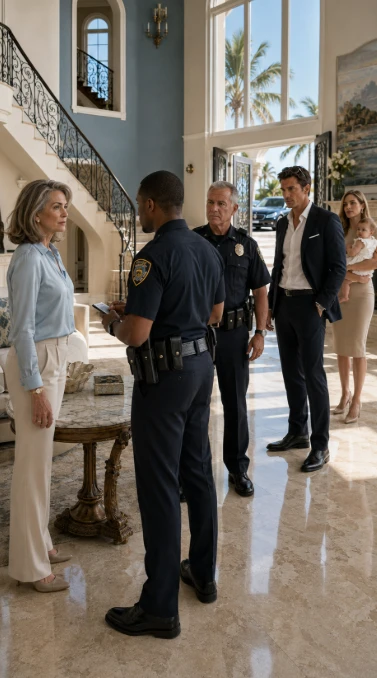
Twenty minutes later, two police cruisers entered the gate.
The younger officer introduced himself as Officer Marcus Bell. His partner, Sergeant Daniel Ruiz, remained several steps behind, studying everyone in the room.
Preston rushed toward them before Evelyn could speak.
“Thank God,” he said. “My mother is confused. She’s recently divorced, she’s isolated, and she’s refusing to let her own family stay in the family home.”
Sergeant Ruiz glanced around the foyer.
“Who owns the property?”
“My mother purchased it impulsively,” Preston said. “We’re trying to help manage things.”
Officer Bell turned to Evelyn.
“Ma’am, are you Evelyn Hale?”
“I am.”
“Do you own this house?”
“Yes.”
“Is anyone here threatening you?”
Evelyn looked directly at Preston.
“My son entered without permission and announced that he and his family were moving in.”
“That’s not what happened,” Preston said.
“You told me I would live in the guesthouse.”
“I suggested an arrangement.”
“You placed your keys on my table.”
Preston gave the officers a strained smile.
“You see what I mean? She’s making ordinary things sound sinister.”
Sergeant Ruiz stepped closer.
“Sir, helping someone manage their affairs is not the same as moving into their home without permission.”
“I’m her only child.”
“That does not make this your property.”
Preston’s jaw tightened.
“She isn’t thinking clearly.”
Evelyn felt the old fear again.
Then a sleek black sedan glided through the gate.
The car stopped beneath the portico.
The rear door opened, and Naomi Reed stepped out wearing a charcoal suit and carrying a thick leather folder.
The color drained from Preston’s face.
“Who is that?” he whispered.
Evelyn looked into her son’s eyes.
For the first time that morning, her hands stopped trembling.
“My attorney.”
Naomi entered the villa with the calm, measured stride of someone who never wasted motion.
She was fifty-two, with a sleek dark bob and the kind of expression that made people reconsider careless statements.
“Good morning, Evelyn,” she said.
“Thank you for coming.”
Naomi nodded to the officers and then looked at Preston.
“Mr. Hale.”
Preston attempted a smile.
“I don’t believe we’ve met.”
“No,” Naomi said. “But I have read your petition.”
The room became still.
Evelyn turned toward her.
“What petition?”
Naomi’s eyes remained on Preston.
“The emergency guardianship petition your son filed yesterday afternoon.”
Kendra inhaled sharply.
Preston’s face tightened.
“I was advised to protect my mother.”
Naomi opened the leather folder.
“You alleged that Evelyn suffers from severe cognitive decline, is incapable of managing money, and is vulnerable to manipulation by strangers.”
Officer Bell looked at Evelyn, then back at Preston.
Naomi continued.
“You requested immediate control of her bank accounts, authority over her medical decisions, and temporary possession of this property pending evaluation.”
Evelyn felt as though the floor had tilted.
“You filed what?”
Preston raised both hands.
“Mom, listen to me.”
“You asked a court to give you my house?”
“I asked the court to protect you.”
“From whom?”
“From people like her.”
He pointed at Naomi.
Naomi’s expression did not change.
“You also listed the villa as a marital-family asset, despite the deed showing Evelyn as the sole owner.”
“That can be corrected.”
“You listed its estimated value at two million dollars below its purchase price.”
Preston said nothing.
“You requested authority to sell it if necessary for your mother’s care.”
Kendra moved away from him.
“Preston,” she whispered. “You said the papers were just preliminary.”
He turned on her.
“Not now.”
Sergeant Ruiz stepped between them.
Naomi handed him a document.
“This is a formal notice that Mr. Preston Hale has no permission to remain on the property. Evelyn would like him removed.”
Preston stared at his mother.
“You’re throwing your son out?”
“I am asking you to leave my home.”
“After everything I’ve done for you?”
Evelyn searched his face.
“What have you done for me, Preston?”
He opened his mouth.
No answer came.
Kendra shifted Lila against her shoulder.
The baby began to whimper.
Preston’s gaze moved from Evelyn to Naomi and then to the officers.
“This isn’t over.”
Naomi closed the folder.
“You are correct about that.”
The officers escorted Preston, Kendra, and Lila outside.
At the SUV, Preston turned back.
“You’re making a terrible mistake, Mom.”
Evelyn stood beneath the villa’s archway.
“No,” she said. “I made it years ago.”
His expression sharpened.
“What is that supposed to mean?”
“It means I confused giving you everything with teaching you gratitude.”
Preston climbed into the SUV and slammed the door.
The vehicle disappeared through the gate.
Evelyn remained standing until the sound of the engine faded.
Then her knees weakened.
Naomi caught her elbow.
“Sit down.”
Evelyn lowered herself onto the nearest chair.
“He tried to have me declared incompetent.”
“Yes.”
“My own son.”
Naomi knelt in front of her.
“We are going to fight it.”
Evelyn stared at the open doorway.
“Why would he do this?”
Naomi hesitated.
“That is what we need to discuss.”
They moved into the library. Naomi placed the leather folder on the desk and removed a stack of documents.
The guardianship petition was only the beginning.
Preston had included a letter from a physician claiming Evelyn showed signs of dementia. Naomi had already contacted the physician’s office.
The doctor had never examined Evelyn.
The signature appeared to have been copied from an old insurance form.
There was also a draft power-of-attorney document, a proposed property-management agreement, and an email from a luxury real-estate agent confirming a private valuation appointment for Monday morning.
Evelyn stared at the email.
“He planned to sell the villa.”
“It appears so.”
“But he only learned about it yesterday.”
Naomi folded her hands.
“Which means he was already preparing to take control of your assets before he knew what those assets were.”
A chill moved through Evelyn.
“Malcolm.”
Naomi nodded.
“Your ex-husband’s name does not appear on the petition, but several documents were created on a computer registered to Hale Meridian Holdings.”
Preston’s company.
Malcolm had founded Hale Meridian as a marine-equipment distributor. Preston joined after college and eventually became chief operating officer.
For years, Malcolm had praised Preston as the future of the family.
Evelyn had never worked at the company, but she had attended dinners, hosted clients, and smiled through speeches about legacy.
“What aren’t you telling me?” Evelyn asked.
Naomi took a slow breath.
“Hale Meridian is in serious financial trouble.”
“How serious?”
“They owe several lenders more than four million dollars. One loan comes due Monday.”
Evelyn looked toward the courtyard.
“So Preston needs money.”
“He needs collateral, cash, or control over an asset he can liquidate.”
“And he thought my house would save him.”
Naomi’s silence answered.
Evelyn pressed a hand against her mouth.
Not because of the villa.
Because she remembered Preston at six years old, asleep against her shoulder during a thunderstorm.
She remembered him at eleven, crying after his first baseball team cut him.
She remembered sitting in a hospital hallway when he had his appendix removed, praying with such desperation that she promised God she would trade every possession she owned for his safety.
How did a child who once held her hand in the dark become a man willing to erase her in court?
Naomi reached across the desk.
“Evelyn, there’s something else.”
“No more today.”
“You need to know.”
Evelyn closed her eyes.
Naomi slid a photograph across the desk.
It showed Malcolm leaving the county courthouse the previous afternoon.
Preston walked beside him.
“They filed the petition together,” Naomi said.
Evelyn opened her eyes.
“He told our friends I had become unstable during the divorce.”
“He may have been building this narrative for months.”
“Years,” Evelyn whispered. “He was building it for years.”
That evening, the villa felt different.
Every empty room seemed to contain an echo.
Evelyn checked the doors twice. She activated the gate’s security system and closed the curtains before sunset.
At nine thirty, headlights appeared outside.
Evelyn’s heart lurched.
She called Naomi before approaching the front door.
The security camera showed Kendra standing beneath the portico with Lila in her arms.
She was alone.
Evelyn opened the door but kept the chain fastened.
“What are you doing here?”
Kendra’s mascara had smudged beneath her eyes.
“Please let me in.”
“Where is Preston?”
“At his father’s house.”
“Does he know you’re here?”
“No.”
Evelyn studied her.
“I don’t know whether I believe you.”
“You shouldn’t,” Kendra said. “Not yet.”
Lila stirred against her shoulder.
Kendra’s voice broke.
“But I have something you need to hear.”
Evelyn called Naomi again. Twenty minutes later, the attorney returned.
Only then did Evelyn allow Kendra inside.
They sat at the kitchen table. Kendra placed her phone between them.
For several moments, she could not speak.
Then she looked at Evelyn.
“I owe you an apology.”
“That is not why you came.”
“No.”
Kendra wiped her face.
“I knew Preston was worried about money. I knew the company was struggling. But he told me it was temporary.”
“When did you learn about the guardianship?”
“Thursday night, after we left your apartment.”
Evelyn stiffened.
Kendra looked down.
“The things I said there were cruel.”
“Yes.”
“I was angry because Preston had told me you refused to help us. He said you had wasted your settlement and expected him to support you.”
“I never asked him for money.”
“I know that now.”
Kendra unlocked her phone.
“After we left, Preston kept talking about how you had nothing. He sounded relieved.”
“Relieved?”
“As though your apartment confirmed something.”
She selected an audio file.
“I woke up after midnight and heard him speaking to Malcolm in the office.”
Kendra pressed play.
Preston’s recorded voice filled the kitchen.
“She looks broke. The apartment is worse than I expected.”
Malcolm answered.
“That doesn’t mean she has nothing.”
“If she had money, she wouldn’t live there.”
“You don’t know your mother.”
Then Preston said, “The guardianship is still the safest route.”
Evelyn’s fingers went cold.
The recording continued.
Malcolm’s voice was low.
“We need access before Monday. Once the lender moves, we lose the company, the lake house, everything.”
“What if she fights?”
“She won’t. Your mother folds when the family applies pressure.”
Evelyn looked away.
On the recording, Preston laughed.
“And if she doesn’t?”
Malcolm answered without hesitation.
“Then we make sure the court believes she can’t make decisions.”
Kendra stopped the audio.
Silence filled the kitchen.
Naomi’s expression was unreadable.
“Is there more?” she asked.
Kendra nodded.
“Much more.”
She opened photographs of documents from Preston’s home office.
There were loan statements, draft affidavits, and photocopies of Evelyn’s old medical records.
Then Kendra showed them a credit report under Lila’s name.
Naomi leaned closer.
“What is this?”
“I found it in Preston’s desk.”
The report listed three accounts associated with Lila’s Social Security number.
The baby was eight months old.
Evelyn looked at Kendra.
“He used your daughter’s identity?”
Kendra’s face collapsed.
“He opened credit lines under her name. He forged my signature on the forms.”
Her hands shook.
“I confronted him this afternoon after we left. He said everyone in the family had to make sacrifices.”
Evelyn looked toward Lila, asleep in a portable carrier beside the table.
“A baby cannot make a sacrifice.”
“I know.”
“What did you say?”
“I told him I was leaving.”
“And?”
“He took my car keys and said I was confused.”
The same word.
The same method.
Naomi sat back.
“He intended to do to you what he is doing to Evelyn.”
Kendra gave a broken laugh.
“I thought I was different.”
Evelyn watched her carefully.
“Why did you act as though you wanted my house?”
Kendra’s eyes filled.
“Because Preston told me about the plan while we were driving here. He said we needed to present a united front. I was afraid if I challenged him, he would take Lila and leave.”
“You told me the house would be wonderful for the baby.”
“I was trying to keep him calm.”
“That does not erase what you did.”
“I know.”
Kendra’s voice dropped to a whisper.
“I am not asking you to forgive me.”
She pushed the phone toward Naomi.
“I’m asking you to stop him.”
Over the next three days, the villa became a command center.
Naomi contacted a forensic accountant, a digital-security specialist, and a criminal attorney for Kendra. Evelyn completed an independent medical evaluation proving she showed no signs of cognitive impairment.
Kendra provided access to Preston’s shared cloud storage.
What they found was worse than anyone expected.
Preston and Malcolm had created a plan called Project Harbor.
The plan had three stages.
First, establish a public narrative that Evelyn was emotionally unstable after the divorce.
Second, obtain emergency guardianship and control her accounts.
Third, use her assets as collateral to delay Hale Meridian’s collapse.
The villa had not created the plan.
It had merely accelerated it.
There were emails between Preston and Malcolm discussing Evelyn’s isolation.
One message from Malcolm read:
She has lost most of her social circle. That works in our favor.
Another from Preston said:
Kendra can testify that Mom forgets conversations.
Kendra had never agreed to that.
There were draft statements in her name anyway.
Naomi printed every page.
The guardianship hearing was scheduled for Tuesday morning.
Until then, Preston remained silent.
Malcolm did not.
He called Evelyn seven times.
She answered the eighth.
“Withdraw your opposition,” he said.
No greeting.
No concern.
Just an order.
Evelyn stood in the villa’s courtyard beneath the lemon trees.
“You forged a doctor’s letter.”
“I had nothing to do with that.”
“You planned this with Preston.”
“Our son is trying to prevent a disaster.”
“His disaster.”
“The company supports sixty-two families.”
“And stealing my home saves them?”
“It buys time.”
“You kept the lake house.”
“The lake house is mortgaged.”
“You kept the boat.”
“The boat is collateral.”
“You kept everything you insisted mattered.”
Malcolm’s voice hardened.
“This is not about old arguments.”
“No,” Evelyn said. “It is about an old pattern.”
“What pattern?”
“You take. Then you explain why the person you took from should be grateful.”
“You are being dramatic.”
Evelyn smiled sadly.
Malcolm had taught Preston well.
“You should think about Lila,” Malcolm said.
The threat was gentle enough to sound like advice.
Evelyn’s hand tightened around the phone.
“What about her?”
“If Kendra destroys Preston in court, the child will grow up without a stable father.”
“A dishonest father is not stability.”
“You always did enjoy making moral judgments from the sidelines.”
“I spent thirty-four years standing beside you.”
“Then stand beside your family now.”
Evelyn looked through the open doors toward the pale-blue wall.
“I am.”
She ended the call.
The courthouse stood beneath a cloudless sky.
Preston arrived wearing a charcoal suit and the expression of a grieving son. Malcolm walked beside him, silver-haired and immaculate.
Reporters were not present. Guardianship hearings were usually quiet affairs.
Still, Preston paused outside the courtroom and placed a hand on Evelyn’s shoulder.
She stepped away before he could touch her.
“Mom,” he said softly, “we can still resolve this privately.”
Naomi stood at Evelyn’s side.
“Speak through counsel.”
Preston ignored her.
“I don’t want strangers deciding what happens to you.”
“You asked strangers to take away my rights.”
“I asked them to protect you.”
“From ownership?”
His jaw tightened.
“From impulsive decisions.”
Evelyn moved past him.
Inside the courtroom, Judge Miriam Cho reviewed the filings.
Preston’s attorney described Evelyn as vulnerable, isolated, and manipulated by Naomi.
He referenced her sudden home purchase, the rapid sale of inherited assets, and her “abrupt estrangement” from her family.
Then Malcolm testified.
He spoke gently.
That was his greatest talent.
He described Evelyn forgetting appointments, becoming suspicious, and making emotional financial decisions.
“After thirty-four years of marriage,” he said, “I recognize when she is not herself.”
Evelyn listened without reacting.
Every lie was built from something small and real.
She had forgotten a dental appointment once.
She had become suspicious after discovering Malcolm had hidden financial statements.
She had made an emotional decision when she painted a wall blue.
Under questioning, Malcolm claimed he wanted nothing from Evelyn.
Naomi rose.
“Mr. Hale, does Hale Meridian Holdings owe approximately four point three million dollars?”
Malcolm’s attorney objected.
The judge allowed the question.
Malcolm’s face remained composed.
“The company has ordinary business obligations.”
“Does a payment of one point eight million dollars come due next Monday?”
“I don’t recall the exact figure.”
Naomi placed a document on the screen.
“Is this your signature?”
Malcolm glanced at it.
“Yes.”
“The payment amount appears directly above your signature.”
“I sign many documents.”
“Do you own the lake house where you currently reside?”
“Yes.”
“Is it pledged as collateral?”
Malcolm hesitated.
“Yes.”
“The boat?”
“Yes.”
“Your company shares?”
“Yes.”
“So when you said you wanted nothing from Evelyn, you meant you wanted nothing except access to an unencumbered villa worth several million dollars.”
Malcolm’s composure cracked.
“That is a distortion.”
Naomi displayed the Project Harbor emails.
Then she played Kendra’s recording.
The courtroom heard Malcolm’s voice:
Your mother folds when the family applies pressure.
Preston stared straight ahead.
Malcolm looked toward him with fury.
The doctor’s letter was introduced next.
A representative from the physician’s office testified that Evelyn had never been examined there.
The signature was fraudulent.
Preston’s attorney requested a recess.
Judge Cho denied it.
Then Preston produced his final weapon.
His attorney placed a document before the court.
A durable power of attorney signed by Evelyn twelve years earlier.
Evelyn recognized it.
She had signed it before surgery to remove a benign tumor.
The document granted Preston broad authority over her finances if she became incapacitated.
“It has never been revoked,” Preston’s attorney said.
Naomi leaned toward Evelyn.
“Did you know he still had this?”
“No.”
The attorney continued.
“The guardianship petition was not an attempt to seize control but to formalize authority Mrs. Hale herself granted her son.”
For the first time that morning, Judge Cho appeared uncertain.
“Ms. Reed?”
Naomi stood.
“The document requires medical certification of incapacity.”
“Which was supplied.”
“With a forged letter,” Naomi said.
“But the underlying authority remains relevant.”
Preston looked at Evelyn.
A faint smile touched his mouth.
He believed he had won.
Judge Cho called a thirty-minute recess.
In the hallway, Malcolm approached Evelyn.
Naomi moved to block him, but Evelyn raised one hand.
“Let him speak.”
Malcolm waited until they were alone near a window.
“This can end today,” he said.
“How?”
“Allow Preston temporary authority. We stabilize the company, repay the lender, and return control.”
“You expect me to trust you?”
“I expect you to understand consequences.”
“What consequences?”
“If Hale Meridian collapses, employees lose jobs. Preston loses his career. Kendra leaves him. Lila grows up inside a scandal.”
“You created the scandal.”
“We created a company.”
“You built it on debt.”
“We built your life too.”
Evelyn looked at him.
“You truly believe that.”
“I gave you everything.”
“You gave me rooms in which I needed permission to breathe.”
His expression hardened.
“You would destroy your son to prove a point?”
“No.”
She stepped closer.
“I would allow my son to face the consequences you taught him he could always avoid.”
Malcolm lowered his voice.
“You don’t know everything.”
“Then tell me.”
“The lender is not negotiating.”
“Why?”
“They want the company.”
“Who?”
Malcolm looked away.
“A private holding group.”
“What group?”
Before he could answer, Naomi emerged from the courtroom.
“We are resuming.”
Kendra had not appeared.
Her attorney could not reach her.
Preston noticed.
His confidence returned.
Without Kendra’s live testimony, the recordings could be challenged. His attorney argued they lacked context and suggested Kendra had been manipulated by Evelyn.
Then the courtroom doors opened.
Kendra entered carrying Lila.
Two federal investigators followed her.
Preston stood.
“What are you doing?”
Kendra did not look at him.
She handed Lila to Evelyn.
It was the first time Evelyn had held her granddaughter since the confrontation at the villa.
Lila rested her head against Evelyn’s shoulder.
Kendra walked to the witness stand.
Under oath, she described the forged credit accounts, the guardianship plan, and the threats Preston made when she tried to leave.
Preston shook his head continuously.
“She’s lying.”
Judge Cho ordered him to remain silent.
Kendra produced the original phone containing the recordings.
A digital examiner confirmed their authenticity.
Then she revealed the final file.
It was a video recorded in Preston’s office two nights earlier.
On the screen, Preston stood beside Malcolm.
Documents covered the desk.
Preston said, “Once the court gives me control, we borrow against the villa.”
Malcolm replied, “Only enough to delay the lender.”
“And after that?”
“We sell the house.”
“What happens to Mom?”
A pause.
Then Malcolm said, “The guesthouse is more than she deserves.”
Evelyn felt Lila breathing against her neck.
Preston stared at the floor.
Judge Cho dismissed the guardianship petition immediately.
She referred the forged documents and identity-theft evidence to prosecutors.
The federal investigators approached Preston.
He stepped backward.
“This is a family matter.”
One investigator removed a pair of handcuffs.
“Identity theft and bank fraud are federal matters.”
Preston looked toward Evelyn.
“Mom.”
It was not an apology.
It was an appeal to instinct.
He expected the woman who had always rushed forward when he was hurt.
Evelyn held Lila tighter.
“Tell them this is a misunderstanding,” he said.
She said nothing.
“Mom, please.”
The handcuffs closed around his wrists.
Malcolm attempted to leave through a side door.
The second investigator stopped him.
“You need to remain available for questioning.”
For the first time in Evelyn’s memory, Malcolm looked old.
Not distinguished.
Not commanding.
Old.
Outside the courthouse, Kendra broke down.
Evelyn stood with Lila while Naomi spoke to the investigators.
“I’m sorry,” Kendra whispered.
Evelyn looked at her.
“For which part?”
“All of it.”
“You believed Preston when he said I was selfish.”
“Yes.”
“You came into my home prepared to take it.”
Kendra wiped her face.
“Yes.”
“You insulted me when you thought I had nothing.”
“Yes.”
Evelyn appreciated that she did not offer excuses.
“Forgiveness is not the same as trust,” Evelyn said.
“I know.”
“Trust may take years.”
“I know.”
“But Lila needs somewhere safe tonight.”
Kendra looked up.
Evelyn handed the baby back to her.
“You may stay in the guesthouse temporarily.”
Kendra began to cry again.
“The main house is not yours,” Evelyn added.
“I understand.”
“And neither is the guesthouse.”
“I understand.”
“You will contribute to expenses when you can. You will attend counseling. You will cooperate fully with the investigation.”
“I will.”
Evelyn held her gaze.
“And you will never again use your child as a key to another person’s door.”
Kendra nodded.
“I promise.”
Naomi joined them.
“There’s one more matter.”
Evelyn noticed the leather folder beneath her arm.
The same folder Naomi had carried into the villa.
“I have had enough matters,” Evelyn said.
“This one changes everything.”
They returned to the villa after sunset.
Kendra settled Lila in the guesthouse while Evelyn and Naomi sat in the library.
Naomi placed three documents on the desk.
The first was a loan agreement between Hale Meridian and Gulf Atlantic Bank.
The second was a notice of default.
The third was an assignment of debt to a company called Rose Bay Holdings.
Evelyn looked at Naomi.
“I know these documents.”
“Yes.”
Months earlier, while Evelyn was selling her inherited commercial properties, Naomi had discovered that Gulf Atlantic Bank intended to sell several distressed business loans as part of a larger restructuring.
One of those loans belonged to Hale Meridian.
At the time, Evelyn had not known Preston and Malcolm were planning to target her.
She had known only that their company was failing and that sixty-two employees could lose their jobs.
Naomi had presented her with a choice.
Evelyn could walk away.
Or she could use part of her inheritance proceeds to purchase Hale Meridian’s debt at a steep discount through a private holding company.
Evelyn had chosen the second option.
She had told herself she was protecting the employees.
Perhaps, secretly, she had also been protecting Preston.
She believed that if the company stabilized, she might eventually restructure the loan and give her son a chance to rebuild responsibly.
Malcolm and Preston had never learned the identity of the private creditor.
They knew only the name.
Rose Bay Holdings.
Naomi pushed the final document toward Evelyn.
“Gulf Atlantic completed the assignment this morning.”
Evelyn stared at it.
“What does that mean?”
“It means Rose Bay Holdings now owns the senior debt secured by Hale Meridian’s company shares, the lake house, Malcolm’s boat, and several investment accounts.”
Evelyn slowly raised her eyes.
Naomi smiled.
“Preston tried to steal your villa to pay a debt he already owed to you.”
The words settled over the room.
Evelyn looked toward the pale-blue wall.
All day, Preston and Malcolm had behaved as though the villa were the only piece on the board.
They had never understood that Evelyn owned the board.
“The lender Malcolm feared,” she whispered.
“You.”
“The private holding group?”
“You.”
“The company?”
“Not yet,” Naomi said. “But because the loan is in default, you have the right to take control of the pledged shares.”
Evelyn stood and walked toward the window.
Outside, the courtyard fountain shone beneath the moonlight.
“What happens to the employees?”
“That depends on what you decide.”
“And Malcolm?”
“The lake house and boat can be sold to satisfy part of the debt.”
“Preston?”
“His company shares are pledged.”
Evelyn thought of him placing his keys on her marble table.
He had entered her home believing he could move her into a guesthouse.
By doing so, he had forced Evelyn to see what mercy without accountability had created.
Naomi opened another folder.
“I prepared several options.”
Evelyn read them until midnight.
She did not seize Hale Meridian for revenge.
She took control to prevent Malcolm’s remaining executives from stripping it apart.
She installed an independent management team and ordered a complete audit. The company’s profitable divisions were preserved. Wasteful contracts connected to Malcolm’s friends were terminated.
A portion of the company was placed into an employee-ownership trust.
Another portion funded restitution for victims of Preston’s fraud, including the accounts opened in Lila’s name.
The lake house was sold.
So was the boat.
Malcolm moved into a two-bedroom condominium outside Tampa.
Several country-club friends stopped returning his calls.
Preston was charged with identity theft, bank fraud, forgery, attempted exploitation of a vulnerable adult, and conspiracy.
Malcolm avoided immediate arrest but became the subject of an expanding financial investigation.
Three months later, Evelyn visited Preston at the county detention center.
He entered the visitation room wearing a gray uniform.
Without the suit, watch, and polished shoes, he looked younger.
For one painful moment, Evelyn saw the boy who had once feared thunderstorms.
Then he sat down and said, “You took the company.”
Not hello.
Not I am sorry.
“You tried to take my legal identity,” she replied.
“I was trying to save what Dad built.”
“You used your daughter’s identity.”
His face tightened.
“That was temporary.”
“She was eight months old.”
“I would have fixed it.”
“After when?”
He looked away.
Evelyn studied him through the glass.
“Did you ever intend to let me keep the villa?”
Silence.
“Preston?”
“We needed liquidity.”
“That is not an answer.”
“The house was too large for you.”
Even now.
Even here.
He believed her home required his approval.
Evelyn leaned toward the glass.
“You did not lose your freedom because I bought a villa.”
He looked at her.
“You lost it because every time someone said no, you treated the word as an obstacle instead of an answer.”
His eyes filled, though he tried to hide it.
“Do you hate me?”
“No.”
The answer surprised him.
Evelyn’s voice softened.
“You are my son. I love you.”
“Then help me.”
“Love is not the removal of consequences.”
His face hardened again.
“So you’re leaving me here?”
“I am leaving your choices with you.”
She stood.
“Mom.”
Evelyn paused.
He placed one hand against the glass.
For an instant, she almost lifted hers.
Then she remembered Lila’s stolen identity, the forged medical letter, the guesthouse Malcolm had said was more than she deserved.
She let her hand remain at her side.
“I hope you become someone Lila can know safely,” she said.
Then she walked away.
Kendra remained in the guesthouse for eleven months.
She found work with a nonprofit credit-counseling organization and attended therapy. She paid rent after her first paycheck, even though Evelyn had not yet asked.
Trust returned slowly.
Not in dramatic declarations.
In small things.
Kendra replaced groceries without being reminded.
She left notes when taking Lila to appointments.
She apologized without demanding immediate absolution.
On Lila’s first birthday, Evelyn gave her a wooden box containing a single brass key.
It opened nothing.
Not yet.
Inside the box was a letter.
A home is never proof of your worth. It is a place where your worth should be protected.
When Lila was old enough, Evelyn planned to explain everything.
The villa changed too.
The guesthouse eventually became Evelyn’s art studio after Kendra moved into a modest apartment nearby.
Evelyn painted the door blue.
The main house remained hers, but she opened two rooms to women rebuilding their lives after financial abuse. Naomi helped establish a foundation called Rose House, named after Evelyn’s grandmother.
Women arrived carrying suitcases, court documents, and expressions Evelyn recognized.
Some had been told they were incapable of handling money.
Some had been convinced that love required surrendering every account, password, and decision.
Evelyn never told them what to do.
She helped them remember that they were allowed to choose.
One year after the courthouse hearing, Rose House held its opening reception.
Sunlight filled the villa. Music drifted through the courtyard. Employees from Hale Meridian attended, including several who now owned shares in the company.
Kendra arrived with Lila, who ran unsteadily toward Evelyn.
Near the marble side table, Naomi raised a glass.
“To Evelyn,” she said, “who discovered that starting over is not the same as beginning with nothing.”
Guests applauded.
Evelyn looked around the room.
At the arched windows.
At the lemon trees.
At the pale-blue wall.
Then Celeste, the neighbor who had posted the housewarming photographs, approached with an embarrassed smile.
“There’s something I should confess,” she said.
Evelyn lifted an eyebrow.
“What?”
“The photograph of the villa.”
“Yes?”
“I didn’t post it accidentally.”
Evelyn stared at her.
Celeste glanced toward Naomi.
“Naomi asked me to.”
The room seemed to narrow.
Evelyn turned.
Naomi set down her glass.
“You knew Preston was preparing the guardianship petition,” Evelyn said.
“I suspected it.”
“When?”
“Before the housewarming.”
“How?”
Naomi reached into her bag and removed a faded envelope.
On the front, in Rose Bellamy’s handwriting, were the words:
For Evelyn, when someone tries to take what is hers.
Evelyn’s breath caught.
Naomi explained.
Years earlier, Rose had hired Naomi’s father, an attorney, to structure the commercial properties. Rose worried that Malcolm would eventually try to control them.
She left instructions that if anyone challenged Evelyn’s ownership or competence, the attorney handling the properties should open a sealed archive.
Inside were records Rose had gathered over decades.
Bank statements.
Letters.
Copies of early Hale Meridian incorporation documents.
And one final secret.
Naomi handed Evelyn an original share certificate.
It showed that Rose Bellamy had been the first private investor in Hale Meridian.
Malcolm had never built the company alone.
Rose had supplied the money that allowed him to begin.
In exchange, she received a silent ownership stake.
Malcolm later claimed the shares had been repurchased.
They had not.
The certificate had remained valid inside Rose’s trust.
Naomi’s voice became quiet.
“Your grandmother’s stake passed to you when she died.”
Evelyn stared at the document.
“How much?”
“Thirty-one percent.”
The room fell silent.
Combined with the defaulted shares securing the debt, Evelyn had not merely taken control of Hale Meridian after Preston’s arrest.
She had owned a decisive portion of the company all along.
Malcolm’s speeches about legacy, sacrifice, and everything he had built had rested on money supplied by the woman he dismissed as Evelyn’s stubborn old grandmother.
Preston had tried to steal Evelyn’s home to save a company that was partly hers before he was born.
Evelyn sank into a chair.
“Why didn’t Rose tell me?”
Naomi unfolded the letter.
“Because she wanted you to choose your life without knowing how much power you had.”
She handed it to Evelyn.
Rose’s handwriting slanted firmly across the page.
My dearest Evelyn,
Power reveals less about the person who has it than the person who believes you do not.
There may come a day when someone mistakes your gentleness for helplessness. Do not rush to correct them. Let them show you who they are.
Then remember who you are.
The shares are yours. The buildings are yours. The choice is yours.
But the most important thing I leave you is not property.
It is permission.
You do not need anyone’s permission to protect your life.
Evelyn read the final lines twice.
When she looked up, her eyes were wet.
“You used the photograph as bait,” she said to Naomi.
Naomi nodded.
“I believed Preston would reveal his intentions if he thought a valuable asset had suddenly appeared.”
“And you did not warn me.”
“I warned you to have security active and asked whether I should attend the housewarming.”
“That is not the same.”
“No,” Naomi admitted. “It is not.”
Evelyn stood.
For a tense moment, no one spoke.
Then Evelyn looked toward Celeste.
“And you agreed to this?”
Celeste swallowed.
“I thought we were protecting you.”
“By testing me?”
“By exposing him.”
Evelyn turned back to Naomi.
“You should have trusted me with the truth.”
“Yes.”
“I am not a piece on anyone’s board.”
“No.”
“Not Malcolm’s. Not Preston’s. Not Rose’s. Not yours.”
Naomi lowered her eyes.
“You’re right.”
The guests watched silently.
Then Evelyn folded Rose’s letter.
“I forgive the intention,” she said. “I do not approve of the method.”
Naomi nodded.
“That is fair.”
Evelyn looked around the villa.
A year earlier, she might have softened her words to protect everyone else from discomfort.
Now she allowed the silence to remain.
It belonged to her too.
Lila tugged at Evelyn’s cream trousers.
“Blue,” the little girl said, pointing toward the wall.
Evelyn lifted her into her arms.
“Yes,” she said. “Blue.”
Kendra approached.
“Why did you choose that color?”
Evelyn looked at the wall Malcolm once would have ordered her to repaint.
Then she looked at the share certificate, Rose’s letter, and the home Preston had believed he could claim simply by entering it.
“Because I liked it.”
Kendra smiled.
“That’s all?”
Evelyn kissed Lila’s forehead.
“That is everything.”
Outside, sunlight moved across the courtyard. The lemon trees stirred in the warm breeze, and the fountain continued its patient song.
On the marble side table lay a single set of keys.
Not Preston’s.
Not Malcolm’s.
Evelyn’s.
She picked them up, felt their weight in her palm, and walked toward the open doors of the life she had chosen.
For thirty-four years, other people had told Evelyn Hale what she owned, what she deserved, what she remembered, and who she was allowed to become.
They had believed her silence meant surrender.
They had believed her kindness meant weakness.
They had believed an aging divorced woman in a tiny apartment had nothing left.
They never understood that Evelyn had not lost her life.
She had been quietly taking it back.