
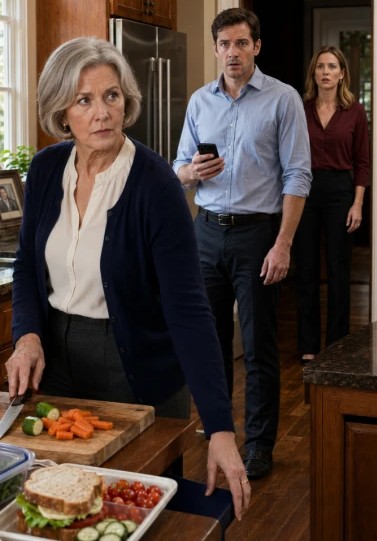
The moment Ashley told me to leave my own house, the lasagna was still cooling on the counter.
The cheese had bubbled over the edge of the blue ceramic dish, leaving a crisp golden line along one side. The smell of basil and roasted tomatoes filled the kitchen, mingling with the faint sweetness of the roses drifting through the open window.
It was David’s favorite meal.
I had made it the same way since he was eight years old—extra basil, browned edges, and the tomato sauce my late husband, Tom, once claimed was good enough to make a man propose twice.
But that evening, my son did not touch it.
He did not even look at me.
“David and I need this house now,” Ashley said.
My daughter-in-law stood in the center of my kitchen with her arms folded tightly across her burgundy blouse. She had positioned herself between the island and the doorway, as if she were already directing movers.
“It’s time for you to find somewhere else to live.”
For several seconds, I heard nothing except the hum of the refrigerator and the tiny crackle of cheese cooling in the dish.
“I’m sorry?” I asked.
Ashley sighed.
It was not the sigh of someone uncomfortable with delivering painful news. It was the sigh of someone frustrated that I had forced her to repeat an obvious instruction.
“We want to start a family,” she said. “We can’t do that while you’re constantly hovering over us.”
Hovering.
I looked around the kitchen.
The curtains Ashley had chosen hung above the sink, replacing the yellow ones Tom and I had bought on our twenty-fifth anniversary. The dishes had been moved from the cabinet near the stove to one across the room because Ashley thought my arrangement was “inefficient.” Three decorative jars I had never purchased sat beside the coffee maker.
I had spent three years shrinking inside my own home so they could feel comfortable.
Apparently, I had not shrunk enough.
“There are plenty of rooms for rent around town,” Ashley continued. “You won’t need much space.”
Rooms for rent.
She wanted me to rent a bedroom somewhere while she remained inside the house where my son had taken his first steps.
The house where Tom had repaired every window by hand.
The house where we had measured David’s height against the pantry door every birthday until he turned sixteen and asked us to stop.
The house where Tom’s coat had hung for three months after his funeral because I could not bear to move it.
The house where his roses still returned every spring.
I slowly reached behind my back and untied my apron.
“I didn’t realize I was making you uncomfortable,” I said. “Perhaps we could discuss some boundaries.”
“No,” Ashley interrupted. “We’ve already discussed it.”
“Discussed it with whom?”
She glanced toward my son.
“With each other.”
I turned to David.
He stood near the dining-room doorway, wearing the pale blue shirt I had given him for his birthday. His hands were tucked into his trouser pockets. His shoulders curved forward, making him look younger than thirty-eight.
Three years earlier, he and Ashley had come to me with anxious smiles and rehearsed humility.
Their rent had increased. David had changed jobs. Ashley said they needed twelve months to save for a home of their own.
I had welcomed them without hesitation.
I cleared the guest room.
I emptied half the hall closet.
I moved Tom’s books into boxes so Ashley could have space for exercise equipment she used twice.
I paid the property taxes, insurance, utilities, repairs, groceries, and most of the household expenses. David contributed occasionally when I reminded him. Ashley called her purchases “improvements,” even when those improvements involved discarding things that belonged to me.
She replaced my curtains.
Rearranged my furniture.
Moved my dishes.
Removed family photographs from the living room because the frames did not suit her color scheme.
Whenever I objected, David gave me the same weary smile.
“She’s only trying to help, Mom.”
Now my only child stood behind his wife while she ordered me out of my home.
I waited for him to speak.
He did not.
“David?” I said.
His eyes finally met mine.
For one breath, I saw shame.
Then he nodded.
Just once.
That tiny movement hurt more than anything Ashley had said.
I had survived Tom’s death.
I had survived the silence that followed, the half-empty bed, the single coffee cup, the unbearable habit of turning to tell him something before remembering he was gone.
But nothing had prepared me for the sight of my son agreeing that I no longer belonged in the home I had built for him.
I looked at both of them for a long moment.
Then I smiled.
“I understand,” I said softly. “I’ll start looking.”
Relief spread across David’s face so quickly that he could not hide it.
Ashley’s shoulders loosened. Her chin lifted. She glanced around the kitchen with the satisfied expression of someone whose renovation had finally been approved.
“Thirty days should be enough,” she said.
“I imagine so.”
“We can help you pack.”
“That won’t be necessary.”
Ashley stepped toward the lasagna.
“Good. I’m glad we handled this like adults.”
She reached for a knife and began cutting into the meal I had prepared for my son.
They believed I had surrendered.
They had no idea I had simply stopped arguing with people who had already shown me exactly who they were.
That night, I went upstairs and locked my bedroom door.
The room still looked mostly as it had when Tom was alive. His photograph rested on the dresser beside a small wooden bowl filled with cuff links, coins, and the silver watch he had worn every day for forty-two years.
I stood before the photograph.
“What did I miss?” I whispered.
Tom smiled back from a summer afternoon fourteen years earlier, his hair silver at the temples, his face sunburned from working in the garden.
I dragged a chair to the closet and climbed carefully onto it.
On the top shelf sat an old jewelry box made of dark walnut. Tom had given it to me during our first Christmas in the house.
Inside were my mother’s brooch, two strings of pearls, several faded photographs, and Tom’s cuff links.
I lifted the velvet lining.
Beneath it lay a folded document sealed inside a plastic sleeve.
The deed.
I carried it to the bed and opened it beneath the lamp.
There, in black ink, was the truth Ashley had failed to investigate.
Margaret Anne Sullivan. Sole owner.
When Tom died, the house passed entirely to me.
My name was on the deed.
My name was on the insurance.
My name was on every tax bill.
I had made every mortgage payment after Tom’s illness forced him to retire. I had paid for the roof, the furnace, the plumbing repair, and the replacement of the cracked foundation wall.
David had occasionally suggested adding his name.
“To make things easier someday,” he always said.
I had considered it.
What mother does not imagine giving everything to her child?
But something had always stopped me.
Perhaps it was instinct.
Perhaps it was Tom’s voice lingering somewhere inside me.
Perhaps some part of me had noticed what love had trained me to excuse.
Holding the deed, I remembered a conversation I had overheard two months earlier.
Ashley had been standing on the back patio with a glass of wine and her phone pressed to her ear.
I had opened the kitchen window to call her in for dinner when I heard her laughing.
“The place is worth nearly eight hundred thousand,” she said. “Maybe more once we open the kitchen.”
I froze behind the curtain.
There was a pause.
“No, David doesn’t want to upset her yet. But once she’s gone, we can change everything.”
At the time, I had told myself she meant after I died.
The thought had wounded me, but I had forced it away.
Now I understood.
They did not merely want privacy. They believed removing me would give them my home.
I slept very little.
At six the next morning, I made coffee, carried it into Tom’s study, and opened the address book I kept in the bottom desk drawer.
Robert Chen answered on the third ring.
“Margaret?”
His voice immediately carried me back twenty years, to the law office where I had worked as a senior paralegal.
Robert had arrived there at twenty-six, brilliant and nervous, with an expensive degree and no idea how to organize a case file. I had taught him how to prepare exhibits, calm frightened clients, and never trust a document merely because it looked official.
He had later become one of the most respected property attorneys in the county.
“I need your help,” I said.
His tone changed.
“What happened?”
“My son and his wife have asked me to leave my house.”
There was a brief silence.
“Whose name is on the deed?”
“Mine.”
“Only yours?”
“Yes.”
“And they are living there under a lease?”
“No.”
“Do they pay rent?”
“Not formally.”
Another silence.
This one was heavier.
“Bring every document you have,” he said. “Come at ten.”
Robert’s office occupied the second floor of a restored brick building downtown. When I arrived, he met me in the reception area and hugged me.
He had more gray in his hair than I remembered, but the same observant eyes.
We sat in his conference room, where I placed the deed, tax records, bank statements, utility bills, and insurance documents across the polished table.
Robert reviewed them slowly.
When he finished, he removed his glasses.
“They’re attempting to remove the legal owner from her own house.”
“I know.”
“You can require them to leave.”
“I know that too.”
“Then tell me what you actually want.”
I looked through the window at people crossing the street below.
“I want everything documented.”
“Why?”
“Because Ashley will lie.”
“And David?”
The question tightened something in my chest.
“I don’t know what David will do.”
Robert leaned back.
“You do know.”
I looked at him.
“You just don’t want to say it yet.”
He was right.
My son had stood behind his wife and nodded.
He had not been confused.
He had not been surprised.
He had known.
“I want them to understand exactly what they tried to take,” I said.
Robert studied me, then nodded.
“We proceed carefully. No threats. No emotional confrontations. Keep copies of everything somewhere outside the house. Record only conversations in which you are legally permitted to participate. Save messages. Save emails. Document expenses and any statements about ownership.”
“I spent thirty-two years working in a law office.”
A faint smile crossed his face.
“I remember. You were terrifying.”
“I was efficient.”
“You were terrifyingly efficient.”
For the first time since the kitchen conversation, I almost laughed.
Then Robert’s expression became serious again.
“There is one more thing. Have they ever asked you to sign financial documents?”
“David has mentioned adding his name to the house.”
“Anything recently?”
I thought back.
Three weeks earlier, Ashley had left a stack of papers near my breakfast plate.
She had said they were forms to lower the homeowner’s insurance premium.
I had not signed them because I wanted to read them first.
Later that day, they disappeared.
I told Robert.
His fingers stopped moving over his legal pad.
“What did the papers look like?”
“Several pages. Yellow tabs. Signature lines.”
“Did you make copies?”
“No.”
“Did you see a title?”
“I remember the words ‘transfer’ and ‘consideration,’ but I didn’t have my glasses.”
Robert’s face hardened.
“Margaret, those may not have been insurance forms.”
A cold sensation moved through me.
“What were they?”
“I don’t know yet.”
He closed the file.
“But from this moment forward, you sign nothing they give you.”
The next morning, I opened my laptop at the kitchen table while Ashley drank coffee across from me.
“I found several apartments,” I said.
Her eyes brightened immediately.
“Already?”
“I thought it best not to delay.”
I turned the screen toward her.
The listings showed small studio apartments, furnished rooms, and senior housing complexes. I had no intention of renting any of them, but Ashley leaned closer with enthusiastic concentration.
“This one is too far from town,” she said. “You don’t want to be dependent on us for rides.”
“I still drive.”
“For now.”
I looked at her.
She smiled as though she had said nothing unusual.
“What about this room?” she asked. “It’s inexpensive.”
The listing showed a narrow upstairs bedroom in an old house on the edge of town. The staircase was steep. The bathroom was shared.
“There’s no kitchen,” I said.
“You don’t cook much anymore.”
The remains of the lasagna sat in the refrigerator.
“I cook almost every day.”
Ashley waved one hand.
“You know what I mean.”
I did.
She wanted me to become smaller in every way—less visible, less independent, easier to dismiss.
“I believe I can move within thirty days,” I said.
Ashley nearly glowed.
Within minutes, she was discussing flooring.
“The wood is too dark,” she said, looking around my kitchen. “A pale oak would make everything feel larger.”
“I see.”
“And this wall should come down.”
“That wall supports the second floor.”
“A contractor can fix that.”
“Have you spoken to one?”
She hesitated for half a second.
“Just casually.”
That afternoon, a contractor arrived to measure the kitchen.
Ashley had not asked permission.
I greeted him politely and asked who had authorized the work.
He looked from me to Ashley.
“Mrs. Sullivan contacted us.”
“I am Mrs. Sullivan.”
Ashley’s face tightened.
“I meant me,” she said. “I’m also Mrs. Sullivan.”
The contractor shifted uncomfortably.
“And who owns the property?” I asked.
Ashley answered before he could.
“We do.”
I held her gaze.
“Do you?”
She stared back.
For one dangerous second, I thought she knew I was testing her.
Then she smiled.
“David and I manage everything now. Margaret is preparing to move.”
I let the silence stretch.
The contractor cleared his throat.
“I’ll need the titled owner’s authorization before beginning structural work.”
“You’ll have it,” Ashley said.
After he left, she turned on me.
“You embarrassed me.”
“I answered his question.”
“You could have supported me.”
“I thought you and David already owned the house.”
Her eyes narrowed.
“Don’t start being difficult now.”
I lowered my gaze, pretending submission.
“Of course not.”
That evening, I wrote down every word.
Over the next week, comfort made Ashley careless.
She told a friend on speakerphone that the house would soon be hers.
She joked that I was “finally moving out.”
She discussed turning my bedroom into a nursery.
She contacted a realtor and asked how quickly a property could be listed after renovations.
She even photographed my jewelry cabinet.
When I entered the room, she claimed she had been checking measurements for storage.
I saved everything.
Screenshots.
Dates.
Times.
Voicemails.
A detailed ledger showing that David and Ashley had contributed less than four percent of the household expenses during their three years in my home.
Meanwhile, Robert worked quietly.
He requested certified ownership records.
He contacted the insurance company.
He reviewed county filings for documents submitted under my name.
On Thursday afternoon, I was slicing cucumbers at the kitchen island when David entered holding his phone.
His face was completely pale.
“Mom,” he said.
I kept cutting.
The knife struck the wooden board with a soft, steady rhythm.
“Mom, I just spoke to the insurance company.”
I stopped.
Behind him, Ashley appeared in the doorway.
Her expression was relaxed until she saw his face.
“They asked me to verify the homeowner’s information,” David continued.
His hand trembled around the phone.
“The house is still in your name.”
I turned slowly.
David looked toward Ashley, then back at me.
“Only your name.”
Ashley’s confident smile vanished.
For the first time, neither of them had anything to say.
I placed the knife flat on the cutting board.
Then I reached beneath the kitchen island and withdrew the thick blue folder Robert had prepared.
David stared at it.
Ashley took one step forward.
“What is that?”
I placed the folder on the counter.
The sound was not loud, but both of them flinched.
“That surprises you?” I asked.
Ashley recovered first.
“No. Of course not. We assumed you would transfer it when you moved.”
“We never discussed a transfer.”
“You said the house would be David’s someday.”
“Someday is not today.”
David lowered his phone.
“Mom, this is getting out of control.”
I opened the folder.
The first document was the certified deed.
The second was a complete record of every mortgage payment, tax payment, insurance premium, and major repair.
The third was a transcript of Ashley telling her friend that she planned to sell the house after I left.
The fourth was a copy of her correspondence with the contractor.
The fifth was a formal notice requiring them to vacate the property.
Ashley read the first page.
Her face hardened.
“You’re evicting us?”
“I am ending your permission to live here.”
“We’re family.”
“Family members do not order the legal owner out of her home.”
David stepped closer.
“Can we please sit down and talk?”
“We tried that.”
“No, Ashley talked. I didn’t.”
I looked directly at him.
“You nodded.”
His mouth closed.
Ashley slapped the notice onto the counter.
“This is ridiculous. David has rights here.”
“What rights?”
“He has invested money in this house.”
I turned to the ledger.
“Six hundred dollars toward the water heater. Three payments toward electricity. One payment to repair the garage door after David backed into it.”
Her cheeks reddened.
“He has maintained the property.”
“He has not mowed the lawn since last summer.”
“We painted the guest room.”
“You painted it without asking.”
“We improved it.”
“You painted over the height marks Tom and I made when David was a child.”
David looked away.
Ashley’s voice sharpened.
“You’re being sentimental and irrational.”
“I expected you to say that.”
I removed another document.
It was a letter from my physician confirming that I was mentally competent, independent, and fully capable of managing my personal and financial affairs.
Ashley’s lips parted.
I watched her reaction carefully.
She was not merely annoyed.
She was frightened.
“Why would you get that?” David asked.
“Because someone recently described me to an insurance representative as confused, forgetful, and unable to understand financial documents.”
Silence fell across the kitchen.
Ashley turned to David.
He stared at me.
I continued.
“The representative documented the call.”
“I never said that,” Ashley replied quickly.
“I did not say it was you.”
Her eyes shifted toward David.
His face remained pale.
Something moved through the room then—something I could not yet name.
Not unity.
Not shared guilt.
Fear.
Separate fear.
David stepped toward me.
“Mom, you don’t understand.”
“Then explain it.”
He opened his mouth.
Ashley interrupted.
“She’s trying to trap us. Don’t say anything.”
I looked at my son.
“Is that what you think?”
He did not answer.
The doorbell rang.
Ashley flinched.
Robert stood outside with a process server.
He entered calmly, carrying a leather briefcase.
“Mr. and Mrs. Sullivan,” he said to David and Ashley, “you are being formally served with notice to vacate.”
Ashley stared at me as the papers were handed to her.
“You planned this.”
“Yes.”
“You let me believe you were leaving.”
“Yes.”
Her face twisted.
“You lied.”
I almost admired the audacity.
“I allowed you to believe what you wanted.”
David looked at Robert.
“How long do we have?”
“Thirty days, provided there are no further violations or evidence of fraud.”
Ashley went still.
“What fraud?”
Robert opened his briefcase.
“The county clerk received an inquiry last month regarding a proposed quitclaim deed transferring this property from Margaret Anne Sullivan to David Michael Sullivan.”
My heart began to pound.
This was new.
Robert had not told me yet.
He placed a photocopy on the island.
My name appeared at the bottom.
The signature looked almost like mine.
Almost.
Someone had forged my signature.
David stared at the page.
Ashley’s face emptied of color.
Robert continued.
“The document was not recorded because the notarial information was incomplete. However, the clerk retained a scanned copy of the inquiry.”
“I’ve never seen that,” Ashley said.
David said nothing.
I looked between them.
“Who prepared it?”
Ashley turned on him.
“David?”
His eyes flashed.
“You’re the one who brought her those papers.”
“You told me they were insurance forms.”
“I told you to get her signature.”
“You said she had already agreed.”
Their words struck the room like breaking glass.
Robert closed the folder.
“I advise both of you to stop speaking.”
Ashley stared at David.
“You said the house was basically yours.”
“It was supposed to be.”
“According to whom?”
“My father.”
The answer came too quickly.
I felt something inside me crack.
“Tom never promised you this house while I was alive.”
David’s face tightened.
“He said it would come to me eventually.”
“After my death.”
“What difference does it make if you don’t need all this space?”
The words hung between us.
They were worse than Ashley’s command.
Worse than his nod.
My son truly believed my continued existence was a technical delay in his inheritance.
I looked at him and saw, for one terrible instant, not the boy whose fever I had sat beside all night, not the teenager whose college letters I had opened with shaking hands, not the man I had comforted when his first marriage ended.
I saw a stranger waiting for me to disappear.
Robert touched my arm.
“Margaret?”
“I’m fine.”
But I was not.
That night, after David and Ashley shut themselves in the guest room, I sat alone in Tom’s study.
Rain tapped against the windows.
The house seemed to breathe around me.
I opened drawers I had not touched since Tom’s death.
Receipts.
Warranty papers.
Old photographs.
A fountain pen wrapped in tissue.
At the back of the lowest drawer, I found a small brass key taped beneath the wood.
I knew immediately what it opened.
Tom had kept a locked compartment inside his rolltop desk. When he died, I could not find the key. Eventually, I stopped looking.
My hands shook as I inserted it.
Inside lay a sealed envelope.
My name was written across the front in Tom’s handwriting.
For Margaret, if David ever asks for the house before it is his.
I stopped breathing.
For several minutes, I could not open it.
Tom had written those words before he died.
He had imagined this moment.
Perhaps he had feared it.
Inside were bank records, letters, and a handwritten note.
Margaret,
I hope you never need to read this.
Three years before my diagnosis, I discovered that David had taken money from the company account. At first I believed it was an accounting error. It was not. Over fourteen months, he transferred seventy-two thousand dollars through false vendor invoices.
I confronted him.
He cried. He said he was in debt. He said he was ashamed. He promised it would never happen again.
I repaid the company and concealed what he did because I believed protecting our son was the same as saving him.
It was not.
A cold wave passed through me.
I kept reading.
He learned that tears could erase consequences.
He learned that love would cover the evidence.
I did that to him. Perhaps we both did.
If he ever pressures you to transfer the house, do not dismiss it as fear or weakness. David is not weak when money is involved. He becomes patient.
Please do what I was too frightened to do.
Let him face the truth.
I pressed the paper against my mouth.
All those years, Tom had carried this alone.
I remembered David’s sudden decision to leave his father’s company. He had claimed he wanted a new direction.
Tom had never contradicted him.
Now I understood the distance that had grown between them during Tom’s final years.
It had not been disappointment.
It had been knowledge.
The next morning, I gave the documents to Robert.
He read Tom’s letter twice.
“This changes things,” he said.
“How?”
“It establishes a history of calculated financial misconduct.”
“He was twenty-six.”
“And now he is thirty-eight.”
“People change.”
Robert looked at me gently.
“Has he?”
I did not answer.
Two days later, the bank called.
A woman named Elena Morales asked me to visit the fraud department.
Robert came with me.
Inside a private office, Elena placed an application on the table.
Someone had attempted to open a home-equity line of credit against my property.
The amount requested was three hundred and fifty thousand dollars.
The application included my name, Social Security number, income information, and a copy of the forged quitclaim deed.
Ashley was listed as an authorized contact.
David was listed as the property owner.
The signature beneath my name was nearly perfect.
“I did not sign this,” I said.
Elena nodded.
“We suspected that. The applicant could not complete identity verification.”
“Who submitted it?”
“The online account was created using an email address registered to your son.”
David had told Ashley to obtain my signature.
David had told the county clerk the house would soon be his.
David had contacted the bank.
Still, I clung to one possibility.
Perhaps Ashley had used his email.
Perhaps she had manipulated him.
Perhaps the son I loved was guilty of cowardice, not calculation.
That hope survived until Robert obtained the insurance recording.
We listened in his office.
A man’s voice spoke through the computer speakers.
My son’s voice.
“My mother is becoming confused,” David said. “She doesn’t always understand paperwork.”
The insurance representative asked whether I had been diagnosed with cognitive impairment.
“Not formally,” David replied. “But it’s obvious to everyone around her.”
“Are you requesting a change in ownership?”
“We’re preparing the transfer.”
“Has the deed been recorded?”
“Not yet.”
“Then we must continue dealing directly with Margaret.”
David’s voice hardened.
“That’s the problem. She forgets conversations. She signs things and then claims she never saw them.”
I gripped the edge of the table.
The representative explained that no changes could be made without verified ownership.
David lowered his voice.
“What happens if a family member becomes legally responsible for her finances?”
“You would need appropriate court documentation.”
“A guardianship?”
“Possibly.”
The recording ended.
Robert paused the file.
Neither of us spoke.
Finally, I asked, “Why would he want guardianship if I had already moved out?”
Robert’s expression was grim.
“To control the house, your accounts, and every other asset in your name.”
My stomach turned.
The room Ashley had encouraged me to rent suddenly returned to my mind.
The steep staircase.
The shared bathroom.
The location far from my doctor, neighbors, and friends.
“For now,” Ashley had said when I reminded her that I still drove.
I looked at Robert.
“They planned to isolate me.”
“That appears possible.”
“Then claim I was confused.”
“Yes.”
“And take control.”
“Yes.”
I closed my eyes.
The betrayal was too large to absorb all at once.
It came in pieces.
David teaching himself to imitate my signature.
David collecting my personal information.
David describing me as incompetent.
David waiting behind Ashley while she did the talking.
He had not been hiding behind his wife because he was weak. He had been hiding because she made a convincing villain.
The next week, Robert arranged mediation.
Ashley arrived wearing a cream dress and no makeup. She looked younger, softer, almost fragile.
David sat beside her but did not touch her.
Their attorney began by describing the situation as a family misunderstanding.
He said Ashley’s comments had been emotional.
He said David believed he had a future interest in the home.
He said no fraudulent documents had been completed.
Robert listened without interruption.
Then Ashley placed both hands on the table.
“I’m pregnant,” she said.
David looked at her in surprise.
So did I.
She turned to him.
“I found out yesterday.”
For one moment, every legal argument disappeared.
I imagined a child with David’s dark hair.
A baby sleeping in the room where I had once rocked him.
A grandchild.
Ashley’s eyes filled with tears.
“We were desperate,” she said. “We wanted stability.”
Robert touched my wrist beneath the table, reminding me not to speak too quickly.
Ashley continued.
“I know I handled things badly. But we’re going to have a baby. Please don’t throw us out.”
David stared at the table.
I studied him.
A man who had just learned he might become a father should have looked shocked, frightened, joyful, overwhelmed.
David looked calculating.
His gaze moved from Ashley to me, then to Robert.
He was measuring the effect of her announcement.
That was when the last illusion died.
I turned to Ashley.
“Did David tell you I had agreed to transfer the house?”
She nodded slowly.
“He said you wanted him to have it before you moved.”
“Did he tell you I was mentally incapable of managing my finances?”
Her eyes shifted toward him.
“He said you were becoming forgetful.”
“Did he tell you he applied for a three-hundred-and-fifty-thousand-dollar loan?”
She stared at me.
“What?”
David’s head snapped up.
Robert slid a copy of the application across the table.
Ashley read the first page.
Her breathing changed.
“You said it was for one hundred thousand,” she whispered.
David clenched his jaw.
“Ashley—”
“You said it was for renovations.”
“It was.”
“This says three hundred and fifty.”
Their attorney raised one hand.
“My clients should not discuss—”
Ashley ignored him.
“Where was the rest going?”
David leaned close to her.
“Stop talking.”
She recoiled.
It was the first time I saw genuine fear in her face.
Not fear of losing my house.
Fear of her husband.
The mediation ended without agreement.
That evening, Ashley knocked on my bedroom door.
She entered alone and closed it behind her.
“I need to show you something,” she said.
She held out her phone.
On the screen were messages between David and a contact saved as Nolan.
At first, the messages appeared to concern a rental property.
Then I read more carefully.
Nolan owned the house containing the upstairs room Ashley had encouraged me to rent.
David had arranged it.
He had promised Nolan six months of payments in advance.
The messages continued.
Once she’s there, document everything.
Missed appointments. Confusion. Anything that makes her look unsafe alone.
Nolan replied:
What if she doesn’t act confused?
David answered:
Then create situations that make her look confused.
My hands went cold.
Another message read:
Ashley thinks we’re renovating and keeping the house. Let her think that. She talks too much, but that helps.
I looked up.
Ashley’s face was gray.
“He used me,” she whispered.
“You participated.”
“I wanted the house.”
“At least you’re honest about that.”
“I thought you were going to give it to David eventually. I thought we were pushing you to do it early. I didn’t know about guardianship.”
“Or the loan?”
“Not the amount.”
“You tried to get my signature.”
Her eyes filled.
“Yes.”
The answer was quiet.
No excuse.
No denial.
I respected the truth more than I wanted to.
“Why are you showing me this?”
“Because there’s more.”
She scrolled.
David had instructed Nolan to photograph me entering and leaving the rental property.
He had discussed filing an emergency guardianship petition after creating a record of supposed confusion.
He had asked how quickly a guardian could sell a house.
Then Ashley opened a photograph.
It showed an insurance application.
Not homeowner’s insurance.
Life insurance.
A policy had been proposed on me for one million five hundred thousand dollars.
David was the beneficiary.
My name appeared on the authorization form.
Again, the signature was forged.
“I found this in his email,” Ashley said.
For several seconds, I could not speak.
“Did he know you were pregnant?”
“No.”
“Are you certain you are?”
Her hand moved instinctively to her stomach.
“Yes.”
“Does he know now?”
“Yes.”
“And you came here anyway.”
She began to cry.
“I don’t know who I married.”
I looked at her for a long time.
“You married someone willing to use your worst qualities as camouflage for his own.”
She covered her mouth.
I did not comfort her.
But I did call Robert.
The police arrived before dawn.
David tried to leave through the garage.
They stopped him beside his car.
He demanded to know what was happening. He accused Ashley of lying. He shouted that the messages were taken out of context.
Then an officer removed his phone from his hand.
David looked toward me.
For the first time since he was a child, he called me Mommy.
“Mommy, please.”
The word nearly broke me.
Nearly.
I stepped closer.
“Did you forge my signature?”
His face crumpled.
“Mom, listen to me.”
“Did you apply for the loan?”
“I was trying to secure our future.”
“Did you call me incompetent?”
“You wouldn’t listen.”
“Did you arrange that room?”
His eyes flickered.
“Mom—”
“Did you take out a life insurance policy on me?”
Ashley made a strangled sound behind him.
David’s expression changed.
The frightened son disappeared.
Something colder took his place.
“You were going to leave everything to me anyway,” he said.
The entire driveway became silent.
Even the officers stopped moving.
I looked at the man I had raised.
“The house, maybe,” I replied. “The money, perhaps. But you wanted it before I was finished living.”
His mouth tightened.
“You don’t understand what it’s like to spend your entire life waiting.”
“Waiting for what?”
“For you and Dad to trust me.”
“Trust is not an inheritance.”
“You always judged me.”
“I protected you.”
“No. Dad judged me. You pitied me.”
He glanced toward the house.
“That place was supposed to be mine.”
“No,” I said. “It was supposed to be your home whenever you needed love. You confused that with ownership.”
The officers placed him in the car.
He did not look back.
The criminal case unfolded over months.
Investigators found the forged deed, the loan application, the guardianship research, the insurance documents, and payments promised to Nolan.
They also found something Ashley had not known.
David had opened a private account under a business name.
The proposed loan proceeds were meant to flow into it.
He had prepared divorce papers.
Once he obtained control of the house and money, he planned to leave Ashley.
Her name appeared on the contractor correspondence, the recordings, and the signature attempt.
David had designed the entire scheme so that if it failed, his wife would appear to be the mastermind.
Ashley had been greedy.
Cruel.
Entitled.
But David had selected those qualities and placed them in front of him like armor.
He had stood silently in the kitchen while she ordered me out because every harsh word she spoke made him look weaker and more innocent.
The nod that had broken my heart had not been submission.
It had been approval.
Ashley accepted a plea agreement for her role in attempting to obtain my signature and misrepresenting ownership to contractors and financial institutions.
She avoided prison but received probation, restitution obligations, and a permanent record.
She filed for divorce before the baby was born.
David faced charges involving attempted financial exploitation, identity theft, forgery, insurance fraud, and conspiracy.
His attorney argued that no transfer had been completed and no money had been obtained.
The prosecutors answered with Tom’s records, the forged applications, the recordings, and David’s messages.
For once, there was no one left to protect him from consequences.
Three weeks before sentencing, Robert asked me to visit his office.
On the table lay Tom’s letter and a new set of documents.
“What are these?” I asked.
“A trust.”
I sat across from him.
After David’s arrest, I had considered selling the house. Every room carried memories, but now some of them felt poisoned.
Then I received a letter from a woman named Evelyn Brooks.
She had read about the case in the newspaper.
Her daughter and son-in-law had convinced her to sell her home, placed the proceeds into a joint account, and taken everything.
Evelyn was living in a rented room at seventy-four.
Her letter ended with one sentence:
I wish I had known someone like you before I signed.
I showed the letter to Robert.
We began talking.
Now the documents lay before me.
The trust would allow me to remain in my home for the rest of my life. After my death, the property would not pass to David.
It would become a small residential and legal-support center for older adults facing family coercion, housing theft, and financial abuse.
The front rooms would become offices.
The upstairs bedrooms would provide temporary housing.
Tom’s garden would remain.
“What will you call it?” Robert asked.
I looked at my husband’s photograph on the corner of his desk.
“The Sullivan House,” I said. “But not for David.”
Robert smiled.
I signed every page.
The trust was irrevocable.
The deed was recorded.
The house my son had tried to steal could never become his.
At David’s sentencing, the courtroom was crowded.
Ashley sat in the back row, visibly pregnant. She did not look at him.
David wore a dark suit and the expression he had used throughout his childhood whenever he expected forgiveness to arrive before punishment.
His attorney spoke about family pressure, financial stress, and emotional instability.
Then the judge asked whether I wished to address the court.
I walked to the front with Tom’s letter folded inside my handbag.
David watched me.
For one second, I saw the boy he had been.
Then I remembered the voice on the insurance recording.
The messages to Nolan.
The room with the steep staircase.
The policy on my life.
I faced the judge.
“My son believed this case was about a house,” I said. “It was not.”
The courtroom remained completely still.
“A house is wood, stone, glass, and memory. What he tried to take from me was not only property. He tried to take my independence. He tried to take my credibility. He tried to make the world believe that my age had erased my judgment.”
I looked at David.
“He counted on my love being stronger than my willingness to tell the truth.”
His eyes lowered.
“For most of his life, he was right.”
I removed Tom’s letter.
“My husband once protected him from the consequences of stealing. I protected him from smaller consequences many times. We called it love.”
My voice trembled, but I continued.
“It was fear. We were afraid that if we stopped rescuing him, we would lose him.”
David began to cry.
This time, I did not look away.
“We lost him anyway.”
The judge sentenced David to prison.
The precise number of years mattered less to me than the fact that the decision was no longer mine to soften.
Outside the courthouse, Ashley approached me.
Her stomach was round beneath her coat.
“It’s a girl,” she said.
I waited.
“I’m naming her Claire.”
“That’s a beautiful name.”
“She’ll need a grandmother.”
The request was not spoken directly, but it stood between us.
I looked at the woman who had once ordered me to rent a room.
“I will not pretend what you did was harmless.”
“I know.”
“I will not give you money without safeguards.”
“I understand.”
“And you will never live in my house again.”
Her eyes filled, but she nodded.
“Then perhaps,” I said, “when Claire is old enough, you can bring her to see the roses.”
Ashley covered her mouth.
It was not forgiveness.
Not yet.
But it was a door left unlocked.
A year later, the kitchen looked almost exactly as it had before Ashley moved in.
I rehung the yellow curtains.
I returned my dishes to their proper cabinets.
I placed the family photographs back in the living room, including one of David as a child.
Some friends asked why I kept it.
Because the child had existed, even if the man had betrayed me.
Erasing love does not erase pain.
It only replaces truth with emptiness.
Claire visited every other Sunday.
Ashley worked at a medical billing office and attended court-ordered counseling. She was quieter than before. Humility did not fit her naturally, but she was learning.
She never entered my study.
She never touched a document without asking.
One spring morning, while Claire slept in a basket beside the open kitchen window, Robert arrived carrying a narrow wooden box.
“I found something,” he said.
He had been helping me organize the final records for the Sullivan House.
Inside an old storage file belonging to Tom, he discovered a second envelope.
It was addressed to Robert.
The letter had been written shortly before Tom died.
Robert handed it to me.
Margaret,
If you are reading this, then Robert decided you were ready.
There is something I never told you about the money David stole.
My pulse quickened.
I continued reading.
David did not spend all of it.
Forty thousand dollars was transferred into an investment account he believed I never found. I recovered it.
I did not return it to the company immediately. I placed it in a separate account because I wanted to create something that would force David to make a choice.
The account has grown.
If David becomes honest, accepts responsibility, and changes, give it to him when you believe he is ready.
If he attempts to take the house from you, use it to protect someone he would never think to protect.
I looked at Robert.
“How much?”
He opened the wooden box.
Inside was a current account statement.
The recovered money, invested quietly for more than a decade, had grown to over three hundred thousand dollars.
Tom had named me as beneficiary.
Beneath the statement lay one final note.
If our son chooses greed, let the thing he stole become the beginning of something generous.
For several minutes, I could not speak.
David’s old theft—the secret Tom had hidden in shame—would now fund the Sullivan House.
It would pay for legal representation.
Emergency housing.
Financial counseling.
Lock changes.
Medical evaluations for older people whose families falsely claimed they were incompetent.
The money David once stole would be used to stop other families from stealing.
I laughed then.
Not because anything was funny.
Because the symmetry was so perfect that grief could not contain it.
Robert smiled.
“Tom planned farther ahead than either of us knew.”
I looked through the window.
The roses were opening.
Claire stirred in her basket, making a small sound in her sleep.
That afternoon, I carried the wooden box upstairs and placed it inside the old jewelry chest.
The original deed still lay beneath the velvet lining.
But it was no longer the most important document there.
The house had changed.
Not its walls.
Not its windows.
Its purpose.
David had believed inheritance meant receiving whatever remained after someone died.
He had been wrong.
Inheritance is also what our choices leave behind while we are still alive.
Tom left caution.
David left evidence.
Ashley left a warning.
I decided to leave a refuge.
Two years later, the Sullivan House officially opened.
The ceremony took place in the front garden beneath an arch woven with Tom’s roses.
Evelyn Brooks cut the ribbon.
Robert stood beside me.
Ashley held Claire’s hand near the back of the crowd.
Above the door hung a brass plaque:
THE SULLIVAN HOUSE
A PLACE TO REMAIN HEARD
I had approved the words myself.
After the guests left, I walked through the quiet rooms.
The former dining room had become a legal office.
The guest room where David and Ashley once slept now held two single beds for emergency residents.
Tom’s study remained mine.
The kitchen remained a kitchen.
I insisted on that.
People in crisis needed coffee, soup, warm bread, and somewhere to sit while telling the truth.
That evening, I prepared a lasagna.
Extra basil.
Browned edges.
Tom’s sauce.
Evelyn sat at the table with two women who had arrived that afternoon. One had been pressured by her nephew to sign away her farm. The other had discovered that her daughter had been using her bank card.
They were frightened.
Ashamed.
Certain they should have known better.
I placed the dish between them.
“You are not foolish because you trusted someone you loved,” I said. “But now that you know, you must protect yourself.”
The younger woman looked at the framed photograph of Tom on the shelf.
“Was this his idea?”
“In a way.”
“And your son?”
I looked toward the window.
Claire was outside with Ashley, carefully touching one of the roses.
“My son gave us the evidence,” I said.
It was not the whole truth.
But it was enough.
That night, after everyone had gone to bed, I stood alone in the kitchen.
For years, I had thought the worst moment of my life was hearing Ashley tell me to leave.
I was wrong.
The worst moment had been David’s nod.
That tiny movement had destroyed the story I had told myself about my son.
But it had also saved me.
Without it, I might have negotiated.
I might have signed something.
I might have mistaken hesitation for kindness and silence for innocence.
Instead, his nod forced me to see clearly.
He had believed it marked the moment I surrendered.
In truth, it was the moment I stopped protecting him.
I turned off the kitchen light and walked toward the stairs.
At the bottom step, I paused.
The handrail was solid beneath my palm.
The house settled softly around me, no longer heavy with betrayal.
Upstairs, the jewelry box waited in the closet.
Inside it lay the old deed, Tom’s letters, the trust documents, and the account statement that had transformed stolen money into shelter.
David had wanted the house because he believed it was worth eight hundred thousand dollars.
He never understood its true value.
The value was not in the land.
It was not in the walls.
It was not even in the memories.
The true value of the house was that it had survived the people who tried to turn love into ownership—and had become a place where no one would ever again be ordered quietly out of their own life.