
Political Firestorm Erupts After Social Media Controversy Involving Zack Polanski and Nigel Farage, Reigniting Britain’s Debate Over Online Speech, Political Responsibility, and Democratic Discourse
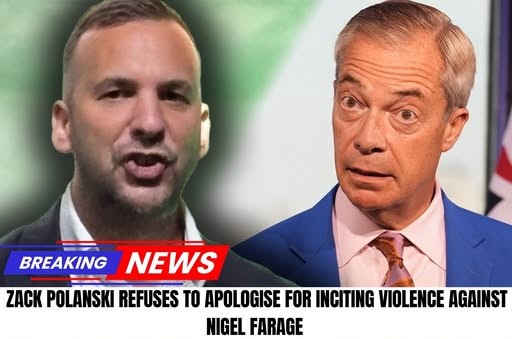
Britain’s political landscape has once again become the focus of intense national discussion following a social media controversy involving Green Party co-leader Zack Polanski and Reform UK leader Nigel Farage. The incident, which rapidly spread across online platforms and political media, has prompted strong reactions from politicians, commentators, supporters, and critics across the ideological spectrum. According to publicly reported accounts, the controversy centers on a graphic image shared on social media that was widely interpreted by many as inappropriate because it depicted violent imagery involving Farage. The incident quickly became a major political story, with demands for clarification, criticism from opponents, and renewed debate over the responsibilities of political leaders in the digital age. While the precise legal implications remain a matter for the appropriate authorities and any official investigations, the episode has already become another example of how social media can transform a single online post into a nationwide political controversy within hours.
The reaction was immediate because political language and imagery have become increasingly sensitive subjects in Britain. Public debate has grown more polarized over recent years, with disagreements surrounding immigration, economic policy, environmental issues, Brexit, national identity, and constitutional reform often producing highly emotional exchanges. Social media platforms have amplified these disagreements by allowing statements, images, and videos to reach millions of users almost instantly. In such an environment, political figures face intense scrutiny, and every post can become the subject of widespread analysis. Supporters may interpret a controversial message as satire, symbolism, or legitimate criticism, while opponents may view the same material as inflammatory, irresponsible, or harmful. This divide has become a defining characteristic of modern political communication.
Reports indicate that criticism intensified after commentators and political opponents questioned whether the image crossed acceptable boundaries of political discourse. Some critics argued that public officials and party leaders carry a special responsibility because their words and actions influence public debate. They contended that imagery perceived as violent, even when intended as satire or political commentary, risks contributing to an already tense political atmosphere. Others expressed concern that increasingly aggressive online rhetoric could normalize hostility toward elected representatives, regardless of party affiliation. For these critics, political disagreements should remain focused on ideas, policies, and democratic competition rather than imagery that may be interpreted as encouraging hostility toward individuals.
The controversy attracted even greater attention after media interviews reportedly focused on whether Polanski would apologize for sharing the image. According to widely reported accounts, he declined to issue an apology during questioning and instead defended his broader position while arguing that the criticism itself reflected a wider political context. His response immediately became another major talking point. Supporters viewed his refusal as an expression of political conviction and argued that politicians should not feel pressured into apologizing simply because opponents object to their commentary. Critics, however, argued that public figures should acknowledge when online content risks being interpreted as promoting hostility or contributing to an increasingly toxic political environment.
As public discussion intensified, attention turned toward the role of police and the legal framework governing online communications. In the United Kingdom, law enforcement agencies may assess reports concerning online content where there are allegations that communications could constitute criminal offenses under applicable legislation. However, the existence of a report or an assessment does not in itself establish that any offense has occurred. Decisions regarding investigations, prosecutions, or other legal action depend upon evidence, statutory requirements, and independent legal processes. Legal experts therefore caution against assuming legal conclusions before official authorities complete any review or announce any formal decisions.
The episode has also reopened a broader debate about the boundaries of political satire and freedom of expression. Throughout British political history, satire has occupied an important place in democratic culture. Cartoonists, comedians, broadcasters, newspapers, and campaigners have long used exaggerated imagery to criticize governments and political leaders. Many defenders of robust free expression argue that democracy depends upon allowing controversial, provocative, and even offensive political commentary, provided it does not cross legal thresholds relating to threats, incitement, or other prohibited conduct. They caution against creating standards that might discourage legitimate criticism of those holding public office.
Others respond that today’s digital environment differs significantly from traditional political satire published in newspapers or broadcast through established media. Images shared online can spread globally within minutes, often detached from their original context and viewed by audiences unfamiliar with the creator’s intentions. Critics argue that the speed and scale of social media increase the responsibility borne by public figures when deciding what they publish. Because political tensions are already high in many democracies, they contend that leaders should consider not only their intended message but also the possible interpretations and consequences of highly charged imagery.
Nigel Farage’s political career provides important context for understanding why the controversy attracted such widespread attention. Over several decades, Farage has become one of Britain’s most recognizable and polarizing political figures. As a leading advocate of Brexit and now leader of Reform UK, he has consistently generated strong reactions from supporters and opponents alike. Admirers view him as a politician willing to challenge established institutions and address issues such as immigration, national sovereignty, and political accountability. Critics argue that his rhetoric has often been divisive and has contributed to political polarization. This sharply divided public perception means that controversies involving Farage frequently become focal points for wider national debates extending far beyond the immediate incident itself.
The Green Party has likewise experienced increasing national attention in recent years. Traditionally associated with environmental protection, climate policy, sustainable development, and social justice, the party has expanded its influence within local government and national politics. Under its current leadership, it has sought to present itself as a broader political movement addressing housing, public services, economic reform, democratic participation, and civil liberties alongside environmental priorities. Consequently, controversies involving senior Green Party figures attract increasing media attention as the party’s national profile continues to grow.
Political analysts note that social media controversies can significantly influence public perceptions regardless of whether legal consequences follow. Modern political communication operates within an environment where headlines, short video clips, screenshots, and online commentary often shape public opinion before lengthy explanations or contextual information become widely available. A single image or statement may dominate news cycles for several days while political opponents and supporters alike seek to frame the narrative in ways favorable to their respective positions. This dynamic places enormous pressure on politicians responding to controversies, particularly when journalists seek immediate answers during live interviews.
Supporters of Polanski have argued that reactions to the incident should be viewed within the broader context of Britain’s highly polarized political climate. They contend that politicians from across the political spectrum frequently employ strong rhetoric, provocative imagery, and emotionally charged language during political campaigns. Some believe criticism directed toward Polanski reflects broader disagreements over his political positions rather than solely the social media post itself. They argue that free political debate inevitably includes robust criticism, satire, and controversial expression, particularly during periods of heightened political competition.
Critics reject that interpretation, arguing that elected representatives should consistently demonstrate restraint regardless of political affiliation. They emphasize that democratic leadership requires maintaining standards of civility even during passionate disagreements. According to this perspective, political discourse becomes healthier when leaders model respectful disagreement while avoiding imagery that could be interpreted as encouraging hostility toward opponents. They warn that lowering standards for one politician may ultimately contribute to deteriorating political discourse across the entire political system.
The controversy has also prompted renewed discussion regarding the responsibilities of social media platforms themselves. Digital platforms increasingly serve as primary channels through which politicians communicate directly with voters, bypassing traditional media organizations. This direct communication offers significant opportunities for transparency and engagement but also creates challenges concerning moderation, misinformation, context, and accountability. Platform policies governing violent imagery, graphic content, and political expression continue evolving as companies attempt to balance freedom of speech with concerns regarding safety and responsible communication.
Media organizations have likewise faced challenges in covering politically sensitive online controversies. Journalists must balance the public’s legitimate interest in understanding significant political developments with the responsibility to avoid unnecessarily amplifying harmful content. Decisions regarding whether to reproduce controversial images, describe them, or summarize their significance often require careful editorial judgment. Many news organizations therefore focus on explaining the broader political context rather than repeatedly displaying potentially offensive material.
Legal specialists observing the debate emphasize that political controversy and criminal liability are not synonymous. Many forms of expression that generate public criticism remain protected under principles of free expression, while genuinely unlawful communications typically require specific legal elements established through evidence and judicial processes. Consequently, observers encourage distinguishing clearly between ethical criticism, political accountability, public opinion, and legal responsibility. Maintaining these distinctions helps preserve confidence in both democratic debate and the rule of law.
Beyond the immediate controversy, the incident reflects wider concerns regarding the tone of modern politics in Britain. Public confidence in political institutions has faced numerous challenges in recent years amid debates over Brexit, economic pressures, immigration, constitutional reform, and public services. Many observers worry that increasingly hostile political exchanges risk discouraging constructive dialogue and undermining trust between elected representatives and the public. Others argue that vigorous political disagreement remains an essential feature of healthy democratic societies and caution against interpreting passionate debate as evidence of democratic decline.
Political communication experts note that controversies such as this often influence future campaign strategies. Parties may reassess internal guidance concerning social media use, encourage greater review of online content before publication, or develop clearer communication protocols for responding to public criticism. As digital platforms continue playing an increasingly central role in political campaigning, managing online communication has become a strategic priority for parties across the political spectrum.
The episode also highlights the growing importance of political accountability in the digital age. Every public post can be archived, shared, analyzed, and debated indefinitely, making online communication effectively permanent. Politicians therefore operate under continuous public scrutiny unlike any previous generation of public officials. While digital platforms offer unprecedented opportunities for direct engagement with voters, they also ensure that controversial statements can rapidly become defining moments within broader political narratives.
Ultimately, the controversy involving Zack Polanski and Nigel Farage extends far beyond a single social media post. It has evolved into a broader national conversation about freedom of expression, responsible political leadership, the limits of satire, the influence of digital platforms, and the standards expected of those seeking public office. Supporters and critics continue interpreting the incident through very different political lenses, reflecting wider divisions within British society regarding acceptable political discourse and democratic accountability.
As public discussion continues, the longer-term impact may depend less on the controversy itself than on how political leaders, parties, institutions, and voters respond to it. Whether the episode ultimately serves as a reminder of the importance of careful communication, reinforces calls for stronger political civility, or simply becomes another chapter in Britain’s increasingly polarized political landscape remains to be seen. What is already clear, however, is that in the age of instant communication, a single social media post can trigger nationwide debate, dominate political headlines, and reignite fundamental questions about democracy, free speech, and the responsibilities that accompany public leadership.