
Boyz n the Hood 2 (2026) – A Legacy Revisited in the Shadow of Change
More than three decades after Boyz n the Hood redefined urban drama for a generation, Boyz n the Hood 2 (2026) arrives with the heavy burden of legacy on its shoulders. The original film, directed by John Singleton, was not merely a coming-of-age story—it was a cultural landmark that captured the harsh realities and fragile hopes of South Central Los Angeles. This sequel does not attempt to replicate that lightning in a bottle. Instead, it reflects on how time reshapes neighborhoods, identities, and inherited trauma. The result is a film that feels both reverent and restless, grappling with whether progress has truly rewritten the narrative or merely disguised it.

Set in a rapidly gentrifying South Central Los Angeles, the story follows the teenage son of Tre Styles, now a community organizer trying to balance idealism with exhaustion. The younger generation navigates a world shaped by social media activism, economic displacement, and a new form of violence that is less visible but equally corrosive. While the first film focused on street survival and father-son guidance, this sequel explores generational disconnect in a different light—what happens when parents who once fought to escape the cycle watch their children confront a system that has simply evolved rather than disappeared? The script weaves together intersecting lives: an aspiring filmmaker documenting neighborhood change, a young entrepreneur tempted by exploitative investors, and a former gang member struggling to mentor kids who don’t trust institutions anymore.

Artistically, the film adopts a semi-documentary aesthetic. Handheld cameras and natural lighting give the streets a raw immediacy, echoing the grounded realism of the original while incorporating modern visual language. Drone shots capture the stark contrast between luxury condos rising beside aging apartment blocks, visually reinforcing the theme of displacement. The soundtrack cleverly blends West Coast hip-hop classics with contemporary trap and socially conscious rap, underscoring how cultural expression evolves yet remains rooted in lived experience. The pacing is deliberate, sometimes even meditative, allowing the audience to absorb the emotional weight behind everyday conversations.

The performances anchor the film’s ambition. The actor portraying Tre’s son delivers a nuanced performance filled with simmering frustration and quiet vulnerability. His dynamic with his father is layered—respect intertwined with resentment, admiration mixed with skepticism. Supporting characters feel authentic rather than archetypal, and the film avoids glamorizing violence. Instead, it portrays consequences with stark clarity. A particularly haunting sequence unfolds not in a dramatic shootout, but in a hospital waiting room, where silence speaks louder than dialogue. It is in these restrained moments that the film feels most powerful.
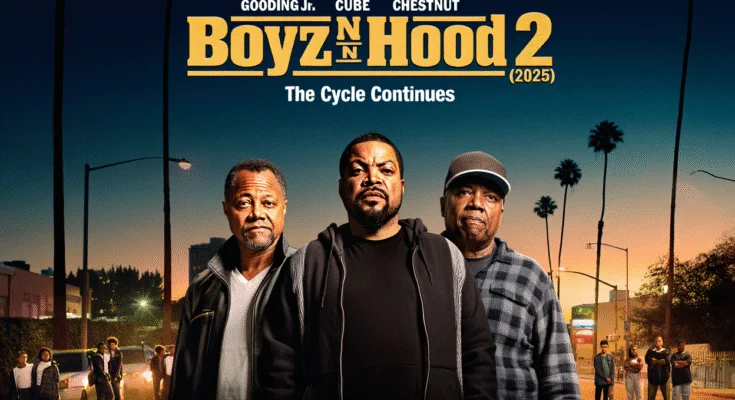
Emotionally, Boyz n the Hood 2 wrestles with the idea of inherited memory. The shadow of the past looms large, and the film never lets viewers forget that history shapes the present. Yet it resists fatalism. Scenes of community gatherings, local art festivals, and grassroots organizing offer glimpses of resilience. The screenplay suggests that while systemic barriers persist, solidarity remains a form of resistance. There is a palpable sense of weariness among the older generation, contrasted with the younger characters’ refusal to surrender. This tension fuels the narrative and gives it contemporary relevance.

Ultimately, Boyz n the Hood 2 (2026) does not seek to outshine its predecessor; it seeks to converse with it. It acknowledges that the world has changed—technology, economics, and language have shifted—but the emotional core of the struggle for dignity and opportunity endures. Though some viewers may find its pacing slower and its conflicts less explosive than the original, the film’s reflective tone feels intentional. It stands not as a nostalgic cash-in, but as a thoughtful continuation of a story that still demands to be told. In revisiting these streets, the sequel reminds us that progress is rarely linear, and the fight for identity and community remains as urgent as ever.