
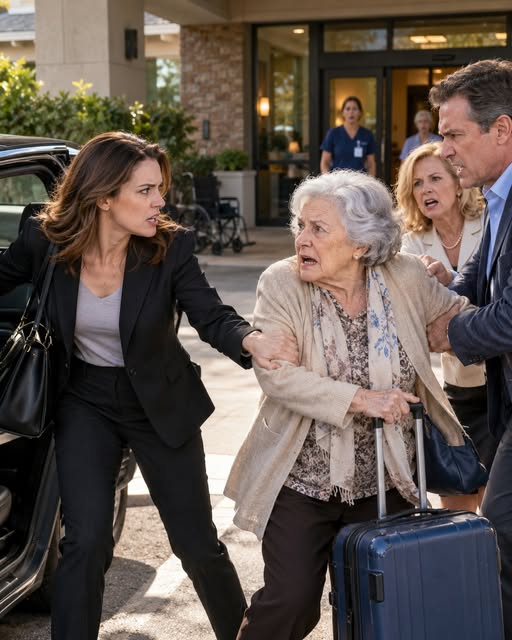
The brass key felt strangely heavy in my palm.
I looked at Grandma Ruth.
“What’s this for?”
She didn’t answer immediately.

Instead, she stared through the windshield at the bank across the parking lot.
My anger faded into something colder.
“What did Dad do?”
Grandma reached into her purse again.
This time, she pulled out an old envelope.
My name was written across the front.
I recognized the handwriting immediately.
Grandpa’s.
My heart began pounding.
Inside was a photocopy of a bank document, several account statements, and a handwritten note dated twenty-seven years earlier.
I read it twice.
Then a third time.
Grandpa had created a separate savings account for Grandma.
It wasn’t enormous, but over decades, with interest and careful investments, it had grown into enough money to provide her with a comfortable life.
More importantly, the account had never belonged to my father.
Grandpa had deliberately protected it.
The brass key opened a safety-deposit box.
We went inside.
A bank employee verified Grandma’s identity and escorted us to a private room.
The box contained old photographs, property documents, a second envelope, and a small notebook.
Grandma opened the notebook with trembling fingers.
Inside were years of handwritten records.
Every withdrawal.
Every transfer.
Every conversation she could remember.
My father’s name appeared repeatedly.
So did my mother’s.
I stared at the pages.
They wanted me to sign documents giving them control over my finances.”
She looked down.
“I knew something wasn’t right.”
My forensic-accounting instincts took over.
I photographed every document.
I made copies.
I called an attorney who specialized in protecting older adulTS.
Then I asked the bank to place additional safeguards on Grandma’s accounTS.
For the first time in months, her shoulders seemed to relax.
But we weren’t finished.
The attorney reviewed the documents and discovered something even more troubling.
My parents had already been preparing paperwork to sell Grandma’s small house.
They had apparently planned to move her into the facility permanently and use the proceeds from the property to pay expenses they claimed were for her care.
Except the paperwork didn’t match the story they’d told Grandma.
And it certainly didn’t match the story they’d told me.
My stomach turned.
The next morning, I received a message from my father.
“Where is Mom? We are worried.”
I showed Grandma.
She stared at the screen for several seconds.
Then she smiled sadly.
“Tell him I’m safe.”
“Do you want me to answer?”
She nodded.
I typed carefully.
We are working with her attorney and the bank to review her financial documenTS. Please direct any questions through her attorney.”
Three dots appeared.
Then disappeared.
Then appeared again.
My father called.
I didn’t answer.
A second call came.
Then a third.
Grandma looked at me.
“You don’t have to protect me from them.”
“I know.”
She took my hand.
“But I don’t want you fighting them either.”
That surprised me.
“Then what do you want?”
She looked toward the window.
“I want my life back.”
That became our goal.
Not revenge.
Not humiliation.
Not destroying my parenTS.
Just Grandma’s life.
Grandma also chose a new place to live.
Not a facility.
Not my apartment.
A small independent-living community near a lake.
It had walking paths, a library, gardening classes, and a dining room where residents could eat together.
When I drove her there, she stepped out of the car and looked around.
“You think I’ll like it?”
“I think you’ll complain about the coffee.”
She laughed.
“Then I’ll know I’m home.”
For the first time since I’d arrived at that nursing facility, I saw the old Ruth Mercer again.
Strong.
Independent.
A little stubborn.
And completely herself.
Months passed.
Grandma planted tomatoes in the community garden.
She joined a book club.
She made friends.
She even started teaching a weekly sewing class.
One Saturday morning, I found her sitting outside beneath a tree, holding a cup of tea.
She handed me an envelope.
“What now?”
“Open it.”
Inside was the brass key.
I smiled.
“You’re giving this to me?”
“No.”
She shook her head.
“I’m giving you the lesson that came with it.”
I looked at her.
She said, “Never assume that being older means being powerless.”
I squeezed her hand.
Then she added something I’ll never forget.
“And never mistake someone’s decision to remain quiet for permission to decide their life for them.”
I thought about that sentence for a long time.
Eventually, my parents asked to meet with us.
Grandma agreed.
We met in a quiet café.
My father looked older than I remembered.
My mother kept her eyes lowered.
There were apologies.
Some were sincere.
Some were awkward.
Some came too late.
Grandma listened without interrupting.
But love doesn’t mean surrendering my voice.”
My father began to cry.
He admitted he’d convinced himself that he was doing what was best because he was overwhelmed.
My mother admitted she’d followed his decisions instead of questioning them.
Grandma didn’t excuse them.
But she also didn’t spend the rest of the afternoon punishing them for their mistakes.
She simply established boundaries.
Her money was hers.
Her home was hers.
Her decisions were hers.
And any future relationship would have to be built on respect.
That was the moment I realized something important.
Sometimes a family isn’t healed by pretending nothing happened.
Sometimes healing begins when everyone finally tells the truth.
A year after that rainy afternoon, Grandma celebrated her eighty-third birthday beside the lake.
There were balloons.
There was cake.
There were dozens of photographs.
And, to everyone’s surprise, my father showed up carrying a small potted rose bush.
Grandma studied it.
“What is this?”
“A peace offering,” he said.
She raised an eyebrow.
“You know I prefer tomatoes.”
Everyone laughed.
Even Dad.
He planted the rose beside her garden.
They weren’t magically a perfect family after that.
Real life doesn’t work that way.
Trust takes time.
Apologies don’t erase consequences.
But something changed.
My parents stopped making decisions for Grandma.
They started asking what she wanted.
And Grandma stopped feeling that she had to whisper when she had something to say.
As for me, I kept the brass key in a small wooden box on my desk.
Not as a reminder of what my parents had done.
As a reminder of what Grandma had taught me.
That dignity doesn’t disappear with age.
That independence deserves protection.
That family should never be measured by who has the most authority in the room.
And that sometimes the person everyone assumes needs saving is actually the person who saves everyone else.
Grandma once arrived at a nursing facility with one suitcase and no explanation.
But she didn’t leave that place broken.
She left with her granddaughter beside her.
She found her voice.
She reclaimed her choices.
And, most importantly, she found a new chapter waiting for her.
Years later, whenever someone asked Grandma about the little brass key she kept in her jewelry box, she would smile.
She never told them it represented betrayal.
She told them it represented freedom.
Because that was Grandma Ruth’s greatest lesson:
You are never too old to choose where your story goes next.