
Chapter 1 — Mechanical Delay
I found out I was probably the father of five-year-old twins while standing on the cold marble floor of O’Hare, thirty-five minutes after cursing the flight delay I was certain would ruin my career.
I was forty-four, and I had made punctuality into something close to a religion.
I owned a small chain of boutique hotels — Miami, Charleston, Savannah, Key West — and that morning I was flying to Boston to close on a historic estate, the largest acquisition of my life.
I had come to the airport with two hours to spare, because I always came with two hours to spare.
And then the departure board flashed the word every traveler dreads: MECHANICAL DELAY.
I called my chief financial officer and told her to start the board meeting without me if she had to, that I would be there the moment they cleared the aircraft.
Then I went looking for a quiet corner away from the crowded gate, toward the floor-to-ceiling windows, and I opened my laptop, and I got through exactly two lines of a financial summary before my life divided cleanly into everything that came before that morning and everything that came after.
I have thought many times since about how close I came to never looking up.
Two lines further into that summary, and I’d have kept my head down until they called my flight.
Instead, a few yards away, something caught the edge of my eye, and I looked.
I have to explain, first, what a delay meant to a man like the one I was that morning, because it is the whole irony of my life.
I had built everything — the company, the reputation, the self — on the principle of never making anyone wait.
Punctuality was not a habit for me; it was a moral position, almost a form of contempt for people who couldn’t manage it.
A man who is on time, I believed, is a man who respects other people’s lives; a man who is late is a man who has decided his own time matters more than yours.
I had fired people, quietly, for a pattern of lateness.
I had ended a friendship, more or less, over a man who kept me waiting forty minutes at a restaurant and did not think it mattered.
And so when that board flashed MECHANICAL DELAY, I experienced it as a small personal catastrophe, a violation of the order I had imposed on my world at such cost — thirty-five stolen minutes that might, I told myself, unravel the biggest deal of my career.
I stood there furious at the airline, furious at the aircraft, furious at the universe for the insult of making me wait.
I did not yet know that those thirty-five minutes were the most important gift I would ever receive, that everything I had organized my life to prevent had just, by breaking down, handed me back the two people who mattered more than every deal I had ever closed.
If that aircraft had been sound, if I had boarded on time as my whole life had trained me to, I would have flown to Boston and closed my acquisition and never once known that my sons were asleep against a wall two gates away.
The universe, it turned out, had to break my most sacred rule to save me.
I have never cursed a delay since.
Chapter 2 — The Way She Brushed Her Hair
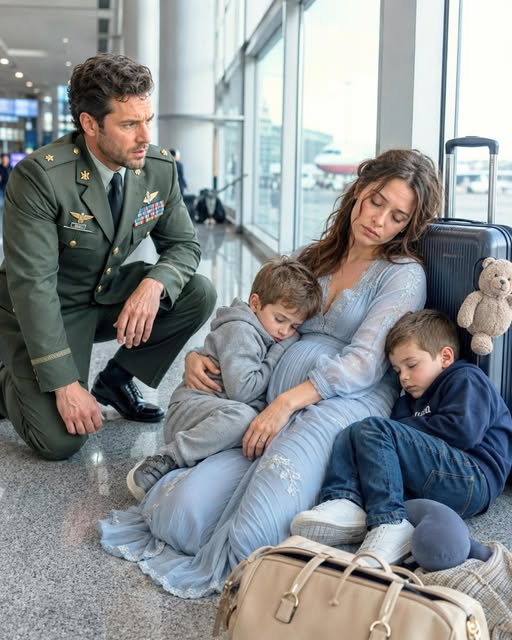
A woman was asleep sitting upright against the wall, next to a scuffed blue suitcase.
Two small boys slept beside her — one with his head against her leg, the other with his fingers wrapped around the suitcase handle as though letting go meant losing everything he had.
I would have walked on.
I want to be honest about that: I nearly did.
But in her sleep the woman lifted a hand and tucked a strand of hair behind her ear, in a particular, delicate way I had watched a thousand times across a thousand dinners, and my whole body knew her before my mind caught up.
Sabine.
The woman who had disappeared out of my life six years before, without a word, without a trace.
She was thinner now, and there was an exhaustion carved into her face that had not been there before, and she wore plain, worn clothes.
But it was her.
For six years I had buried the memory of her under grand openings and investor dinners and red-eye flights, and my mother had handed me, over and over, an explanation gentle enough to swallow: that Sabine had realized she did not belong in our world, and had chosen to walk away with her dignity intact.
I had wanted to believe it, because the only alternative I could imagine — that the woman I loved had simply left me — was too much to carry.
It never once occurred to me that there might be a third possibility, worse than either, sleeping now against a wall in Terminal 3 with two children beside her.
Chapter 3 — What My Mother Told Me
I had met Sabine when she was coordinating charity galas for my family’s foundation in Chicago.
I was thirty-five and she was thirty-one, and she was not the least bit intimidated by the family name.
She challenged me when she thought I was wrong.
She laughed, openly, at the stiff old traditions that surrounded us.
And my mother, Adelaide, had disliked her from the first evening.
“Enjoying someone’s company is one thing, Sebastian,” she had told me once over dinner, in the cultured, unhurried voice she used for her most ruthless pronouncements.
“Building a family legacy with them is another thing entirely.” I had told my mother, plainly, that Sabine was the only woman I would ever want to build a family with.
And a few months after that, I traveled abroad for three weeks to oversee a hotel opening, and when I came home to Chicago, Sabine’s apartment was empty.
Her phone was disconnected.
My texts went undelivered; my letters came back unopened.
My mother told me, with every appearance of sympathy, that Sabine had begged us not to look for her — that she had chosen to go.
And I, wounded and proud and thirty-eight years old, believed her, and stopped searching.
It is the single greatest failure of my life, and it took me six years and a flight delay to understand that the story I had accepted so easily had been built, brick by brick, specifically so that I would accept it.
I have thought a great deal, since, about why I believed it — why a grown man, a supposedly shrewd one, swallowed whole the tidy explanation that the woman he loved had simply chosen to vanish.
And the answer is not flattering, but it is important, because it is how these things are done.
My mother did not have to convince me of a lie against my will.
She had only to offer me a lie I already wanted to believe.
Because the truth — that Sabine had been driven out, threatened, paid to disappear, that I had failed to protect her — would have required me to act, to fight, to tear my own family apart to find her.
But the version my mother handed me, the one where Sabine had gently walked away, asked nothing of me at all except that I nurse my wounded pride and move on.
It let me off every hook.
It made my inaction not cowardice but dignity, not failure but restraint.
A good manipulator does not fight your desires; she saddles them.
My mother read, correctly, that a proud man reeling from abandonment would rather believe he had been left than believe he had been robbed, because being left only costs you your heart, while being robbed costs you your heart and demands that you do something about it.
She gave me the cheaper grief on purpose.
And I took it, because it was cheaper, and I called my taking of it maturity.
That is the part I cannot fully forgive in myself — not that I was deceived, but that the deception worked because some part of me preferred it.
Sabine spent six years paying the price of a lie I found comfortable.
I will be reckoning with that for the rest of my life.
Chapter 4 — The Notch
One of the boys stirred, and sat up, and rubbed his eyes, and my mouth went dry.
Because the child had my dark, wavy hair, and the exact square line of my late father’s jaw, and — I could not look away from it — a small, distinct notch in his left eyebrow, the very notch I had looked at in the mirror every morning of my life while I shaved.
I was still staring at it when Sabine opened her eyes.
The moment she saw me, every drop of color left her face, and her arms came around both boys at once, pulling them in against her chest, an instinct older than thought.
I took one slow step forward.
“Sabine.” She looked at me the way you’d look at a ghost that had stepped out of a wall.
“It can’t be.” “I’ve been telling myself the same thing for six years,” I managed.
She pressed her lips together and looked down at the boys, then back up at me, and her eyes were full of something I could not at first name — grief, and caution, and beneath them both a terrible, careful anger.
“Sebastian,” she whispered.
“Your mother never told you.
Did she.”
Chapter 5 — Are They Mine
It took me a few seconds to find any voice at all.
“Told me what?”
The older boy had opened his eyes now too, and he was watching me with an expression so familiar that my chest physically hurt.
“Their names are Micah and Toby,” Sabine said, quiet.
“How old are they?” “Five.” I went down onto my knees on the cold airport floor, level with them.
“Are they mine?” She nodded, once.
And then she reached into a worn tote bag and drew out a thick stack of paper bound with a rubber band, and set it in my hands, and I understood as I looked at it that I was holding the physical shape of the six years I had lost.
Unopened letters, addressed in my own hand to my own office, every one stamped RETURN TO SENDER.
Printouts of emails to an account I’d long abandoned.
And a cashier’s check for sixty thousand dollars, signed in my mother’s unmistakable, elegant hand.
“Your mother offered me this to disappear,” Sabine said, her voice dropping to something cold and even.
“I refused it.
Three days later she told me you already knew about the pregnancy, and that you wanted nothing to do with any of us.”
I held that stack of paper in my hands and I could not speak, because it was not just evidence.
It was the physical body of six years.
Every returned letter in that bundle was a night I had sat down and written to a woman I believed had left me — the letters I’d sent in the first raw months, before my pride hardened, when I still hoped.
RETURN TO SENDER, every one, in a stranger’s rubber stamp.
I had written them believing they went unanswered because she did not want them.
They had gone unanswered because they had never been delivered — pulled from the mail, rerouted, returned, by a hand in my own family.
And the check.
Sixty thousand dollars, in my mother’s elegant hand, the hand that had signed my birthday cards, offered as a price for the erasure of my own children.
Sabine had refused it.
That was the detail that undid me most, holding the bundle: that a pregnant woman, alone, threatened, with every reason in the world to take the money and vanish quietly, had instead refused sixty thousand dollars and kept trying to reach me — had made seventeen phone calls I would only learn about later, had mailed letters that came back, had held on to hope in me long past the point where hope was rational, until my family’s law firm finally frightened her into flight.
She had fought for me, for us, harder and longer and more alone than I had ever fought for her.
I had stopped searching after a few wounded weeks.
She had kept a bundle of returned letters in a suitcase for six years.
Holding them in that terminal, I understood the true measure of what had been taken, and the true measure of the woman it had been taken from, and I was ashamed, and I was awed, and both feelings were correct.
Chapter 6 — Return to Sender
“I never knew,” I said.
“Sabine, I swear before God, I never knew any of it.” “I can see that now,” she whispered, and the seeing of it seemed to cost her something.
She told me the rest in a flat, careful voice, the voice of a person who has learned that her own story can be turned into a weapon against her.
Three days after she refused the check, her apartment lease was abruptly canceled by a landlord who would give no reason.
And then the family’s corporate attorney had served her with a formal notice, warning that any further attempt to contact me would be treated as harassment and extortion.
She had been pregnant, alone in a city, and threatened by a law firm, and she had run, because running was the only door left open to her.
“Then why are you back in Chicago now?” I asked, my heart going hard against my ribs.
She lifted her eyes and pointed, past my shoulder, at the departure board — no, past it, at the concourse beyond.
“Because your mother found us again.” My phone chose that exact moment to buzz in my hand.
MOTHER, the screen said.
I answered, and Adelaide spoke without a word of greeting.
“Sebastian.
Do not believe a single thing that woman tells you.” I stood slowly and looked around the terminal.
“How do you know who I’m standing with?”
Chapter 7 — The Folder
She was fifty yards away across the concourse.
My mother, sixty-eight years old, straight-backed and composed, and beside her Raymond — our family’s senior corporate counsel — holding a thick gray folder against his chest.
I crossed the distance before either of them could move toward Sabine and the boys.
“Hand me the folder, Raymond.” He tightened his grip on it.
“Sebastian, this is entirely inappropriate.
An airport is not the place to discuss private estate matters.” “Then it certainly wasn’t the place to hunt down a mother and two five-year-olds,” I said.
My mother lifted her chin.
“You’re emotional.
That woman staged this, with precise timing.” “I didn’t stage anything,” Sabine said from behind me, the boys tucked behind her.
“I was trying to leave.” My mother did not so much as glance at her.
“Sebastian, you have a closing in Boston that affects hundreds of our employees.
Do not throw away years of work over an unverified story.” “I’ve already seen the returned letters, Mother,” I said.
“And the check with your signature on it.” “Letters prove nothing about paternity.” “No,” I said.
“They prove that someone intercepted my mail for six years.” Raymond started to speak, and I cut across him.
“What is in the folder, Raymond?
Hand it to me now, or you are finished as our counsel before I leave this terminal.” He looked at my mother.
He hesitated.
And that hesitation told me everything.
I have negotiated across a lot of tables in my life, and I have learned that the truth almost never arrives as a confession.
It arrives as a hesitation — the half-second pause before a smooth answer, the glance toward the person whose permission is being sought, the small physical tell that the words about to be spoken are not the words the speaker believes.
Raymond had a ready answer for me; men like Raymond always do.
He could have handed me the folder and spun it, or refused me and cited privilege, or done any of a dozen practiced lawyerly things.
But before he did any of them, he looked at my mother.
In a dispute between a man and his own attorney, my lawyer looked to my mother for instruction — and in that single glance the entire architecture of the last six years stood revealed.
Because a lawyer who looks to your mother before answering you is not your lawyer.
He is hers.
He had been hers the whole time, through every “corporate power of attorney” and every “estate matter,” taking his real orders from the woman beside him while nominally serving me.
I had walked into that terminal believing I had a family and a mother and a trusted counsel.
In the space of one hesitation I understood that I had a mother who ran a machine, and a lawyer who was a part of it, and that the machine had been built, in part, to operate on me — to manage me, the way it had managed Sabine, the way it managed everything that threatened the order my mother served.
The folder in Raymond’s hands was almost beside the point after that.
The glance had already told me the truth.
I just had to take the folder to prove it to everyone else.
Chapter 8 — The Report
I took the folder out of his hands and tore open the clasp, and what was inside turned my stomach.
A private investigator’s report.
Surveillance photographs — Sabine walking the boys to preschool, the three of them crossing a street, holding hands.
Copies of the children’s daily schedules.
And a drafted legal settlement, in which my mother offered Sabine two hundred thousand dollars in exchange for absolute silence, the surrender of every letter and email, and an irrevocable agreement that any future contact with the family would be routed through Raymond’s firm.
“You hired a private investigator,” I said, “to follow my children.” “To investigate children whose legal status is entirely unverified,” my mother corrected, without a flicker of shame.
And that was when Sabine reached into a hidden pocket inside the worn blue suitcase and drew out a single sheet of paper, folded into quarters, soft at the creases from years of handling.
“Show him this one too, Sebastian,” she said.
I unfolded it.
It was on my hotel company’s letterhead, dated six years earlier.
It was brief and it was brutal: it stated that I was fully aware of the pregnancy, wished to establish no relationship with Sabine or the children, and directed all future communication to Raymond’s firm.
And at the bottom of the page was my signature.
Before that, though, in the seconds after I first tore the folder open, there had been the other thing, the thing I keep coming back to.
Across the top of the drafted settlement, printed in cold official capitals, were two names I had never seen written down before, the names my sons carried through five years of a life I knew nothing about: MICAH KINGSLEY MARSH.
TOBY KINGSLEY MARSH.
My family’s name, the name I had spent my whole life protecting, sitting there in the middle of my children’s — proof that Sabine had never tried to hide from me who their father was, had given them my name openly even as my family spent a fortune to keep them from me.
And beneath the names, the photographs.
That is what I could not get past, standing in that terminal: not the money, not even the forged letter, but the photographs.
My mother had paid a stranger to follow my sons.
To photograph them crossing a street holding their mother’s hands.
To document the route they walked to preschool, the times they came and went, the small unguarded pattern of two five-year-olds’ days — and to compile it all into a folder, coolly, as leverage.
There is a particular horror in seeing your own children rendered as surveillance, as a problem to be managed, as targets.
These were not photographs a grandmother takes.
They were photographs a predator takes, and the woman who had commissioned them was my mother, and she was standing three feet from me explaining, without a flicker of shame, that it was all perfectly reasonable given that the children’s status was, as she put it, unverified.
Chapter 9 — I Never Signed This
I looked at the signature for two full seconds.
“I never signed this document.”
Sabine closed her eyes, and tears slid down her cheeks, and I understood, watching her, that she had hated this single sheet of paper for six years.
She had read it during late-night fevers and on fatherless birthdays, while filling out school medical forms, every time one of our sons asked why the other fathers came to the school plays.
Raymond had gone pale.
But my mother did not so much as blink.
“It was the best decision for everyone involved, Sebastian.” The silence after that was a physical thing, pressing on the four of us.
“You forged my signature,” I said, and my voice had dropped into a register I didn’t recognize as my own.
“I prevented you from making a permanent, life-altering mistake,” she answered, as calm as if she were correcting a billing error.
I keep returning to how calm she was, because the calm was the most damning thing of all — more damning than the forgery itself.
A person who forges a signature in a moment of desperation, in a panic, to avert some catastrophe they genuinely believe is coming, is a person who has done a terrible thing under terrible pressure, and you can at least understand the fear that drove them.
But my mother was not afraid, and had not been afraid, not for one second of the six years.
She stood in that terminal, caught, with the evidence in my hands and her grandsons three feet away, and she answered me in the same unhurried, cultured tone she used to discuss table settings.
Because to her, it was not a crime that had been exposed.
It was a management decision that was being second-guessed by an employee who had gotten above himself.
She had forged my name onto a document renouncing my own children, and she experienced my discovery of it not as shame but as inconvenience — the tiresome business of having to justify, to a subordinate, a call that had been correct.
That calm told me the thing I most needed and least wanted to know: that this had not been a moment of weakness in an otherwise loving woman.
A moment of weakness comes with remorse when it is found out.
This came with none.
It came with the serene confidence of a person who believed, fully and without doubt, that she had every right to author my life, forge my hand, and dispose of my children, because she had decided that her judgment superseded mine in all things and always would.
There was no version of the story in which she was sorry, because in her own mind she had done nothing but her duty.
And a person who feels no remorse for a thing like that is a person you cannot reason your way back to.
You can only, at last, refuse them the power to do it again.
“They are my sons.” And at last my mother turned her gaze on Micah and Toby — and there was nothing in it, no warmth, no grandmother’s softening, only a cold aristocratic arithmetic, weighing two small boys and finding them a liability on a balance sheet.
Chapter 10 — Her Place
“Those children didn’t need a father, Sebastian,” my mother said, smooth and unhurried.
“Their mother simply needed to understand her place.”
Sabine flinched as though she had been struck across the face, and something in me that had been my mother’s son for forty-four years quietly and permanently came apart.
Their mother simply needed to understand her place. I have turned that sentence over more times than any other from that day, because it is the whole of my mother’s philosophy compressed into eight words, and it explains everything she did.
To Adelaide, the world was a structure of places — high ones and low ones, ones you were born into and ones you could never earn your way up to — and the gravest sin a person could commit was to reach above the place assigned to them.
Sabine’s crime, in my mother’s eyes, was not any wrongdoing.
It was ambition of the unforgivable kind: a woman without the right name, the right money, the right lineage, presuming to marry into the family and carry its heirs.
My mother did not hate Sabine for anything Sabine had done.
She hated her for what Sabine represented — the collapse of a boundary my mother had spent her whole life policing.
And once you understand that, the monstrousness becomes almost coherent.
The forged letter, the intercepted mail, the private investigator, the settlement — none of it was personal cruelty, exactly.
It was enforcement.
My mother was a border guard, and Sabine had crossed a line, and my sons were the evidence of the crossing, and all of it had to be erased to restore the order my mother believed the universe depended on.
That is the thing I finally saw, standing in that terminal: that my mother was not protecting our family from an outsider.
She had no family in the sense that word is supposed to mean.
She had an estate, and a name, and a hierarchy, and she had mistaken the defense of those things for love so completely and for so long that she could look at her own grandsons and see only trespassers.
And I had been raised inside that mistake, and had nearly lived my whole life inside it, and it took two small boys asleep against a wall to finally show me the door out.
I want to describe what did not happen next, because it matters.
I did not shout.
I did not lunge, or weep, or beg her to explain.
I have inherited, from the same woman standing in front of me, a certain terrible calm that arrives in me at the worst moments, and for the first time in my life I turned it fully against her.
I took out my phone.
I called my CFO and canceled the Boston acquisition — the largest deal of my career, the thing I had built my whole identity around never missing — in a single flat sentence, and I did not feel the loss of it at all.
Then I called my company’s legal and IT departments and instructed them to lock down and preserve every historic email, every server backup, every corporate mail log associated with my mother and with Raymond.
And then I flagged down the airport security officers near the gate and asked them, quietly, to escort my mother and my lawyer away from my family.
My mother stared at me as though I had struck her.
“You are destroying your own family, Sebastian.” “No,” I said.
“I’m finally finding out who destroyed it six years ago.”
Chapter 11 — I Cannot Participate
Raymond set his briefcase down on a chair, and the color drained entirely out of his face.
“Adelaide,” he said.
“I cannot participate in this any longer.”
That single sentence did what nothing I had said could do: it cracked my mother’s composure, for the first time in my life.
Raymond asked to speak with me in private.
I refused.
Whatever he had to say, he would say it in front of Sabine, because she had earned the right to hear every word, and because I would never again build a wall between her and the truth.
So he said it there, in the terminal, haltingly.
Six years ago, my mother had instructed his firm that I wanted all contact with Sabine severed.
He had never personally watched me sign the letter she was holding; he had assumed the signature had been authorized through a corporate power of attorney.
And then he admitted the worse thing — that when Sabine refused the sixty-thousand-dollar check and kept trying to reach me, my mother had ordered him to escalate the legal threats until she left Chicago.
“I should have verified it with you directly, Sebastian,” he said.
“Yes,” I said, quiet.
“You should have.” My mother turned and walked toward the exit without another word, and no one moved to stop her, and I did not watch her go.
There was something far more important in front of me.
Chapter 12 — Are You Really Our Dad
I knelt down to eye level with my sons.
Micah was staring hard at his shoes.
Toby had not let go of the handle of the blue suitcase.
“Are you really our dad?” Micah asked, so quietly I almost missed it.
I heard Sabine catch her breath beside me.
“I am,” I said, as gently as I knew how.
“And we’re going to figure all of it out together, slowly, with no rush.
But there’s one thing I need you both to know right now, tonight.
Your mother tried everything she could think of to find me.
Everything.
And I never knew you existed, or I would have moved the whole world to get to you.” Toby’s small brows drew together as he worked at it.
“So… you weren’t mad at us?” And that question broke something in my chest that I don’t think has ever fully healed since.
“I could never be mad at you, buddy,” I said.
“Not ever.
I just didn’t know.
But I know now, and I’m here.” I did not force a hug on them, and I did not promise to buy back six years in an afternoon.
I asked them, instead, if they were hungry.
I have replayed that question of Toby’s — so you weren’t mad at us? — more than almost anything else from that day, because of what it revealed about the six years I had missed.
My sons had grown up without a father, and a child cannot hold the true, complicated adult explanation for such a thing.
A child needs a reason, and when no reason is given, a child supplies one, and the reason a child supplies is almost always the same: it must be my fault.
He must not have wanted me.
I must not be worth staying for.
Somewhere in those five years, my little boy had done the terrible private math that lonely children do, and had arrived at the conclusion that his father’s absence was a verdict on him — that he had, somehow, by existing, made me angry enough to stay away.
He had carried that.
At five years old, he had carried the belief that he was the kind of child a father gets mad at and leaves.
And so when I knelt on that airport floor, the most important thing I could possibly do was not to promise him trips or toys or a bedroom of his own.
It was to reach into that private math and correct the single wrong number at the center of it: you did not do this.
You were never the reason.
I did not stay away because of anything about you; I stayed away because I did not know, and if I had known, nothing on earth could have kept me from you.
I do not know if he fully believed me that afternoon.
But I have spent every day since making it true in the only language a child actually reads, which is not words but presence — showing up, and showing up, and showing up, until the old math is overwritten by the new arithmetic of a father who is simply, reliably, there.
Chapter 13 — Sandwiches and Juice Boxes
An hour later the four of us were sitting in a quiet airport cafe over sandwiches and juice boxes and a cup of coffee I let go stone cold, and Sabine answered my questions carefully, the way a person does when they have learned that information can be used to hurt them.
I learned that Micah was obsessed with geography and knew nearly every state capital.
That Toby took apart every plastic toy he owned to see how it worked, and couldn’t always get it back together.
That they had shared a room since they were babies.
That Sabine had worked as an administrative assistant at a medical clinic, and had raised the two of them through the hardest early years with the help of her sister, Camille.
They had come back to Chicago eight months ago for a job.
That was when the private investigator had found them.
First a letter from Raymond’s firm.
Then a phone call.
Then the same black sedan parked near the boys’ preschool three days running — and Sabine, understanding at last that she was being hunted again, had taken a few days off work and bought bus tickets to get the boys somewhere safe while she found a legal-aid lawyer.
Our meeting in that terminal had not been arranged by anyone, or staged, or timed.
It was a thirty-five-minute mechanical delay, and nothing more.
That night I booked two adjoining suites for the three of them at one of my hotels downtown, and Sabine accepted only after I put the rooms strictly in her name and swore that my mother would have no access to the building.
She also agreed to a court-admissible DNA test — an independent lab, her own attorney present.
She had learned, the hard way, to trust nothing that came from my side of things unverified.
I did not blame her.