
Chapter 1 — The Gate
I had not driven through the gates of the Lockridge estate in ten years, and I would not have driven through them now for any living member of that family.
I came for a dead one.
The morning was gray and close, the Georgia sky the color of old pewter, and the church bells were still going somewhere behind the pines when the car came up the long drive and stopped near the family cemetery.
I got out in my service uniform — not as armor, though I know that is how it looked to them, but because I had flown in overnight from Fort Benning after a training rotation and there had been no time to be anything but what I am, which is a soldier.
Then the doors opened behind me, and my children climbed out one at a time, and I heard the whispering start before the last of them had both feet on the grass.
Five of them.
Wes first, nine and grave, already reaching for his little sister’s hand.
Then Ira, then Abe.
Then Romy.
Then Delphie, the baby, four years old and blinking at the crowd.
I did not have to look at the mourners to know what they were seeing, because I had spent ten years watching it dawn on strangers in grocery stores and school pickup lines.
Five children with the same dark hair, the same set to the jaw, the same particular Lockridge eyes.
But they were not a matched set to me, and I need to say that, because I know how it looked and I know how a story like this gets told — the wronged wife arriving with her five little pieces of evidence, a walking accusation in ascending heights.
That is not who my children are and it is not why they were there.
Wes is grave and watchful and carries his siblings’ worries like a coat that is still too big for him, and I worry that I have let him grow up too fast.
Ira is the one who laughs, who cannot hold still, who would have been fidgeting through the service if there had been a service for us to sit in.
Abe is quiet and reads the room before he enters it.
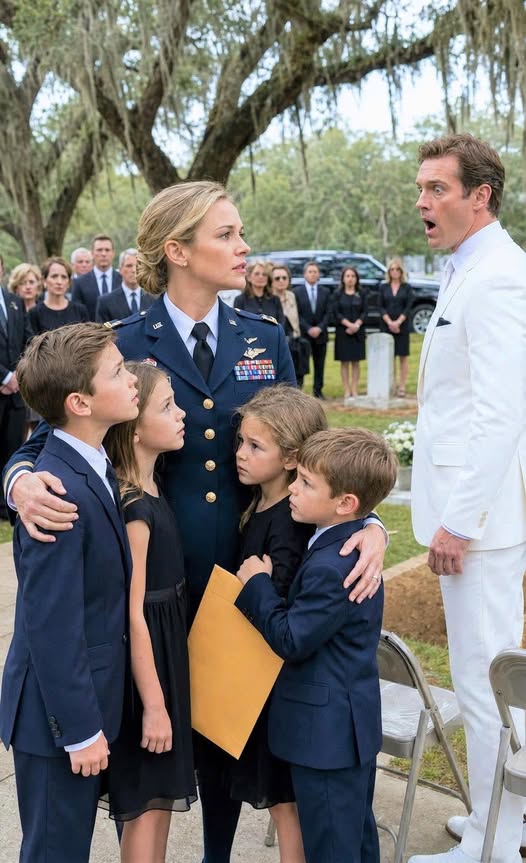
Romy feels everything at full volume and will not be told a comfortable lie.
Delphie is four and believes the world is fundamentally good, and I would burn down anything that tried to teach her otherwise.
They are five whole people, not five copies of a man’s face, and the tragedy of that morning — one of the several tragedies of it — is that the crowd in that cemetery could only see the face.
I had not brought them to make a point.
I want that understood before any of the rest of it.
I had brought them because a good man had loved them from a great distance for the last two years of his life, and had died without once getting to hold them, and I was not going to let him go into the ground without the people he had loved standing there to say goodbye.
That the standing-there happened to detonate a decade of lies was not my design.
It was only what happens when you finally let the truth walk in the front door instead of keeping it, the way that family had, locked in a back room.
I had brought them to say goodbye to their grandfather, who was the only person on that entire estate who had ever, in eleven years, treated me like I was real.
Chapter 2 — Ten Years
My name is Sabra Cadwell.
It was Sabra Lockridge for eight years, and then a man gave me ten minutes in a walnut-paneled study to explain my whole life, and did not use them to listen, and I took my own name back and did not look behind me.
I had married Rhett Lockridge at twenty-four, a small-town girl marrying into one of the oldest fortunes in the state, and I had loved him in the uncomplicated way you love someone before you have learned what a person is willing to believe about you.
His family never warmed to me.
I was not from anywhere that mattered to them; I had gone to a state school on an ROTC scholarship; I had a career of my own that I would not give up, which they found first amusing and then, as it became clear I meant it, threatening.
For eight years I absorbed the small cruelties of that house the way you absorb weather.
And then, in the ninth year, the accusation came — an affair, they said, with a rival of Rhett’s, evidence and all — and Rhett, who I had stood beside through the hardest stretch of his early career, who I had believed knew me down to the bone, looked at the evidence someone handed him and did not look at me.
Ten minutes.
A decree already drawn up.
Sign here.
I have gone back to those ten minutes more times than I would admit to anyone.
Not because I wish I had said something different — I said everything; I begged him to make one phone call, to check one date, to look at me — but because of what those ten minutes taught me about the difference between being loved and being useful.
For eight years I had believed Rhett loved me.
What I understood in that study, watching him keep his eyes on a folder rather than turn them on my face, was that he had loved the version of me that was convenient to love — the wife who made him look settled, who softened his father’s disappointment in him, who asked for little.
The moment I became inconvenient, the moment believing me would have cost him a fight with his family and a hard look at his own life, the love evaporated so fast it was clear it had never had much weight to begin with.
A man who loves you does not need evidence to disbelieve a lie about you.
He disbelieves it on principle, because he knows you, and then he checks, because he is careful with what he loves.
Rhett did neither.
He took the easier story because it let him keep his comfortable life and shed the wife who complicated it, and he dressed that cowardice up as heartbreak, and I think he half believed it himself.
I was escorted off the property that afternoon by a man from the estate’s security detail, carrying one suitcase, and I did not yet know that I was three weeks pregnant, or that I was carrying twins, or that this was only the beginning of what that lie would cost all of us for a decade.
Chapter 3 — The One Who Wrote Back
Everyone in that family let me go without a word.
All but one.
Ames Lockridge, Rhett’s father — the old man they all deferred to and none of them resembled — mailed a single Christmas card to my Army post office box the winter after the divorce, and I kept it folded inside my Bible for years, because it was the only kindness anyone with that name had ever shown me.
I did not know, that first year, what the card meant.
I thought it was an old man’s manners.
It was more than that, though I would not learn how much more until much later.
Ames was the kind of quiet that people mistook for coldness — a man who had built a company and buried a wife and raised a son he was privately disappointed in, and who watched more than he spoke.
I had loved him, in a wary way, during my marriage — the only one of them I had.
At the interminable Lockridge dinners, while the others performed their wealth at each other, Ames would catch my eye across the table with something that was almost an apology in it, and once, only once, after his son had said something cutting about my “little Army hobby,” the old man had said, quietly, into the silence, “It is not a hobby, Rhett.
Your wife has taken an oath.
Ask yourself how many you’ve taken.” No one had ever defended me in that house before or since.
I never forgot it.
And I think, looking back, that Ames saw in me something he had wanted and failed to build in his own son — a person who stayed inside her word when it cost her, who did the hard thing because it was the right one.
When his boy threw out a pregnant wife on a stranger’s word, Ames said nothing at the time, because that was his tragedy and his flaw, the saying-nothing — a man of that generation and that fortune, who had learned to keep the peace of the family above the truth of it, and who would regret the keeping for the rest of his life.
But he did not forget.
And somewhere in the years I was overseas raising his grandchildren on a captain’s pay, Ames Lockridge was quietly doing the thing his son never bothered to do, which was to ask questions.
I did not know any of that as I stood at his graveside.
I only knew that of all the people I might have crossed the country to honor, he was the one, and that my children had a right to stand beside the grandfather who had, in his own hidden way, chosen them — even if they had never once been allowed to meet him.
Chapter 4 — Elke
We had not reached the grave when Elke Trask stepped into our path.
Ten years had not touched her, or she had paid a great deal to make it seem so.
She had been at the edge of my marriage for its last two years, a family friend of the Lockridges, beautiful and patient and always somehow present, and I had been too naive to understand what her patience was for.
She looked at my children with an expression I can only describe as appraisal, the way you’d look at a problem you thought you’d already solved and found back on your desk.
“Well,” she said, pitching her voice to carry.
“I suppose the service doesn’t teach shame.” Wes’s hand tightened in mine.
I felt the whole cemetery lean toward us, hungry, and I understood that to a certain kind of person my children were not five human beings but a scandal that had arrived wearing shoes.
I looked at Elke and I did not raise my voice, because I have learned that the quietest thing in a room is often the thing everyone strains to hear.
“Move,” I said.
She did not.
She looked at my children again, and something crossed her face — not shame, she had none, but calculation faltering — and she said, “You don’t really expect people to believe this little parade is an accident.” “They came to say goodbye to their grandfather,” I said.
“To a man,” she said, “who was not their family.” I did not answer that.
I had learned, in eleven years of that family and ten more of the wider world’s opinions, that you cannot argue a person out of a cruelty they are enjoying, and that the attempt only feeds them.
So I stood there in my uniform with my children gathered close and I let the silence sit, and I kept my face still, and I did the thing the Army had spent twenty years teaching me, which is to be the calmest object in a chaotic field and let the chaos exhaust itself against your stillness.
The mourners watched.
Elke’s smile began, very slightly, to strain, because a cruelty that draws no blood is an embarrassment to the one who swung it, and I was giving her nothing to work with — no tears, no shouting, no scene she could later describe as the unstable ex-wife making a spectacle at a funeral.
And that was when Romy let go of my hand.
Chapter 5 — Romy’s Words
My daughter was seven, and she had her grandfather’s chin, which she had never known to be her grandfather’s chin, and she stepped forward out of our little line and looked past Elke toward the coffin resting over the open ground, and she said, clearly, in the voice of a child who has not yet learned that some truths are supposed to be kept:
“He was our grandfather.”
I did not tell her to say it.
I want that on the record too.
I had not coached my children or rehearsed a scene; I had told them only that we were going to say goodbye to a good man who had loved them from far away, and Romy, being seven and honest, had simply corrected a woman who was telling a lie about her family.
That is the thing about raising children on the truth: you cannot then be surprised when they use it.
I had decided, years before, back when the twins were small and I was so tired I could barely see, that whatever else I failed at, I would not raise my children inside a lie the way their father’s whole family lived inside one.
I would tell them the truth in the size they could hold at each age, and never make them keep a secret to protect an adult’s comfort.
It had worked; it had made them into people with a plain moral clarity that sometimes startled other parents and always made me proud.
But it also meant that when a beautiful, cruel woman stood in front of my daughter and announced that the grandfather she had come to mourn was not her family, Romy did not do the thing a child raised on secrets does, which is look to her mother and wait to be told what was safe to say.
She simply told the truth, because the truth was the only currency she had ever been given, and she spent it without fear.
I could have stopped her.
I saw the words coming a half-second before they arrived, and I let them come, and I have never once regretted it.
But a thing happens when a child says a true thing plainly in a place full of adults who have spent years agreeing not to.
The whole cemetery changed.
The whispering stopped.
And across the grass, at the head of the grave, the man who had given me ten minutes ten years ago turned around.
Chapter 6 — Recognition
I had wondered, over the years, what it would be like to watch Rhett Lockridge see them.
I had built the moment up in my mind sometimes, on the bad nights, into something operatic and satisfying.
It was not satisfying.
It was one of the saddest things I have ever watched happen to a person.
I think a younger version of me — the one escorted off the property with a suitcase, the one who cried in a barracks bathroom so her new colleagues wouldn’t hear — had genuinely wanted this to feel like a triumph.
She had earned the wanting.
But somewhere in ten years of two-a.m. feedings and duty rotations and teaching five children to tie their shoes and stand up straight and tell the truth, that hunger had quietly starved to death, and what was left in its place, watching Rhett’s face come apart, was something closer to pity than I ever expected to feel for him, and beneath the pity, mostly, a bone-deep weariness.
Because there is nothing to celebrate in watching a man discover, in public, over his father’s coffin, that he threw away his own children and his own marriage for a lie he never bothered to check.
It is not a victory.
It is just waste — ten years of it, laid out on the grass between us — and no amount of my being right could turn it back into the years my sons and daughters might have had a father, if their father had been a different kind of man.
He looked at Wes first, because Wes was closest and tallest, and I saw him register the jaw, his own jaw, his father’s jaw.
Then his eyes moved down the line, unwilling and unable to stop — Ira, Abe, Romy, and last of all little Delphie holding my finger with her whole fist, and I watched the truth arrive in him not as a gasp but as a kind of collapse from the inside, the way a building comes down when a support is pulled: quietly, and then all at once, and then not standing at all.
He did not cry out.
He did not stagger.
He simply went very white and very still, a man doing math he did not want the answer to and getting it anyway.
“Mrs.
Lockridge—” he started, and then stopped, because he had called me by a name I had given back to the courthouse ten years ago, a small thing that told me he had not once, in all that time, thought of me as anything but a woman who used to belong to him.
“It’s Cadwell,” I said.
“It has been for ten years.” He looked from the children to me and back, and his mouth worked, and what he finally managed was the smallest and most honest question he had asked me in a decade.
“How old are they?”
Chapter 7 — The Frame
I told him.
I did not soften it, and I did not sharpen it into a weapon; I simply laid it down between us like a thing too heavy to keep carrying.
The twins, Wes and Ira, were nine — born six months after he signed the decree, in a base hospital in Germany, while he was here believing whatever he had been told.
Abe came the year after, from a weekend we had spent in Savannah trying, both of us, to save something already lost.
The girls followed.
I had raised all five alone, on a soldier’s salary, moving them across three postings and an ocean, and he had not known any of them existed because he had never asked a single question that might have troubled the story he found easier to believe.
“The affair,” he said, hoarse.
“The evidence—” “There was no affair, Rhett.
There was never an affair.” And I told him the shape of the lie, because he had a right to it now even though he had forfeited the right ten years ago by not wanting it: that the night I was supposedly in a hotel in Atlanta with his rival, I had been eighty miles away at a logistics seminar in Augusta, checked into military lodging under my commander’s orders, a fact that a single phone call could have confirmed and that he had never made.
That the hotel record with my name on it had been arranged.
That a clerk had been paid to put it there.
And here is the part I had made my peace with long before that morning, the part I did not say aloud because it would have been cruelty rather than truth: the frame was clumsy.
It was not some criminal masterpiece that any reasonable man would have fallen for.
A hotel record and a paid rumor — that was all it was, and it would have come apart in an afternoon under the lightest honest scrutiny, one phone call to my command, one look at the training orders that had my name on them in a government database.
The frame worked not because it was good but because Rhett wanted it to work.
Elke had understood something about him that I had been too much in love to see: that he was already, quietly, looking for a door out of a marriage that complicated his comfortable life, and that all she had to do was hand him a reason that let him feel wronged instead of guilty.
She did not have to convince him.
She only had to give his cowardice a costume.
That is the thing I needed him to understand, standing over his father’s grave — not that he had been deceived, but that he had been complicit in his own deception, that a braver or a kinder man would have seen through it in an hour, and that the ten lost years were not something that had merely happened to him.
They were something he had chosen, in a walnut study, in ten minutes, with the door already open.
I watched him hear it, and I watched him understand, before I said another word, who had done the arranging — because he turned his head, slowly, toward Elke, and on his face was the particular horror of a man realizing that the person he had believed for ten years was standing right beside him and had not, in all that time, ever once looked surprised.
Chapter 8 — What He Didn’t Ask
“You,” Rhett said to her.
It was not a question.
Elke had been in that world long enough to know when a room had turned, and this one had.
But she had also built her whole life on the belief that a story told confidently enough becomes true, and she reached for that now, because it was all she had.
“Rhett, darling, listen to me,” she said, and her hand found his sleeve.
“She was going to embarrass you.
She never belonged here — a small-town girl playing house in a family she didn’t understand.
I did what needed doing.
I protected you.” She said it as though it were reasonable, as though protected were a word that could be made to fit what she had done, and I think it was that, more than anything, that finished it for Rhett — not my evidence, not Romy’s words, but the sound of the woman he had believed describing the destruction of his family as a favor.
“You didn’t protect me,” he said.
“You took ten years of my children’s lives and you handed me a reason to be glad about it.” He pulled his arm out of her grip like it had burned him.
And then he did the thing I had not been able to picture in ten years of picturing this: he looked at me, and at the five children who were his, and he did not rage or grandstand or fall to pieces for the crowd.
He just said, very low, “What do I do.” As if there were something.
As if it were not a decade too late to ask.
And I understood, hearing it, the whole shape of the man I had married. What do I do — not what have I done, not how do I begin to make this right, not even, first, I’m sorry. Even now, even here, undone over his father’s grave with the wreckage of his own life spread on the grass in front of him, his instinct was to be handed the next step, to have someone competent tell him how to fix the thing so the discomfort would stop.
It was the same instinct that had let him sign the decree — the reaching for the easy exit, the outsourcing of the hard interior work to whoever would take it off his hands.
For eight years I had been the one who took it off his hands.
Elke had understood that vacancy in him and filled it with a lie.
And now, in his ruin, he was looking at me to fill it again, to tell him what to do, as though I were still his to lean on.
I was not.
That was the whole answer, and I gave it to him with my silence: there was nothing for me to tell him.
Whatever came next for Rhett Lockridge, he was going to have to find it the way the rest of us find things, alone, in the dark, without anyone to hand him the map.
It was, I realized, probably the first genuinely fatherless moment of his life.
His own father had just made sure of it.
Chapter 9 — What Elke Left Behind
I did not have Elke Trask arrested at the graveside.
I want to say that plainly, because the version of this story I told myself in my angriest years ended with handcuffs at the funeral, and the real one did not, and the real one is better.
There were no officers waiting behind my car.
There was no document served over the open grave.
That is not how these things actually end, and I had stopped, somewhere in ten years of raising children on my own, needing the ending to be a spectacle.
I understand the appeal of the spectacle; for years I fed on it, privately — the fantasy of the perfect public ruin, the handcuffs at the party, the villain dragged away shrieking while a crowd I imagined into being turned against her.
It got me through some hard nights.
But somewhere along the way I noticed the fantasy had a cost, which was that it kept me tethered to Elke Trask, kept a version of her living rent-free in my head, kept the shape of my own healing dependent on her someday getting what she deserved.
I did not want to give her that.
The truest freedom I found, in the end, was not the freedom of watching her fall; it was the freedom of no longer needing to.
Her fall, when it came, would come through the slow machinery that catches people like her — the audits and the subpoenas and the courtrooms, grinding along in offices I would never sit in, on a schedule that had nothing to do with my grief and asked nothing of me.
That is how it actually works, and it is less satisfying than the fantasy and infinitely better, because it means the justice does not depend on you, does not require you to organize your life around someone else’s punishment, does not hold your peace hostage to their ruin.
What there was, instead, was the plain fact that Elke’s undoing was already in motion and had nothing to do with me.
Because Ames Lockridge, before he died, had gone looking — and what he found when he looked was not only the truth about his grandchildren.
It was where the money had been going.
For years Elke had made herself useful to the family’s finances, and for years she had been quietly moving company funds into accounts that were her own, confident that no one who mattered was paying attention.
Ames had been paying attention.
The forensic audit his estate set in motion had been filed with people whose job it was to act on it long before any of us stood in that cemetery, and it would run its course in offices and courtrooms over the following years without my ever lifting a hand — the embezzlement, the wire fraud, the paid-for hotel record surfacing as one more thread in a much larger unraveling.
Standing at the grave, I did not threaten her.
I only said, because it was true, “You should call a lawyer, Elke.
Not about me.
About what Ames found.” And I watched her understand, for the first time, that the old man she had underestimated had reached out of his own grave and taken hold of her, and that there was nothing left for her to say to any of us.
Chapter 10 — Ames Knew
Rhett was still standing there like a man in a house that had come down around him, and I decided he had earned, if nothing else, the truth about his father.
So I told him.
“Your father found out three years ago,” I said.
“When he started asking where the money was going, he hired his own people, and they found the children before they found the fraud.” I took the Christmas card from inside my jacket — worn soft at the folds now, ten years old — and I did not hand it to him, because it was mine, but I let him see it.
“He wrote to me.
For the last two years of his life, every few weeks.
He sent the children things at Christmas and on their birthdays, small things, nothing that would draw attention.
He set up trusts for their education in his own name, separate from the company, separate from you, where no one could ever touch them or use them against me.” Rhett’s face was doing something I had never seen it do.
“He asked me to keep it quiet until he was gone,” I said.
“He said — and I’m telling you his words, Rhett, not mine — that he wanted you to have to face it when you had no one left to hide behind.
I think that was the only way he knew how to be your father, at the end.
To make sure the truth was waiting for you where you couldn’t buy your way around it.” What I did not tell Rhett, because it was mine and not his, was what those two years of letters had meant to me.
I had been a long time alone by then — proud of it, mostly, and competent at it, but alone in the particular way of a person who has learned not to expect help and so has stopped being able to receive it.
And into that came, every few weeks, an envelope in a shaking old hand, addressed to a post office box on a base half a country away.
He never asked for anything.
He never once suggested I owed him access to the children, or tried to negotiate, or made his kindness a lever.
He wrote to me the way a person writes to family — small news, a line about the weather in Georgia, a question about whether the boys were reading, a few dollars tucked in at Christmas as though they were down the road and not across an ocean.
He asked, near the end, for a photograph, and I sent him one, all five of them squinting on a beach in a country he’d never see, and he wrote back that he had put it on his desk where he could see it while he worked, and that he had been a coward once when it mattered and was trying, in the only ways left to an old man, not to die as one.
I have that letter still.
Of everything I carried out of my marriage to that family, the only thing worth keeping was the friendship of the one old man in it who understood, before the end, that silence in the face of a lie is not neutrality.
It is a choice.
And he spent the last of his life trying to unmake the one he’d made.
Rhett put his hand over his mouth.
His own father had known his children for two years, had loved them by mail across an ocean, and had chosen to let him find out over a grave — and I watched him understand that this, too, was a thing he had earned, and that the gentlest man in his family had judged him and found the judgment necessary.
Chapter 11 — Goodbye, Grandfather
I did not let any of it go on in front of my children longer than it had to.
They were young, and they had come for a reason, and the reason was not to watch a man come apart.
“Let’s say goodbye,” I said to them, in the ordinary voice I use for bedtimes and skinned knees, and the whispering crowd parted for us, because there are moments when even the cruelest onlookers understand they are in the presence of something they should not interrupt.
One at a time, my children went to the grave.
Wes laid a single flower on the polished wood and stood a moment with his hand on it, the way he’d seen soldiers do.
Ira and Abe followed.
Romy set down a card she had drawn that morning without telling me, folded crooked, a picture of a house with too many windows and a stick figure marked Grandpa Ames though she had never seen his face.
And Delphie, who was four and did not understand any of it, put down a dandelion she had picked from the edge of the drive because it was yellow and she had wanted to.
“Bye, Grandpa,” she said, to a man she had never met, who had loved her anyway.
I stood behind my five children with my throat closed, and when they had finished I stepped forward and did the only thing I knew how to do for a man like Ames Lockridge, which was to bring my hand to the brim of my cover and hold him a slow salute — one soldier to another kind of soldier, the kind who does the quiet right thing when no one is watching and expects no medal for it.
Then I lowered my hand, and I gathered my children, and I turned us toward the car.
I have rendered a great many salutes in my career, to flags and to officers and to the folded flags handed across caskets to widows who could not stop shaking.
I meant that one more than most of them.
Because it seems to me that we hand out our honors, as a society, so badly — that we reserve them for the loud kinds of courage, the charges and the medals and the names on the buildings, and overlook almost entirely the quiet kind that is actually rarer and harder, the courage of an old man in a hard family who spends the last two years of his life quietly setting right a wrong he was too weak to prevent, and asks for no credit, and dies before he can be thanked.
Ames Lockridge never wore a uniform.
But he understood, at the end, the only thing my uniform has ever really stood for, which is that you do the right thing because it is the right thing, and you do it when it costs you, and you do not do it for the parade.
So I saluted him.
And I like to think that somewhere his quiet, watchful ghost understood that of all the people gathered at his grave — the ones who shared his blood and his name and his fortune — the only full honors he received that day came from the small-town girl his son threw away, and the five grandchildren he loved by mail, standing together in the gray Georgia morning, getting it right.