
I did not call my mother immediately.
That surprised even me.
Four days earlier, I would have.
I would have demanded an answer before I had finished reading the letter.
Eleven years in the Navy had taught me to respond quickly when something went wrong.
Motherhood had taught me something harder.
Not every urgent feeling required an urgent decision.
So I folded Eleanor’s letter, placed it back inside the envelope, and made breakfast.
Dad sat at the table while I scrambled eggs.
Neither of us spoke much.
He offered to help.
I gave him bread to toast.
It felt strangely ordinary.
Maybe that was what families did around enormous truths.
They still needed breakfast.
Lily came home from Eleanor’s just after nine carrying a paper bag.
She ran into the kitchen.
“Mom, we have flower seeds.”
She dumped six packets onto the table.
Purple coneflowers.
Lavender.
Asters.
Morning glories.
Dad looked at them.
“You planning a farm?”
“A purple garden.”
“Ah. Naturally.”
She studied him.
Children rarely ignore emotional weather, even when adults try to hide it.
“Are you staying?”
Dad looked at me before answering.
“Just for breakfast.”
Lily nodded.
“Okay.”
No fear.
No distress.
Just information.
I had worried the events of our first night home would change something permanent inside her.
Maybe some things had changed.
But children could also heal when adults became predictable again.
Dad did not reach for her.
He did not ask for a hug.
He let her decide the distance.
After several minutes, Lily pushed a seed packet toward him.
“You can help dig when it’s warm.”
Dad’s eyes filled.
He cleared his throat.
“I’d like that.”
She returned to her cereal.
No ceremony.
No speech about forgiveness.
Just a future possibility offered in the form of a small paper packet.
It taught me more than anything the adults had said.
After Lily left the room to draw, Dad and I went through the box.
The old education trust had been created by my grandfather when I was two.
It was not enormous by Rowan family standards.
But by ordinary standards, it was life-changing.
Two hundred and fifty thousand dollars invested for college or professional training.
By the time I was eighteen, it should have been worth considerably more.
I never knew it existed.
When I enlisted, I assumed my parents had saved nothing for college.
They told me money was tight.
That had influenced my choice.
Not entirely.
I had wanted the Navy.
But the promise of training, stability, and education benefits had mattered.
“Did Grandpa leave anything for me?” I asked Dad.
He rubbed his forehead.
“I knew he had accounts for the grandchildren. I thought Eleanor controlled them.”
“She apparently didn’t.”
“No.”
We found annual statements until I was sixteen.
Then they stopped.
The final balance was $412,684.
The next folder contained a bank transfer request.
Every line had been completed except one.
PURPOSE OF DISTRIBUTION.
The box was blank.
The authorization carried my mother’s signature.
And Martin’s.
Dad stared.
“So he did know.”
“Or signed something without knowing what it was.”
“That’s a generous interpretation.”
“I’m trying not to make the same mistake everyone else made.”
He looked at me.
“Which mistake?”
“Deciding the answer before asking the question.”
Dad nodded slowly.
“You sound like Naomi.”
“Apparently it’s contagious.”
Naomi arrived an hour later.
She brought pastries and skepticism.
“Where did this box come from?”
“My parents’ basement.”
“Who maintained it?”
“My mother.”
“Has anyone altered it?”
“Probably not since Dad removed it yesterday.”
“Probably is a word attorneys dislike.”
“I’m developing a list.”
She put on gloves before handling the oldest documents.
Eleanor arrived soon afterward.
When she saw the letter she had written to my mother, she sat down.
“I had forgotten this exact wording.”
“But not the education trust.”
“No.”
“You knew it disappeared.”
“Yes.”
“Why didn’t you tell me?”
She looked at me with the same painful honesty she had shown since finding us.
“Because your mother begged me not to.”
“Why?”
“She said she would repay it.”
“Repay what?”
“I never knew the entire amount.”
“You knew enough to write this letter.”
“Yes.”
“What did she use the money for?”
Eleanor looked toward Dad.
“I assumed you knew.”
He shook his head.
She sighed.
“The foundation.”
Of course.
I almost laughed.
“The charity again.”
“Not exactly.”
Eleanor folded her hands.
“Your mother was trying to keep it alive.”
“When?”
“After your grandfather died.”
I remembered that period.
I was sixteen.
The foundation’s old building had flooded.
A major donor had withdrawn.
Dad lost his job for several months.
My mother disappeared into meetings and paperwork.
I had been too young to understand any of it.
“How much did she take?” I asked.
Eleanor looked at Naomi.
“We need records.”
“I want the answer you know.”
“Approximately four hundred thousand dollars.”
The number matched.
My education fund had not disappeared into luxury.
It had saved my parents’ charity.
Again.
The discovery did not make it acceptable.
But it changed the shape of the betrayal.
My mother had apparently spent years taking from one good thing to save another.
And each time, she had convinced herself she would put it back before anyone noticed.
I knew people like that.
Not criminals in their own minds.
Borrowers.
Fixers.
People who believed tomorrow would rescue every bad choice made today.
“What happened after you wrote the letter?” I asked Eleanor.
“Your mother came to see me.”
“Here?”
“At my office.”
“What did she say?”
“That telling you would destroy your relationship with her.”
“And you agreed?”
“No.”
“But you still didn’t tell me.”
“I was hospitalized three weeks later.”
My memory clicked into place.
Heart surgery.
Restricted visitors.
Cancelled calls.
Then I received orders that changed my duty station.
Months passed.
Life moved.
Eleanor continued.
“After I recovered, Margaret told me she had confessed.”
My eyes closed.
“She lied.”
“Yes.”
“And then told you I wanted nothing to do with you.”
“Yes.”
Dad stood abruptly and walked toward the kitchen window.
“I lived in that house,” he said.
No one spoke.
“I lived beside her every day.”
He turned.
“How did I miss all of this?”
Eleanor answered before I could.
“Because Margaret is very good at making a burden look like competence.”
Dad leaned against the counter.
“That sounds exactly right.”
I thought of my mother at charity events.
Always carrying three clipboards.
Always solving problems.
Always saying, Leave it with me.
Maybe she had been saying those words for so long she no longer knew when to ask for help.
The gala was two days away.
Naomi recommended postponing it.
Eleanor refused.
“Hundreds of people have travel arrangements. The foundation has vendors, staff, scholarship recipients.”
“This is not a business inconvenience,” Naomi said.
“I know.”
“You may have significant financial irregularities.”
“I know.”
“And your CFO is involved.”
“Possibly.”
Naomi removed her glasses.
“You are exhausting.”
Eleanor almost smiled.
“I pay you well.”
“You do.”
I listened.
Then I said, “Hold the gala.”
Both women looked at me.
“Why?” Naomi asked.
“Because the charity is bigger than this mess.”
Dad nodded.
“Claire’s right.”
I continued.
“If students are getting scholarships and families are getting help, cancelling everything only turns our problem into their problem.”
Naomi considered that.
“We can freeze the scheduled trust transfer separately.”
“Do it.”
Eleanor looked at me.
“The Homeward Project will lose the building.”
“Maybe.”
“Without the six hundred thousand—”
“That money is mine.”
“Yes.”
“And I haven’t decided what to do with it.”
Eleanor nodded.
“Of course.”
Something in her response loosened a knot inside me.
No pressure.
No expectation.
For the first time in this entire story, the choice really belonged to me.
I met my mother that afternoon at a coffee shop.
Neutral territory.
Dad offered to come.
I said no.
Eleanor offered to come.
I said no.
Naomi offered to sit at another table pretending not to listen.
I almost said yes.
Instead, I went alone.
Mom was already there.
She looked as if she had not slept.
She stood when she saw me.
“Claire.”
“Sit.”
She did.
I placed Eleanor’s letter on the table.
Mom looked at the envelope.
Her face changed.
“I wondered where that was.”
“Dad had it.”
She closed her eyes.
“Of course he did.”
“You spent my education trust.”
“Yes.”
No denial.
No hesitation.
“How much?”
“Four hundred and twelve thousand.”
The precision hurt.
“You remember the exact amount?”
“Every dollar.”
“Why?”
“The foundation was collapsing.”
“That isn’t what I asked.”
She looked at me.
“Because I told myself it was temporary.”
There it was.
The family phrase.
Temporary.
Our living arrangement had been temporary.
The money transfer was temporary.
The false forms were temporary.
The silence was temporary.
People could do extraordinary damage while promising themselves it would only last a little while.
Mom wrapped both hands around her coffee.
“The foundation had twenty-one employees. We were funding school lunches at three elementary schools. We had scholarship commitments. The bank was calling our line of credit.”
“So you used my money.”
“Yes.”
“Without asking.”
“You were sixteen.”
“So?”
“I convinced myself that preserving the foundation was preserving your grandfather’s legacy for you.”
“That makes no sense.”
“I know.”
“You keep saying that.”
“Because I have spent years learning things after they would have been useful.”
For the first time, I saw the resemblance between her and Eleanor.
Not in their faces.
In their regret.
Both had strong wills.
Both mistook certainty for strength.
Both had lost years because neither wanted to be the first to soften.
“Did Martin help you take it?”
Mom looked surprised.
“No.”
“His signature is on the transfer.”
“He signed the annual trust authorization paperwork.”
“Without reading it?”
“Yes.”
“That doesn’t sound good for a CFO.”
“He trusted me.”
The sentence sat heavily between us.
“So Martin didn’t know.”
“Not until later.”
“When?”
“About two years after.”
“What did he do?”
“He was furious.”
“With you?”
“With himself.”
That also sounded like Martin.
“What happened then?”
“He arranged a repayment plan.”
I frowned.
“There was no money in the trust when I turned eighteen.”
“No.”
“Why?”
“Because I stopped the repayments.”
“Why would you do that?”
“Because you enlisted.”
I stared at her.
She continued quickly.
“You said you didn’t want college. You had education benefits. The foundation was still struggling. I thought—”
“You thought you knew better.”
“Yes.”
The word barely made sound.
“And Eleanor found out.”
“Yes.”
“She told you to tell me.”
“Yes.”
“You told her you did.”
“Yes.”
“Then kept us apart.”
Mom looked down.
“Yes.”
That hurt most.
More than the money.
More than the house.
“You let me think she didn’t care.”
“I was afraid.”
“Of what?”
“That you would choose her.”
The answer was so small I almost did not understand it.
“Choose her?”
“She had money. Influence. Connections. She could give you everything I couldn’t.”
I stared.
“Mom, I joined the Navy.”
“I know.”
“I moved across the country.”
“I know.”
“I had a baby.”
“I know.”
“At what point were you worried Grandma was going to steal me?”
Mom’s eyes filled.
“It was never rational.”
“No.”
“She offered to pay for private school when you were twelve. Do you remember?”
“Barely.”
“She made it sound like our local school wasn’t good enough. Like what we gave you wasn’t enough.”
“So you said no.”
“Yes.”
“And somehow that became proof she wanted me.”
“Over time.”
I sat back.
Families could build entire walls from sentences no one meant the way they were heard.
Eleanor believed she was offering.
Mom heard judgment.
Mom hid things.
Eleanor heard rejection.
And I spent years believing silence meant indifference.
“How does Oakwood fit?” I asked.
Mom rubbed her thumb against the paper cup.
“When Eleanor bought the house, it felt like the same thing again.”
“Helping?”
“Replacing us.”
“She bought it for me.”
“I know.”
“Did you forge my refusal letter?”
Mom’s face tightened.
“Yes.”
There it was.
One of the central truths.
Quiet.
Undramatic.
Devastating.
“Why?”
“I wanted her to stop.”
“So you wrote a letter pretending to be me.”
“Yes.”
“And told Martin I refused.”
“Yes.”
“What about the fake email last year?”
“No.”
“You’re sure?”
“Completely.”
“The power of attorney?”
“No.”
“The missing declaration?”
“I knew Martin filed something. I didn’t know exactly what.”
“Lily’s credit line?”
“No.”
“Who created the email?”
“I don’t know.”
I watched her.
I had spent my entire life knowing when my mother was hiding something.
Now she was not.
She looked almost relieved to have run out of secrets.
Almost.
“Why did you throw us out?” I asked.
Her face crumpled slightly.
“I thought someone was watching the house.”
“Who?”
“I didn’t know.”
“Why would you think that?”
“Because I found documents in Dad’s desk that weren’t there before.”
“What documents?”
“Copies of Lily’s Social Security card.”
A chill moved through me.
“How did they get there?”
“I don’t know.”
“Why didn’t you tell me?”
“You had just come home.”
“That is exactly when you tell me.”
“I panicked.”
“You could have taken us somewhere safe.”
“Yes.”
“You could have called the police.”
“Yes.”
“You could have called Eleanor.”
She looked down.
“Yes.”
“But instead you made us leave.”
“I thought if whoever was looking for the documents believed you weren’t with us, they would stop.”
I stared at her.
“That was your plan?”
“It wasn’t a plan.”
At last, something we agreed on.
She wiped her eyes.
“I knew you were angry. I knew you would go somewhere safe.”
“You didn’t know that.”
“No.”
“Lily slept in my car.”
Mom closed her eyes.
“I know.”
“I found crackers hidden in her coat.”
Her shoulders shook once.
I did not reach for her.
Not because I wanted to punish her.
Because forgiveness was not the same thing as removing consequence.
“I’m not telling you that to hurt you,” I said.
“I know.”
“I’m telling you because you need to understand that good intentions are not the same as good decisions.”
“I understand.”
“No. You’re beginning to.”
She looked at me.
That sentence hurt her.
But she nodded.
“You’re right.”
We sat quietly for a while.
Then she asked, “Is Lily all right?”
“She’s planting purple flowers in spring.”
Mom smiled through tears.
“That sounds like Lily.”
“It does.”
“Will I see her?”
“Eventually.”
She accepted that.
No argument.
No bargaining.
That mattered too.
That evening, Naomi found the origin of the fake email.
Not the person.
The origin.
It had been created using an account recovery phone number belonging to the Rowan Community Foundation.
“That narrows it to how many people?” I asked.
“Twelve with administrative access at different times.”
“Great.”
“One of them was Martin.”
“Of course.”
“One was your mother.”
“Of course.”
“And one was your father.”
I stared.
“Dad barely knows how to attach a photograph.”
“That is not a legal defense.”
I almost smiled.
“Who else?”
Naomi listed names.
Foundation accountant.
Office manager.
IT consultant.
Former development director.
Board treasurer.
Most meant nothing to me.
Then one name did.
“Rachel Mercer?”
“You know her?”
“She worked with Mom forever.”
“Fifteen years.”
Rachel had been at every fundraiser when I was growing up.
She brought me cupcakes on my sixteenth birthday.
She knitted Lily a blanket.
“Why would Rachel create an email pretending to be me?”
Naomi looked at the screen.
“I didn’t say she did.”
“Right. Facts.”
“You’re learning.”
Eleanor entered the kitchen carrying takeout containers.
“What are we learning?”
“That everyone in our family communicates terribly.”
“I could have told you that for free.”
Naomi looked at her.
“And yet you never did.”
Mrs. Alvarez had sent dinner.
We ate at the kitchen island.
For the first time, the investigation became almost domestic.
Lily colored beside us.
Eleanor opened soy sauce packets.
Naomi complained that the noodles were too spicy.
I listened to all of them and realized something strange.
I felt safe.
Not because everything was solved.
It wasn’t.
Not because everyone was trustworthy.
They weren’t.
But because no one at that table was asking me to ignore what I knew.
That mattered.
Trust was not believing someone would never disappoint you.
It was believing they would let you see the truth when they did.
The next day, Rachel Mercer called me.
I had not contacted her.
“Claire?”
“Hi, Rachel.”
“I heard you’re home.”
There was something cautious in her voice.
“Yes.”
“Can we talk?”
“About what?”
She paused.
“The Homeward Project.”
My grip tightened.
“What about it?”
“I think you need to know why your name is attached.”
I sat down.
“My name is attached?”
Silence.
“You don’t know.”
“No.”
“Oh.”
That one syllable told me more than a paragraph.
“Rachel.”
“I think I made a mistake.”
“Tell me.”
She took a breath.
“Last year, Margaret brought us an email from you authorizing the foundation to use income from your housing trust.”
“My mother received the fake email?”
“She forwarded it.”
That matched what Mom had said.
“Who showed it to her?”
“I don’t know.”
“I thought you were about to tell me.”
“I’m getting there.”
Rachel continued.
“I was preparing the grant application. Your authorization meant we could list six hundred thousand in committed private support.”
“So the project became viable.”
“Yes.”
“And my name went on the application.”
“As a donor.”
I closed my eyes.
“Claire Rowan.”
“Yes.”
“Did anyone verify the email?”
“Martin did.”
Of course.
“He told us it was legitimate?”
“He told us the trust could make the transfer.”
Different wording.
Important wording.
“What was your mistake?” I asked.
“I created the email address.”
My heart skipped.
“What?”
“Not the message.”
“Explain.”
“Your mother complained that your Navy email filters were blocking foundation updates. She asked me to create a family email account so she could send you photographs, newsletters, things like that.”
“When?”
“Three years ago.”
“Did she use it?”
“Not really. I sent the login information to your parents’ house.”
“Who had the password?”
“Margaret.”
“Anyone else?”
“Martin’s assistant might have. I copied her because Martin was trying to coordinate trust documents with you.”
There it was.
Not a villain.
A chain.
One ordinary administrative decision after another.
Shared passwords.
Assumptions.
Poor verification.
Family shortcuts.
The kind of environment where one person could do something dishonest and ten other people could unknowingly make it possible.
“Why are you telling me now?”
Rachel’s voice softened.
“Because your mother called me last night.”
“What did she say?”
“That she had finally told you the truth about your education account.”
I waited.
“And?”
“She asked me to stop protecting her from consequences.”
That did not sound like the mother I had known.
Maybe that was the point.
People could change after finally losing the thing they were trying too hard to preserve.
Naomi traced the fake email’s login history.
The account had been accessed from three places.
My parents’ house.
The foundation office.
And a nursing rehabilitation center.
Eleanor stared at the location.
“I was there.”
“What?” I asked.
“After my second surgery.”
Martin was there too.
So was his assistant.
So were several family members.
The clue widened instead of narrowing.
Then Naomi found a password-reset request.
The recovery email belonged to someone named Beth Collins.
Martin’s former executive assistant.
Eleanor remembered her immediately.
“She retired two years ago.”
“Why would she have access?” I asked.
“She managed Martin’s calendar, trust files, travel, everything.”
Naomi called her.
Beth answered from Arizona.
She remembered the account.
More importantly, she remembered the email.
“I didn’t write it,” she said.
“But you reset the password,” Naomi replied.
“Yes.”
“For whom?”
A pause.
“Martin.”
I looked across the table.
Martin, seated beside Eleanor, went still.
“I never asked you to do that,” he said.
Beth sounded confused.
“Yes, you did.”
“When?”
“After Eleanor’s surgery. You called me from the rehab center.”
“I was in Chicago that week.”
Silence.
Naomi looked up sharply.
“Can you prove that?”
“I spoke at the regional finance conference.”
Within three minutes, his calendar confirmed it.
Martin had been six hundred miles away.
“So someone called pretending to be Martin,” I said.
Beth exhaled.
“I suppose.”
“Did you recognize the voice?”
“I thought I did.”
“That isn’t the same thing.”
“No.”
“Male or female?”
“Male.”
That narrowed the circle.
Slightly.
Then Dad, who had been listening quietly, spoke.
“Did the caller say why he needed the password?”
Beth paused.
“Yes.”
Everyone waited.
“He said Claire had changed her mind about the donation and needed documents before her next deployment.”
I frowned.
“I was already deployed.”
Beth became quiet.
“Oh.”
Naomi leaned back.
There it was.
A timeline error.
Small.
Human.
The person who made the call knew about me.
Knew about the trust.
Knew about Martin.
But did not understand my Navy schedule.
We were no longer looking at someone at the center of the family.
We were looking at someone near it.
The answer came from the gala seating chart.
Not financial records.
Not phone logs.
A seating chart.
Lily had fallen asleep on Eleanor’s sofa while the adults reviewed final gala details.
I was looking for Rachel’s table assignment when I noticed a familiar surname.
COLLINS.
“Beth is attending?”
Eleanor looked.
“No. That’s her son.”
“Her son?”
“Daniel Collins. He volunteers with the foundation.”
Naomi stopped typing.
“What does he do?”
Eleanor called the events director.
The answer came back.
Daniel Collins had been volunteering with the Homeward Project for almost two years.
He helped manage donor records and digital newsletters.
My stomach sank.
“Did he have access to the foundation email system?”
“Yes,” Naomi said.
“And his mother had Martin’s old account recovery information.”
“Yes.”
“Would he know about the trust?”
“Possibly.”
Martin looked troubled.
“I used to discuss accounts at home when Beth worked late.”
“Did Daniel ever work for you?”
“Internship. One summer.”
Piece by piece.
Not a master criminal.
Not an elaborate conspiracy.
A young man who had been around the machinery of the family for years.
But motive still mattered.
“Why?” I asked.
Naomi kept searching.
The answer appeared in the Homeward Project donor files.
Daniel Collins was not stealing from the charity.
He was one of the people trying to save it.
His younger brother, Aaron, had served in the Marines.
After leaving the service, Aaron and his wife spent nearly six months moving between relatives while he found work.
The Homeward Project had begun partly because Rachel and Daniel told my mother what had happened.
I sat back.
“He thought the trust money should go to the project.”
“Maybe,” Naomi said.
“He had my fake email.”
“Possibly.”
“He could have reset the password.”
“Possibly.”
“He could have created the power of attorney.”
“We need proof.”
We got it from something even more ordinary.
A printer.
The fake power of attorney contained a faint tracking pattern identifying the office printer used to produce it.
The machine belonged to the foundation’s development department.
Daniel’s volunteer badge logs showed him in the office that evening.
No one else with access was there.
Naomi called him privately.
He agreed to meet.
No police.
No dramatic scene.
Just a conference room the morning of the gala.
Daniel was twenty-nine.
I remembered him vaguely as a lanky teenager who helped stack chairs after charity dinners.
Now he sat across from us in a gray suit, hands clasped tightly.
He did not deny it for long.
“I never meant to hurt anyone.”
I had learned to distrust that sentence.
“What did you mean to do?”
“Get the housing project funded.”
“With my money.”
“With trust income.”
“My trust.”
“Yes.”
“You forged my authorization.”
He looked down.
“Yes.”
“Why?”
“Because everyone kept saying the project was going to die because wealthy people couldn’t agree on paperwork.”
Eleanor’s face tightened, but she said nothing.
Daniel continued.
“My brother came home and slept on my couch for five months. His wife was pregnant. He had been promised support that didn’t exist.”
I listened.
“He kept saying he felt stupid because he could handle a deployment but not rent an apartment.”
Something inside me softened despite myself.
Not toward the decision.
Toward the human being.
“I understand wanting to help,” I said.
Daniel looked up.
“Then you understand.”
“No.”
His hope disappeared.
“I understand the feeling. I do not understand deciding that feeling gave you permission to become me.”
He looked down again.
“I thought the money was already intended for charity.”
“Because of the forged refusal letter.”
“Yes.”
“That one wasn’t yours.”
“No.”
“Did you know it was forged?”
“Not at first.”
“When did you know?”
“After Rachel mentioned Claire said she’d never heard about the trust.”
“When was that?”
“About six months ago.”
“And you continued.”
“Yes.”
“Why?”
“Because by then the building was under contract.”
There it was again.
Tomorrow fixing yesterday.
One compromise creating another.
“What about Lily’s Social Security number?”
Daniel’s face changed.
“That was a mistake.”
Naomi leaned forward.
“Explain.”
“The trust software required a contingent beneficiary.”
“You entered a five-year-old child.”
“I thought that was standard.”
“And the credit account?”
“I didn’t understand that the system would open one.”
Martin interrupted.
“It should not have.”
Daniel nodded quickly.
“It was a linked verification service. When I saw what happened, I panicked.”
“You called Martin’s office?”
“Yes.”
“And he froze it.”
“Yes.”
My anger shifted.
Not vanished.
Changed.
“What about declaring me missing?”
Daniel shook his head.
“That was Martin.”
Martin closed his eyes.
“Yes.”
The pieces finally aligned.
No single mastermind.
No grand scheme.
Just multiple people crossing lines for different reasons.
My mother forged the original refusal because she feared losing me to Eleanor.
Martin used improper legal shortcuts because he believed I had rejected the property and trusted paperwork he should have questioned.
Daniel impersonated me because he believed charitable purpose justified access to money he thought I had already agreed to donate.
Rachel created an insecure email arrangement because she was trying to make communication easier.
Dad saw warning signs and avoided asking questions because confrontation made him uncomfortable.
Eleanor offered help in ways that sometimes felt like control, then allowed pride to keep her from reaching me directly.
And me?
I had been gone.
Not because I had done anything wrong.
But distance had allowed everyone else’s assumptions to fill the space where my voice should have been.
Naomi handled the legal consequences quietly.
The fraudulent documents were revoked.
My credit was secured.
Lily’s record was corrected.
The six hundred thousand dollar transfer was cancelled.
Daniel resigned from the foundation and agreed to cooperate fully with the investigation and restitution process.
Martin stepped aside as CFO pending an independent review.
My mother took a leave from the foundation.
No stage announcements.
No public spectacle.
No one turned the gala into a courtroom.
By evening, hundreds of people gathered beneath soft lights in the old museum ballroom.
Scholarship recipients sat with their families.
Veterans spoke with donors.
Volunteers carried trays of sparkling water.
For years, I would remember how normal the evening looked.
Maybe that was appropriate.
Most family reckonings did not happen beneath thunderclouds.
They happened while the rest of the world continued eating dinner.
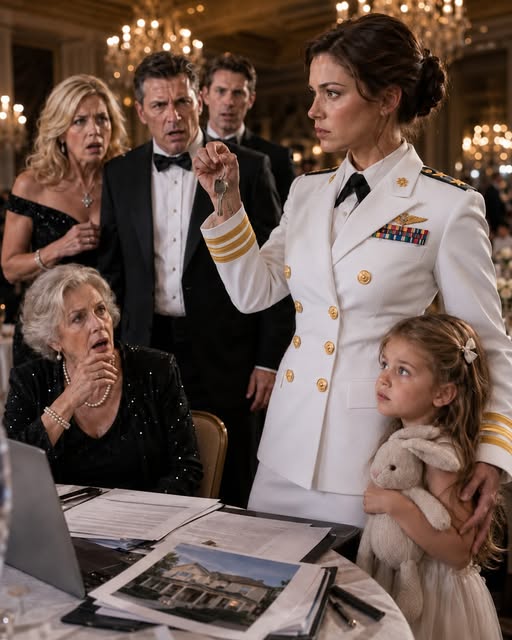
I wore my Navy dress uniform.
Lily wore a purple dress Eleanor had bought after asking my permission first.
That detail mattered.
Mom stood across the ballroom.
She did not approach.
Neither did Dad.
They waited.
That mattered too.
Martin gave up his speaking slot.
Rachel introduced the Homeward Project instead.
She explained that funding remained incomplete and that the building purchase might be delayed.
No false promises.
No mysterious donor.
No mention of me.
Then something unexpected happened.
A veteran named Marcus Reed stood.
He had used one of the foundation’s job-training programs years earlier.
He pledged ten thousand dollars.
A local construction company matched it.
Another donor offered fifty thousand.
Someone else offered temporary apartments if the building deal fell through.
Within twenty minutes, the room had pledged nearly two hundred thousand dollars.
Not enough.
But something.
I watched from the back.
For months, my family had treated the project as if saving it required one enormous secret.
It turned out asking openly created possibilities secrecy never had.
Eleanor appeared beside me.
“You’re thinking.”
“I’ve been accused of it.”
“What are you going to do?”
“About what?”
“The six hundred thousand.”
I looked at her.
“You’re not going to advise me?”
“No.”
“That must hurt.”
“Deeply.”
I smiled.
Then I looked at the families in the room.
“I’m keeping the house.”
“Good.”
“I’m keeping most of the trust.”
“Also good.”
“And I’m donating one hundred thousand to the Homeward Project.”
Eleanor nodded.
“Why?”
“Because I want to.”
She smiled.
That was the entire difference.
My mother cried when I told her.
Not because of the amount.
Because I said the words myself.
“I don’t deserve that,” she whispered.
“It isn’t for you.”
She nodded.
“I know.”
“It also doesn’t erase anything.”
“I know.”
“Stop saying that.”
A tiny laugh escaped her.
“I’m trying.”
We stood near the museum terrace doors.
Dad hovered several feet away.
I looked at him.
“You can come over.”
He did.
For a moment, the three of us stood together.
Not repaired.
Not restored.
Just present.
Mom twisted her wedding ring.
“Claire, I owe you more apologies than I know how to make.”
“You probably do.”
“I don’t expect you to forgive me quickly.”
“Good.”
She almost smiled.
“I want to tell you something without turning it into an excuse.”
“Okay.”
“When you enlisted, I thought I had lost you.”
“You didn’t.”
“I know. But I experienced it that way.”
I listened.
“Then when Lily was born, you became so capable so quickly. You didn’t need me the way I expected.”
“I needed you.”
“Not in the way I wanted.”
That was painfully honest.
“I think I spent years trying to make myself necessary.”
“By controlling things.”
“Yes.”
“Money. Grandma. The house.”
“Yes.”
I looked across the ballroom at Eleanor.
“She did the same thing differently.”
Mom followed my gaze.
“I know.”
“Maybe that’s where you learned it.”
“Maybe.”
For years, I had imagined healing as an apology followed by relief.
It was not.
Healing was often more complicated.
It was discovering the origin of a behavior and still holding someone responsible for changing it.
It was understanding without excusing.
Caring without surrendering your boundaries.
“I want you in Lily’s life,” I said.
Mom’s eyes filled.
“But slowly.”
She nodded.
“And safely.”
“Yes.”
“And I decide what that looks like.”
“Yes.”
Dad spoke.
“I agree.”
I looked at him.
“You need to stop disappearing into agreement.”
He blinked.
“What?”
“You can’t spend your whole life saying yes to whichever woman is speaking.”
Mom actually laughed.
Dad sighed.
“That seems unfairly accurate.”
“For starters,” I said, “family counseling.”
Dad looked alarmed.
Mom looked amused.
“I’m serious.”
“So am I,” Dad said. “That’s why I’m alarmed.”
For the first time since I came home, all three of us laughed together.
It did not solve anything.
It did something smaller.
Sometimes smaller was enough.
Spring came late that year.
By March, the last piles of snow still clung to the edges of the yard.
By April, Lily was checking the flower beds every morning before kindergarten.
“Nothing,” she would announce.
“Plants take time.”
“I gave them water.”
“Still.”
“I gave them talking.”
“Useful.”
“I gave them a song.”
“That might delay them.”
She frowned at me.
Then one morning, a tiny green shoot appeared beside the porch.
Lily screamed as if she had discovered buried treasure.
I ran outside in socks.
“What happened?”
“Purple flowers!”
“It’s green.”
“It will be purple.”
That confidence.
I envied it.
Eleanor came for breakfast every other Sunday.
She no longer arrived with gifts unless she asked first.
The first time she texted, MAY I BRING LILY A BOOK?, I stared at the message for a full minute.
Growth looked different on everyone.
For Eleanor, it looked like a question mark.
Mom and Dad visited twice a month.
The first visits were awkward.
Mom asked permission before entering Lily’s room.
Dad repaired the loose porch railing and then asked if I actually wanted it repaired.
“You already did it.”
“I’m practicing.”
Family counseling was worse before it was better.
We spent three sessions arguing about the meaning of the word help.
Eleanor attended one session.
Then two.
Then, astonishingly, Martin joined.
Our therapist, Dr. Shaw, once looked around the room and said, “I feel as though I should charge by corporation.”
Even Eleanor laughed.
Martin did not return as CFO.
He decided he had spent too much of his life managing family money and too little managing family relationships.
He began teaching finance part-time at a community college.
When I asked whether he liked it, he said, “Students ask questions before signing things. I find it refreshing.”
The independent review found no further missing funds.
It did find years of sloppy governance.
Shared passwords.
Informal approvals.
Family members signing documents for each other.
Nothing dramatic.
Just the dangerous belief that trust meant procedures were unnecessary.
The foundation changed its board.
Added outside oversight.
Required independent financial controls.
Rachel became interim executive director after Mom chose not to return immediately.
The Homeward Project survived.
Not because of my hundred thousand alone.
The building owner extended the purchase option after hearing what the program intended to do.
Several contractors donated labor.
A federal grant filled part of the gap.
By the following winter, twelve families were living there.
I visited once.
Only once.
Not because I disliked it.
Because I did not want the project to become the place where my family proved it had been worth hurting me.
It stood on its own.
That mattered.
I stayed in the Navy.
For months, everyone assumed I would leave.
Mom assumed it because she thought Lily needed stability.
Eleanor assumed it because she thought I might want to manage part of the family company.
Dad assumed nothing because therapy was apparently working.
The decision belonged to me.
I accepted a shore assignment nearby.
Lily stayed at Oakwood.
So did I.
One evening in early summer, I sat on the porch watching Lily water her purple flowers.
They had finally bloomed.
Coneflowers leaned toward the sun.
Lavender bordered the walkway.
Morning glories climbed a trellis Dad had built.
Eleanor sat beside me with iced tea.
“Your grandfather would have liked this house,” she said.
“You bought it.”
“He would still claim credit.”
“That seems genetic.”
She smiled.
Across the yard, Lily called, “Great-Grandma!”
“Yes?”
“Admiral needs a uniform.”
Eleanor looked at me.
“Am I allowed to purchase a rabbit-sized naval uniform?”
“No.”
“What if I ask first?”
“You just did.”
“And?”
“No.”
She sighed.
“This boundary system is oppressive.”
I laughed.
Lily ran toward us.
“Mom!”
“What?”
“Grandma’s here.”
I looked toward the driveway.
My mother stood beside her car holding a covered dish.
She did not walk up immediately.
She waited.
I raised my hand.
She came toward us.
“What did you bring?” I asked.
“Potato salad.”
“Why?”
“Your father made too much.”
From the driveway, Dad shouted, “That is not what happened.”
Mom called back, “You used six potatoes!”
“There were six people!”
“Six very small people?”
Lily ran to him.
Dad opened his arms, then paused.
Lily closed the distance herself.
I watched.
That was how trust returned.
Not in speeches.
In pauses.
In asking.
In letting the other person choose.
Mom sat on the porch step.
Eleanor shifted her chair slightly.
For several minutes, neither woman spoke.
Then Mom looked at the flower beds.
“Purple.”
“Lily chose them,” I said.
Eleanor took a sip of tea.
“Excellent taste.”
Mom glanced at her mother.
“You hated purple when I was little.”
“I hated the purple curtains you wanted.”
“You said purple was theatrical.”
“They had tassels.”
“I was nine.”
“You had terrible judgment.”
Mom smiled.
Eleanor did too.
Another small thing.
Another opening.
Lily returned with Dad.
“Can we eat outside?”
I looked at the table on the porch.
“Sure.”
We brought plates.
Dad carried lemonade.
Mom sliced tomatoes.
Eleanor complained about paper napkins.
Lily told everyone an extremely long story about a caterpillar she had seen near the mailbox.
No one interrupted her.
I sat there listening to the people who had shaped my life.
None of them were who I had thought they were four months earlier.
Neither was I.
I had believed resilience meant enduring.
It did, sometimes.
But endurance alone could become another kind of silence.
Real resilience also meant changing the rules after survival.
Asking questions.
Accepting help without surrendering control.
Offering forgiveness without pretending the past had not happened.
Walking away from habits that had once protected you but no longer did.
I looked at Oakwood Avenue.
The house had once been a secret.
Then evidence.
Then a question.
Now it was simply home.
Not because Eleanor bought it.
Not because a trust declared it mine.
Not because my family finally told the truth.
It became home because Lily’s purple flowers grew beside the porch.
Because Dad’s crooked trellis leaned slightly left.
Because Mom had begun knocking even when the door was open.
Because Eleanor had learned to ask before giving.
Because I had chosen to stay.
That evening, after everyone left, Lily and I sat on the front steps.
She leaned against me.
“Mom?”
“Yeah?”
“Are we still camping?”
I smiled.
“No.”
“How do you know?”
I looked at the porch light glowing above us.
At Admiral sitting in the window.
At the flower beds moving softly in the summer breeze.
Then I looked at my daughter.
“Because we know where we’re waking up tomorrow.”
She thought about that.
“Here?”
“Here.”
“And next week?”
“Here.”
“And after my birthday?”
“Still here.”
She smiled.
“Good.”
Then she rested her head against my arm.
After a minute, she asked, “Do houses know when people belong in them?”
I considered the question.
Five-year-olds had a talent for finding the complicated part of everything.
“I don’t think houses decide that.”
“Who does?”
“We do.”
She seemed satisfied.
The streetlights came on one by one.
Somewhere down the block, a dog barked.
A sprinkler clicked across a lawn.
The ordinary sounds of people living ordinary evenings.
Four months earlier, I had stood outside another house in the snow believing home was something someone else could take away.
I knew better now.
A house could be bought.
A trust could be forged.
Money could be hidden.
Family stories could be rewritten until everyone forgot which parts were true.
But home was something different.
Home was the place where truth no longer had to compete with fear.
Where love was allowed to include boundaries.
Where help came with questions instead of conditions.
Where mistakes could be named without becoming the whole story of a person.
Lily yawned.
“Bedtime?”
“No.”
“It absolutely is.”
“Five more minutes?”
I smiled.
“Three.”
“Four.”
“Three and a half.”
She held out her hand.
“Deal.”
We shook on it.
Across the yard, purple flowers moved beneath the porch light.
For the first time since returning from deployment, I was not wondering who had lied, what had been taken, or what truth might appear next.
There would still be difficult conversations.
There would be holidays when old habits returned.
There would be days when forgiveness felt easy and others when it felt impossible.
There would be consequences that could not be undone simply because people regretted them.
That was all right.
A good life did not require a perfect family.
It required people willing to become more truthful than they had been yesterday.
I looked at my daughter.
She was humming softly to Admiral.
Tomorrow, she would water the flowers.
Dad would probably call to complain that the trellis was leaning.
Mom would bring something we did not need and ask before leaving it.
Eleanor would send a text with too much punctuation.
And I would go to work.
Ordinary.
Steady.
Chosen.
After years of believing strength meant never needing anyone, I had discovered something better.
I could need people without handing them the steering wheel.
I could love my family without allowing them to decide what was best for me.
I could forgive without forgetting what the truth had cost.
And I could teach Lily something no trust document ever could.
A home was not a gift someone gave you.
It was a life you built carefully, honestly, one choice at a time.
I stood and offered her my hand.
“Come on, sailor.”
She picked up Admiral.
“I’m the captain.”
“Of course you are.”
“And you’re the sailor.”
“I outrank you.”
“Not in this house.”
I laughed.
On that point, there was probably no use arguing.
We stepped inside together.
And this time, when I closed the door behind us, no one was being sent away.
We were home.
-END OF PART 3 – PLEASE “LIKE” AND SHARE THIS POST ON FACEBOOK TO SUPPORT US IN SHARING EVEN MORE STORIES